Is the brain-computer interface just a passing fad? But it's going to be too late if you don't act now.
The start of the technology venture capital investment in 2026 has already reached a climax.
On January 6th, news spread that the non-invasive brain-computer interface company "Qiangnao Technology" had completed a financing of 2 billion yuan, adding fuel to the fire of brain-computer interface concept stocks. A relevant person from Qiangnao Technology responded, "We have indeed completed the financing. Please refer to the company's official release for specific details. The raised funds will be used to accelerate the R & D of core brain-computer interface technologies, break through in extreme engineering, scale up product production, and achieve mass production."
On January 7th and 8th, the brain-computer interface sector continued to strengthen. Stocks such as Chuangxin Medical, Nanjing Panda, and Yanshan Technology continued to hit the daily limit. However, some individual companies have also attracted regulatory attention.
The most important stimulus for this wave of market is that Elon Musk dropped a bombshell on social media: Neuralink plans to start the "mass production" of brain-computer interface devices in 2026 and advance the surgical process to the "fully automated" stage; the indications will also expand from brain-controlled peripherals for patients with amyotrophic lateral sclerosis to visual reconstruction for the blind.
In addition to the "timing", there is also the "geographical advantage" set by China's top - level policy design. In the "15th Five - Year Plan", the brain-computer interface is listed as one of the six future industries; regions such as Shanghai and Shenzhen have directly established special funds worth billions of yuan for brain-computer interfaces and brain science.
Indeed, currently, both non-invasive and invasive brain-computer interfaces face many uncertainties in large-scale application. Many people question, "It's both money - burning and can't generate short - term profits", and the application population is mainly critically ill patients, which is far from ordinary people's lives. Why should we still invest heavily?"
An investor who invested in Qiangnao Technology in 2018 once told 36Kr, "In the field of brain-computer interfaces, once a company or team gains a leading advantage, it's very difficult for others to catch up and surpass. By analogy with innovative drugs, if the difficulty of switching from target A to target B is 50 points, then the difficulty for latecomers to copy the work of a brain-computer interface company may be as high as 90 points. Because they have to rebuild a disciplinary ecosystem and have an entire cross - functional team to match the business."
As a cutting - edge interdisciplinary subject, the brain-computer interface needs time to build technical and systematic barriers. A detailed review shows that the companies with faster progress in clinical trials and product launches have been established for a long time and are backed by well - known investment institutions.
In addition, VC firms such as Sequoia China, IDG, CDH, and Baidu Ventures have invested in several brain-computer interface companies with different technical routes.
In 2026, the brain-computer interface track may welcome a wave of big financing years. Leading players such as Boraycon and Qiangnao Technology will also strive for listings on the STAR Market and the Hong Kong Stock Exchange. Investment institutions are also expanding from mainly medical investors to those in the technology and consumer tracks. After all, the more imaginative scenarios for brain-computer interfaces are in consumer healthcare, especially when combined with the concept of embodied intelligence.
Although the secondary market is bustling, currently, the brain-computer interface companies with the highest "brain content" are still mainly unlisted enterprises. What are the differences in the prospects of different technical routes? How are the technical capabilities and implementation status of these high - "brain content" companies?
Non - invasive: Vast Scenarios, Embodied, Medical, Entertainment...
In the non - invasive brain-computer interface track, Qiangnao Technology is a firm and important "flag - bearer". In addition, there is Rouling Technology, which announced on January 5th that it had received investment from Chunxiao Fund, Lingweiyisi, which was invested in by Mihoyo in the early years, and Yansileinao, a wholly - owned subsidiary of Yanshan Technology.
In fact, non - invasive brain-computer technology is not new. During the previous round of financing boom from 2019 to 2021, this direction was highly sought after, and its main applications were concentrated in scenarios such as sleep monitoring and intervention, attention monitoring, and diagnosis and treatment of mental diseases.
However, the capabilities of many products such as sleep monitors and headbands are quite homogeneous, and the user education cost on the 2C side is high. Many companies failed to meet their performance commitments during financing, causing the track to cool down for a while.
Although non - invasive methods have advantages such as a short development cycle and a wide range of applicable users, the technical bottlenecks at that time were also obvious. The core issue was the low quality of signal reading and writing.
The human skull is not only a solid shield to protect the brain but also an "insulating wall" for electrical signals. When using electroencephalogram (EEG) technology to capture the potential changes generated by neuronal activities on the scalp surface, problems such as electrical signal attenuation and blurring, and low spatial resolution are likely to occur.
Musk has also publicly talked about the limitations of non - invasive methods many times. In June 2025, at the Neuralink summer update press conference, he pointed out, "Non - invasive brain-computer interfaces like EEG are like trying to transmit information through a straw, and the transmission rate is stuck below 1 bit per second. To achieve true brain - computer symbiosis, the bandwidth must be increased to the level of millions or even billions of bits per second."
He also once compared non - invasive brain-computer interfaces to "listening to a football game outside the stadium". You can hear the loud cheers inside, but you can't distinguish a player's shouts or the situation on the field. In contrast, the signal quality of invasive brain-computer interfaces is more like putting a microphone right next to a player's mouth.
Therefore, most current non - invasive brain-computer interface companies no longer focus solely on pure brain - intention control but instead focus on applications such as intelligent bionic hands and bionic legs. Signal collection mainly uses electromyography (EMG), supplemented by neural electrical signals and AI algorithms, to more accurately identify people's movement intentions and control hardware.
In essence, this type of product is similar to the "exoskeleton" that was also popular in 2025 and is more inclined to the concept of embodied intelligence. It is very different from the logic of conducting human clinical trials for conventional medical devices and registering them in hospitals.
In the medical scenario, although it's difficult to achieve "human - machine symbiosis" with non - invasive brain-computer interfaces, with technological progress, the non - invasive EEG transmission rate of some domestic companies has increased by an order of magnitude of 10 times. Pu Muming, an academician of the Chinese Academy of Sciences and a brain science expert, recently said in an interview that the industrial prospects of non - invasive brain-computer interfaces are greater than those of invasive ones.
He pointed out that there are already mature applications of non - invasive brain-computers in China. For example, through personalized brain region positioning technology, targeted electrical stimulation of patients can effectively improve their sleep; precise transcranial magnetic stimulation also has great potential in treating depression, stroke rehabilitation, etc. Of course, the key for this type of product is to "have objective data support".
Invasive: The "Craniotomy" Competition for Hardcore Players
If the non - invasive approach follows the logic of "finding a hit product" with AI + hardware, then the first step for invasive brain-computer interfaces is to climb the "Mount Everest" of medicine. Although the medical track in the primary market faced a cold winter from 2022 to 2024, invasive brain-computer interfaces still had a wave of "mini - spring" in financing due to their high technological barriers and clinical value.
Different from the rapid iteration of consumer - grade products, invasive brain-computers must face three harsh "mountains": the safety of long - term implantation, the stability of signal reading and writing, and the compliance of medical device registration.
Currently, the evaluation of brain-computer interface companies in the capital market has shifted from single - point technical advantages to the implementation of full - stack capabilities. Therefore, the progress of human clinical trials and data performance have become the most important indicators to verify the technical capabilities of each company.
There are only a few domestic teams with the ability to develop a full system including electrodes, algorithms, and neural chips. The industrial layout is concentrated in cities such as Shanghai, Beijing, and Shenzhen. Especially in Shanghai and Beijing: Shanghai leads with its clinical resources and industrialization speed, while Beijing closely follows with the original innovation from top - level research institutions.
Some representative companies in Shanghai include Boraycon, Jieti Medical, and Brain Tiger Technology.
Boraycon
Boraycon was established in 2011. Its chairman, Xu Honglai, and general manager, Huang Xiaoshan, both graduated from the Department of Biomedical Engineering of Tsinghua University and studied under Professor Hong Bo. The team has a strong low - key and pragmatic "Tsinghua style" and rarely accepts media interviews. In 2026, Boraycon will strive for a listing on the STAR Market.
In the first ten years after its establishment, Boraycon mainly focused on domestic substitution of non - invasive EEG equipment, such as wireless EEG acquisition systems and high - frequency EEG machines. These product lines not only provided cash flow to support its continuous R & D of invasive brain-computer interfaces during the cold winter of medical capital but also honed its engineering and industrialization capabilities.
Boraycon's brain-computer interface system, Neo, is also known as a "semi - invasive" system in the industry. Compared with Neuralink, which directly penetrates deep into the cerebral cortex, Boraycon's electrodes are attached to the dura mater.
If the cerebral cortex is regarded as a box of soft tofu, then the dura mater can be understood as the outer packaging film that protects the tofu. To avoid problems such as scarring and displacement caused by electrodes penetrating the "tofu" and to find a balance between high - signal intensity and small implantation damage, Boraycon chose the minimally invasive epidural technical route.
In terms of clinical trials, as of the end of 2025, Boraycon had completed the implantation and follow - up of 32 patients with paraplegia due to cervical spinal cord injury. According to its disclosure, 100% of the patients achieved home - based brain - controlled grasping assistance and rehabilitation training, and the average grasping score of the patients increased by 8 - 9 points. Currently, it is promoting the application for the registration and listing of Class III medical devices.
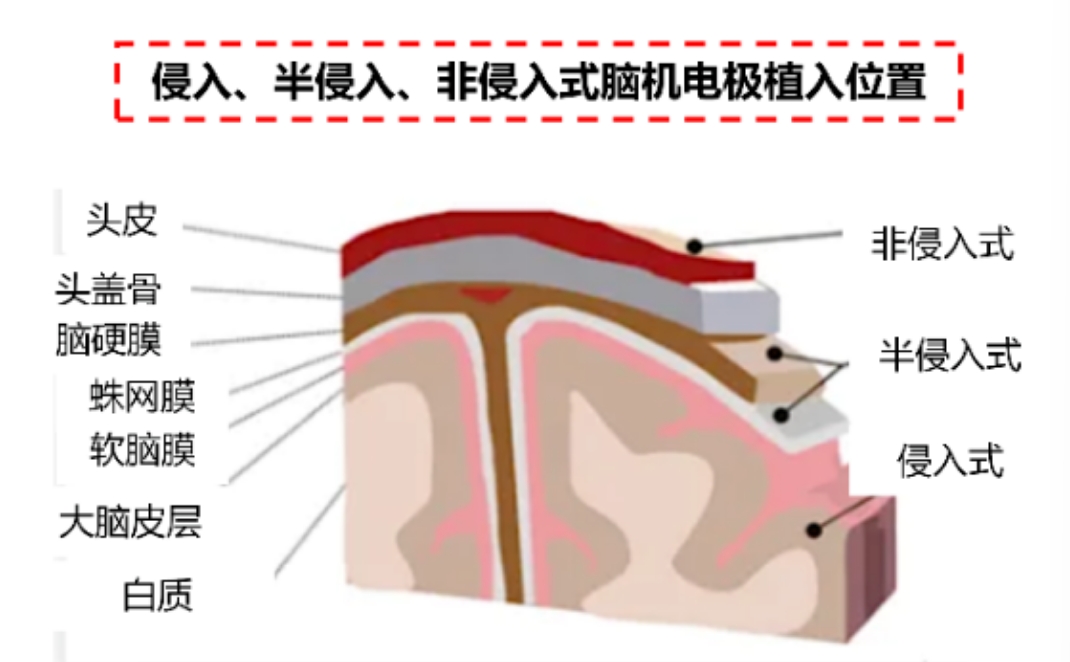
Source: CITIC Construction Investment Research Report
Jieti Medical
The core barrier of Jieti Medical lies in its "ultra - flexible neural electrode" technology. In early 2025, it received a Series B financing of 350 million yuan from investors including Qiming Venture Partners, OrbiMed, and Lilly Asia Ventures.
The two founders, Li Xue and Zhao Zhengtao, are both post - 90s scientists. They were introduced to the Center for Excellence in Brain Science and Intelligence Technology of the Chinese Academy of Sciences by Academician Pu Muming in the early years. To address problems such as electrode displacement caused by human movement, Jieti Medical reduced the size of the flexible electrodes to 1% of a hair strand to stably collect signals at the same position.
At the end of December 2025, Jieti Medical announced the successful completion of its second invasive brain-computer interface clinical trial. The subject was a patient with high - level paraplegia due to spinal cord injury; the third clinical trial was also successfully implanted.
It is understood that the first - generation implant system has 64 electrode channels, and the first prospective clinical trial of the second - generation 256 - channel system (WRS02) is planned to be carried out soon. The application fields of the second - generation system will also expand from patients' movement control to language reconstruction for aphasics; it is expected that the brain - controlled peripherals will be upgraded to "smoothly control a five - axis robotic arm and initially control an embodied intelligent robot", etc.
Li Xue once told 36Kr that the medical field is a necessary path, but Jieti's goal is to promote brain-computer interfaces to a wider range of consumer - grade human - machine interaction scenarios through technological iteration. It not only hopes to restore patients' motor abilities and sensory perceptions but also hopes to help patients explore the boundaries of human control.
Brain Tiger Technology
Brain Tiger Technology is one of the domestic enterprises that explicitly benchmarks against Neuralink. Its founder, Professor Tao Hu, was the former deputy director of the Shanghai Institute of Microsystem and Information Technology of the Chinese Academy of Sciences. He resigned from this position at the end of 2024 and fully devoted himself to industrialization.
Brain Tiger Technology also has a unique differentiation technology in flexible electrodes. It uses silk protein as the electrode coating material. This biological material has controllable degradability. It can provide hardness assistance during implantation and then degrade and disappear after implantation, reducing long - term damage to brain tissue.
In terms of signal collection strategy, different from Neuralink's deep single - point sampling method, Brain Tiger Technology chooses "wide - area multi - point sampling", that is, 64 collection points are distributed in different functional areas on the surface of the cerebral cortex to achieve a wider "planar coverage" and synchronously collect diverse signals from different functional areas.
In December 2025, Brain Tiger Technology announced the successful implantation surgery for a patient with high - level paraplegia (with an 8 - year illness history). The surgery used a minimally invasive implantation method similar to DBS (deep brain stimulation). After systematic training, the patient's brain - control decoding rate in the standard test reached 5.2 bits per second. It is reported that this data ranks among the top in the world.
Some representative companies in Beijing include Xinzhida, Zhiran Technology, Heze Technology, and Mingshi Brain - Computer.
Xinzhida
In the brain-computer interface landscape in Beijing, as a company key - incubated by the Beijing Institute for Brain Disorders and the Zhongguancun Development Group, Xinzhida occupies a special ecological niche and undertakes the important task of transforming the scientific research achievements of the Luo Minmin team at the Beijing Institute for Brain Disorders and multiple PIs (principal investigators) within the institute.
According to industry news, Xinzhida may start a mixed - ownership reform, introduce social capital, and operate according to a market - oriented system.
It is understood that the "Beijing Brain No. 1" uses a semi - invasive technical route. Its 128 - channel wireless fully implanted brain-computer system is implanted outside the dura mater. In terms of trials, it has entered the stage of investigator - initiated clinical trials (IIT). In 2025, 6 human implantations were completed, helping patients with spinal cord injury, stroke, and amyotrophic lateral sclerosis achieve the substitution and rehabilitation of motor and speech functions.
The "Beijing Brain No. 2" chooses a fully invasive approach similar to Neuralink. It has released a 1024 - channel wired product and is expected to be upgraded to a 512 - channel wireless version in 2026 and complete the engineering prototype. It will also enter the IIT verification stage.
Zhiran Medical
Established in 2022, in mid - 2025, Zhiran Medical completed a Series A financing of over 300 million yuan. It was jointly founded by Dr. Fang Ying and Dr. Song Qi and is a startup with strong PI and CEO configurations.
Chief Scientist Fang Ying is a researcher and doctoral supervisor at the Beijing Institute for Brain Disorders and has long been engaged in research on flexible high - throughput electrodes and neural recording and regulation. CEO Song Qi is a serial entrepreneur and was the former CEO of Koya Medical. He has rich experience in the clinical transformation and registration of Class III medical devices.
High - throughput flexible electrodes are also the core technology of Zhiran Medical. It is reported that on average, each channel of its electrodes can collect signals from more than one active neuron. At the same time, it uses a "stretchable design" to prevent relative movement between the electrodes and brain tissue, reduce the immune - inflammatory response, and overcome the bottleneck of unstable long - term collection.
In terms of clinical trials, at the end of 2024, Zhiran completed an implantation surgery at the Second Affiliated Hospital of Zhejiang University and collected various neuron signals in the deep brain area. At the end of 2025, a wireless signal collection system was implanted in a glioma patient at the China - Japan Union Hospital of Jilin University. Judging from the public information, it is more inclined to perform