Some people in the country spend up to five hours commuting every day, and this city has the toughest commuters.
China's rail transit leads the way.
According to the introduction of the Ministry of Transport in July last year, during the "14th Five-Year Plan" period, the operating mileage of urban rail transit in China is about 11,000 kilometers, ranking first in the world. The same is true for urban public transportation, with the total length of its operating routes reaching 1.75 million kilometers. As a result, about 100 million people take rail transit for efficient commuting every day across the country, and at the same time, 100 million people take buses to travel through the streets and alleys.
These transportation networks that connect every corner of the city are not only the core link connecting the work and life of urban residents, but also provide a reliable commuting guarantee for countless workers.
So, which cities have more convenient and efficient commuting? Which cities offer a more fulfilling commuting experience?
Recently, the China Academy of Urban Planning and Design released the "2025 Commuting Monitoring Report of Major Chinese Cities" (hereinafter referred to as the "Report"). The report focuses on 45 cities across the country covered by rail transit and presents data related to the well - being and pain points of living in dozens of cities across the country from multiple dimensions.
01. Extended Commuting Distance and Increased Job - Housing Separation
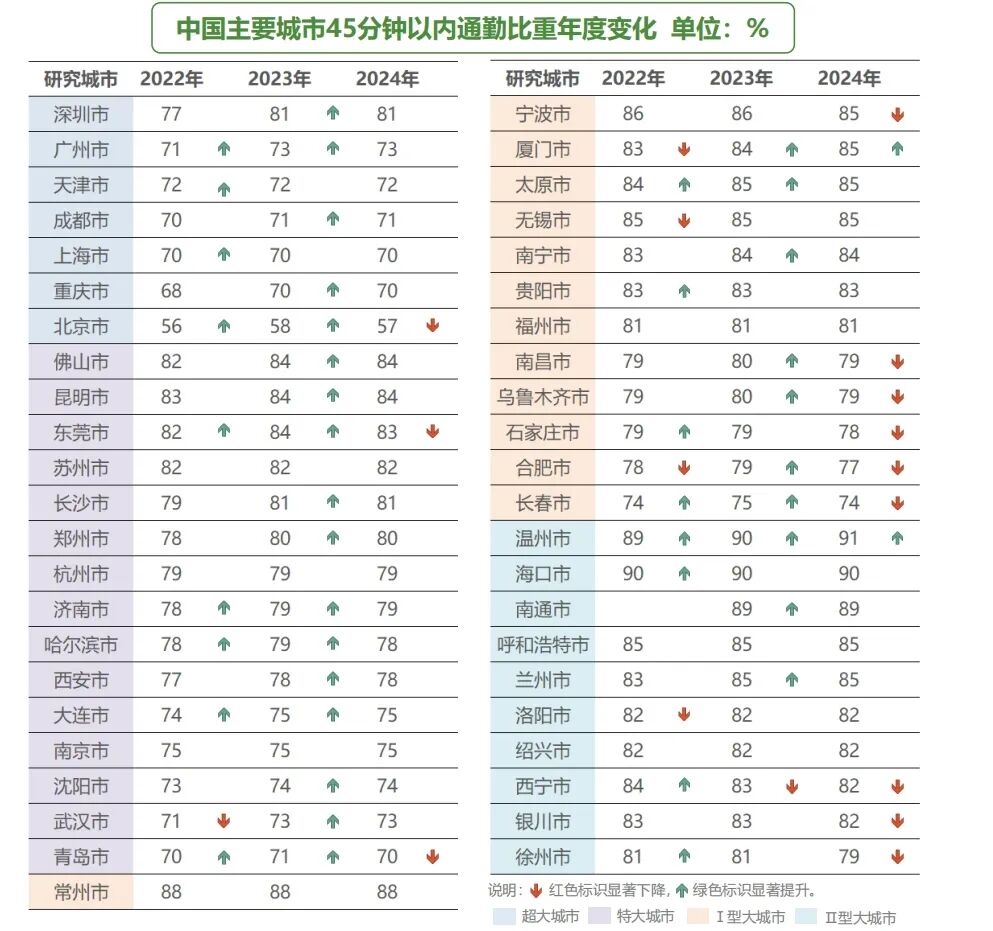
In the past five years, although the urban commuting radius has been continuously expanding, and the degree of job - housing separation and the average distance have been increasing, thanks to the improvement of rail and urban transportation infrastructure, the proportion of commuting within 45 minutes has been steadily increasing. By the end of 2024, the average proportion of commuting within 45 minutes in major cities was 77%, an increase of 1 percentage point compared with 2020. Shenzhen (81%), Foshan and Kunming (84%), Changzhou (88%), and Wenzhou (91%) represent the highest levels of four types of cities respectively.
However, in Hefei and Xuzhou, the proportion decreased by 2 percentage points, the largest annual decline. Hefei also had the largest decline in the proportion of commuting within 45 minutes in the past five years, dropping from 81% to 77%.
Source: "2025 Commuting Monitoring Report of Major Chinese Cities"
In terms of the commuting spatial radius, the commuting spatial radius of 43 cities increased by 1 - 3 kilometers. Among them, 20 cities such as Shenzhen, Chengdu, and Hangzhou remained stable for three consecutive years, and 10 cities such as Zhengzhou and Guiyang increased by 1 kilometer year - on - year. Beijing, Shanghai, and Chongqing tied for the largest commuting spatial radius in the country at 42 kilometers, indicating that these three megacities are expanding in a "sprawling" manner.
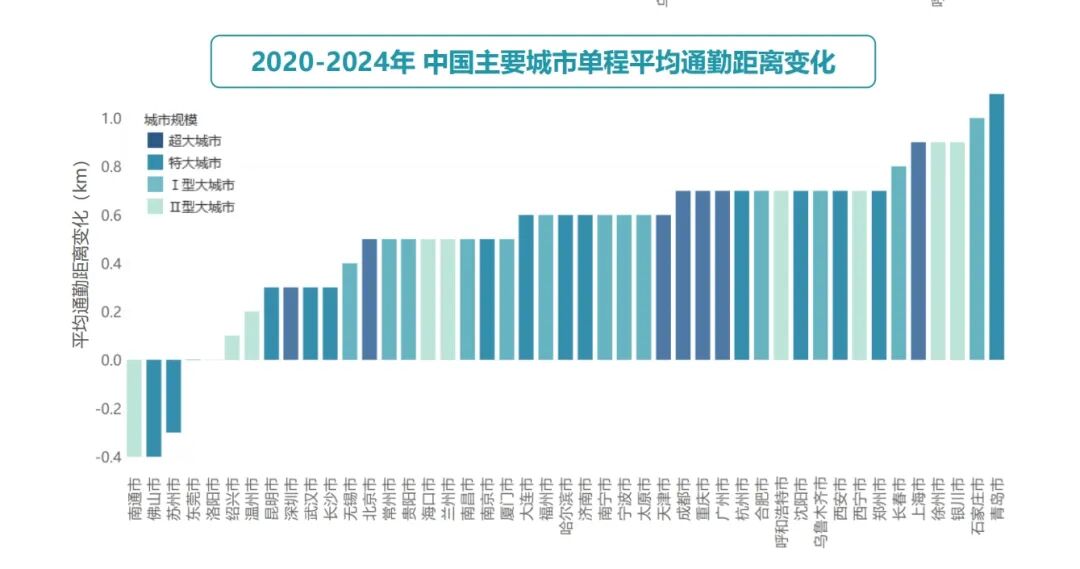
As the commuting radius expands, the commuting distance in 40 cities is also increasing. For example, the average commuting distance in megacities reaches 9.6 kilometers, and in large - scale cities, it is 8.3 kilometers. The average commuting distance in cities such as Shanghai and Xuzhou increased by nearly 1 kilometer, increasing the traffic pressure. The average commuting distance in cities such as Shenzhen, Ningbo, and Dongguan decreased by 0.1 kilometers year - on - year, optimizing the job - housing spatial relationship.
It is worth noting that the commuting distance in cities such as Qingdao, Shijiazhuang, and Xining exceeds 9 kilometers, approaching or even exceeding the level of megacities.
Source: "2025 Commuting Monitoring Report of Major Chinese Cities"
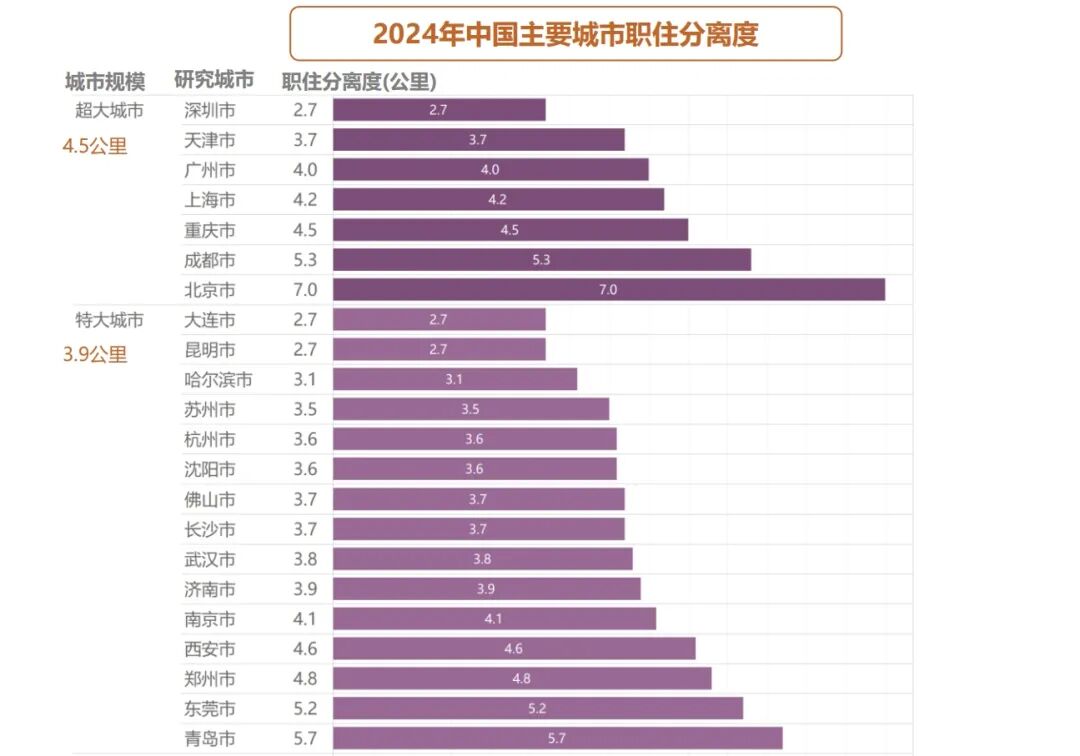
Meanwhile, in terms of the degree of job - housing separation, 26 cities saw a year - on - year increase, and 6 cities saw a year - on - year decrease. Among them, Xiamen has the lowest job - housing separation degree in the country at 2.4 kilometers; Qingdao's job - housing separation degree increased from 5.4 kilometers to 5.7 kilometers, the largest annual increase.
The change in commuting distance also brings fluctuations in well - being. For example, in terms of the proportion of "happy commuting" within 5 kilometers, most cities have stopped the decline and started to rise. By the end of 2024, the proportion of happy commuting within 5 kilometers in major cities was 52%. The proportion of happy commuting in 33 cities remained the same year - on - year, indirectly indicating that urban residents prefer short - distance and low - cost commuting life.
Among them, Hangzhou increased by 1 percentage point year - on - year and has maintained growth for three consecutive years. Wenzhou, with a proportion of 66%, became the "happiest city".
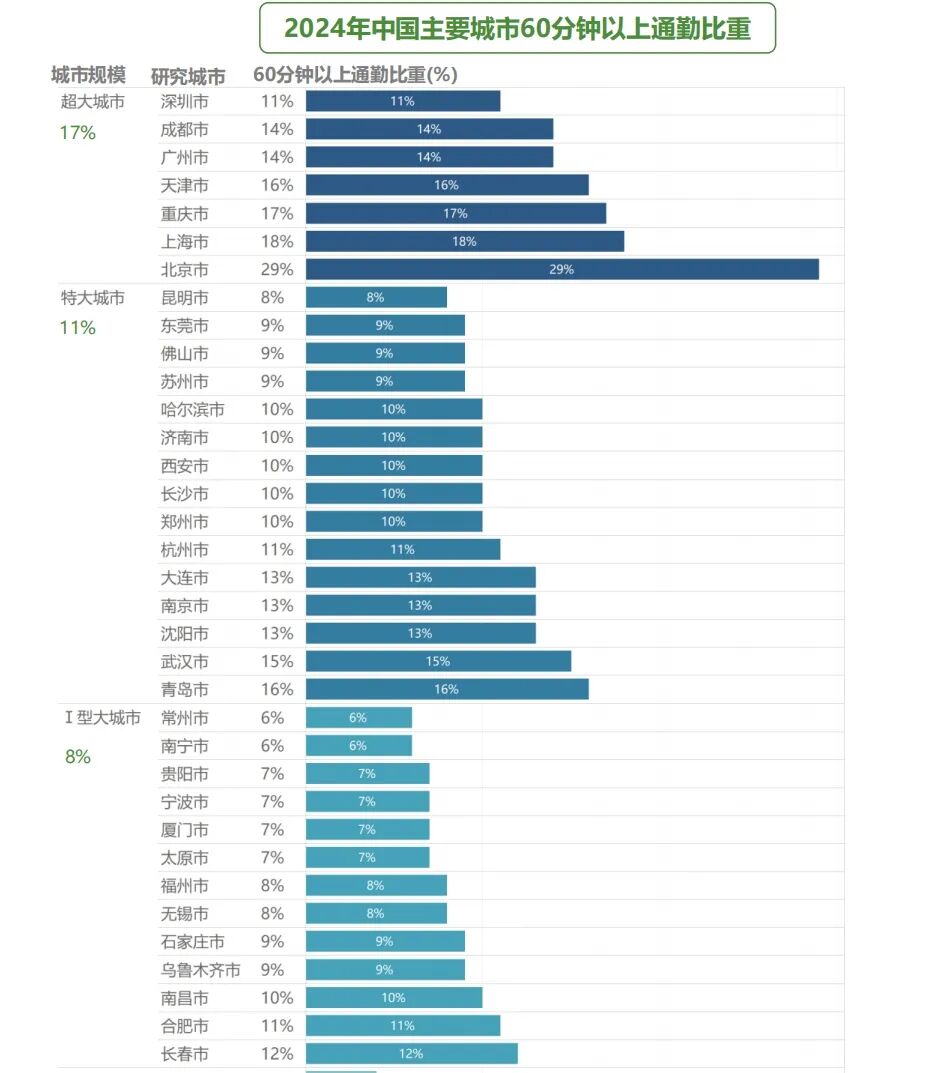
While the proportion of happy commuting is gradually recovering, the proportion of commuting over 60 minutes is increasing in some cities. The proportion of extreme commuting in 32 major cities increased by 1 - 2 percentage points. Only Shenzhen and Nantong saw a slight decline, and cities such as Qingdao and Jinan showed an intensifying trend.
Source: "2025 Commuting Monitoring Report of Major Chinese Cities"
02. Beijing vs. Shenzhen: The Most Arduous and the Most Efficient
As two of the four first - tier cities, Beijing and Shenzhen have completely different commuting performances.
Take Beijing for example. As the first city in China to open a subway, it has the most arduous daily commuting.
Let's look at some data:
The proportion of commuting within 45 minutes is only 57%, the lowest in the country;
The proportion of commuting over 60 minutes is 29%, the highest in the country;
The degree of job - housing separation has increased to 7.0 kilometers, making it the only city in the country to exceed 7 kilometers;
The commuting spatial radius is 42 kilometers, ranking first in the country;
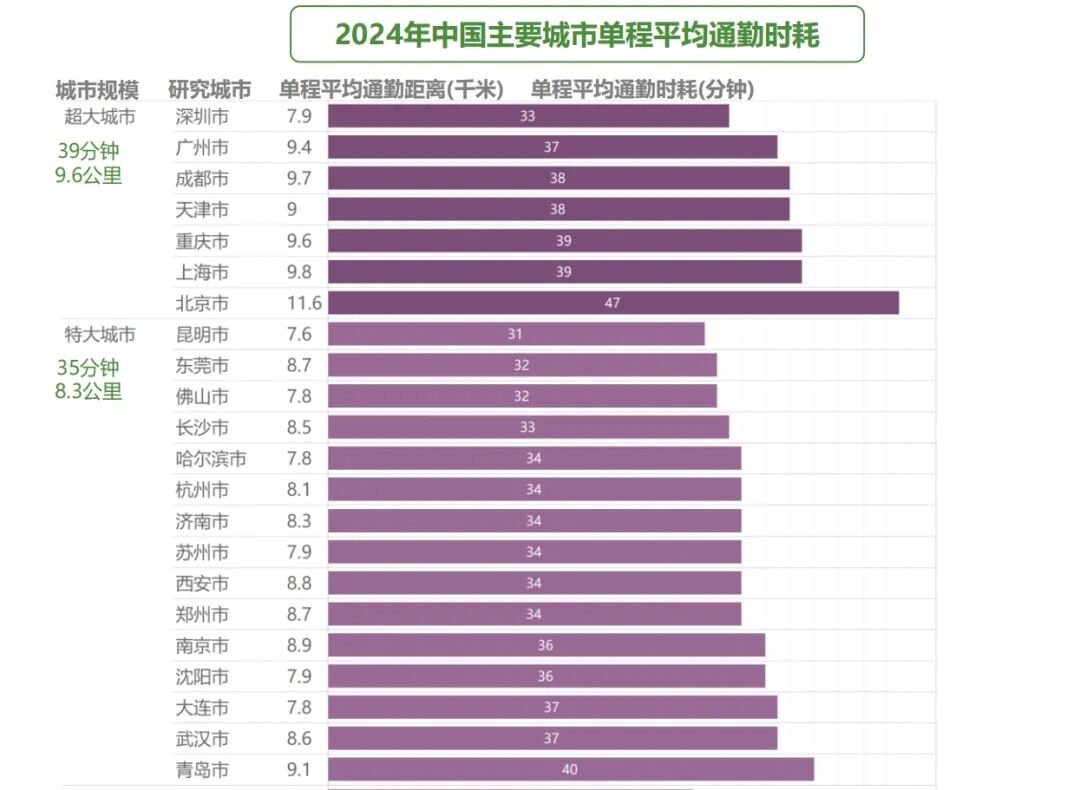
The commuting distance is 11.6 kilometers, the longest in the country, and the only city to exceed 10 kilometers;
The one - way commuting time is 47 minutes, the longest in the country;
The longest commuting distance and the longest travel time intuitively show the severity of the job - housing imbalance in Beijing. Working in the urban area and living in the suburbs has become the norm for most workers in this city. Inevitably, the gap between job and housing is widening.
Source: "2025 Commuting Monitoring Report of Major Chinese Cities"
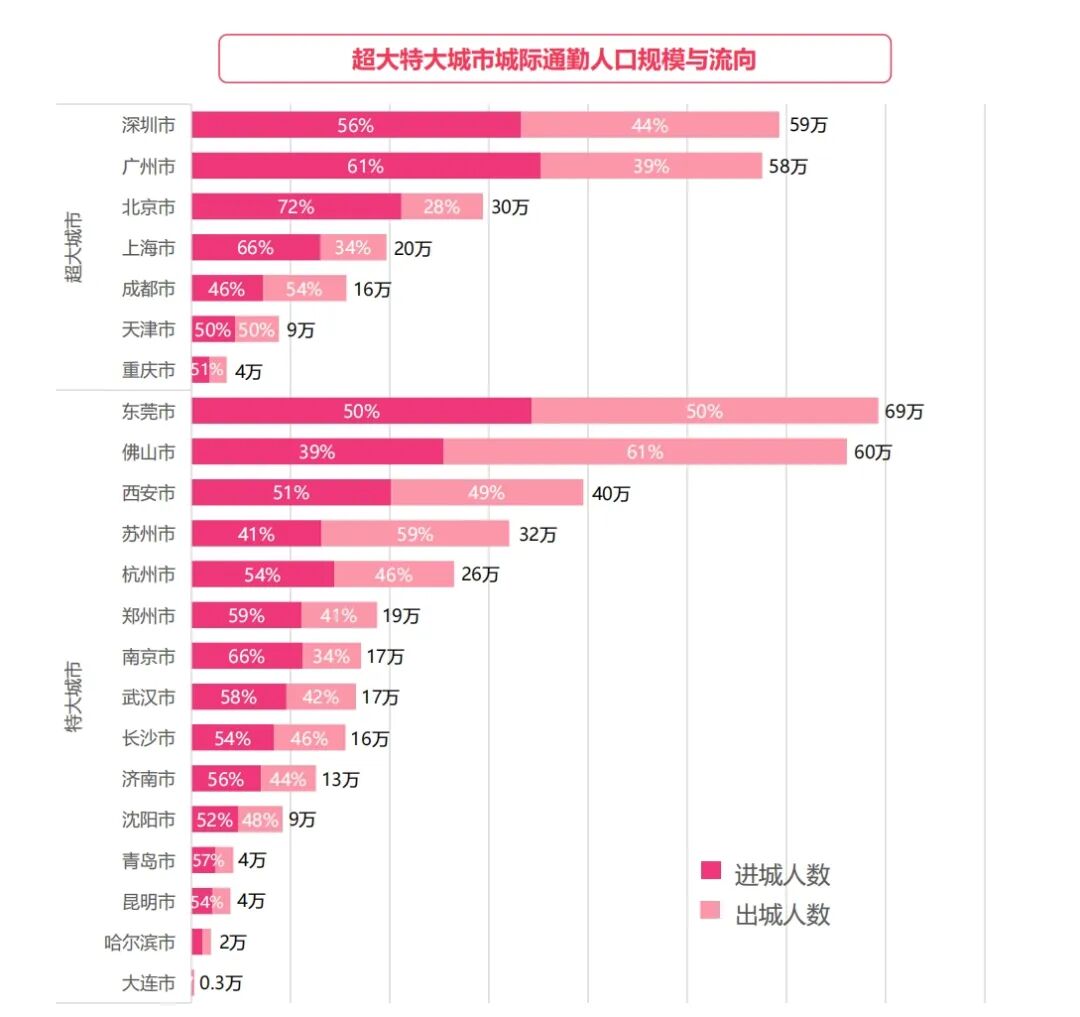
The inter - city commuting data further confirms this. According to the report, the inflow - to - outflow ratio of inter - city commuting in China's megacities is 1.5:1, while in Beijing, this ratio is as high as 3:1, which means that a large number of people around Beijing commute to work in Beijing every day.
The high "arduousness index" of commuting in Beijing is not due to the lack of public transportation facilities. In fact, Beijing has currently built a 1,244 - kilometer rail transit network, with the longest total operating mileage in the country. The core problem is that the city is too large. In terms of urban area, Beijing is about 2.6 times that of Shanghai and 8.2 times that of Shenzhen. Perhaps this is the root cause of the difficult commuting.
Different from Beijing, Shenzhen is a city with a fulfilling commuting experience.
The proportion of commuting within 45 minutes in Shenzhen has increased to 81%, making it the first megacity in the country to exceed 80%. The commuting distance is only 7.9 kilometers, the lowest among megacities. The proportion of happy commuting within 5 kilometers is 60%, the highest among megacities, which means that many people in Shenzhen can choose slow - moving ways such as cycling to commute.
Source: "2025 Commuting Monitoring Report of Major Chinese Cities"
In addition, the degree of job - housing separation in Shenzhen is 2.7 kilometers, far lower than that of other megacities and large - scale cities. The short distance between the place of residence and the workplace directly reduces the commuting time and cost for workers in Shenzhen.
The fulfilling commuting experience in Shenzhen is not only related to its compact urban spatial scale but also to the vigorous construction of urban public transportation. For example, the total length of the urban rail transit network in Shenzhen is 567.1 kilometers, supporting a network density of 0.28 kilometers per square kilometer. In addition, the proportion of 45 - minute service capacity of buses in Shenzhen reaches 60%, further shortening the commuting time of Shenzhen residents and providing double guarantees for the fulfilling commuting experience in Shenzhen.
03. 4 Million People Commute Across Cities Daily, with the Most in the Greater Bay Area
With the rapid development of urban agglomerations and metropolitan areas, many workers in cities choose to separate their places of residence and work, and "two - city commuting" is becoming more and more common. According to the report, in 22 megacities and large - scale cities in China, about 4 million people commute across cities to work every day.
Source: "2025 Commuting Monitoring Report of Major Chinese Cities"
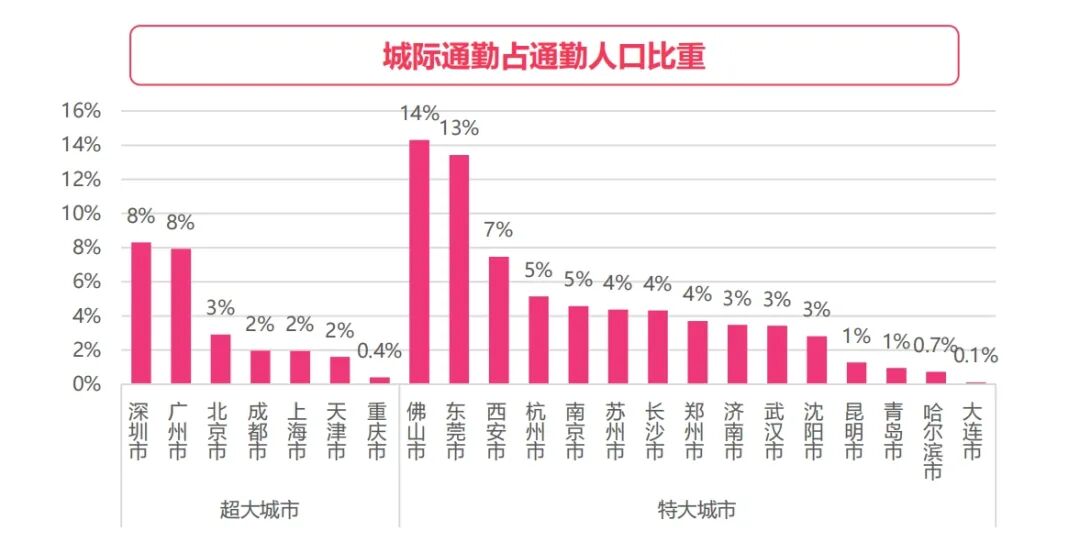
Regionally, the Guangdong - Hong Kong - Macao Greater Bay Area is the most concentrated, accounting for 25% of the national total. Among them, Dongguan (690,000), Foshan (600,000), Shenzhen (590,000), and Guangzhou (580,000) form the two largest commuting circles in the country. In addition to the large total volume, the two - way flow feature is also more significant.
Source: "2025 Commuting Monitoring Report of Major Chinese Cities"
In addition to the Greater Bay Area, Xi'an is also a gathering place for cross - city commuting. The scale of cross - city commuting in Xi'an reaches 400,000 people, accounting for 7% of the city's commuting population, ranking fifth in the country.
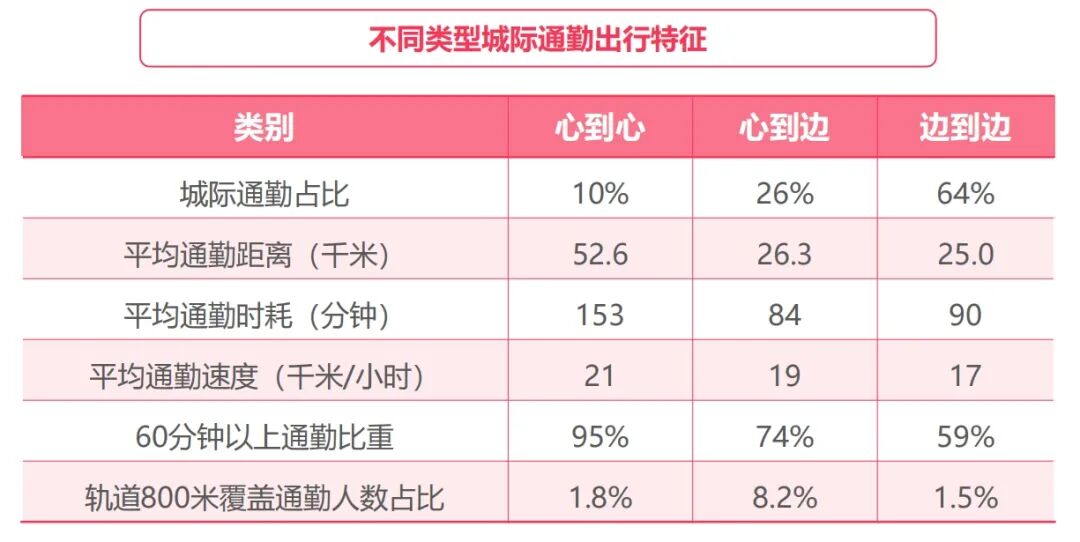
Cross - city commuting often means a longer commuting distance and time. According to the report, among the cross - city commuting population in the country, 10% of cross - city commuting occurs between the central areas of two cities ("center - to - center"). The average distance of this type of commuting reaches 52.6 kilometers, but the coverage rate within 800 meters of the rail is less than 2%. Therefore, most people are in a situation of extreme commuting: the average one - way commuting time is 153 minutes, which means spending more than 5 hours on commuting a day.
Among this group, about 200,000 are workers in Beijing, Shanghai, Guangzhou, and Shenzhen.
Source: "2025 Commuting Monitoring Report of Major Chinese Cities"
It is not easy for urban workers to commute, but the continuously upgraded rail transit is bringing new expectations.
In 2025, the total operating mileage of the subway across the country increased by 855.31 kilometers, covering 22 cities such as Beijing and Jinan. In 2026, cities such as Guangzhou, Wuhan, Xi'an, and Suzhou are starting the application process for a new round of subway construction planning. In the future, new lines may fill in the blanks or strengthen connections, further shortening the distance between cities and between urban and suburban areas. As the commuting time is continuously shortened, every hard - working person will have more wonderful time to enjoy life. (Reference: "2025 Commuting Monitoring Report of Major Chinese Cities")
This article is from the WeChat public account "Future Habitable". Author: Future Habitable. Republished by 36Kr with permission.