Pet owners can't keep pet hospitals afloat.
Author | Huang Yida
Editor | Zhang Fan
On December 22, 2025, Ruipai Pet submitted its prospectus to the Hong Kong Stock Exchange and is expected to become the "first stock in China's pet medical industry".
In fact, the rush of pet medical concepts to IPO is not something new. In 2023, Xinruipeng, the largest domestic pet medical platform, submitted its prospectus to the U.S. Securities and Exchange Commission. At that time, it happened to be the up - and - coming period of the pet economy, and relevant concept stocks successively entered the capital market. The market valuation of Xinruipeng was as high as 30 billion yuan. However, Xinruipeng's listing process did not meet expectations, got stuck in a long - term standstill, and finally withdrew its listing application in 2024.
From the perspective of the industry fundamentals, Xinruipeng's failure to list is deeply related to the business form of the domestic pet medical industry. The domestic pet medical industry has long presented a competitive pattern characterized by small - scale, scattered, and weak players. Currently, the industry's chain - store rate is 22%, and single - entity hospitals remain the mainstream form. In terms of industry concentration, public data shows that in 2024, the CR5 of the domestic pet medical market in terms of revenue was only 15.4%. Ruipai Pet, which submitted the prospectus this time, ranked second in the industry with a market share of 4.8%.
From the perspective of industry prospects, according to data from Frost & Sullivan, the market size of the domestic chain pet medical service industry reached 11 billion yuan in 2024 and is expected to grow to 22.6 billion yuan by 2030, with a CAGR of about 12.6% during this period. By 2035, the industry scale will double again to 49.4 billion yuan, and the CAGR will slightly accelerate to 17% during this period.
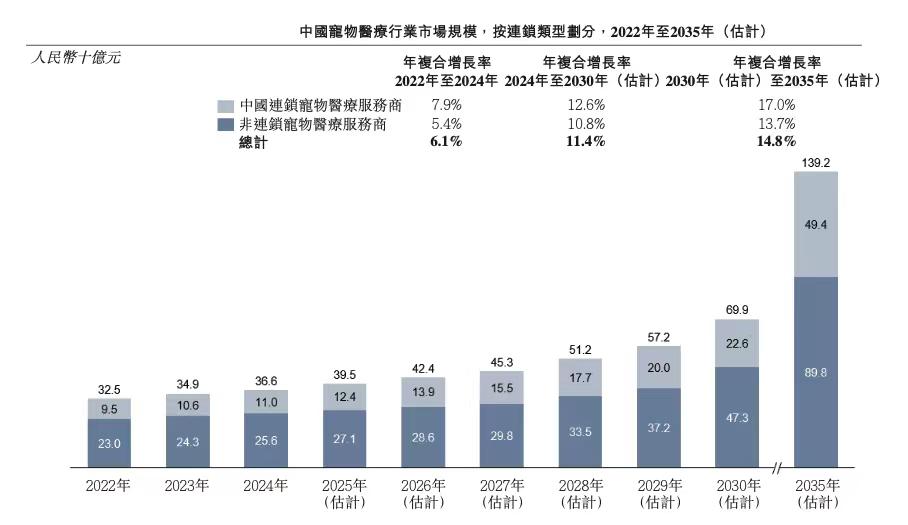
Chart: The scale and forecast of China's pet medical market; Source: Company prospectus, 36Kr
However, against the background of strong demand, the development dilemma reflected by Xinruipeng's failed listing precisely points to the long - standing pain points in the domestic pet medical industry. Meanwhile, the operational weaknesses exposed by itself are also the core reasons for not being recognized by the market.
So, against this background, what differentiated advantages does Ruipai Pet, another leading player in the pet medical industry, have compared with Xinruipeng when it tries to go public? At the same time, what hidden concerns should not be ignored?
01 Stronger performance than Xinruipeng
When it comes to the core reason for Xinruipeng's previous failed attempt to go public in the United States, it is the continuous performance losses. The financial reports show that from 2019 to 2022, Xinruipeng's cumulative net profit loss reached as high as 4 billion yuan, and there was a reverse development trend where the gap between revenue growth and net profit loss expanded simultaneously. Such performance naturally left investors with the stereotype that "the chain pet medical industry makes a lot of noise but little profit".
Looking at Ruipai Pet, although its current revenue scale is significantly lower than that of Xinruipeng, its net profit performance is significantly better than the latter. According to the company's prospectus data, from 2022 to the first half of 2025, the company's adjusted net profit (excluding the change in the book value of redeemable liabilities) only showed a loss in 2023, and it achieved profits in other years. It is worth noting that the adjusted net profit margin in profitable years was only in the range of 3.9% - 7.7%, and the overall net profit level was relatively low.
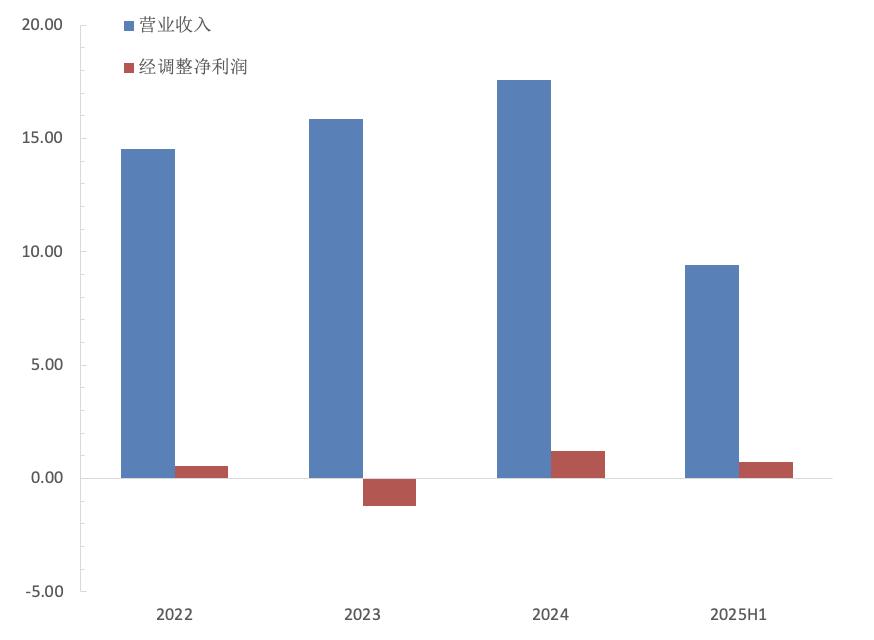
Chart: Ruipai Pet's revenue and net profit performance; Source: Company prospectus, 36Kr
The main reason for Ruipai Pet's low net profit margin is the relatively weak profitability of the company's core business.
Overall, Ruipai Pet's gross profit margin during the reporting period was in the range of 21 - 25%. Looking at different businesses, as the revenue pillar, the diagnosis and treatment service business accounted for more than 90% of the revenue after 2024, but the highest gross profit margin during the same period was only 22.7%, which was the main reason for pulling down the company's overall gross profit margin. Nevertheless, the company's comprehensive gross profit margin of over 20% is already the highest in the industry.
The gross profit margins of the pet product sales and grooming services businesses are relatively high, reaching 44% and 39% respectively in the first half of 2025. However, the combined revenue of these two businesses accounted for only a single - digit percentage of the total revenue during the same period, which was of limited help in improving the company's overall profitability.
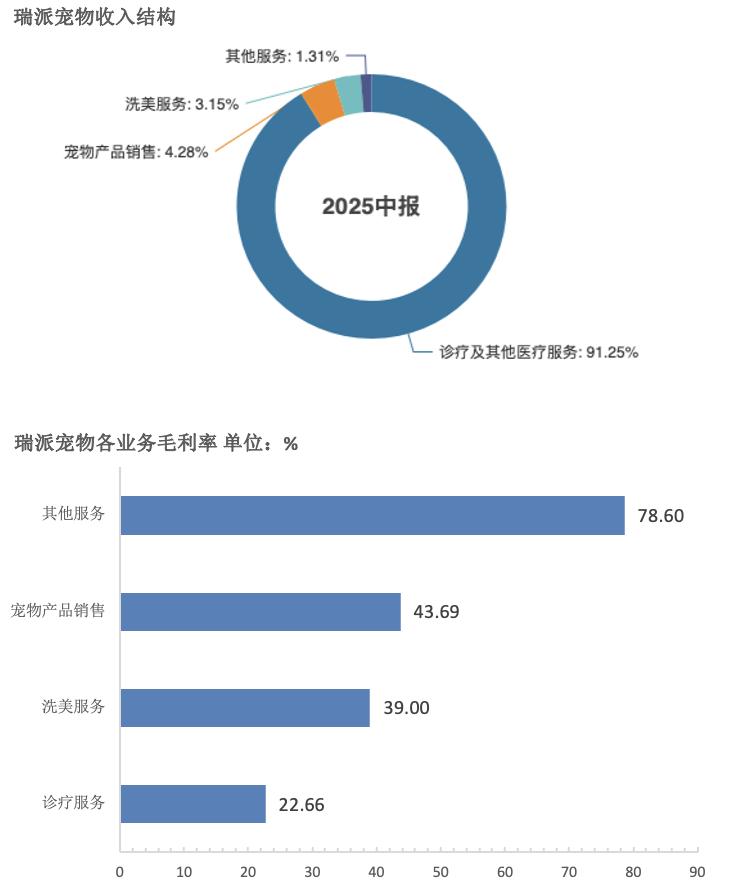
Chart: Ruipai Pet's revenue structure and gross profit margin performance of each business in the first half of 2025; Source: Company prospectus, 36Kr
The overall low gross profit margin in the pet medical industry is the result of the combined effect of multiple factors. From the demand side, public data shows that in 2024, the average annual consumption of a single dog/cat in China was 2,212 yuan, of which medical expenses were only 270 yuan. In the same period, the per - capita medical and health care consumption expenditure of Chinese residents was 2,547 yuan. Although the absolute value of the average annual medical expenditure per pet is not high, considering the long - term nature of pet - keeping and referring to the overall level of residents' medical and health care consumption expenditure, pet - keeping still imposes a certain economic burden on many families, which may have a certain inhibitory effect on the demand for the pet medical industry.
Looking at the age structure of domestic pet owners, those born in the 1990s and 2000s together account for 68% of the market share and are the dominant force in the pet consumption market. However, most people in these two age groups are in the early stages of their careers, with relatively limited income levels and insufficient disposable funds. Although they have a strong willingness to keep pets, they are more cautious in making consumption decisions when facing relatively high - priced pet medical expenses and are more price - sensitive, which further inhibits the release of demand in the pet medical market.
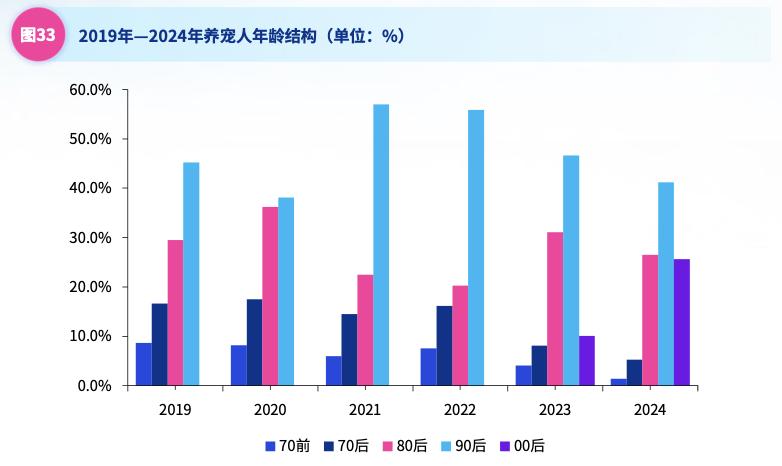
Chart: The age structure of pet owners in China; Source: KPMG, 36Kr
Against the background of the structural suppression of demand in the pet medical market, the pricing of pet medical services is constrained. At the same time, due to the long - term shortage of veterinary talents in the pet medical industry, the labor costs of pet medical enterprises have been significantly increased. Coupled with the fact that the industry has not yet formed a unified standard for diagnosis and treatment fees, many small and medium - sized institutions often engage in price wars to attract customers. The resonance of the above multiple factors directly or indirectly deepens the dilemma of the low gross profit margin in the industry.
Looking at the gross profit margin performance of the two leading companies, Xinruipeng and Ruipai Pet, Xinruipeng's highest comprehensive gross profit margin during the reporting period was only 5.6%, while Ruipai Pet's was as high as 22.7%. Ruipai Pet not only ranks first among large - scale pet medical institutions but also significantly leads Xinruipeng. The significant difference in the gross profit margins of the two leading companies is directly related to their business expansion models.
02 Performance differences due to different business expansion models
When it comes to the reason for the difference in the gross profit margins between Ruipai Pet and Xinruipeng, the key lies in the VDP model adopted by Ruipai Pet in mergers and acquisitions. That is, when acquiring pet hospitals, it usually acquires 60% of the equity, and the original team retains 40% of the shares.
The reason why Ruipai Pet and Xinruipeng have become industry leaders is mainly that they both targeted the characteristics of the domestic pet medical industry, which is fragmented with single - entity hospitals as the main form. They both took acquisitions as the core path to promote chain - store expansion, thus rapidly increasing their market shares and standing out. However, there are significant differences in their merger and acquisition models.
Xinruipeng's mergers and acquisitions were mainly led by Hillhouse Capital, with a relatively aggressive strategy. The number of its affiliated hospitals increased rapidly, reaching about 1,900 at its peak (in 2022). Since Xinruipeng preferred full - scale acquisitions, it operated with heavy assets, and its integration efficiency was relatively low. Coupled with the loss of talents and internal competition caused by disorderly expansion, under the combined effect of the above factors, Xinruipeng's comprehensive costs soared, its profit margin was severely squeezed, and its performance fell into continuous losses. At the same time, its balance sheet was not healthy, and the potential credit risk cannot be ignored.
Looking at Ruipai Pet, its style of mergers and acquisitions is more moderate. The VDP model is more cost - effective than full - scale acquisitions. While ensuring the company's control over the acquired stores, it retains the core medical team through interest binding. As minority shareholders of the company, the original team has higher enthusiasm in business development, and the team stability is relatively stronger. Moreover, retaining the original team also alleviates to some extent the common industry problem that the high salary expenditure caused by talent loss/shortage erodes profits.
In terms of market layout and cost control, Ruipai Pet has built a three - level medical cooperation system of "city - center hospitals - regional - center hospitals - community hospitals" to achieve resource concentration and controllable service quality. At the same time, the store density and coverage area are more reasonable compared with Xinruipeng to avoid the problem of inefficient operations caused by disorderly competition among its stores. More importantly, through the referral mechanism, it realizes the cross - regional sharing of medical resources, which also solves to some extent the pain point in the industry that after the chain - store operation of medical institutions, the scale effect cannot be released due to the difficulty in sharing personnel and equipment.
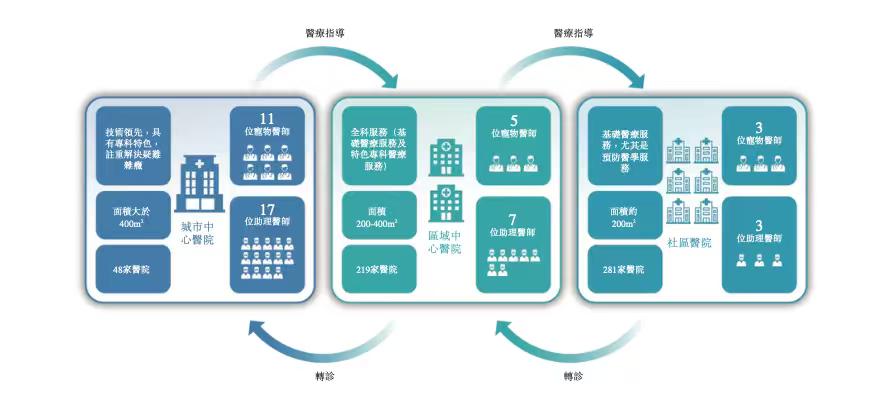
Chart: Ruipai Pet's three - level medical cooperation system; Source: Company prospectus, 36Kr
Reflected in the financial statements, Ruipai Pet not only significantly leads Xinruipeng in terms of gross profit margin. In terms of management expenses, the median of Xinruipeng's management expense ratio is about 22%, while that of Ruipai Pet during the reporting period is 9%. It is worth noting that the sales cost of pet hospitals includes a certain proportion of employee salaries, so the cost and expense expenditures are relatively rigid. The above financial data shows that Ruipai Pet is superior to Xinruipeng in both labor cost control and total cost control.
In summary, the underlying logic for the significant difference in the profitability of the two companies is that Ruipai Pet's VDP model has considerable comparative advantages in cost control in the pet medical industry. Based on the three - level medical cooperation system to improve operational efficiency, coupled with the referral mechanism to drive the release of a certain scale effect, is another key factor supporting Ruipai Pet's leading gross profit margin over Xinruipeng.
03 Some hidden concerns of Ruipai Pet
For companies that achieve chain - store operations through mergers and acquisitions, the goodwill risk caused by continuous mergers and acquisitions is the most prominent concern.
As of the first half of 2025, Ruipai Pet had a total of 548 pet hospitals, including 120 self - built hospitals and 428 acquired hospitals. During the same period, the company's goodwill reached 1.792 billion yuan, accounting for about 68.4% and 51% of non - current assets and total assets respectively. If the goodwill ratio is too high and the future performance fails to meet expectations, goodwill impairment needs to be recognized. The impairment amount is directly included in the income statement. With Ruipai Pet's current net profit level, potential goodwill impairment may cause a significant decline in the current profit or even a loss.
It is worth noting that Ruipai Pet closed 38 community hospitals in 2024 and had closed 23 community hospitals and 3 regional - center hospitals in the first half of 2025. Correspondingly, losses of 12.58 million and 10.37 million due to hospital closures were recognized in the performance of 2024 and the first half of 2025 respectively. Therefore, store closures are an important indicator for predicting performance. If a large number of acquired hospitals fail to meet performance standards and are shut down, the impact of goodwill impairment on performance expectations needs to be considered.
The stability of Ruipai Pet's profitability is another fundamental issue worthy of attention. After excluding the change in the book value of redeemable liabilities, the adjusted net profit generally shows a large - scale fluctuation trend. Even though its performance in recent years has been better than that of Xinruipeng, with the current net profit level, it is not an exaggeration to say that it has increasing revenue but not increasing profit.
On the other hand, the overall profitability of the pet medical industry is relatively weak. Leading enterprises either suffer continuous losses or operate with meager profits, which all reflect that the ceiling of the pet medical industry is not high.
Taking the mature U.S. pet medical industry as a reference, its chain - store rate is currently only 30%. From the relatively fragmented industry form of the mature market as a whole, the current 21.8% chain - store rate in the domestic market indicates that although there is still room for improvement in the future, the chain - store rate is approaching the ceiling. Therefore, the pace of industry chain - store expansion is expected to slow down in the future, and it is also difficult to replicate the development path of other consumer industries where rapid concentration occurs and the profitability of leading enterprises is significantly improved.
In terms of valuation, Xinruipeng's market valuation was nearly 30 billion yuan at that time, but due to performance flaws and many problems in operation and governance, its fundraising failed, which also provides a certain reference for Ruipai Pet's valuation. From the perspective of performance, Ruipai Pet is significantly better than Xinruipeng. Considering the pace and market environment of Hong Kong IPOs in the past two years, it is unlikely to repeat Xinruipeng's mistakes. However, Ruipai Pet lacks obvious explosiveness in terms of performance, and the expectations are relatively dull, so it may face valuation pressure in the future.
*Disclaimer:
The content of this