Stop mental exhaustion. How can entrepreneurs reconcile with self-doubt?
· This article dissects the operating mechanism of self-doubt and provides three counterattack strategies.
· In many cases, self-doubt stems from asymmetry: comparing your chaotic process with others' glamorous final results, which leads to unfair self-deprecation and is a cognitive bias trap.
· Coping strategies: Stop making unfair comparisons and recognize your own courage and perseverance; regard others' success as inspiration rather than a threat; establish a long-term perspective and view your career in terms of "decades" rather than "days", understanding that the compound interest effect requires time to accumulate.
· Entrepreneurs must have the ability of self-dialogue. Self-doubt cannot be eliminated but can be tamed. Its appearance precisely proves that you are breaking out of your comfort zone, which is a sign of growth rather than a harbinger of failure.
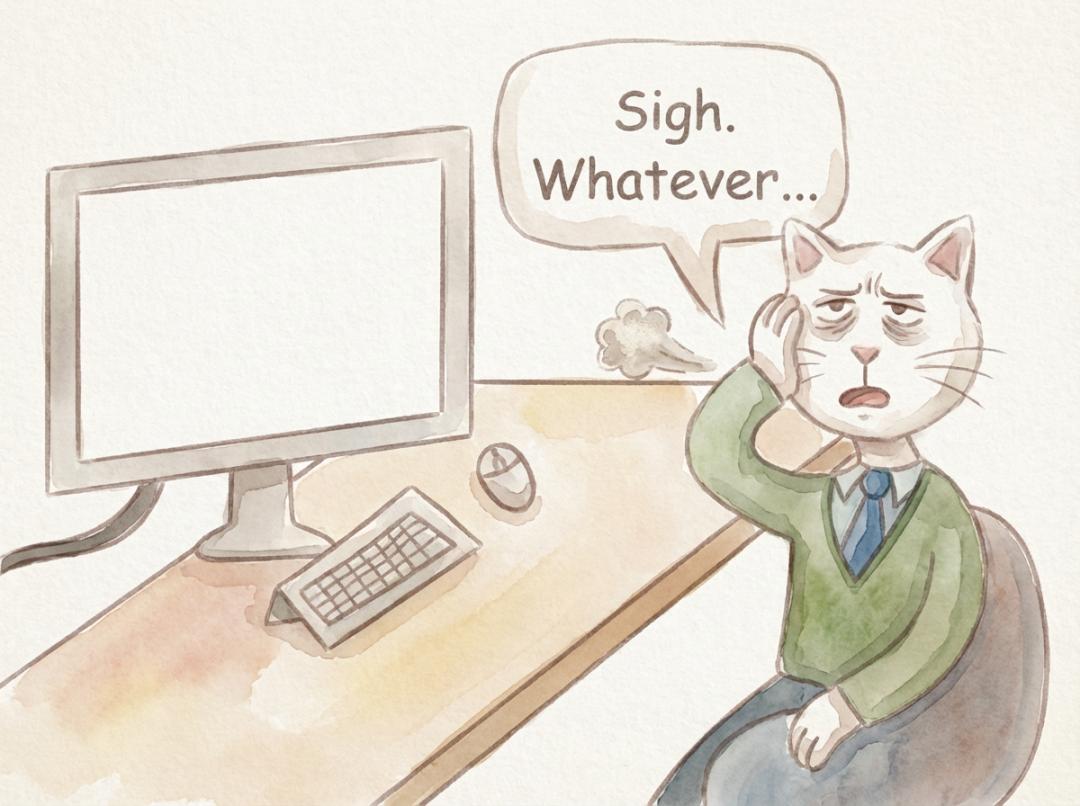
In the early morning at the office, you stare at the various data on the computer screen, and the mouse hovers over the "Send" button for ten minutes. Clearly, this document has been polished for months, but you just can't press the send button. Because there's a voice in your head playing on a loop: "Are you really ready? Why do you think you can succeed?"
This voice sounds so rational and objective that you almost believe that giving up is the wisest choice.
But the truth is: You are being deceived by self-doubt.
Data shows that 72% of entrepreneurs face high levels of anxiety, job burnout, and even depression due to the pressure of starting a business. Moreover, many entrepreneurs have experienced moderate to severe "imposter syndrome" - even after achieving success, they still feel like "imposters" who will be exposed at any time.
These seemingly isolated dilemmas actually reveal a long-neglected truth: Self-doubt is not your personal problem but a psychological mechanism with regular patterns. If you understand its operating rules, you'll find that those seemingly impeccable "rational analyses" are nothing special.
You're Fighting a Phantom
The biggest trick of self-doubt is to make you believe in a "capability gap" that doesn't exist at all.
You see your peers' product launches being glamorous, the financing news of your competitors flooding in, and industry leaders talking eloquently on stage. Then you look back at yourself: your product is still being polished, your team is facing numerous difficulties in the process of running in, and you're dealing with one problem after another every day.
So you conclude: They have what I don't.
However, this conclusion is based on a fatal cognitive bias. Some call it "the asymmetrical nature of creativity" - for any work, there are two completely different perspectives: the viewer's perspective and the creator's perspective. The viewer can only see the final product - the polished result presented to the public. The viewer can't see all the failed previous versions, the countless hours of practice, the discarded drafts, or the sleepless nights spent on creating the presented content. For the viewer, everything seems seamless because the quality of the final result is the only thing that matters.
On the creator's side, it's a beautiful chaos that only you have to go through. As a creator, you have to go through every daunting step in the process, transforming the seed of an idea that once existed in your mind into something you're proud of and can present to others.
And when you examine your own entrepreneurial project, what do you see? It's the hesitation in every decision-making gap, the uncertainty in every direction adjustment, every unsolved problem, and every imperfect detail.
This is the cruel part of asymmetry: You compare others' final results with your chaotic process. Naturally, the conclusion is "I'm not as good as them."
What's more insidious is that this cognitive bias will reinforce itself. When you think "others are better than me," you'll unconsciously look for evidence to verify this judgment:
· You'll pay more attention to their success news and ignore their setbacks;
· You'll magnify their advantages and downplay your own progress;
· You'll attribute their luck to ability and your own efforts to luck.
This is self-doubt: It makes you overestimate others' abilities and underestimate your own, and then uses this illusory gap to prove that "you're not good enough."
Self-doubt also has a fatal blind spot: It only lives in the present and can't see the future.
When your product only has 5 users on the first day of its launch, it'll say: "See, no one needs your product." When your financing BP is rejected by the 10th investor, it'll say: "Your project is no good." When you haven't had new growth for three consecutive months, it'll say: "You've reached your ceiling."
This is like deciding "I can't finish the marathon" just because you feel tired at the 5th kilometer. But the fact is, every person who has finished a marathon has wanted to give up at some point.
Self-doubt uses the current dilemma to construct a "certain failure" future, making giving up seem like the most rational decision. But it forgets a key fact - the future is never a simple extension of the present but an open system composed of countless choices and turning points.
And when you understand self-doubt, you'll find that the seemingly rational voice is actually the most irrational. Because it only sees half of the story - the half of the dilemma but not the half of the turning point.
From Passive Defense to Active Attack
So, how to counterattack? The key lies in: Not eliminating self-doubt but learning to recognize it, dissect it, and tame it.
Strategy 1: Give Yourself Due Recognition
First of all, you need to break the illusion created by symmetry.
When you see others' successful products, remind yourself: What you see is their final result, while you're going through every painful step of the creative process. This isn't a fair comparison and shouldn't be used as the basis for judging the quality of your work.
Imagine: If those entrepreneurs you look up to could see themselves from your perspective - only seeing the glamorous product launches, perfect products, and enthusiastic user feedback - they'd also doubt themselves. Because they've also experienced countless moments of "this is definitely over" and questioned their choices late at night.
So, give yourself due recognition:
· The fact that you dared to start is already courage;
· You're solving real problems, even if you haven't found the perfect answer;
· You're making progress every day, even if it's not obvious enough;
· You're still persevering, which already surpasses most people.
Don't be too hard on yourself. You're doing something difficult, and the difficulty itself proves its value.
Strategy 2: Change Your Perspective
When you see others getting financing, getting promoted, or achieving success in their projects, and that stinging feeling hits - stop and change your perspective: Their success doesn't reduce your chances of success. Entrepreneurship isn't a zero-sum game; it's not that if they win, you lose.
Regard others' life experiences as an inspiration for possibilities rather than a competitive threat.
On this entrepreneurial road full of uncertainties, every successful person is a light, illuminating the possibilities ahead. When you change your perspective in this way, you'll find that you'll become a more powerful entrepreneur because you'll no longer waste your energy on internal strife but use it to drive yourself forward.
Strategy 3: Establish a Long-Term Perspective
All meaningful careers and professional lives need time to shape and develop.
Imagine: Every thing you do now is quietly building a ramp for future growth. Every line of code you write, every customer you meet, and every iteration you make are all accumulating potential energy. This potential energy isn't visible in the short term, but after enough time has passed, you'll be surprised at how far you've come.
When you're engaged in meaningful work, you must be able to exchange short-term disappointment for long-term progress.
This isn't self-comfort but a profound understanding of the rules of entrepreneurship:
· The compound interest effect takes time to show;
· Word-of-mouth communication needs accumulation to explode;
· Ability improvement needs repetition to achieve qualitative change;
· Good luck needs perseverance to be encountered.
Examine your career from a "decades" perspective rather than a "days" perspective.
Looking at today's setbacks from a ten-year perspective, you'll find that they're just a small bump in the long journey. Looking at today's failures from a lifetime perspective, you'll find that they might be the most valuable learning opportunities.
Make Peace with Self-Doubt
However, it should be noted that no matter how you deal with it, self-doubt won't disappear. To truly "tame" self-doubt - it's not about eliminating it but learning to coexist with it.
In a sense, the existence of self-doubt proves one thing: You're doing something meaningful. If what you're doing isn't challenging at all, if your goals are easily achievable, and if your dreams are mediocre - you won't doubt yourself. Only when you're climbing a real mountain will you question "Can I reach the summit?" halfway up.
So, when self-doubt appears, don't panic. Its appearance precisely indicates that you're breaking out of your comfort zone and doing something beyond your current abilities. This is a sign of growth, not a harbinger of failure.
But this doesn't mean you have to passively endure its torture. Instead, you should actively master the ability to silence it:
When it says "You're not as good as others," you reply: "What I see is their finished product, and what I'm going through is my own process. This isn't a fair comparison."
When it says "Even your friends are better than you," you reply: "Their success is an inspiration, not a threat. I'm happy for them and believe my time will come."
When it says "You're doomed to fail," you reply: "You only see today, but today's result doesn't represent all the possibilities of tomorrow."
This ability of self-dialogue is a must for entrepreneurs. It allows you to stay sober in the darkest moments, choose to persevere when you most want to give up, and find your way on the loneliest road.
Finally, remember a fact: You're not alone on this road. 72% of entrepreneurs are experiencing anxiety, many entrepreneurs have had the feeling of being an "imposter," and almost all startups face the threat of failure. This also shows that your struggles are normal, your doubts are common, and your fears are reasonable. Equally true is that those who ultimately succeed have all stood where you are now. They've also doubted, feared, and wanted to give up. The only difference is that they learned to tame that "rational monster."
Moving forward in the face of doubt is the norm for entrepreneurs.
This article is from the WeChat official account “Sequoia Capital Insights” (ID: Sequoiacap), author: Hong Shan. It is published by 36Kr with authorization.