56 deals, 2.6 billion yuan, a flurry of angel rounds... Where did the money in education investment go in 2025?
If only judged by the surface quantity, there was no obvious cliff in the primary market of the education industry in 2025. There were still dozens of investment, financing, and M&A events throughout the year, covering multiple directions such as AI education, vocational education, educational hardware, and corporate training. However, when these events are re - disassembled in terms of rounds, amounts, business forms, geographical distribution, and investor structure, we will find that:
Capital is not simply "continuing to invest." Instead, it is redefining the investable boundaries of the education industry through a series of more specific and cautious choices.

Data source: Compilation of publicly disclosed investment and financing events in the domestic primary market education industry in 2025
This change is not concentrated in a single financing or a single star company but is scattered among a large number of small - and medium - scale, early - stage, or structural transactions. The following systematically sorts out the structural characteristics of investment and financing in the education industry in 2025 from five dimensions.
01 Round Structure: Education financing is disassembled into "early exploration" and "stock integration"
From the perspective of the financing round structure, the education industry in 2025 did not simply "favor the early stage" but presented a dual - track structure that evolved over time. This feature is particularly clear when comparing the data from January to September 2025 with the annual data.
In the first nine months of 2025, the investment and financing structure of the education industry was highly concentrated. Angel round financing accounted for nearly 70%. The number of Series A and later rounds was limited, and M&A events were also relatively scattered. Whether it was the children's intelligent hardware project Hezhi Technology, the children's programming education project Paiyo Programming Puzzle, the AI college entrance examination volunteer filling platform Gaokao Zhiyuan, or the AI interview platform Zhiwa Interview, most of them were still in the product or model verification stage when they received capital support. The financing characteristics of this stage can be summarized as: early rounds, restrained amounts, and mainly "exploratory intervention."

Financing events in the domestic primary market education industry from January to September 2025
However, when the time axis was extended to the whole year, the round structure began to change. The angel round was still the most numerous financing type, but its proportion decreased significantly. It was not taken over by Series A or B but was "diverted" by M&A, strategic investment, and a small number of mid - and late - stage rounds. The acquisition of Kuxuan Technology by Beisen Holdings, the acquisition of Tianyu Flight Training by HNA Holdings, and the education asset M&A completed by Xueda Education through its subsidiary all occurred in the latter part of the year. At the same time, some strategic transactions that were not standard equity financing also began to appear frequently.

Financing events in the domestic primary market education industry from January to December 2025
This change indicates that capital is participating in the education industry in a more differentiated way: early - stage projects are continuously and small - scale explored, while the stage where capital really increases investment is often through the integration of mature assets to complete the layout.
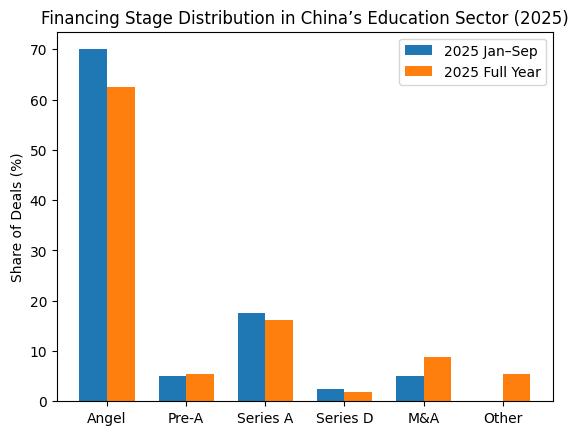
Comparison of financing events in the domestic primary market education industry from January to September 2025 and the whole year
Therefore, looking back from the annual perspective, the round structure of the education industry in 2025 did not simply extend forward but was disassembled into two relatively clear paths: one end is the early exploration with controllable costs, and the other end is the stock integration based on certain cash flows and business synergy. Projects in the middle stage that require continuous capital patience face higher financing thresholds.
02 Financing Scale and Structure: Capital pays for the "verification stage" rather than for expansion
Corresponding to the round structure, the financing scale of the education industry in 2025 also showed a highly concentrated feature. Several million to tens of millions of yuan became the most common financing range. This scale is sufficient to support product R & D, team building, and preliminary market verification, but obviously not enough to support national expansion or heavy - asset investment.
Looking at specific projects, whether it is the AI IELTS learning platform Tangzhexue, the college student employment consultation platform Bishifu, or the enterprise digital - intelligent education service provider Colette Education, their financing scales are closer to "verification - type investment" rather than "expansion - type capital." The requirements of capital in these projects are very clear: first prove that there is a real demand for the product and the payment logic is valid, and then discuss the next step.
In contrast, the number of financing events that reached or were close to the scale of 100 million yuan throughout the year was limited and highly concentrated in a few non - pure education forms. The so - called "non - pure education" here mainly refers to the fact that their commercial value does not entirely depend on courses or teaching services themselves but comes from broader consumption, hardware, or industrial application scenarios. The AI children's educational toy brand Haivivi received 200 million yuan in Series A financing, which is closer to consumer - grade hardware in essence; Cloud Deep Technology in the field of embodied intelligence completed a 500 million yuan Series C financing, and its application scenarios cover multiple fields such as industry and robotics, and education is just a part of them.
The reason why such projects can carry large - scale funds is not because they have a "stronger educational attribute." On the contrary, it is because they do not completely bind their value within the education industry. The large - scale funds in 2025 did not leave the market but chose to bypass the ceiling of the "single education track" and flow to projects with greater industrial extensions.
03 Business Field: Capital systematically avoids the core of teaching and turns to peripheral links of education
From the perspective of business distribution, the education projects that received financing in 2025 showed a highly consistent directional feature: almost no projects directly cut into the core of classroom teaching or the curriculum system.
This is particularly obvious in AI education - related financing. The projects that received capital support are mostly concentrated in links such as college entrance examination volunteer filling, study - abroad application, interview coaching, and companion learning, such as AdmitAI Zhixuan Youlu, Zhiwa Interview, and Fenghuolun Yingtu. These business links have highly standardized features, the products can be split, the delivery can be replicated, and the regulatory risks are significantly lower than those of classroom teaching.
Educational hardware projects also show a similar trend. Hezhi Technology emphasizes the companionship attribute of portable intelligent hardware. Haivivi and Lingyu Universe emphasize children's companionship, consumption, and intelligent interaction experience. The product narratives deliberately weaken the expressions of "replacing teachers" or "reshaping the classroom" and place education in a broader usage scenario.
This choice is essentially a response to the real - world constraints of the education industry. As the link with the clearest regulatory boundaries and the highest intervention costs in the education system, classroom teaching makes capital more inclined to participate in the education value chain through peripheral businesses rather than directly cut into the core of teaching.
04 Geographical Distribution: Education investment and financing are moving closer to the "demand - generating areas"
From the perspective of spatial structure, education investment and financing in 2025 were no longer highly concentrated in first - tier cities. There were multiple education - related financing events in Jiangsu, Guangdong, Zhejiang, Hunan, Henan, Shaanxi, Shanxi, and other places.
This change is highly related to the project types. Drone, aviation training, vocational skills, and industrial training projects often rely on the local industrial foundation and employment needs. For example, there were multiple drone and aviation training - related projects in Jiangsu and Guangdong, and the implementation of their businesses itself requires being close to industrial clusters. Projects around central state - owned enterprise recruitment and family education services are also more likely to form stable demand in the regional market.
In contrast, first - tier cities mainly host platform - type tools, AI services, and early - stage exploration projects, while businesses that really rely on delivery and resource integration are moving towards the demand side. In 2025, geography is no longer just the registration place or office location but is gradually becoming a part of the business model itself.
05 Investor Structure: Education is becoming an "industry - synergy - type" investment target
From the perspective of the investor composition, a significant change in the education industry in 2025 is the obvious increase in the participation of industrial capital and local guidance funds.
Gaodun Group participated in the Series A financing of Gaojiu Consulting, valuing the synergy of career planning and training business; Beisen Holdings supplemented its corporate training service capabilities through M&A, which is a typical industrial extension; The local industrial fund supported Xiaomawang to complete its Series D financing, which more reflects the consideration of regional talent cultivation and long - term industrial layout.
In contrast, pure financial VCs mostly appear in early - stage projects, playing the role of exploration and screening rather than promoting large - scale expansion. The dominant logic of capital in the education industry in 2025 is shifting from "valuation - driven" to "resource - driven."
06 In 2025, capital re - entered the education industry with clearer boundaries
Looking at the five dimensions of rounds, amounts, businesses, geography, and investor structure comprehensively, the investment and financing in the education industry in 2025 showed clearer structural features. Capital is still present, but the way of participation has shifted to more specific and restrained choices.
What was left in this year was not a few star projects or eye - catching numbers but a clearer set of judgment criteria: at what stage to invest, how much to invest, which businesses to invest in, where it happens, and who should invest. For the education industry, this structural clarity may be more meaningful in the long run than short - term popularity.
This article is from the WeChat official account "Duojing" (ID: DJEDUINNO), author: Deng Lixian, published by 36Kr with authorization.