From 400,000 to 600,000 vehicles, new automotive players are being re-stratified.
From the perspectives of sales volume and profitability, 2025 can be regarded as the first truly "stratification year" for new - force car - makers.
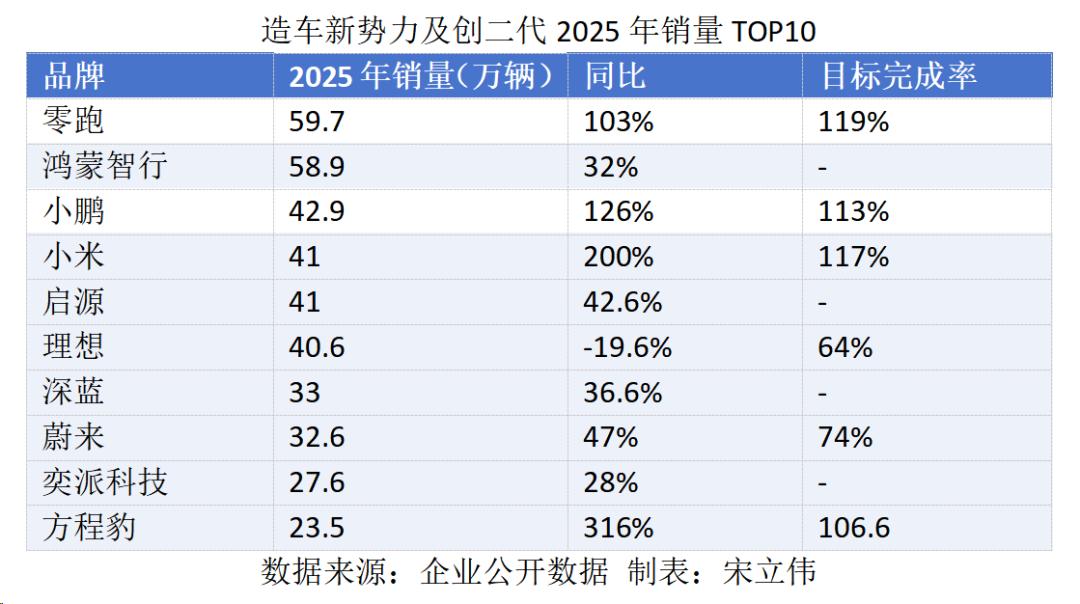
In this year, Leapmotor (09863.HK) brought its annual sales volume close to 600,000 vehicles, and Hongmeng Smart Mobility approached the same level with its "Five Brands". Meanwhile, 400,000 vehicles became a clear dividing line. A group of new - force car - makers stepped onto a new stage, while some enterprises were forced to adjust their paces between goals and reality.
If we only look at the list, the change in 2025 was just a reshuffle of rankings. However, when we break down the data into monthly figures and product structures, we can see a deeper level of differentiation. Looking back at 2025, whether it's new - force car - makers or the "second - generation startups" of traditional groups, it's becoming clear who has achieved scale, who is still paying the price for scale, and who is being backfired by the growth structure.
More importantly, with the implementation of the "anti - involution" policy, cash flow and profitability have been brought back to the forefront. The competition logic of new - force car - makers is shifting from "who sells more" to "who can achieve high - quality and continuous delivery".
The 600,000 - vehicle mark appears for the first time, and the top new - force car - makers complete the shift
In 2025, for the first time, there was a single - brand player in the new - force camp approaching the 600,000 - vehicle level.
According to the company's public data, Leapmotor delivered approximately 597,000 vehicles in 2025, a year - on - year increase of 103%. This not only set a new historical high but also exceeded the annual target of 500,000 vehicles. In December, its deliveries exceeded 60,000 vehicles, a year - on - year increase of 42%, and the scale effect began to show at the monthly level.
What supported this upward rush was a set of products and rhythms closer to the mainstream market. In the past year, Leapmotor achieved intensive coverage in the core price range of 70,000 to 200,000 yuan through new models such as the B10, B01, and Lafa5, as well as the annual facelift of the C - series. The pricing strategy and product launch resonated, and the sales curve was continuously lifted.
Beyond the increase in scale, Leapmotor also showed key business signals in 2025. Public data shows that Leapmotor's semi - annual financial report in the first half of 2025 showed a positive net profit for the first time, and then the 1 millionth vehicle rolled off the production line. In March 2025, Leapmotor reached a strategic cooperation with FAW Group and announced at the end of the year that FAW had taken a stake. Coupled with the breakthrough in the overseas market with the help of the Stellantis Group, its shareholder structure and development certainty were further enhanced.
Right behind is Hongmeng Smart Mobility.
In 2025, the five brands under Hongmeng Smart Mobility delivered a total of 589,000 vehicles, a year - on - year increase of 32%, forming the first echelon of new - force car - makers together with Leapmotor.
Different from being highly dependent on AITO in 2024, the internal structure of Hongmeng Smart Mobility began to show clearer differentiation in 2025. This differentiation is not simply the ebb and flow of brands but is reflected in the dynamic adjustment among channel resources, product rhythms, and sales efficiency. As sales performance becomes an important reference for resource allocation, the support levels obtained by different brands at the terminal gradually diverge, forming an operating mode oriented by market results.
Looking at the annual structure, AITO was still the main source of sales for Hongmeng Smart Mobility, delivering approximately 423,000 vehicles throughout the year, accounting for more than 70% of the total. Zhijie delivered approximately 90,000 vehicles throughout the year, a year - on - year increase of 56%, becoming the most important source of incremental sales in the alliance. Xiangjie achieved rapid growth on a low base. Zunjie completed its initial market entry. Since its launch in September 2025, Shangjie has achieved stable deliveries in a relatively short period with the help of the smart - selected vehicle channel network.
This operating mechanism is also spreading beyond Hongmeng Smart Mobility. According to the publicly announced cooperation arrangements, in 2026, the "Yijing" and "Qijing" projects jointly promoted by Huawei Yinwang with Dongfeng and GAC respectively will officially enter the market stage. Beyond the original Hongmeng Smart Mobility system, Yinwang is starting to promote multi - party cooperation in a more open way, which means that the intelligent vehicle system led by Huawei will form two parallel paths in the same market and compete on the same technology platform.
The appearance of the 600,000 - vehicle mark means that the new - force car - makers have completed the transition from "top players" to "scale - type automakers" for the first time. Below this line, the competition is extending from the competition between single brands to the comparison at the platform and system levels.
The 400,000 - vehicle mark is a dividing line, with some accelerating and some under pressure
If the 600,000 - vehicle mark represents the first echelon, then the 400,000 - vehicle mark has become the entry threshold for the second echelon of new - force car - makers.
In 2025, XPeng (XPEV.US) delivered nearly 430,000 vehicles throughout the year, a year - on - year increase of 126%, exceeding the target of 380,000 vehicles. Looking at the annual curve, XPeng achieved high - speed growth, but in the last two months, sales did not continue to rise. From September to October, after XPeng Motors' monthly sales once approached 40,000 vehicles, the sales of main models such as the MONA M03 and P7+ declined, and the sales of the new P7 also declined after a brief increase.
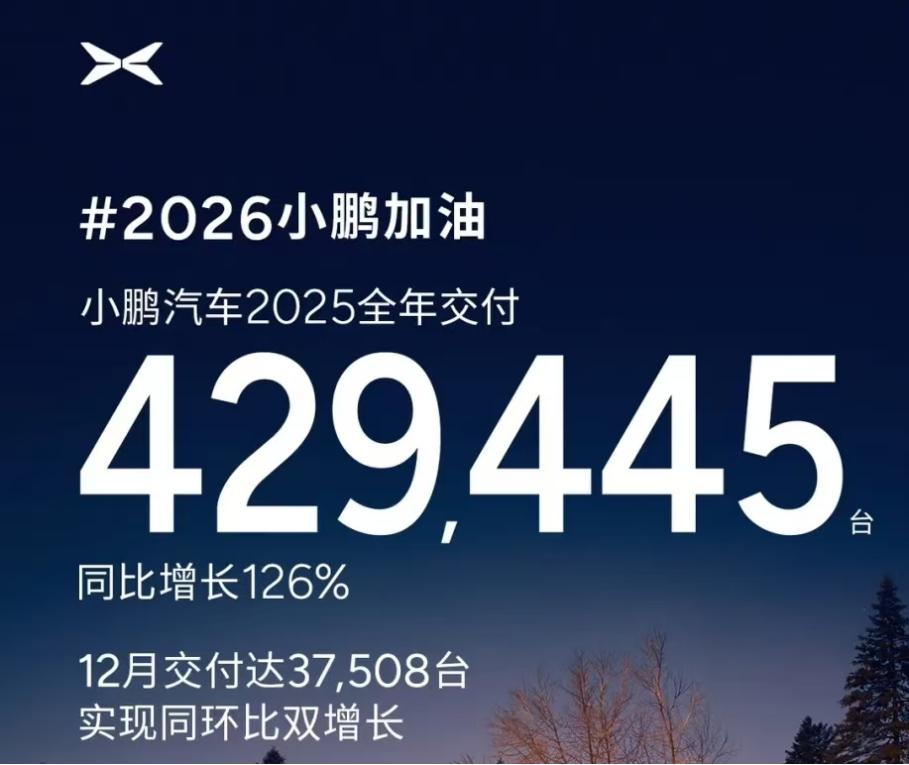
Image source: Company
After achieving the "breakthrough in quantity", XPeng has entered a new stage. Simply put, for XPeng, future growth no longer depends only on the ability to increase sales volume but is more constrained by the product update rhythm and structural stability.
It's worth mentioning that in 2025, XPeng delivered 45,000 vehicles overseas, a year - on - year increase of 96%, becoming an important buffer. The P7+ Extended - Range and G7 Extended - Range models unveiled in the fourth quarter laid the foundation for its product offensive in 2026.
Right behind XPeng is Xiaomi Auto.
Based on comprehensive public information, Xiaomi Auto delivered more than 410,000 vehicles in 2025, exceeding the target of 350,000 vehicles. With only two models, the SU7 and YU7, it ranked among the top new - force car - makers. In December, Xiaomi Auto's deliveries reached 50,000 vehicles, and the annual delivery curve showed an overall upward trend.
However, when we shift our perspective from the annual cumulative figures to the monthly structure, the growth was not always linear. Third - party statistics show that in the first eleven months of 2025, the SU7's sales declined month - on - month in seven months. In November, sales dropped to 12,520 vehicles, a 57% decline from the peak of 29,244 vehicles in March.
What's more worthy of attention is that this fluctuation did not stay at the "monthly ups and downs" but gradually spread to both the supply and demand sides. On the supply side, the production capacity of Xiaomi's two - phase factory was rapidly released, with the annualized actual production capacity exceeding 480,000 vehicles. On the demand side, the SU7 continued to be under pressure due to the combined effects of multiple public opinion events and recalls. After the concentrated launch of competitors at the same price range, the configuration advantage of the SU7 was diluted, and the popularity of its own YU7 also diverted some potential customers. The change in the supply - demand relationship began to directly affect the terminal performance.
Reflected in the second - hand market, the prices of all SU7 models declined, and it was difficult to transfer orders. A large number of low - mileage vehicles flowed into the market, with vehicles with a mileage of less than 10,000 kilometers accounting for more than 30%. Some car dealers took risk - aversion measures such as "selling at a loss". The inventory of the SU7 Ultra exceeded 30 days, and the average loss was as high as more than 60,000 yuan. The brand value continued to be under pressure in the second - hand market.
Li Auto (LI.US) was in an obvious adjustment period.
In 2025, Li Auto delivered 406,000 vehicles throughout the year, only achieving 64% of the revised target of 650,000 vehicles. In December, it delivered 44,246 vehicles, a year - on - year decline of 24% but a month - on - month increase of 33%, showing signs of recovery.
In this year, the temporary setback in the electric vehicle product line had a substantial negative impact on Li Auto. The quick replacement of the i6 and the rebound in the sales of the L - series became important supports for it to stop the decline. The industry believes that whether this rebound can continue in 2026 remains to be further observed.
At the 300,000 - vehicle level, a test of efficiency after scale increase
In 2025, NIO (NIO.US) delivered 326,000 vehicles throughout the year, a year - on - year increase of 47%, achieving 74% of the annual target of 440,000 vehicles. Among the top new - force car - makers, this volume is not low. However, compared with the operating mode of multiple brands running in parallel and continuous expansion of the organizational structure, the scale of the 300,000 - vehicle level still seems tight.
Looking at the performance at the end of the year, NIO's trend became significantly stronger. In December 2025, the company's deliveries reached 48,135 vehicles, a year - on - year increase of 54.6%. Among them, the NIO brand delivered 31,897 vehicles, LeDao 9,154 vehicles, and Firefly 7,084 vehicles. Multiple brands began to show their presence in the delivery data, and the complexity of the system operation also increased accordingly.
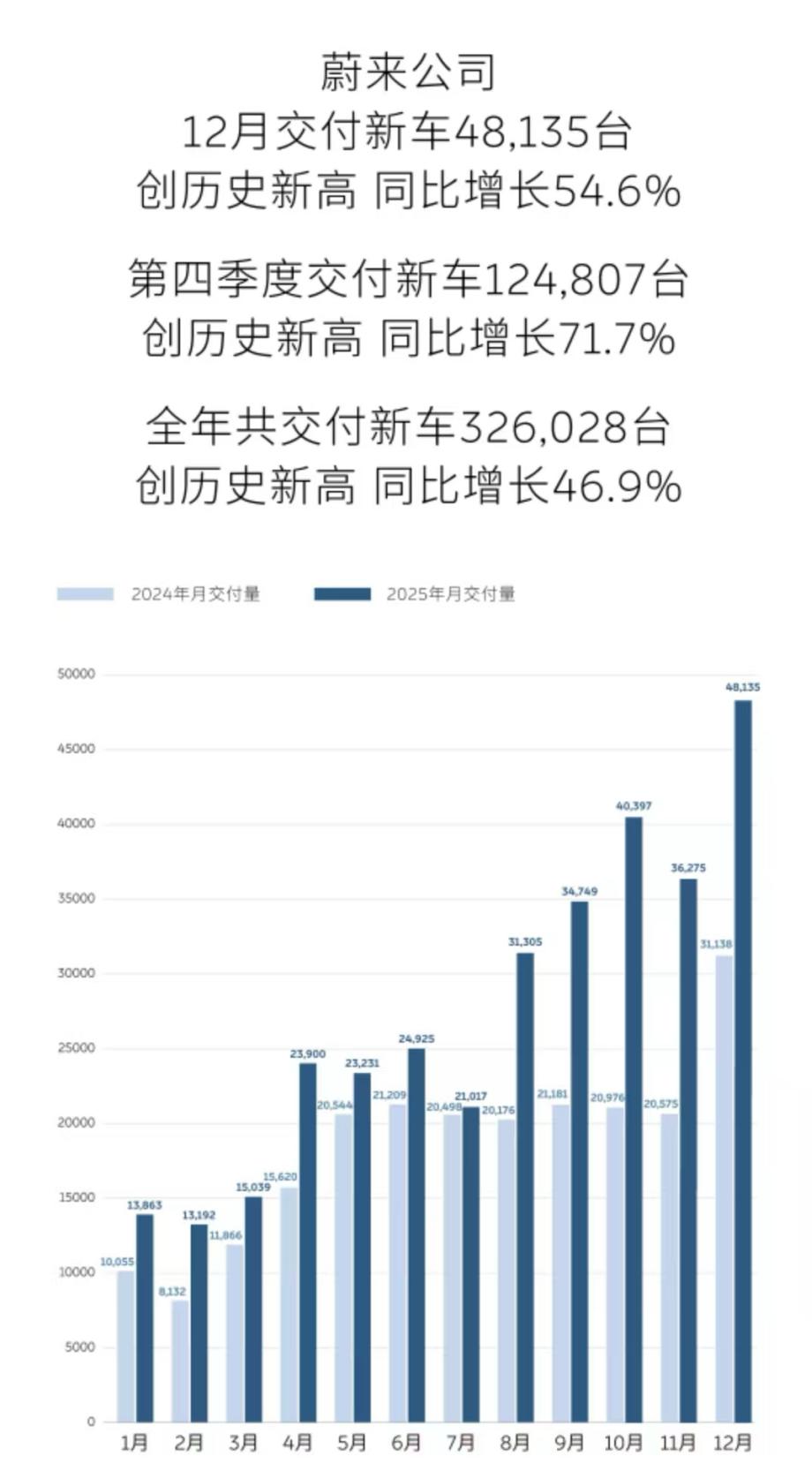
Image source: Company
The most direct driving force came from the new ES8. Just this single model delivered more than 22,000 vehicles in December, breaking the single - month delivery record for vehicles priced above 400,000 yuan and becoming an important support for NIO's temporary recovery.
If we further break down this rebound, its internal structure is also worthy of attention. Against the background of multiple brands running in parallel, NIO's new incremental sales are still mainly concentrated in a single high - end model, indicating that the short - term improvement mainly comes from a single - point breakthrough in products rather than a simultaneous improvement in overall efficiency.
Looking at the annual structure, this feature is also clear. In 2025, the NIO brand delivered 178,806 vehicles throughout the year and was still the main source of the company's sales. The LeDao brand delivered 107,808 vehicles throughout the year, with a rapid increase in sales volume within the year and has formed a considerable scale. The Firefly brand delivered 39,414 vehicles throughout the year, starting its scale - building in the first full - year. The simultaneous operation of the three brand lines significantly increased the requirements for R & D investment, channel adaptation, and organizational efficiency at NIO.
Under such an operating structure, the 300,000 - vehicle mark is no longer just a scale indicator but a real threshold.
As sales volume increases, the costs of resource allocation, channel operation, and organizational coordination brought about by multiple brands running in parallel also increase simultaneously. Whether the temporary rebound can continue depends on whether these costs can be absorbed by the new system capabilities. Meanwhile, continuous investment is still needed for multi - brand R & D, independent channel construction, and supply chain expansion. Against the background of relatively limited profit margins for mid - and low - end brands, NIO's goal of achieving positive profits is subject to higher constraints, and it still needs to find a more delicate balance between scale expansion and cost control in the short term.
Among the "second - generation startups" of traditional groups, not many have truly succeeded
Different from new - force car - makers, the new brands of traditional automakers are more like an "second - generation startup" experiment within the organization. By 2025, the results of this round of experiments have gradually emerged: there are many players in the field, but not many have achieved scale and a stable development path.
Among the central - state - owned enterprise camp, Dongfeng (00489.HK) and Changan (000625.SZ) are the two with the most comprehensive "second - generation startup" layouts. According to public data calculations, in 2025, the total sales volume of Changan's three "second - generation startups", Qiyuan, Deepal, and Avatr, was approximately 864,000 vehicles. In the same period, the total sales volume of Dongfeng's Yipai Technology, Voyah, and Mengshi was approximately 436,000 vehicles.
Within the Dongfeng system, Yipai Technology is the main carrier of the "second - generation startups". In 2025, its annual sales volume was approximately 276,000 vehicles, a year - on - year increase of 28.3%. However, about 10% of its sales volume still consisted of fuel - powered vehicles, and the growth mainly came from scale expansion rather than structural transformation. Voyah delivered approximately 150,000 vehicles throughout the year, a year - on - year increase of 87%, still 50,000 vehicles short of the annual target sales volume, but still in the medium - scale range. Mengshi's annual sales volume was approximately 10,000 vehicles, with the M817 estimated to contribute more than 70%. In the high - end off - road niche market, the scale boundary is still clear, but it is still short of the 12,400 vehicles promised by Huawei.
In contrast, the overall promotion rhythm of Changan's "second - generation startups" is faster. Qiyuan, a low - end brand, had annual sales of more than 411,000 vehicles in 2025, a year - on - year increase of 42.6%. Deepal's annual sales volume was approximately 333,000 vehicles, a year - on - year increase of 36.6%. Although its monthly sales have recently stabilized at 30,000 vehicles, it is still in a loss - making state, and its growth is highly dependent on continuous investment. Avatr's annual sales volume exceeded 120,000 vehicles