Sad news, Stack Overflow is completely dead. The number of questions is even lower than that in the first month after its launch 18 years ago.
It's even quieter than when it first launched. Stack Overflow has completely cooled off!
Once the holy land for programmers to ask questions, the number of questions asked now is even less than that in the first month after its launch 18 years ago.
(This downward trend seems to be retracing its steps...)
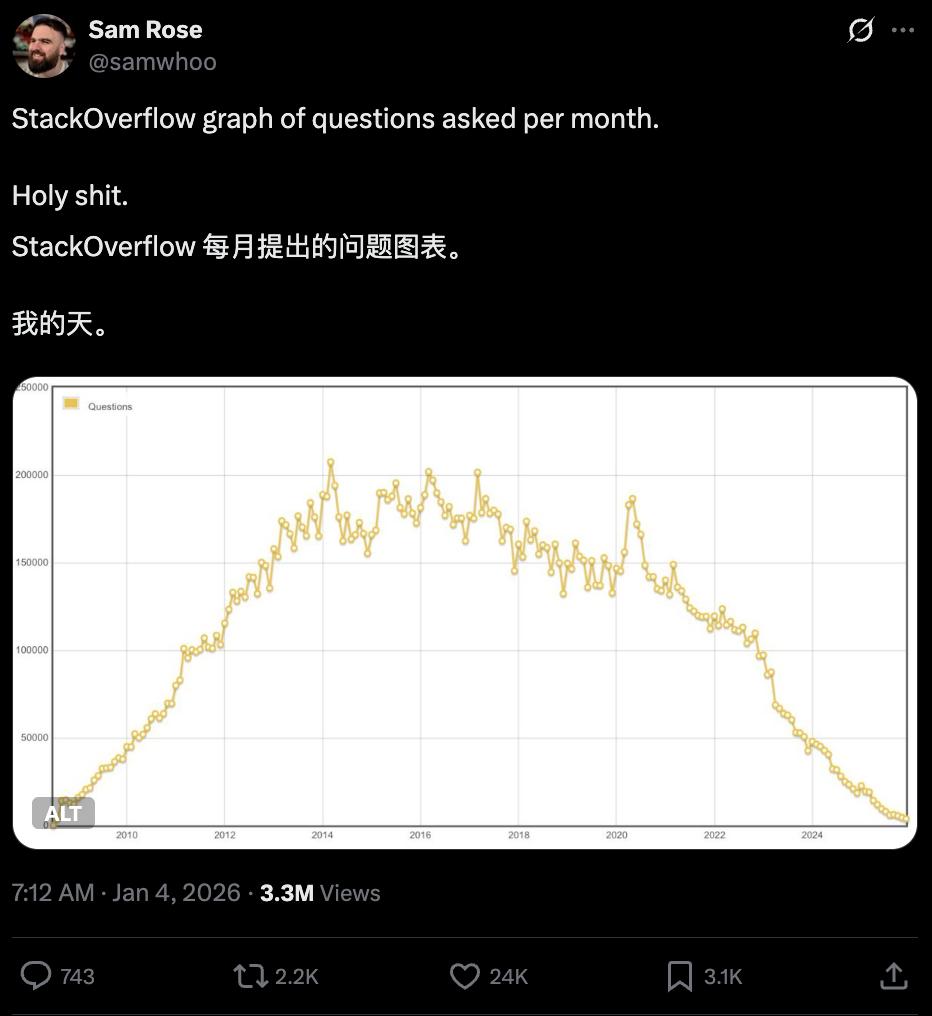
The number of developers worldwide has multiplied several times, and new tools and languages are emerging constantly. However, "asking questions" has disappeared.
Of course, when Stack Overflow cooled off, everyone's first reaction was to blame AI Coding.

So, why does its decline make so many people feel sorry?

It had over 180 sub - sites at its peak
Going back to 2008, Stack Overflow was launched with the positioning of high - quality and reusable answers and quickly became a lifesaver in the programmer community.
In the 2000s, programmers mainly relied on forums or personal blogs to solve programming problems.
However, such answers were usually scattered and unsearchable. This inefficient way also made many experts reluctant to share solutions.
So, Joel Spolsky, the founder of Fog Creek and the author of "Joel on Software", and Jeff Atwood, a well - known programmer and the author of "Coding Horror", created Stack Overflow. It continued to gain popularity after its official launch in 2008.
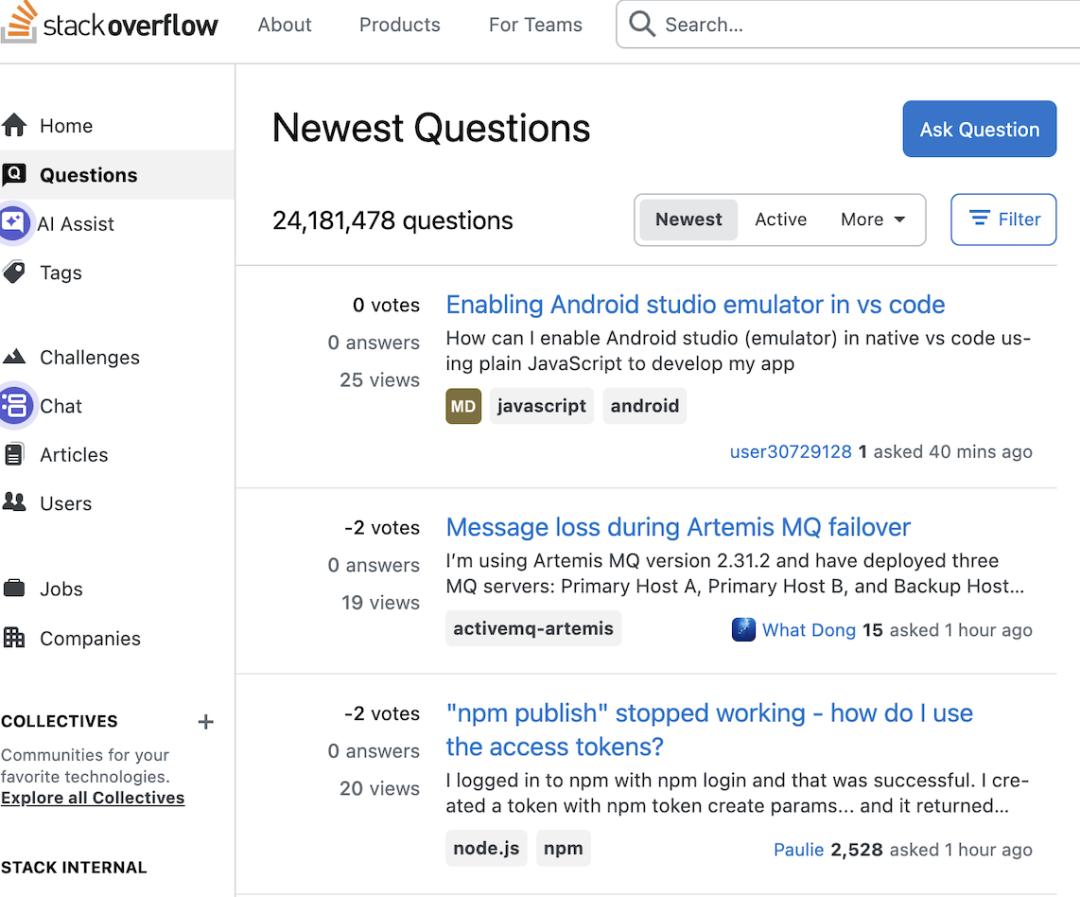
It focuses on specific questions and emphasizes verifiable and reusable answers. The main issue it addresses is not "whether there are people to answer" but "which answers are worth keeping".
The Q&A mechanism at that time was very efficient. For example, questions or answers could be voted on. High - quality content voted up would naturally float to the top, and contributors would get Reputation. In essence, this quantified the influence of technology.
Through voting, the reputation system, and strict question norms, Stack Overflow quickly compressed scattered engineering experience into a highly structured and long - term reusable knowledge base.
For a long time, it even became the default destination for Google's technical searches.
The process for most programmers to solve problems was like this:
Google → Stack Overflow link → Copy code → Make a few changes → Solve the problem.
Following this process, most stuck problems could be solved.

From 2013 to 2017, Stack Overflow reached its peak.
At its peak, it had over 180 sub - sites. It was not only exclusive to programmers but covered almost all STEM fields. From programming to mathematics, physics, and statistics, as long as it was a technology - related question, you could find peers to discuss on Stack Overflow.
At that time, Stack Overflow became the world's largest and most practical knowledge infrastructure for developers.
However, this once holy land for developers has also been impacted by AI.
In the AI era, its foundation has been shaken
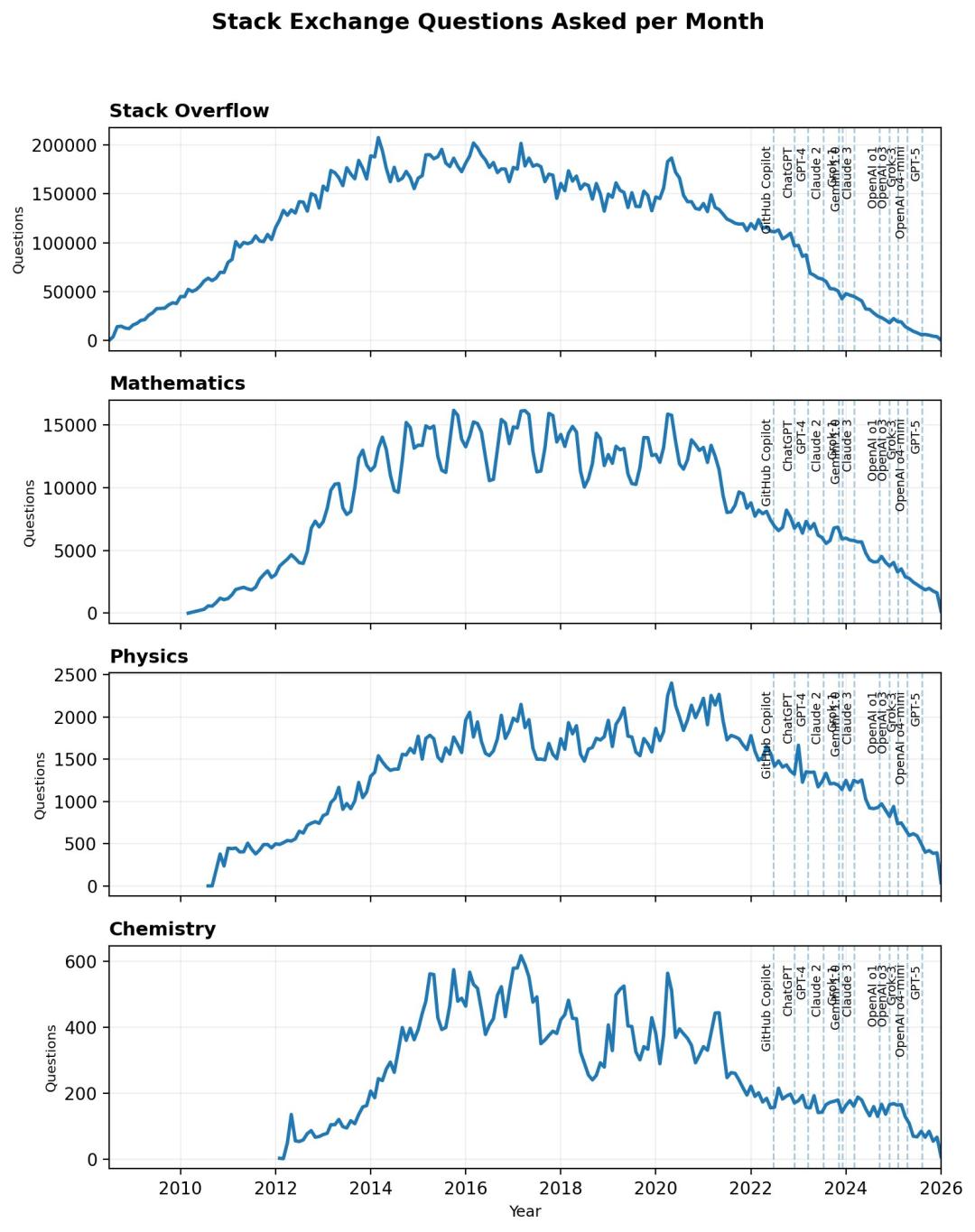
Judging from the data, the number of Q&As on Stack Overflow has been declining all the way until it has fallen below the starting point 18 years ago. In this process, AI really has to take the blame.
The emergence of AI tools such as GitHub Copilot, ChatGPT, and Claude has changed developers' habits.
Programmers have found that many questions no longer need to be asked publicly.
In the past, it was getting stuck → posting a thread → waiting for someone to answer;
Now it is getting stuck → asking AI → making local changes → continuing to work.
The act of asking questions has disappeared, but knowledge has not.
In fact, AI training still relies heavily on high - quality content on Stack Overflow. However, due to its greater convenience, it has diverted the traffic from Stack Overflow.
Stack Overflow has become "a platform that is replaced by the knowledge it created".

But it's not entirely fair to blame AI completely.
Actually, even before the emergence of ChatGPT, Stack Overflow was on a downward trend because of being overly nitpicky.
Many novice questions were taken down soon after being posted due to reasons such as "wrong format" or "too basic". This gradually dampened people's enthusiasm for participation.

Later, in order to deal with the impact of AI, the platform also integrated AI functions. As a result, junk answers flooded, and the once - proud content quality declined sharply.
Stack Overflow's own 2025 annual report also pointed out that although the usage rate of AI tools reached a new high (84%), developers' evaluations of it have been declining, and they no longer trust it.
Isn't this also the situation of Stack Overflow...

So, in the future, will Stack Overflow focus on vertical technology fields to regain its features or completely embrace AI and restructure its model?
Reference links:
[1]https://x.com/samwhoo/status/2007590903448514921/photo/1
[2]https://x.com/luismbat/status/2007764994642075663?s=20
[3]https://survey.stackoverflow.co/2025
This article is from the WeChat official account "Quantum Bit". The author focuses on cutting - edge technology. 36Kr published it with authorization.