Starlink satellites are operating at a lower orbital altitude, and the "land grab" for space resources has further escalated.
Every special move by SpaceX, under Elon Musk's leadership, draws high - level attention from the global industry. Recently, SpaceX announced that it will lower the orbital altitudes of thousands of Starlink satellites to reduce the risk of collisions. This move has sparked intense discussions in the industry, with many experts expressing concerns, and it will further intensify the competition for resources.
4,400 Starlink Satellites to Lower Orbits in the Name of Reducing Collision Risks
Michael Nichols, the vice - president of the Starlink project, said that the company is "initiating a major restructuring plan for the satellite constellation," lowering all currently operating satellites at an altitude of about 550 kilometers to an orbit of about 480 kilometers. The aim is to move the satellites to a less congested orbital layer, reducing the risk of collisions. Additionally, when a satellite malfunctions or fails, it can leave the orbit and burn up in the atmosphere more quickly, thus reducing the generation of space debris. It is reported that approximately 4,400 Starlink satellites will participate in this orbital altitude adjustment by 2026.
Nichols pointed out that in addition to creating a relatively safer and more controllable space for satellite operations, this adjustment is also closely related to the solar activity cycle. Solar activity has a cycle of about 11 years, and the intensity of the activity directly affects the density of the Earth's upper atmosphere. The next solar minimum is expected to occur in the early 2030s. As the solar minimum approaches, the density of the upper atmosphere will decrease, which means that the natural orbital decay time of satellites at the same altitude will be extended. By lowering the orbital altitude, during the solar minimum, the orbital decay time, which could otherwise exceed four years, can be shortened to a few months, with the orbital decay rate increasing by more than 80%.
Moreover, in theory, lowering the satellite's orbital altitude can also reduce latency. However, since not all latency is caused by the satellite's distance, the improvement in latency due to a 70 - kilometer change in orbital altitude is very limited.
Overall, the Low Earth Orbit (LEO) is becoming more congested than ever. Recently, a paper published by researchers from the Massachusetts Institute of Technology showed that many satellites may soon be flying in orbital regions that are already too congested to operate safely in the long term.
In 2019, about 13,700 vehicles (including satellites and various debris) were flying at high speed in the Earth's low - orbit, at altitudes below 2,000 kilometers. However, by 2025, this number had risen to 24,185, an increase of 76%. It is estimated that by the end of 2029, about 70,000 satellites may reside in the LEO, more than five times the number in 2019.
In 2019, only 0.2% of Earth - orbiting satellites were forced to perform more than 10 collision - avoidance maneuvers per month. By early 2025, this proportion had increased seven - fold to 1.4%. This figure may not seem high, but it means that about 300 or more satellites have to spend a lot of time avoiding debris and other spacecraft.
Different satellite operators choose different thresholds to implement the collision - avoidance mechanism. NASA spacecraft usually avoid risks when the collision risk exceeds one in ten thousand, while SpaceX is more cautious, using its autonomous space - avoidance system to avoid objects with a risk of more than one in 3.3 million.
This new study shows that satellite operators can make better use of the available space by reducing the number of satellites launched into already over - congested orbits and coordinating the operation of constellations so that satellite orbits are synchronized rather than intersecting. However, at the current stage, it seems unrealistic for satellite operators to coordinate the operation of constellations. Therefore, SpaceX's act of actively lowering orbits to avoid space congestion and collision risks is a viable approach in the current situation.
Intensified Competition for Limited Resources Poses Challenges to the Development of Satellite Internet
SpaceX's active lowering of orbits to avoid collision risks can be seen as a passive response and a relatively short - term measure. Researchers at MIT believe that the orbital region between 400 - 600 kilometers will be quite congested. Although the Starlink satellites are currently lowered to an orbit of 480 kilometers, which is not congested for the time being, as more various spacecraft are launched in the future, this orbit will also become congested. From this perspective, it exposes the lag of the existing international space rules, and the competition for limited orbital resources is intensifying.

Starlink is currently the fastest - growing satellite service operator globally. After only five years of commercial operation, Starlink has connected more than 9 million users. In 2025 alone, Starlink acquired more than 4.6 million new users.
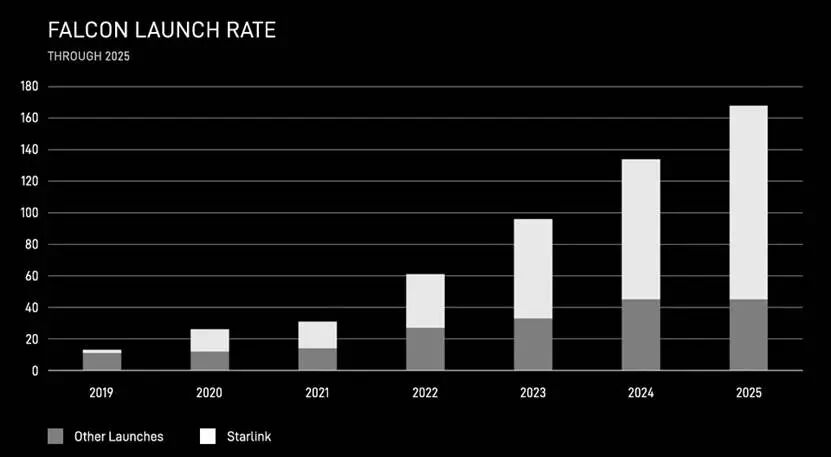
SpaceX has completed more than 300 dedicated Falcon 9 rocket launches, all designed for the Starlink constellation. In 2025, SpaceX carried out more than 120 dedicated Falcon 9 launch missions to deploy Starlink V2 Mini satellites. The new - version satellites weigh 575 kilograms, a reduction from the previous version, and through optimized design for known vulnerable points and failure links in the early versions, their reliability has been significantly improved. The reduction in the weight of each satellite allows the Falcon 9 to carry more satellites per mission, injecting more effective capacity into the constellation. In 2025, SpaceX launched more than 3,000 optimized V2 Mini satellites, adding more than 270 Tbps of capacity to the constellation. As can be seen from the following figure, Starlink has accounted for the majority of satellite launches in recent years.
Against the backdrop of Starlink's rapid development, domestic and foreign experts often compare the development of China's satellite internet with it.
Overall, China's satellite internet has fully entered the "accelerated" stage of parallel large - scale construction and application exploration, extending from professional fields to the general public, after technical verification and initial construction. In August 2025, the Ministry of Industry and Information Technology issued the "Guiding Opinions on Optimizing Business Access to Promote the Development of the Satellite Communication Industry," proposing the goal of developing more than 10 million satellite communication users by 2030 and suggesting "organizing and carrying out commercial trials of satellite Internet of Things and supporting eligible enterprises to rely on low - orbit satellite Internet of Things constellations."
In terms of constellation construction, China's satellite internet constellations feature a combination of national leadership and commercial forces. On the one hand, national teams represented by China SatNet are leading the construction of a low - orbit broadband satellite constellation with global coverage and are also actively promoting the integration of satellite communication with 5G/6G. In 2025, through a new - technology test satellite, the world's first mobile - phone - to - satellite broadband video call based on the 5G NTN standard was achieved; at the same time, local state - owned assets represented by Shanghai Yuanxin are also involved. It is expected that by the end of 2026, the number of Shanghai Yuanxin's in - orbit satellites will reach 648. On the other hand, private enterprises have also made significant breakthroughs. Take Geespace, a subsidiary of Geely, for example. Its independently built Geely Constellation Phase I completed global networking in September 2025, with a total of 64 satellites launched, achieving real - time communication coverage of the world except for the North and South Poles, becoming the first global low - orbit satellite Internet of Things constellation led by a private enterprise.
It can be seen that the development of China's satellite internet has become another key force globally. Inevitably, the competition for orbital resources will escalate. SpaceX's act of lowering orbits is seriously squeezing the development space of subsequent countries and enterprises. According to the rules of the International Telecommunication Union, orbital and frequency resources follow the principle of "first come, first served." Starlink, with its first - mover advantage, has occupied a large amount of high - quality low - orbit resources. As of now, it has launched more than 10,000 satellites in total, with more than 9,300 in orbit. In the long run, there may well be a situation where "the first - comers divide up space and set the rules first." The "land - grabbing" of low - orbit resources poses severe challenges to the development of satellite internet. In the future, coordinating international rules, accelerating constellation networking, and speeding up the research and development of space - debris removal technology may be the main ways to break this "land - grabbing" situation.
This article is from the WeChat official account "Internet of Things Think Tank" (ID: iot101), written by Zhao Xiaofei, and is published by 36Kr with authorization.