Investment exceeding 60 billion in three years, the Atomic Energy Law will come into effect on January 15, 2026. Who is taking orders for controlled nuclear fusion?
The "buzz" around controllable nuclear fusion has spread from laboratories to the capital market.
For example, the Wind Controllable Nuclear Fusion Concept Index had a cumulative increase of 83.19% in 2025. The policy window has also opened — the Atomic Energy Law will be implemented in 2026, with the state level explicitly supporting fusion energy for the first time. Anhui, Sichuan, and Shanghai are vying vigorously for the high - ground of the fusion industry, backed by the accelerated progress of a number of large - scale scientific facilities such as EAST, the Chinese Tokamak series, and BEST.
An obvious sign is: project tenders are on the rise. Just for the BEST facility in Hefei, the budget last year exceeded 2 billion yuan. Industry insiders estimate that the investment in domestic fusion projects in the three years from 2025 to 2027 will be close to 60 billion yuan. This is no longer a distant scientific fantasy, but a real industrial chain competition — orders have been placed. Which companies have really won the contracts?
Large facilities "place orders", and the manufacturing industry takes the lead in receiving them
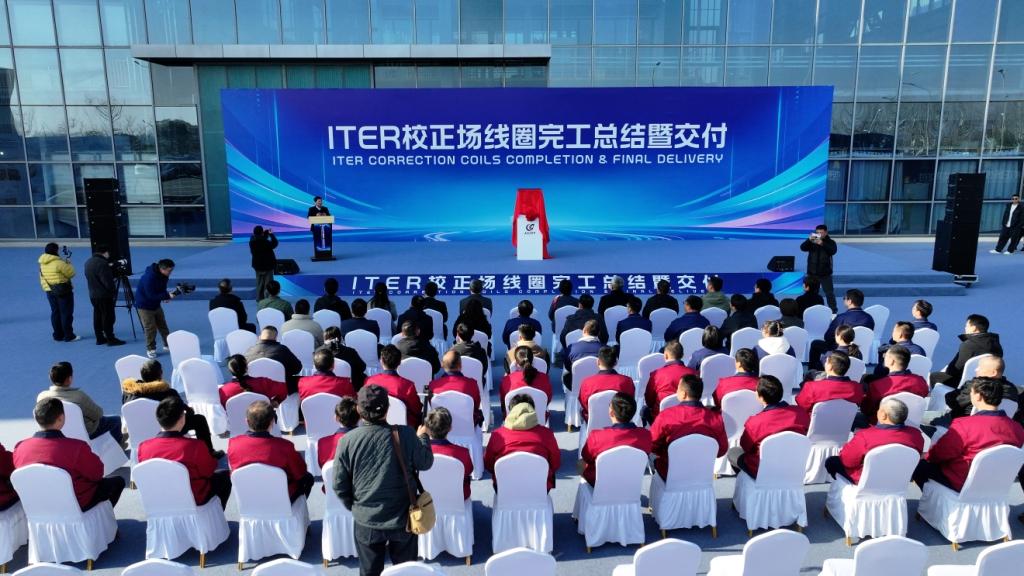
ITER, the world's largest fusion experimental reactor project, has become a "training ground" for Chinese manufacturers. At the end of last year, the Institute of Plasma Physics of the Hefei Institutes of Physical Science, Chinese Academy of Sciences, announced that all the correction field coils for ITER had been completed, with 100% domestic materials and processes. Almost simultaneously, the Chinese consortium led by the Southwestern Institute of Physics (SWIP) won a large order for the ITER power supply system.
These things may sound very high - tech, but behind them are real factories at work. Dongfang Electric, Shanghai Electric, Western Superconducting Technologies, Antai Science & Technology... The names of these companies appear repeatedly on the ITER supplier list. Manufacturing coils requires extreme superconducting materials, and making power supplies tests high - power conversion technology. Every component is challenging the industrial limits.
Domestic manufacturers have accumulated technology and experience by supplying to ITER and are now applying them to their own fusion facilities. Shanghai Electric admits that it has participated in several major domestic large - scale facilities, including EAST, CRAFT, BEST, and the Chinese Tokamak No. 3 and No. 4. The rapid progress of these facilities has first driven a group of manufacturing enterprises capable of solving complex processes.
Three regions are in the lead, and the fusion strategies of Anhui, Sichuan, and Shanghai
Under the national layout, local regions also have their own plans. Anhui, Sichuan, and Shanghai each hold an ace facility but have different approaches.
Hefei is betting on a "research - industry" integration model. Relying on the Institute of Plasma Physics of the Chinese Academy of Sciences, it has both established facilities like EAST and is vigorously promoting the new BEST project. Hefei's idea is straightforward: to gather industrial chain enterprises around large - scale facilities. There are now nearly 60 relevant companies in the local area, ranging from those making superconducting materials to those doing design. The tender for the BEST project cost more than 2 billion yuan last year, and most of this money went into the pockets of local and domestic suppliers.
Sichuan is taking the "hard equipment" route. SWIP is located in Chengdu. The Chinese Tokamak No. 3 is being upgraded, aiming for a combustion experiment in 2027. The planned Chinese Tokamak No. 4 focuses on high - temperature superconducting magnets. Sichuan has clearly stated in its policy documents that it will use large - scale projects to drive supporting industries and develop component industries such as vacuum devices and special valves. It is really digging deep into manufacturing.
Shanghai is playing a "high - end" card. Last year, the China Fusion Energy Company with a registered capital of 15 billion yuan was established in Shanghai, and the Chinese Tokamak No. 4 has also landed there. Shanghai has no shortage of funds and an international environment. It aims to tackle core technologies, such as high - temperature superconducting magnets, and use artificial intelligence to improve fusion control levels. It is more like laying out future industrial standards and R & D high - grounds.
Although the three regions all seem to be involved in fusion, on closer inspection, Anhui is competing for engineering and industrial agglomeration, Sichuan is focusing on equipment manufacturing and supporting industries, and Shanghai is vying for core technologies and headquarters economy. This competition has pre - divided the territory of the Chinese fusion industry.
The flow of 60 billion yuan in investment: materials, equipment, and engineering services reap the first - wave dividends
No one can be sure when fusion power plants will be operational. But for now, real investment has poured in. Industry insiders estimate that the total investment in domestic fusion projects from 2025 to 2027 will be close to 60 billion yuan. This money is flowing into three most practical areas: special materials, core equipment, and engineering services.
Materials are the first hurdle. The interior of a fusion facility is a hellish environment: temperatures of hundreds of millions of degrees and strong radiation. The first - wall materials must be able to withstand these conditions. Tungsten - copper composite materials, high - performance superconducting wires (such as niobium - tin wires), tritium - handling materials... These niche fields have extremely high technological barriers. Once selected for a project, it means a long - term "ticket". Relevant enterprises rely on this "technological expertise".
Equipment manufacturing is the highlight. Whether it's the giant coils of ITER or the vacuum chamber of BEST, they are all non - standard, oversized, and ultra - precise "iron lumps". Manufacturing them requires the ability of special welding, precision machining, and complete assembly. For example, Hefei Forging Machine Tool Group provides heavy - duty presses for BEST, and Harbin Welding Institute Co., Ltd. solves special welding problems — behind the orders is actually a competition of manufacturing capabilities.
The third area that is easily overlooked is engineering design and services. Fusion facilities are extremely complex. From design, construction to commissioning, they require professional general contracting and integration services. China Nuclear Engineering & Construction Group Corporation is involved in the renovation of the Chinese Tokamak No. 3, and China Nuclear Power Engineering Co., Ltd. appears in the ITER consortium, which follows this logic. As the projects progress, the demand for such engineering services will increase.
The rhythm of the 60 - billion - yuan investment is reshaping the industrial chain. In 2026, it will be a year of intensive project tenders and accelerated order releases. For enterprises, whether they can enter the project supplier list now may determine how far they can go in the fusion industry in the future.
The fusion story in 2026 is less of a science - fiction tale and more of an engineering account. The law has given the green light, local regions are actively taking the lead, and large - scale facilities are being launched one after another — all of this has ultimately translated into specific tender documents and procurement contracts. The capital market is hyping concepts, but the industry is facing real delivery pressure: Can the coils be completed on time? Does the magnet performance meet the standards? Is the welding process up to par?
Although the commercialization of fusion energy still has a long way to go, on the road to that ultimate goal, an industrial cluster based on high - end manufacturing and hard technology has sprouted. It is still unknown who will dominate in the future, but one thing is certain now: Orders don't lie. They are telling the market that the prelude to the energy revolution starts from the machine tools in the workshop and the test reports in the laboratory.
This article is from the WeChat official account "Foreseeing Energy", author: Foreseeing Energy, published by 36Kr with authorization.