These 16 characters will determine the fate of BYD, Geely, Great Wall, Wenjie, and the "Wei Xia Li" brands in 2026.
The industrial battle smoke of 2025 has not completely dissipated, and the outline of 2026 is gradually becoming clear.
At the beginning of the new year, as the cornerstone of China's current manufacturing industry and a core industry with intensive implementation of cutting - edge technologies and a high degree of marketization, the development trends of China's new energy vehicle industry are worth reviewing again: We will start from both the supply and demand sides to discuss the industrial development trends of new energy vehicles in 2026.
Today, let's first analyze the demand side. We will conduct in - depth discussions from four aspects: the domestic demand market, the external demand market, products, and the matching of supply and demand.
The content involved in this article represents only the author's personal views for discussion and exchange, and does not constitute any investment or reference advice.
01 The second - derivative inflection points of vehicle ownership and penetration rate have been reached, and the domestic market will enter a low - growth maturity stage
In the past three years, China's new energy vehicles have enjoyed the era bonus of the "collision between technology and demand" in the domestic demand market. The electrification revolution combined with policy subsidies has stimulated the demand market and quickly supported an incremental market.
However, no industry can deviate from the traditional supply - demand relationship. Sustained high - speed growth only exists in an ideal state, and the new energy vehicle industry is no exception. The first predictable expectation for the new energy vehicle market in 2026 is that the incremental space in the domestic market has reached its peak, and the entire new energy vehicle market will maintain a long - term slightly increasing market pattern.
According to the data from the Passenger Car Association (compulsory traffic insurance), the annual growth rates of new energy vehicles in 2023 and 2024 reached 39% and 47% respectively. Since the end of 2022, the annual sales scale of new energy passenger vehicles has soared from 5.26 million to 12.4 million (expected), and the penetration rate is very likely to exceed 50% for the first time.
It also means that in the next two years, the growth rate of new energy vehicles may slow down and remain in a low - growth range of less than 10%. There are mainly three reasons:
· The most obvious one is the decline of subsidies. Since the fourth quarter of this year, the trade - in subsidy policies in different regions have started to decline. Next year, the purchase tax on new energy vehicles will be reinstated (levied at a half rate), which will also affect the performance of the demand side for some time. At the end of this year, during the last period of the purchase tax discount, there will also be a wave of pre - overdrawn demand.
· Secondly, at the macro level, the per - capita vehicle ownership has reached a new stage. Currently, China's per - capita vehicle ownership is 251 per thousand people, far lower than that of the United States (848 per thousand people) and Germany (645 per thousand people). However, it is obvious that there are significant differences in purchasing power, urban supporting facilities, and population structure among countries, so simple horizontal comparisons cannot be made.
The theoretical peak calculation of China's vehicle ownership needs to consider a series of factors such as economic structure, population density, and urban planning, which is a relatively complex issue. We directly adopt the calculation results of Mr. Xu Changming, the editor - in - chief of "China Automobile Market Outlook" and the deputy director of the State Information Center: 400 - 450 per thousand people. Currently, the per - capita vehicle ownership level is about 60% of this theoretical peak.
In the United States, the per - capita (per thousand people) vehicle ownership increased from 467 in 1965 to 640 in 1975, with a net increase of nearly 200 vehicles per thousand people. From 1975 to 1985, within the same ten - year period, the net increase was only 100 vehicles per thousand people. From 1985 to 1995, the net increase was only 26 vehicles per thousand people.
That is to say, when the per - capita vehicle ownership approaches about 70% of the theoretical limit, the growth rate will significantly slow down and reach the second - derivative inflection point of the S - shaped curve. Now, if we make a pessimistic estimate (400 vehicles per thousand people), we are about to enter the low - growth range of per - capita vehicle ownership.
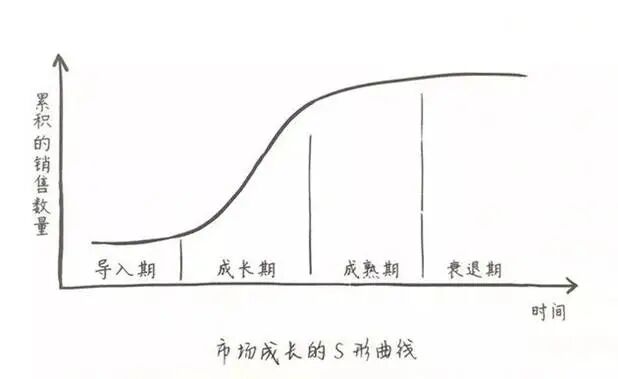
Figure: The S - shaped curve of market growth, Source: Internet
· Finally, the penetration rate of new energy electric vehicles has exceeded 50%. Following the same logic as per - capita vehicle ownership, according to the innovation diffusion theory, when the penetration rate exceeds 50%, the market officially transitions from the early mass market to the late mass market, the growth driver changes, and the speed naturally slows down.
That is to say, the growth rate of vehicle ownership slows down, and the penetration rate of electric vehicles into fuel - powered vehicles also slows down. Therefore, there is little possibility of a significant increase in the growth rate. In fact, the entire new energy market entered a "low - single - digit" growth cycle in the second half of 2025.
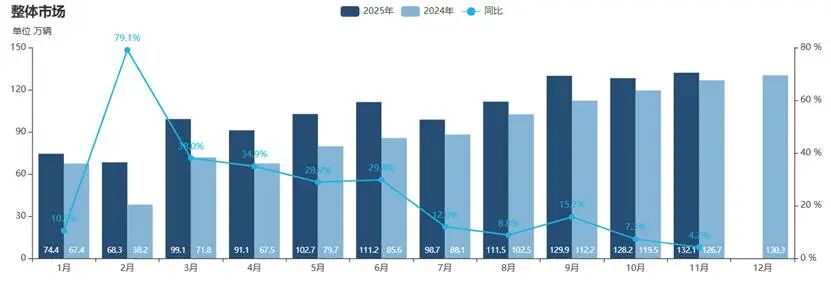
Figure: The year - on - year growth rate trend of new energy vehicles from 2024 to 2025, Source: Passenger Car Association
In the outlook of "China Automotive News" at the end of the year, most industry experts also expressed relatively cautious views on the domestic demand market next year.
From the perspective of domestic demand, in 2026, all the "players" (automobile manufacturers) seem to have to face a more severe market environment. If we still see some automobile manufacturers setting overly high annual sales targets next year, there are only two possibilities: either they have truly defeated their competitors, or they are just making unrealistic claims.
02 The "100 - dollar/kWh" singularity + the global infrastructure cycle, 2026 will be the year of explosive growth for China's new energy vehicle exports
If we start from the major topic of vehicle exports to discuss the development expectations of the new energy industry in 2026, we can analyze from numerous aspects to prove or disprove the potential market space. Even the policies and trends in different regions are different, making the discussion rather broad.
Therefore, we compared those well - known automobile enterprises in history (such as Toyota and Volkswagen) to find out what specific and meaningful logics they had before their export volume increased, and whether we can find some clues in 2026.
Actually, the story of Toyota's globalization is well - known to everyone. During the oil crisis, Toyota stood out with the Corolla, a small - displacement model. It also reduced costs through the Toyota Production System and industrial alliances. Today, we mainly discuss the internal logic from two indicators:
· A lower cost ratio compared to competitors (that is, so - called small displacement). For example, the Corolla's fuel consumption was 7.8L/100km, while the average fuel consumption of American cars was about 13L/100km. This is obvious.
· The potential infrastructure investment cycle. The increase in automobile exports usually follows the infrastructure investment cycle of the importing countries. For example, when Toyota entered the US market, it coincided with the large - scale highway infrastructure construction period in the United States (from 1956 to 1972, the "Federal - Aid Highway Act") for establishing the national interstate and defense highway system. After Volkswagen and Toyota entered China, they also caught up with the "road - building period" when China launched the construction of the "Five Vertical and Seven Horizontal" National Trunk Highway System.
At the same time, automobile enterprises usually enter emerging markets in two steps: first, import and assemble, and then gradually increase the localization rate. Therefore, the port infrastructure cycle is actually closely related to the globalization of automobile brands. For example, during Toyota's globalization process, it happened to experience the container standardization revolution.
In summary, the substitution advantage (cost) of comparable competitors and the infrastructure cycle (road - building and port - connecting) are actually two potential pre - conditions for the increase in export volume.
Back to 2026, considering the current global penetration rate, the comparable competitors for new energy vehicles are not the competition among different brands in the same industry but the transition between fuel - powered and electric vehicles. For new energy vehicles, the most core factor may be the cost singularity of 100 dollars/kWh.
Actually, the statement that 100 dollars/kWh will become the cost singularity for the development of electric vehicles is not new. As early as when Tesla launched the "Roadrunner" battery project, it indicated the ideal battery cost target of 100 dollars/kWh. Peter Mertens, the CTO of Audi, also made a similar statement. In 2023, Miao Wei, the deputy director of the Economic Committee, also had a similar expression at the World Power Battery Conference.
There are two reasons:
Firstly, it is based on numerical calculations. Whether it is the total cost - of - ownership calculation or the simple calculation of unit power cost, both can confirm this statement. Let's use the simple calculation of power cost. The cost of the fuel - powered system of a compact family car is usually between 2,000 and 3,500 dollars. Take an electric vehicle equipped with a 60 - kWh battery as an example:
The critical battery unit price = 3,000 dollars / 60 kWh = 50 dollars/kWh. The cost - parity point of the whole - vehicle manufacturing is approximately (the cost of the fuel - powered vehicle's power system / the battery pack capacity) × 2 times. So, the cost - parity point between fuel - powered and electric vehicles for an electric vehicle equipped with a 60 - kWh battery is exactly 100 dollars/kWh.
Secondly, it is based on historical experience. In 2024, the Chinese electric vehicle market experienced an obvious increase in the pure - electric vehicle penetration rate, and 2024 was the key time node when the battery cost dropped to 100 dollars/kWh without subsidy.
According to the prediction of BloombergNEF, the average price of the global LFP battery pack may continue to decline to about 105 dollars in 2026. In fact, BloombergNEF predicted last year that the average price of the battery pack in 2026 would drop below 100 dollars/kWh. This year, considering geopolitical factors, the predicted decline rate of the battery pack price next year is slightly more conservative.
From the trend perspective, the global electric vehicle market is obviously approaching the cost - parity point of 100 dollars/kWh between fuel - powered and electric vehicles. The year - on - year surge in the export volume of new energy vehicles in the second half of this year may be an obvious signal.
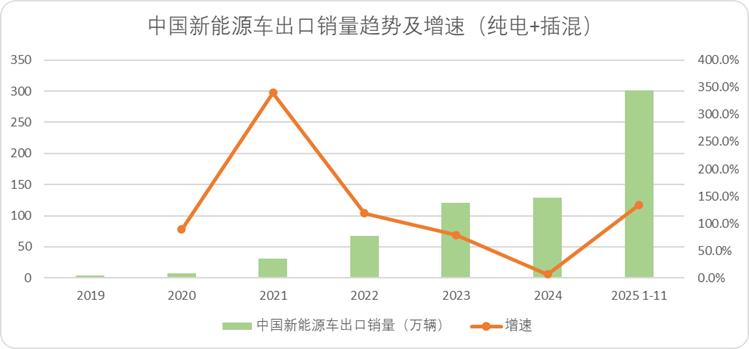
Figure: The export sales trend and growth rate of China's new energy vehicles, Source: Western Securities
At the same time, in the past five years, the investment in transportation infrastructure has reached a peak globally. According to the "Research and Consulting Report on the Competition Pattern and Investment Value of China's Transportation Investment Industry from 2025 to 2030" recently released by CRI, the global transportation infrastructure investment scale reached 2.8 trillion dollars in 2024, with a compound annual growth rate of 5.7% from 2019 to 2024.
According to the destinations of China's automobile exports this year, they are relatively scattered. However, most of the destinations for the export of complete vehicles are currently the regions with relatively intensive infrastructure road investment, such as South America, the Middle East, and Central Asia. The overseas production capacities of BYD, Geely, Chery, and SAIC will also be put into production and released in a concentrated manner next year.
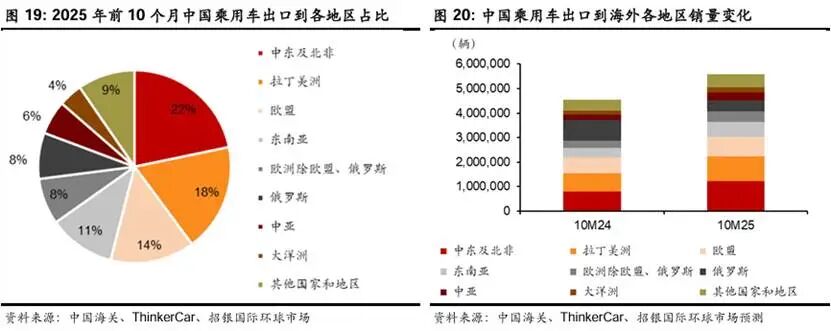
Figure: The illustration of export regions in the first 10 months of 2025, Source: CMBI
The infrastructure in the "port - connecting" aspect is also advancing simultaneously. Since last year, the leading liner companies have launched a wave of investment in port terminals. CMA CGM, Maersk, and Mediterranean Shipping have all announced their port investment and expansion plans for 2026. The handling volume of global ports has increased significantly in the past five years.
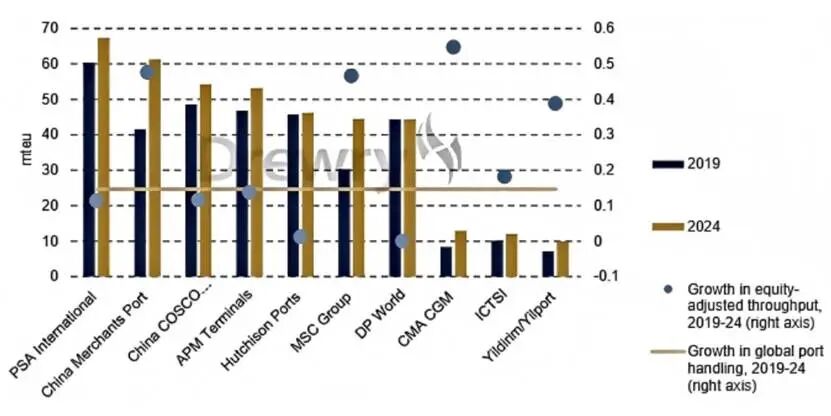
Figure: The growth rate of the global port handling volume in the past five years, Source: Drewry
In summary, the critical value unit price in the overseas market and the increasing infrastructure investment in emerging markets both indicate that the export of automobiles in 2026 will have a relatively optimistic and clear prospect.
03 The threshold for the "A00 - class volume - driven strategy" is getting higher, and the "30,000 - dollar" effect continues to ferment
In the past three years, when discussing the trends of new energy vehicles, we have always repeatedly mentioned the "30,000 - dollar effect" of electric vehicles. That is, the 30,000 - dollar price range is the core price range for electric vehicles to penetrate into the market share of fuel - powered vehicles, and it is also the price range where China's current mainstream purchasing power is most concentrated.
This has been confirmed in most cases: the average selling price of new energy vehicles increased to 171,000 RMB in 2024, approaching the 30,000 - dollar range. However, since 2025, the selling price of new energy vehicles has not increased but decreased, and currently it remains at around 160,000 RMB.
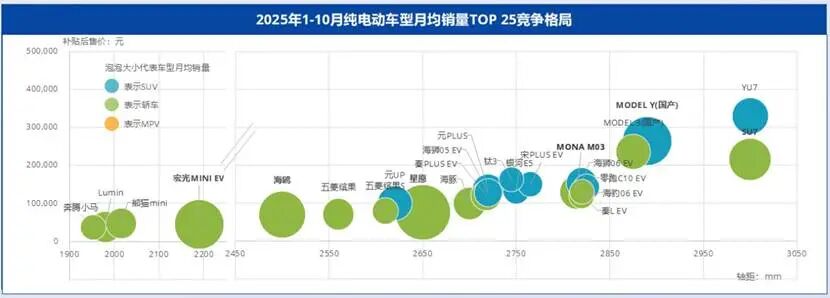
Figure: The sales pattern of pure - electric vehicles from January to October 2025, Source: Passenger Car Association
Actually, around 30,000 dollars (about 200,000 RMB) is the price range where most popular models are concentrated. Above this price range, there are relatively popular models (such as MODEL 3/Y; S/YU 7), and below it, there is the