He, the king of competition in China's private rocket industry
On the evening of September 5, 2025, the sky over Jiuquan, Gansu, was clear with gentle winds and warm sunshine. It was the perfect season in autumn in the frontier region.
At 19:39, at Launch Pad 95A of the Jiuquan Satellite Launch Center, the countdown reached zero. Flames gushed out from the bottom of the launch tube, and a carrier rocket soared into the sky, leaving a straight trail of flame in the twilight.
Soon, confirmation came from the control hall: Multiple commercial satellites had been accurately placed into the sun - synchronous orbit, and the mission was successfully completed.
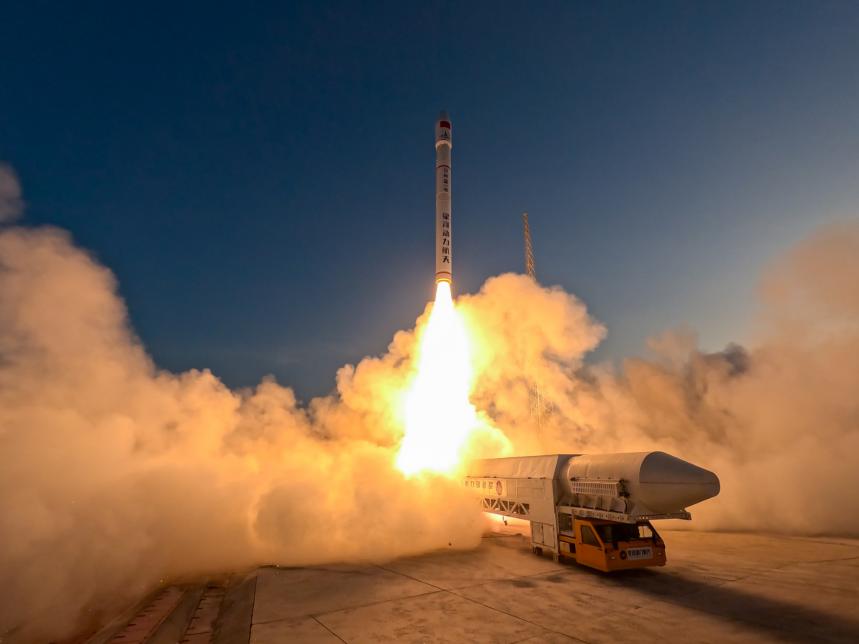
Launch picture of Ceres - 1, Source: Galaxy Space
The rocket that carried out this mission was the Ceres - 1 carrier rocket. Since its successful comeback on December 5, 2023, this model has achieved 11 consecutive successful launches. At this moment, it has become the private commercial carrier rocket with the most launches and the most successful launches in China.
The private aerospace company behind the Ceres - 1 has been called the "most competitive rocket company" in the private aerospace industry due to its stable and high - frequency launch achievements.
Its name is Galaxy Space.
Opportunity
If we trace back the commercial rocket competition that is taking place in China and around the world today, many clues will point to the same time point, 2002.
That year, after two failed attempts to purchase decommissioned intercontinental missiles from Moscow as launch vehicles, Elon Musk made a decision that seemed almost reckless at the time: instead of buying rockets, he would build them himself.
Thus, SpaceX was born.
But at that time, this decision was not regarded as a "business opportunity" but more like an overstepping behavior.
In the industry consensus at that time, rockets were never a business friendly to startups. A single launch failure often meant that years of investment would be wiped out instantly, and it could even directly end a company's credit and orders.
For this reason, the US aerospace industry was long dominated by military giants such as Boeing and Lockheed Martin. Later, in 2006, they merged to form the United Launch Alliance (ULA), which almost monopolized the US government's launch missions.
Their main rockets, such as the Atlas V and Delta IV, were reliable in performance but extremely expensive. The cost of a single launch generally ranged from 100 million to several hundred million US dollars, and some heavy - lift models were even more expensive. In such a system, rockets were more like "custom - made projects" rather than standardized products.
Elon Musk was not a traditional aerospace engineer. He was more like someone who entered the aerospace industry with a business intuition. He repeatedly emphasized a judgment that sounded unrealistic at the time -
Rockets should be reusable, just like airplanes.
His judgment later changed the entire industry.
After the establishment of SpaceX, with the repeated test flights, failures, and retests of the Falcon series of rockets, from the first successful recovery of the first - stage rocket to the continuous increase in launch frequency, commercial rockets gradually changed from "technological wonders" to "industrial tools".
By the late 2010s, SpaceX's commercial launch orders accounted for more than 60% of the global commercial orbital launch market, completely breaking the monopoly of traditional giants such as the United Launch Alliance (ULA). The US commercial launch market has since shifted to "market - based competition".
This change soon resonated across the ocean.
In China, the aerospace industry has long been dominated by the national team, focusing on national strategic tasks. The launch capabilities are stable, but commercial efficiency and cost control are not the primary goals.
But in November 2014, a turning point came.
That month, the State Council issued the "Guiding Opinions on Innovating the Investment and Financing Mechanisms in Key Areas to Encourage Social Investment" (commonly known as "Document No. 60"), which for the first time clearly encouraged private capital to participate in the construction of civil space infrastructure at the national level. Thus, the commercial aerospace industry saw a policy breakthrough.
Before that, the path of SpaceX to reduce costs and achieve large - scale launches through rocket recovery technology had been initially verified. The demand for low - orbit satellites was growing rapidly, and the frequency of commercial launches was continuously increasing. Launching was no longer just a "national project" but an industrial service that could be delivered according to contracts and settled by the number of launches.
Soon, changes began to appear in the Chinese market.
In 2015, the "Medium - and Long - Term Development Plan for the National Civil Space Infrastructure (2015 - 2025)" was released, clearly supporting private capital to invest in satellite research and development and system construction. The commercial aerospace industry in China began to truly heat up.
A number of private rocket companies with different backgrounds were established one after another.
Landspace, established in 2015, was founded by people from the financial field. However, the core team of its business line has long been deeply involved in liquid rocket and engine technology, aiming at higher carrying capacity and reusable paths.
Deep Blue Aerospace, established in 2016, was founded by a team from the aerospace research system. They have rich experience in liquid rocket design, engine technology, and vertical recovery technology. They integrate the industrial chain through a private - owned mechanism and focus on the path of low - cost reusable liquid rockets.
iSpace, also established in 2016, emphasizes capital efficiency, engineering rhythm, and commercial orders, and uses market logic to drive technological iteration.
Another aerospace engineer from the state - owned system founded Galaxy Space.
His name is Liu Baiqi.
Technical Experts
In the Hollywood movie "Apollo 13" released in 1995, there is a classic line:
Failure is not an option.
For a long time, this sentence was almost the common creed of engineers in the aerospace system. Safety, reliability, and zero errors were far more important than speed and scale.
The first half of Liu Baiqi's career unfolded within such a value system.
Liu Baiqi, born in 1978, graduated from the School of Transportation of Jilin University with a major in Vehicle and Transportation Engineering. Then, he went to Beijing to study at Beihang University, known as the "West Point" of the aerospace industry, for further education.
In 2008, the Beijing Olympics put the whole city in a rare spotlight. National narratives, technological confidence, and the emotions of the era converged in this year. The concept of "serving the country through aerospace" that had long been emphasized on the campus of Beihang University was given a more realistic background.
It was in this year that Liu Baiqi obtained his doctorate from Beihang University. He chose to stay at the university and engage in teaching and research work in the School of Instrumentation Science and Opto - electronics Engineering, serving as a supervisor for postgraduate students.
In the eyes of the outside world, this was a stable and respectable academic path: teaching, research, papers, and academic titles would all progress steadily along a well - proven track. But three years later, Liu Baiqi took the initiative to step out of this track.
In 2011, he left the university and joined the China Academy of Launch Vehicle Technology, devoting himself to the overall design of carrier rockets.
At this time, China's carrier rockets were entering a critical stage of high - intensity development. As the starting year of the "12th Five - Year Plan", aerospace launch missions were intensively carried out in this year. The number of launches reached a record high of more than 20 times throughout the year, and the China Academy of Launch Vehicle Technology undertook 17 of these launch missions, almost launching rockets on a monthly basis.
At such a tense and task - intensive time, entering the core system of China's carrier rockets not only enabled Liu Baiqi to move from relatively abstract theoretical research to real and complex engineering practice but also allowed him to have a deeper understanding of the real trade - offs between time, cost, and reliability in large - scale aerospace projects through systematic participation in rocket overall design, model development, and engineering coordination.
This experience of being deeply involved in the national rocket system later became the most core and scarce underlying logic and source of capabilities when he embarked on the business of commercial rocket startups.
Around 2015, when private rocket companies began to emerge in China, Liu Baiqi was also interested. But he didn't rush to enter the market. Instead, he chose a more restrained approach: continuously observing industry changes, systematically researching market demand, and repeatedly pondering a question - if he were to do it, where should he start and how could he go further.
Liu Baiqi clearly knew that rocket startups were not about individual heroism. It must rely on a team that truly understands engineering and can fight tough battles. Therefore, he decided to first find the right people, form a good team, and then establish the company after locking in the direction and path.
He first invited Liu Jianshe, his undergraduate classmate from the School of Transportation of Jilin University. Liu Jianshe joined the 11th Institute of the Sixth Academy of China Aerospace Science and Technology Corporation in 2003 and has long been involved in rocket research and development. He is a senior expert in the domestic rocket field.
Meanwhile, Xia Dongkun, Cheng Shengqing and others also joined one after another. Without exception, these partners all have solid academic backgrounds and long - term front - line engineering or industrial experience.
After completing the team building and direction demonstration, in 2018, Liu Baiqi believed that the time was ripe. He officially left the state - owned system and founded Galaxy Space in Yizhuang, Beijing.
Perhaps none of the players who had already entered the market at that time expected that the entry of this "technical expert" team would completely rewrite the rhythm of private rocket launches.
The Most Competitive One
"Galaxy Space's business model is to use the rockets it has developed to send customers' satellites into space and then charge launch service fees, freight, etc."
On July 15 last year, Liu Baiqi introduced the company in a very simple sentence at a press conference for Chinese and foreign journalists held by the State Council Information Office under the theme of "Strivers on the New Journey":
"You can also think of Galaxy Space as a company that 'delivers express' to space."
At the beginning of its startup, Galaxy Space established a relatively restrained but practical development path - "start small and support development through actual operations". The company did not bet on liquid rockets with the highest technical difficulty and longest cycle at the beginning. Instead, it chose to enter the market with small solid rockets with controllable investment and relatively mature technical routes, and then challenge high - difficulty goals.
The path is to provide launch services for micro - satellites through the Ceres series, polish the engineering system and accumulate launch experience in real - world missions, and strive for a stable cash - flow foundation. Then, it will promote the research and development of high - reliability, recyclable, and low - cost liquid rockets, namely the Pallas series, aiming at the high - cost and low - efficiency problems in space launches.
Under this strategy, the Ceres - 1 has become the representative product of Galaxy Space that has completed the engineering and commercial closed - loop earliest. Since 2020, this small solid rocket, about 20 meters long and 1.4 meters in diameter, has repeatedly broken records of domestic private rockets:
On November 7, 2020, the Ceres - 1 (Yao 1) successfully made its maiden flight at the Jiuquan Satellite Launch Center, becoming the first carrier rocket of a Chinese private enterprise to send commercial satellites into a 500 - kilometer sun - synchronous orbit;
On December 7, 2021, the Ceres - 1 (Yao 2) launched five satellites at once, completing the first multi - satellite commercial launch of a domestic private rocket;
On September 5, 2023, the sea - launched version of the Ceres - 1 successfully took off near Haiyang, Shandong, completing the first sea - based launch of a Chinese private rocket company.
By September 2025, the Ceres - 1 had successfully completed as many as 20 commercial launches.
Even though not all of its launches were successful, and it experienced two launch failures in September 2023 and November 2025, the 20 successful launches still made Galaxy Space the private rocket company in China with the highest launch frequency, the most aggressive engineering rhythm, and the first to establish stable engineering performance capabilities.
It is truly the "most competitive one" among private rocket companies.
Leap
Although it did not enter the market very early, Galaxy Space has continuously attracted high attention from the capital market.
Since its establishment, the company's financing rhythm has almost advanced in tandem with its engineering progress. In 2019, it completed a 100 - million - yuan "Angel +" round of financing, and in 2020, it completed a 200 - million - yuan Series A financing.
With the continuous implementation and success of the launch missions of its core product, the Ceres - 1, the financing scale of Galaxy Space further expanded. In September 2025, the company completed a Series D financing of up to 2.4 billion yuan, breaking the record for the single - round financing amount of domestic private rocket enterprises.
This financing scale is second only to the 6.7 - billion - yuan financing of state - controlled Yuanxin Satellite in 2024, becoming the second - highest single - round financing case in China's commercial aerospace field, highlighting the trend of concentrated investment by capital in leading private rocket enterprises.
On October 22, 2025, the official website of the China Securities Regulatory Commission released an announcement showing that Galaxy Space had officially submitted an IPO guidance filing to the Beijing Securities Regulatory Bureau. So far, together with companies such as Tianbing Technology, Landspace, iSpace, and CAS Space, it has stood on the starting line for the "first private rocket stock".
Two months later, on December 26, the Shanghai Stock Exchange issued the "Guidelines for the Application of the Rules for the Review of Issuance and Listing on the Shanghai Stock Exchange No. 9 - Application of the Fifth Set of Listing Standards on the Science and Technology Innovation Board for Commercial Rocket Enterprises", clearly providing institutional support for the listing of commercial aerospace enterprises. The field of commercial rockets, which was once highly engineering - oriented and far from the capital market for a long time, has begun to be incorporated into a clearer and more predictable institutional framework.
Liu Baiqi is never in a hurry to label Galaxy Space as "successful". However, time and repeated launches have already given a judgment. It is steadily moving forward on the right track.
Yuval Noah Harari, an Israeli historian, put forward an important view in his book "Sapiens: A Brief History of Humankind": The real power of human beings does not come from the muscles or wisdom of individuals, but from the ability to complete large - scale cooperation across blood relations and direct interests around a commonly - believed goal.
Aerospace is one of the most extreme and demanding manifestations of this cooperation ability.
It requires compressing knowledge, engineering, capital, organization, and patience into each launch. There is no buffer zone for failure, and success never comes by chance.
From basic research and rocket overall design in the state - owned system to the engineering delivery of commercial rockets, Liu Baiqi and his team are not subverting aerospace itself. Instead, they are participating in verifying a more realistic thing:
When rockets are no longer just "national projects" but gradually become industrial products that can be delivered, audited, and reviewed, China's commercial aerospace industry will truly stand at a new historical juncture.
This article is from the WeChat official account "Business Strategy Review" (ID: hstl8888