BYD surpassed Tesla for the first time in a full year, and the global throne of pure electric vehicles has changed hands.
After 2025, the champion of global pure - electric vehicle sales was announced, but it wasn't Tesla.
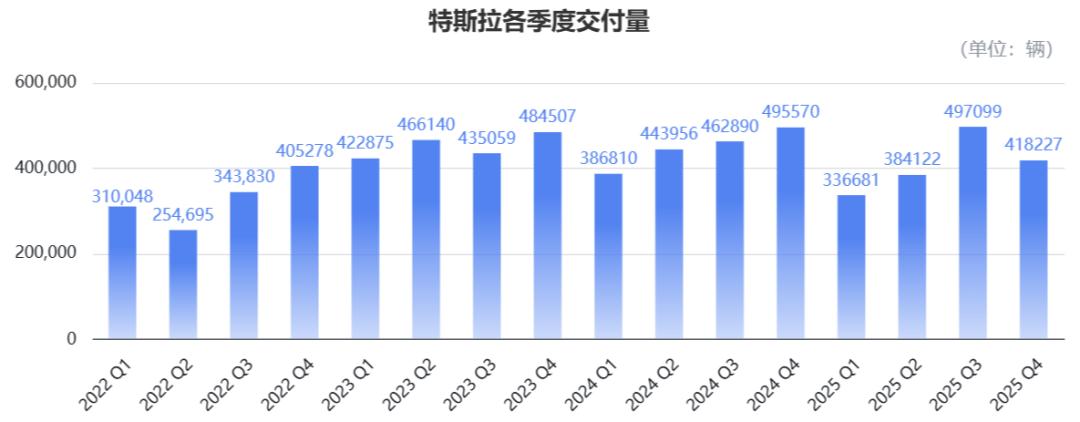
This automaker, which had won the global pure - electric vehicle sales championship for three consecutive years, has just announced its vehicle sales for the fourth quarter and the whole year:
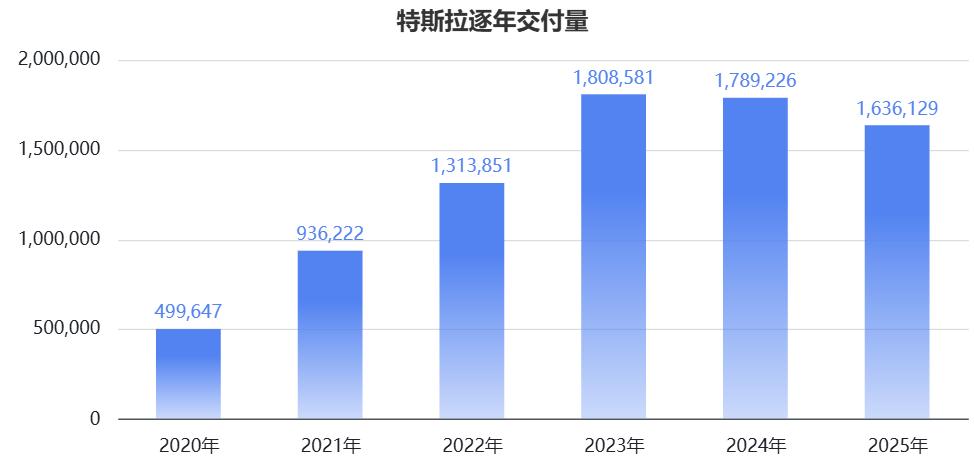
In 2025, the sales volume was 1.636 million vehicles, a year - on - year decrease of 8.6%. That is to say, the downward trend that started in 2024 still couldn't be stopped.
As one thing declines, another rises. A new global champion of pure - electric vehicle sales was born. Who is it?
It's the Chinese automaker that Elon Musk said "didn't count as a competitor" 14 years ago, BYD.
Standing at the starting point of the new year, we have also sorted out the development context of Chinese automakers from the sales competition pattern of the past year.
Tesla cedes the global pure - electric vehicle sales championship, and BYD takes the crown
At the beginning of the new year, various lists for 2025 were released. One of the most significant conclusions in the automotive circle was probably the change of the throne in the global pure - electric vehicle market:
Tesla's three - year streak as the global champion of pure - electric vehicle sales was broken, and the new champion is BYD.
Let's first look at the most core figures.
In the fourth quarter of 2025, Tesla delivered 418,227 vehicles, a year - on - year decline of 16%. Among them, there were 406,585 Model 3/Y and 11,642 other models.
This "other models" refers to Model X/S and Cybertruck.
The outside world was not surprised by Tesla's Q4 sales decline.
Because the US tax credit policy expired in September 2025, and after that, buying a new car would cost an additional $7,500 (about 52,000 yuan).
Many consumers chose to buy cars before the policy phased out. As a result, Tesla set a record high in deliveries in the third quarter, with sales surging 29% quarter - on - quarter to 497,000 vehicles, actually overdrawing the fourth - quarter sales.
Actually, a few days before the sales were announced, Tesla very rarely released a summary of the forecasts of 20 analysts on its official website.
The average forecast for Tesla's Q4 sales was 422,850 vehicles, a 15% decline compared with the same period in 2024.
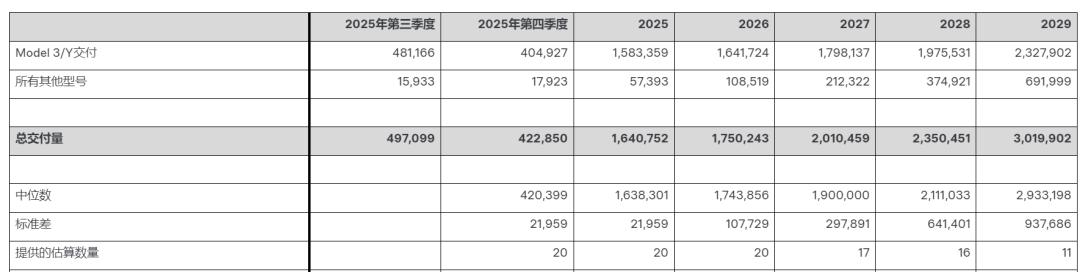
Although Tesla stated in the document at that time that "it did not recognize any information, suggestions or conclusions provided by the analysts", the actually announced sales volume was more than 4,000 vehicles less than the analysts' average expectation.
Looking at the annual cumulative sales, Tesla's global sales in 2025 were 1.655 million vehicles, a year - on - year decline of 9%. Among them, there were 1.6 million Model Y/3 and 53,900 other models.
In terms of the trend, this was already the second consecutive year of annual sales decline for Tesla. Its peak sales were 1.8086 million vehicles in 2023, and it had been the world's number one in pure - electric vehicle sales for three consecutive years by 2024.
The reason for this year's decline was, of course, not just the phasing out of the policy in the US market. Tesla's sales also showed signs of fatigue in the European and Chinese markets.
Tesla's most successful product combination in the past few years - the once - invincible Model 3 and Model Y - was under obvious pressure in 2025. Their past outstanding advantages have now been shaken under the siege of Chinese electric vehicles.
Tesla launched the "Standard Edition" of Model Y and Model 3 in October, with prices about $5,000 (about 35,000 yuan) lower than the previous basic models, hoping to maintain sales.
However, contrary to expectations, the new cars' effect on boosting sales was less than expected. The outside world hoped that the prices could be lowered further or a new mass - market model could be launched.
While Tesla's sales were declining, on the other side of the earth, with BYD's soaring sales, a new global pure - electric "king" was on the horizon.
BYD's production and sales report for December showed that the company's new - energy vehicle sales in 2025 were 4.6 million vehicles, a year - on - year increase of 7.73%.
Among them, the annual sales of pure - electric models were 2.257 million vehicles, a year - on - year increase of 27.9%, accounting for 49% of the total sales, almost half.
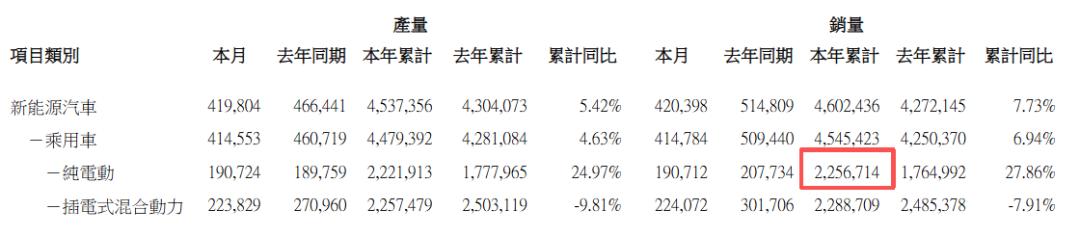
BYD had previously surpassed Tesla in pure - electric vehicle sales in single quarters many times. This was the first time that its annual pure - electric vehicle sales topped the global list, far exceeding Tesla's 1.636 million vehicles.
Maybe Elon Musk 14 years ago could never have imagined this situation -
In 2011, when Elon Musk was interviewed by the media, he laughed and said that "he didn't think BYD was a competitor".
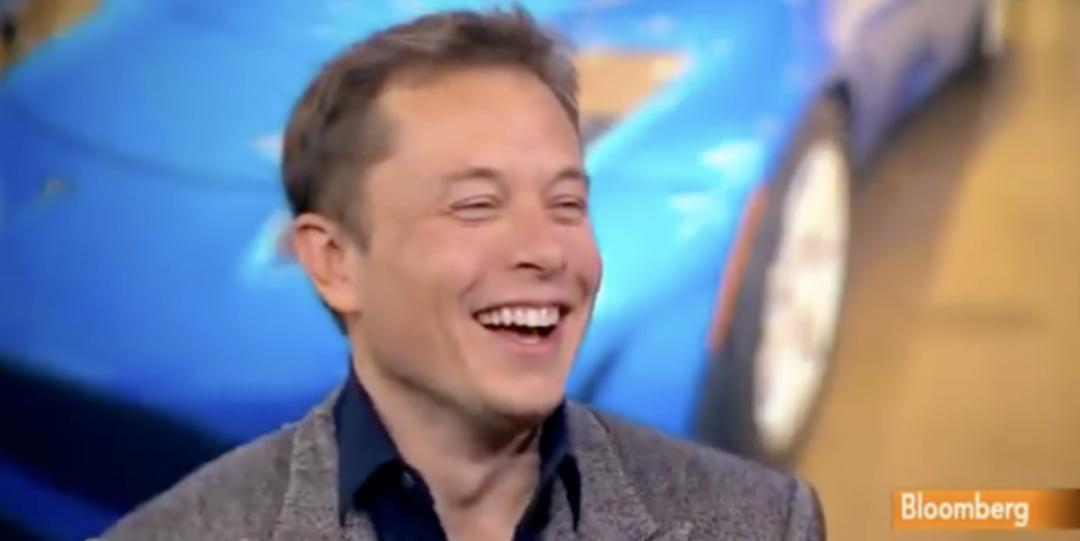
But by 2023, Musk's attitude had completely reversed.
Some netizens reposted that 2011 video on the social platform X. Musk left a message in response: "That was a long time ago. Their cars are now highly competitive."
However, if we only focus on these two companies, we actually underestimate the breadth of the competition.
The pressure brought by Chinese automakers to the automotive circle can't be hidden after all.
December sales list released. How competitive are Chinese automakers?
With the release of the sales data for the last month, the competition pattern in the domestic automotive circle in 2025 has become completely clear.
Based on the announced annual sales of 14 automakers/brands in 2025, we can summarize and draw ten conclusions to serve as a reference for the new trend at the new node:
In the horizontal comparison of 2025 sales, XPeng has the highest year - on - year growth rate
Affected by the phasing out of policies, the outside world didn't feel the "end - of - year surge effect" as strongly as in previous years, and the sales in the fourth quarter slowed down.
However, the annual sales of most automakers still increased year - on - year.
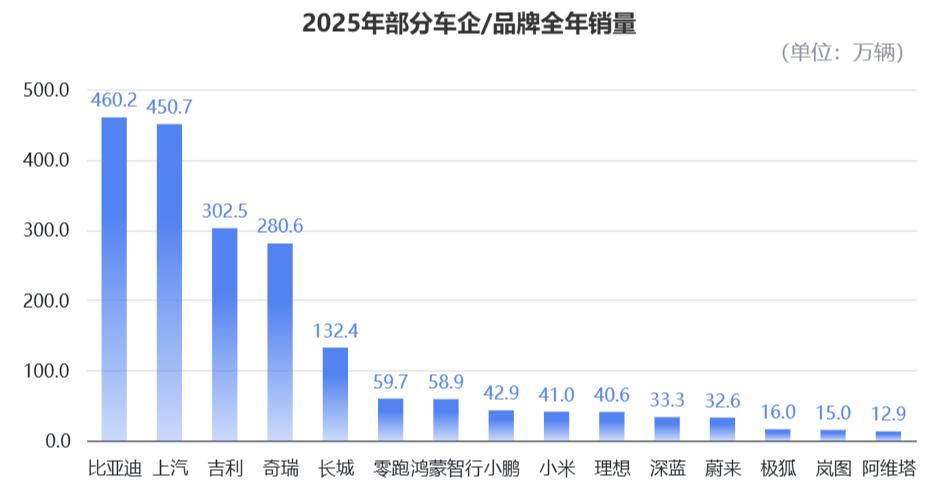
The highest sales growth rate was achieved by XPeng. Its sales in 2025 were 429,000 vehicles, a year - on - year increase of 125.9%.
Among the leading new - force automakers, only Li Auto experienced a year - on - year decline due to the transformation. Its sales in 2025 were 406,000 vehicles, a year - on - year decline of 18.8%.
10 automakers announced their annual sales targets, and 6 exceeded them
Among these automakers, a total of 10 automakers clearly announced their annual sales targets for 2025.
And 6 of them finally achieved their annual sales targets, namely BYD, SAIC, Geely, Leapmotor, XPeng, and Xiaomi Auto.
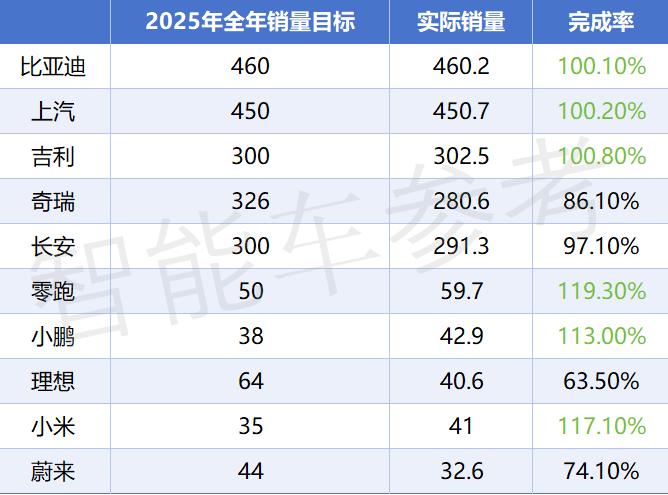
Among them, Leapmotor and Xiaomi Auto were the most ahead of schedule. Leapmotor exceeded its target by 19%, and Xiaomi exceeded it by 17%.
BYD and SAIC compete for the first place in domestic automobile sales
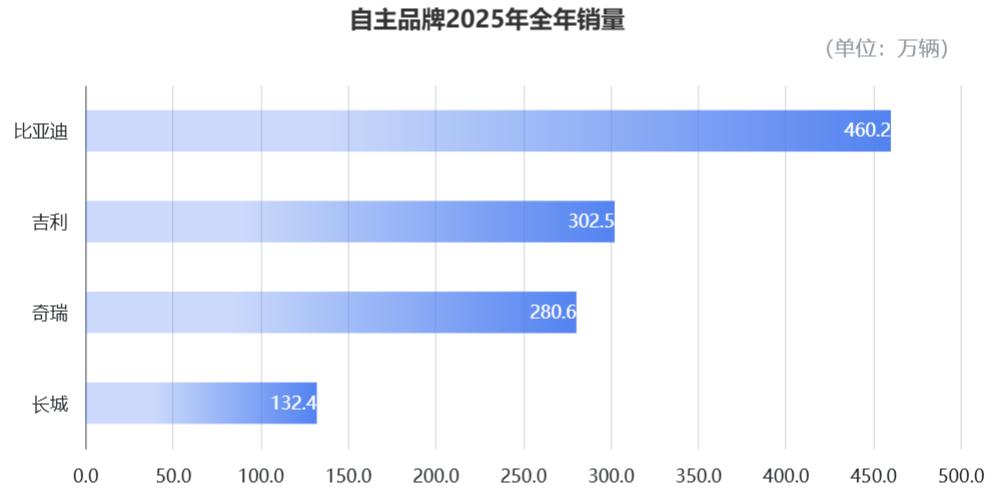
The throne of the first place in sales belongs to BYD. Its annual sales reached 4.6 million vehicles, a year - on - year increase of 7.7%. Among them, the Dynasty/Ocean networks, the main contributors, contributed a total of 4.1052 million vehicles.
Moreover, its overseas sales for the whole year were 1.0496 million vehicles, a year - on - year surge of 145%, and the proportion in the total sales increased to 22.8%.
Another competitor for the "king" throne, SAIC, sold 4.507 million complete vehicles throughout the year, a year - on - year increase of 12.3%.
However, if we count the terminal retail sales, SAIC's delivery volume was 4.67 million vehicles, which was also leading in the industry.
Geely and Chery compete, and Great Wall grows steadily
Among the leading self - owned brands, in addition to BYD, Geely, Chery, and Great Wall are also growing.
Geely's annual sales exceeded 3.02 million vehicles, a year - on - year increase of 12.7%. Chery achieved 2.806 million vehicles in the whole year, a year - on - year increase of 7.8%.
On an annual basis, there was a gap of 220,000 vehicles between them. However, on a monthly sales basis, Chery and Geely surpassed each other many times, and the gap was narrowing.
Great Wall Motors' annual sales were 1.324 million vehicles, a year - on - year increase of 7.3%.
The new - energy and overseas markets have become Great Wall's growth engines. The new - energy vehicles sold 403,700 vehicles throughout the year, a year - on - year increase of 25.44%, accounting for 30.5% of the total sales. The overseas sales were 506,100 vehicles, a year - on - year increase of 11.68%, setting a new record.
Leapmotor and HarmonyOS Smart Mobility compete for a new sales record among new - force automakers
In 2025, the champion among new - force automakers was undoubtedly Leapmotor. Its annual sales were 596,000 vehicles, a 42% increase year - on - year, breaking the annual sales record of new - force automakers. In 2026, it will strive for 1 million vehicles in sales.
The annual sales of HarmonyOS Smart Mobility's entire series were 589,000 vehicles, trailing Leapmotor by a narrow margin of less than 8,000 vehicles.
Specifically in December, Leapmotor's sales were 60,423 vehicles. HarmonyOS Smart Mobility's entire series delivered 89,611 vehicles, and the sales of AITO were 57,778 vehicles.
Who will be the champion among new - force brands in 2026 may still have new variables.
Xiaomi's monthly sales exceed XPeng's, and both exceed 400,000 vehicles in annual sales
Xiaomi Auto ranked third among new - force automakers in December, with monthly sales exceeding 50,000 vehicles for the first time.
After the launch of the YU7 in June, the delivery volume exceeded 150,000 vehicles, and it topped the sales list of mid - to large - sized SUVs for four consecutive months.
XPeng's sales in December were 37,508 vehicles, a 2% year - on - year increase. Its major move was the upcoming release of the 2026 XPeng P7+ and G7 in January this year.
The annual sales of both automakers have exceeded 400,000 vehicles. XPeng and Xiaomi's sales were 429,000 vehicles and over 410,00