Lei Jun disassembled a car during a live stream, directly addressing doubts about "fine print marketing" and the "green belt warrior" claim.
On January 3rd, Lei Jun, the founder, chairman, and CEO of Xiaomi, held his first live - stream of the new year. During this live - stream, Xiaomi engineers disassembled a standard version of the Xiaomi SU7 on - site. When talking about the reason for disassembling the car, Lei Jun said, "Some bloggers commented that 'the SU7 is Xiaomi's first car. Lei Jun surely knew it would be disassembled by others, so the materials used are particularly solid. But it may not be the case for the second car'."
The entire live - stream lasted for 4 hours. During the live - stream, Lei Jun and Xiaomi's automotive engineers provided detailed explanations on the product features of the Xiaomi SU7, such as the headlight design, body color, zero - gravity seat design, noise - reduction function, three - electric system design, and assisted driving function.
The Xiaomi SU7 is Xiaomi's second new car. Three minutes after its launch, the number of large - amount pre - orders exceeded 200,000, and within one hour, it exceeded 289,000. On January 1st, Lei Jun revealed that six months after the launch of the Xiaomi SU7, the number of delivered vehicles had exceeded 150,000, which was 2.3 times that of the SU7 during the same period.
During the live - stream on January 3rd, Lei Jun introduced that the cumulative delivery volume of Xiaomi cars in 2025 exceeded 410,000. "The annual task we set at the beginning of 2025 was to deliver 300,000 vehicles. Later, as the progress was smooth, we raised the target to 350,000, and finally, we achieved a delivery volume of over 410,000."
While the delivery volume was rising, Xiaomi, a new player in the automotive industry, also experienced a "duet of ice and fire" in terms of sales and popularity in the past year.
During the last hour of the live - stream, Lei Jun and his team gave a unified response to seven controversial topics about Xiaomi cars since last year, such as "the Green Belt God of War", "fine - print marketing", and "charging only once for a 1300 - kilometer journey". Lei Jun said that the sudden influx of doubts in the past half - year had left them a bit dazed. The out - of - context and malicious criticism had really cast a large psychological shadow on him.
Regarding the new plan for 2026, Xiaomi has set the delivery target for its cars at 550,000 this year.
Lei Jun Himself Tried to Lift the Car Hood
During the live - stream, Lei Jun not only tried to lift the hood of the SU7 with his own hands. Taking advantage of the live - stream car disassembly, Lei Jun also responded to topics that users were concerned about, such as the tail - wagging issue, the strategy of sacrificing wheels to protect the car, and the performance of the A - pillar of Xiaomi cars.
The Xiaomi automotive team introduced during the live - stream that in terms of the braking system, all models of the SU7 are equipped with relatively expensive fixed calipers. They also said that "fixed calipers generate greater braking force" and "fixed calipers are relatively high - end". The Xiaomi automotive team introduced that the vehicle's braking system includes a four - layer redundant system consisting of the brake pedal, ESP, DPB, and kinetic energy recovery.
Li Xiaoshuang, the vice - president of Xiaomi Auto, said, "We have also noticed occasional tail - wagging situations on the Internet. A certain proportion of the reasons is that the ESP (Electronic Stability Program) was turned off. Additionally, on slippery roads, the adhesion between the tires and the ground is relatively low. Electric vehicles have high horsepower. When you step on the accelerator hard and turn the steering wheel sharply, it is easy for the vehicle to skid. Therefore, we have specifically launched a slippery - road mode, where the ESP can intervene more strongly and earlier."
Lei Jun also added, "We suggest that everyone should not turn off the ESP on public roads. If you want to experience the driving control without ESP, we recommend that you go to a racetrack or participate in a driving experience course. Otherwise, it is easy to cause the vehicle to tail - wag."
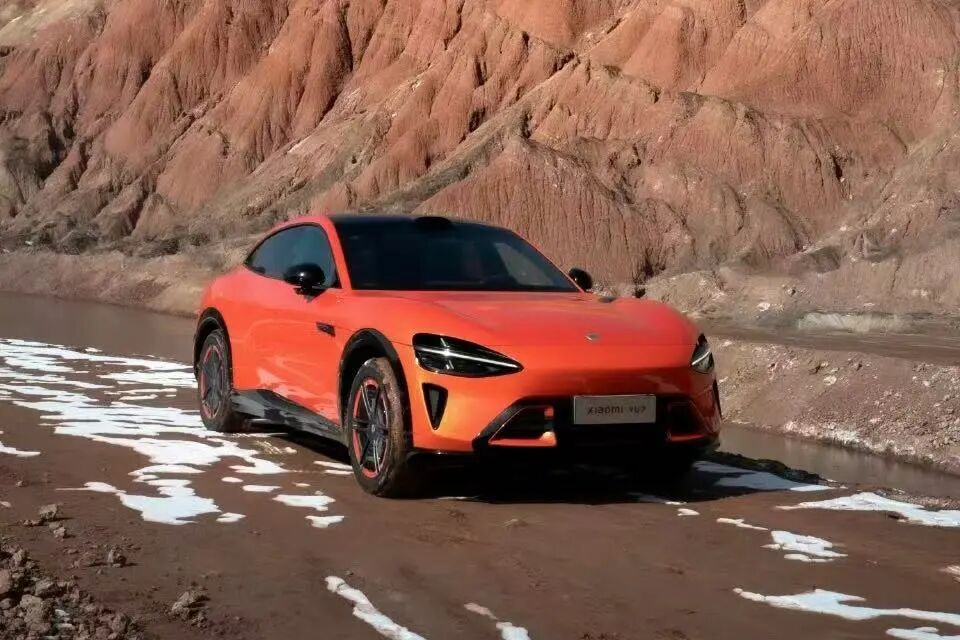
Image source: Xiaomi Auto
In terms of assisted driving, Li Xiaoshuang introduced that in November 2025, Xiaomi Auto released the enhanced version of HAD, which introduced reinforcement learning and world models. This brought three improvements in the driving experience: First, the acceleration and braking of the car in the assisted - driving state will be more human - like; Second, lane - changing and detouring scenarios will be more decisive and smooth; Third, there is an upgrade in the active safety ability. Whether in manual driving or assisted - driving mode, active safety will be guaranteed. In addition, based on the AEB (Autonomous Emergency Braking), the enhanced version has launched the AES (Emergency Steering Assist). When a collision cannot be avoided and the surrounding environment is safe, the vehicle will automatically trigger a lane change to avoid risks.
Lei Jun emphasized that no matter how advanced the assisted - driving technology is, everyone must pay attention to safe driving, and manual driving is very important.
During the live - stream, Xiaomi Auto also showed a test video of the SU7's 25% offset collision. After hitting an obstacle, the car body bounced to the left, and the wheels were thrown out. Lei Jun said that some people thought that the wheels of Xiaomi cars fell off after a collision, but in fact, it is a strategy of "sacrificing wheels to protect the car, using minimal effort to achieve maximum results". "Many consumers don't understand the strategy of sacrificing wheels to protect the car. In fact, this is our safety strategy. If someone on the Internet criticizes us for this again, please help us explain."
Xiaomi's automotive engineers said that during a 25% offset collision, the longitudinal beams of the car absorb relatively little energy, and most of the force is directed towards the A - pillar. Without a good strategy in this process, the A - pillar will bear a large amount of force. Xiaomi's strategy is to make the car body slide away as much as possible. By the time it reaches the A - pillar, the car has already shifted, achieving the effect of using minimal effort to achieve maximum results. For this reason, the cross - beams and sub - frames of the Xiaomi SU7 have a side angle, and the impact force will push the car outward. In addition, the wheels will rotate and be thrown out during a collision to avoid moving into the car.
Xiaomi Auto also showed the 2200 - megapascal embedded roll - cage in the A - pillar. In response to the widespread discussion caused by the "2200MPa Xiaomi Super - strong Steel" being marked as a "project name" in small print, Li Xiaoshuang responded, "It is indeed an advanced material jointly developed by us and the team of Academician Wang Guodong. It is one of the highest - strength materials currently used in mass - produced cars. The 2200MPa super - strong steel is genuine."
Lei Jun said, "I don't understand why there have suddenly been all kinds of doubts. Everyone is welcome to disassemble our cars. If needed, we can also provide samples."
Fine - print Marketing Is an Industry Bad Habit
During the live - stream, Lei Jun said that this car disassembly was to respond to various questions about Xiaomi cars on the Internet in the past period. Xiaomi responded very little in the past because it believed that good products would speak for themselves, and the innocent would be cleared without constant self - justification. However, recently, many Xiaomi fans suggested that they should respond actively and in a timely manner.
"The sudden influx of doubts in the past half - year left us a bit dazed," Lei Jun said. During the last hour of the live - stream, Lei Jun, Li Xiaoshuang, and Xu Jieyun, the special assistant to the chairman of Xiaomi Group and the deputy general manager of the Strategic Marketing Department, gave a unified response to the topics that Xiaomi cars had been attracting attention and facing doubts recently.
Regarding 'the Green Belt God of War'
Xu Jieyun said, "To a large extent, some people deliberately collected these videos, maliciously edited them, and then labeled them as 'the Green Belt God of War' and promoted them everywhere. What made us most indignant was that our car owners were subjected to personal attacks from many mysterious accounts. The Xiaomi car owners' community and the legal department joined hands to support the car owners in collecting evidence and filing lawsuits."
Lei Jun said that scolding Xiaomi can indeed attract traffic, but one must be objective and not deliberately smear or take things out of context. Xiaomi attaches great importance to the voices of real users. If the comments are correct and objective, Xiaomi is very willing to accept and make corrections.
Regarding 'Closing the Comment Section'
Previously, the comment sections of some platforms were closed during the Xiaomi 17 Ultra press conference. Xu Jieyun said that this was actually to prevent the overwhelming attack of trolls, which would affect the experience of normal users.
Regarding 'Charging Only Once for a 1300 - Kilometer Journey'
Xu Jieyun said that this was a misrepresentation of a statement Lei Jun made during a live - stream.
Lei Jun explained, "Actually, this matter is very simple. I have participated in many long - distance tests from Beijing to Shanghai. We wanted to challenge whether the standard version of the SU7 (with a CLTC range of 835 kilometers) could complete a 1300 - kilometer journey with only one charge." He also popularized the knowledge that the CLTC range is the range under standard working conditions, and this range will be reduced in scenarios such as high - speed driving and winter. In this case, whether it is possible to complete the journey from Beijing to Shanghai with only one charge in winter is actually a huge challenge.
"I've seen several peers use the expression of 'charging only once for a certain number of kilometers'. Why is it that when I talk about a real test with a complete video as evidence, it is criticized as excessive or false promotion? I hope that when netizens see such information, they can help us report it. This is clearly the work of malicious trolls trying to smear us," Lei Jun said.
Regarding 'Instant Braking from 200 km/h'
Xu Jieyun said that when Xiaomi shot this video, it actually wanted to show the braking performance of the carbon - ceramic brake discs of the Xiaomi SU7 Ultra. The statement of "instant braking from 200 km/h" was a comment Lei Jun made after the actual test.
Xu Jieyun also gave an analogy, saying that some people might say "watching a dozen episodes of a TV series in one go". So how long is "one go"? If such expressions are constantly nit - picked and exaggerated into false promotion, is there a problem?
Lei Jun frankly said that the out - of - context and malicious criticism had really cast a large psychological shadow on him, and he had to double - check every word he said. For this live - stream, he prepared a thick note, and he almost wanted to just read from the script. He also asked everyone if they really wanted to see such a Lei Jun. Do they want Lei Jun to just read from the script in the future?
Regarding '7000 Lawyers'
Xiaomi said that there are not 7000 lawyers in Xiaomi, and they hope to strengthen the construction of the legal team in the new year.
Regarding 'Xiaomi Preventing Farmers from Selling Millet'
Xu Jieyun said that this is completely a result of misleading and distorting information, creating an online public opinion crisis. Xiaomi Corporation has nothing to do with millet as a grain. "We definitely have no such motivation or ability to prevent farmers from selling millet."
Regarding 'Fine - print Marketing'
Xu Jieyun said bluntly that objectively speaking, it has long been an industry practice to add fine - print annotations to promotional materials such as posters and PPTs. The main consideration was to comply with the advertising law, but in the process, the feelings of the public were indeed ignored. As a result, there were some cases that were criticized, such as the claim of "Xiaomi 17 Pro, the King of Backlight Photography". After adding fine - print annotations, it was compliant, but it did seem like an intentional exaggeration. The same goes for the aforementioned Xiaomi super - strong steel. "We have heard your criticism. Since November last year, we have required the Xiaomi team to use large - print text in explanations and annotations, presenting them openly so that users can see clearly."
Lei Jun said that using fine - print text is indeed an industry bad habit, and Xiaomi will start to change it immediately. However, misinterpreting the practice of using fine - print annotations to comply with the advertising law as false promotion or excessive marketing by Xiaomi is a huge misunderstanding of Xiaomi.
At the end of the live - stream, Lei Jun revealed that the annual delivery target for Xiaomi cars in 2026 is 550,000, and the cumulative delivery volume in 2025 exceeded 410,000. Lei Jun also said that he hopes to achieve better results than this target by the next New Year's Eve.
This article is from the WeChat official account "Time Finance APP" (ID: tf - app), written by He Qing, and is reprinted by 36Kr with authorization.