More than 10 cases: The track favored by L'Oréal remains hot.
Amid the general slowdown of the global beauty market and the impact of geopolitics, L'Oréal acquired Creed, a top - tier salon fragrance brand under the Kering Group, for a sky - high price of 4 billion euros (approximately 32.82 billion yuan), revealing the most certain bet direction of the giants for the future.
In addition, in 2025, LVMH took a stake in BDK Parfums, and Estée Lauder made its first investment in a Mexican brand, XINÚ, in Latin America.
Behind the intensive layout actions of leading enterprises, on the one hand, it not only reshapes the competitive landscape of the global perfume market but also highlights the strong growth resilience of this category in the consumer wave.
On the other hand, in the corporate chessboard, perfume has been upgraded from an add - on category to a strategic stronghold for market competition. The competition logic is shifting from a stock game to the exploration of new growth.

Under the slowing growth, is niche high - end perfume the next breakout point?
Currently, although the perfume - related businesses from raw material suppliers to brand owners are still in a growth trend, the growth rate has significantly slowed down. Meanwhile, it is worth noting that "high - endization" has become the key engine to resist cyclical fluctuations, contributing the most certain growth in the financial reports of giants.
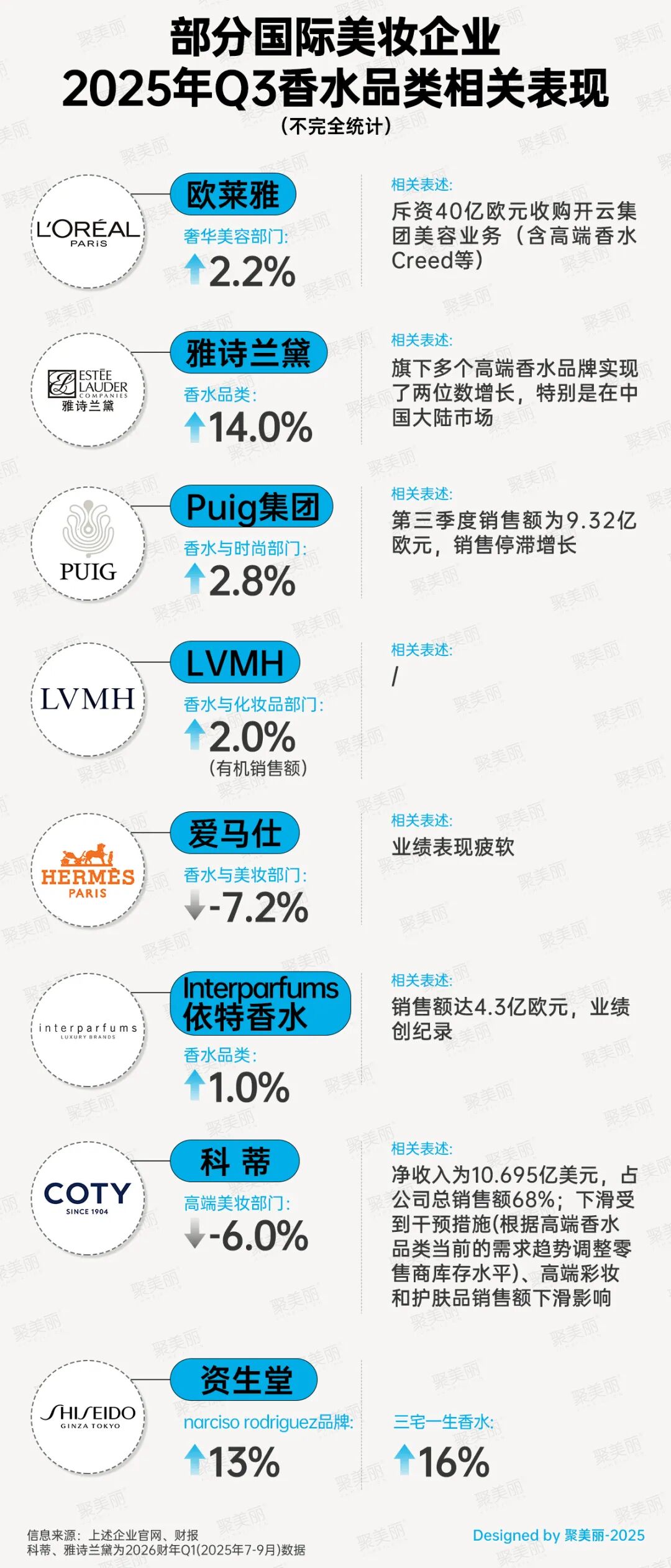
As shown in the following figure, compared with before, Hermès and Coty, whose perfume businesses used to boost their performance, saw a year - on - year decline of 7.2% and 6% respectively in the third quarter of this year, in sharp contrast to the 9.3% increase in 2024. At the same time, the perfume business growth of L'Oréal, Puig, etc. also did not exceed 3%, indicating a significant weakening of growth momentum.
Even so, many enterprises said that their high - end perfume brands achieved considerable growth, becoming highlights of their performance. Among the strategic brands of the Shiseido Group's Next5, the perfume brands Issey Miyake and Narciso Rodriguez increased by 16% and 13% year - on - year respectively. Estée Lauder also clearly pointed out in its financial report that many of its high - end perfume brands even achieved double - digit growth.
This is verified in the upstream of the industrial chain. Compared with the previous double - digit growth, international fragrance and flavor giants generally showed weakness in the first three quarters of 2025. Except for the slight increase in sales of Givaudan and IFF, DSM - Firmenich and Symrise declined year - on - year.
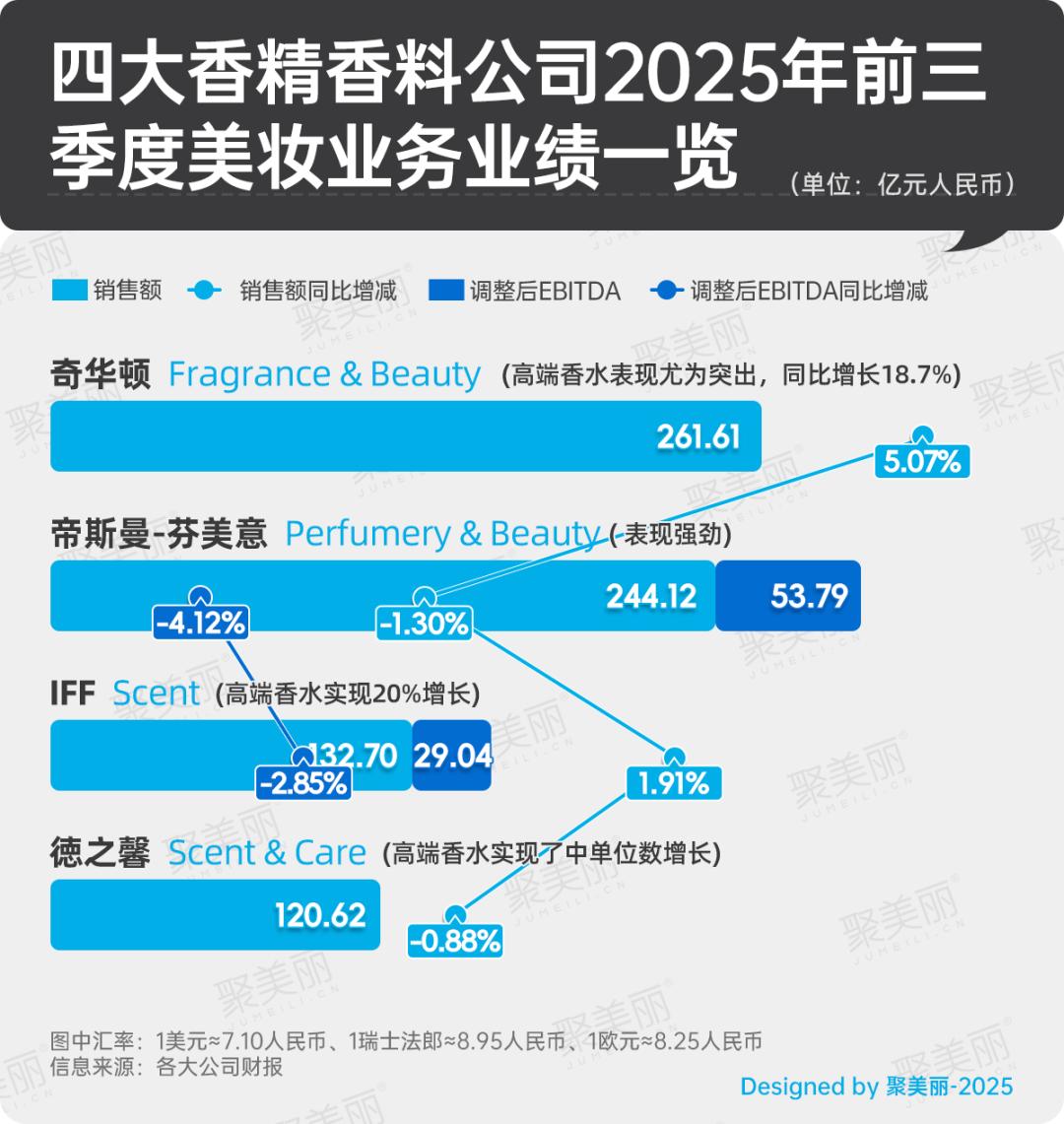
However, focusing on the high - end perfume raw material business, Givaudan increased by 18.7% year - on - year.
It can be seen that high - end perfume has stronger anti - cyclical ability and market attractiveness, which also provides clear guidance for the strategic layout of international beauty enterprises. In order to restart the growth engine, enterprises have increased their investment in perfume and focused their investment on this niche segment with still room for growth.
Led by L'Oréal, the perfume track remains hot!
Despite facing macro - level pressures, the global perfume market has a promising future. According to relevant data from Mordor Intelligence, the fragrance market was worth 76.71 billion US dollars (approximately 540.5 billion yuan) in 2025 and is expected to reach 112.46 billion US dollars (approximately 792.4 billion yuan) by 2030, with a compound annual growth rate of 7.95% during the forecast period.
Against this broad prospect, international beauty groups and upstream suppliers have accelerated their layout.
In 2025, there were over 10 investments in perfume and fragrance
In 2025, industrial capital represented by L'Oréal, Estée Lauder, and LVMH was particularly active. According to an incomplete statistics by Jumeili, there were more than ten investments and acquisitions of perfume brands globally. Among them, equity investment became the mainstream method, indicating that capital aims to establish long - term and in - depth strategic partnerships rather than simple financial investments.
Among them, L'Oréal's layout was the most coherent and aggressive. It successively invested in two high - end perfume brands within a month and also obtained the operation rights of the beauty and perfume of a fashion brand, quickly supplementing its high - end portfolio.
Subsequently, in October, through a historic cooperation with the Kering Group, L'Oréal brought Creed, a representative of high - end niche fragrances with a history of over 200 years, under its wing. This deal marked the ultimate layout of L'Oréal in the niche perfume field.
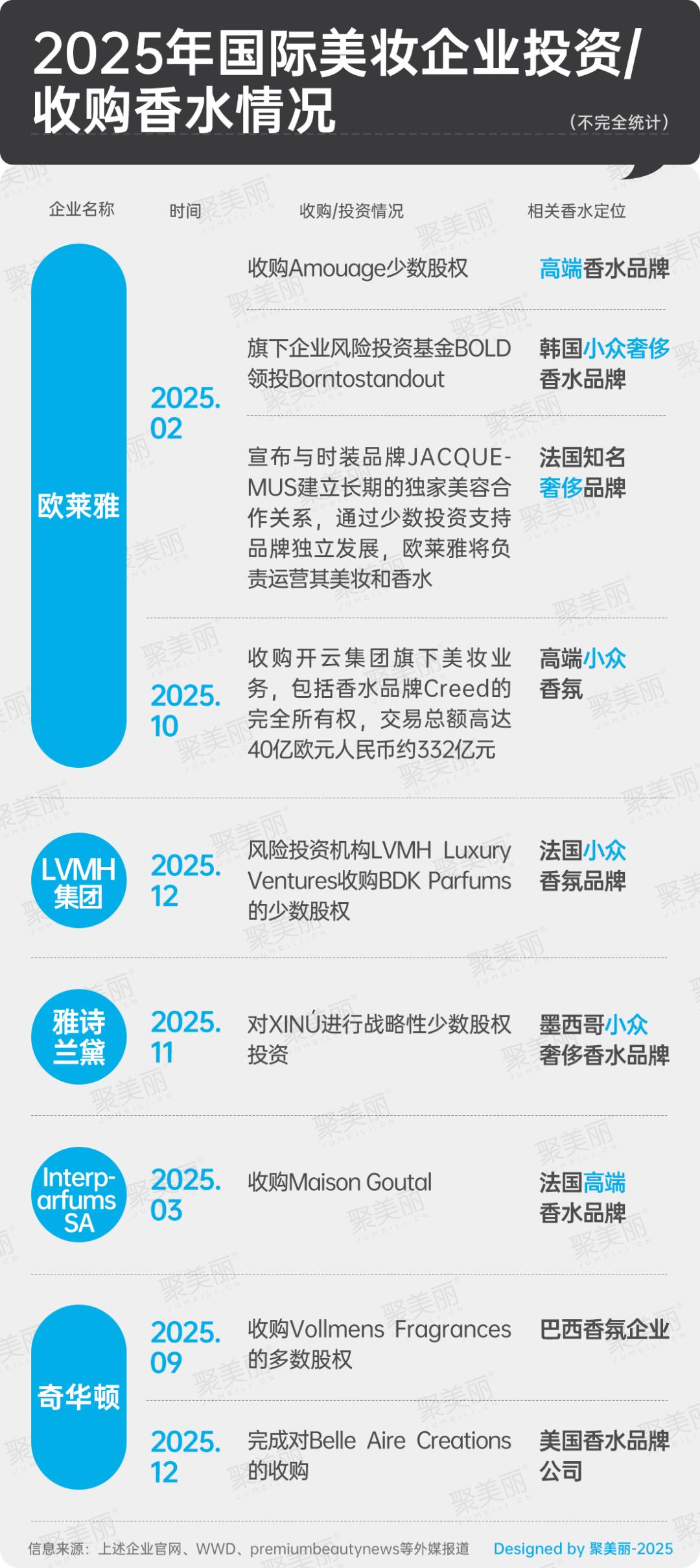
In addition, Estée Lauder and the LVMH Group also followed closely, but with different strategies, investing in perfume brands with strong regional characteristics and focusing on raw material quality respectively.
In November, Estée Lauder made a strategic minority equity investment in XINÚ, a niche luxury brand from Mexico, taking a fancy to its unique Latin American plant fragrance sources and cultural narrative.
In December, the LVMH Group invested in BDK Parfums, a French niche fragrance brand. This brand focuses on returning to the essence, emphasizing high - quality raw materials, adhering to handmade production, and conveying a unique artistic perspective and sensory narrative.
International luxury brands are keen to seize the differential value of the niche high - end fragrance track through equity investment, while upstream raw material giants tend to directly consolidate the supply chain and regional markets through acquisitions.
For example, Givaudan, a fragrance and flavor giant, successively acquired perfume and fragrance companies Vollmens Fragrances and Belle Aire Creations within three months to strengthen its position in the North American and Brazilian markets.
In addition to the above two groups eyeing the "cake" of perfume, many private equities and funds are also involved.
However, different from beauty enterprises focusing on single - category perfume brands, funds and investment companies are more optimistic about home fragrance brands close to daily life.
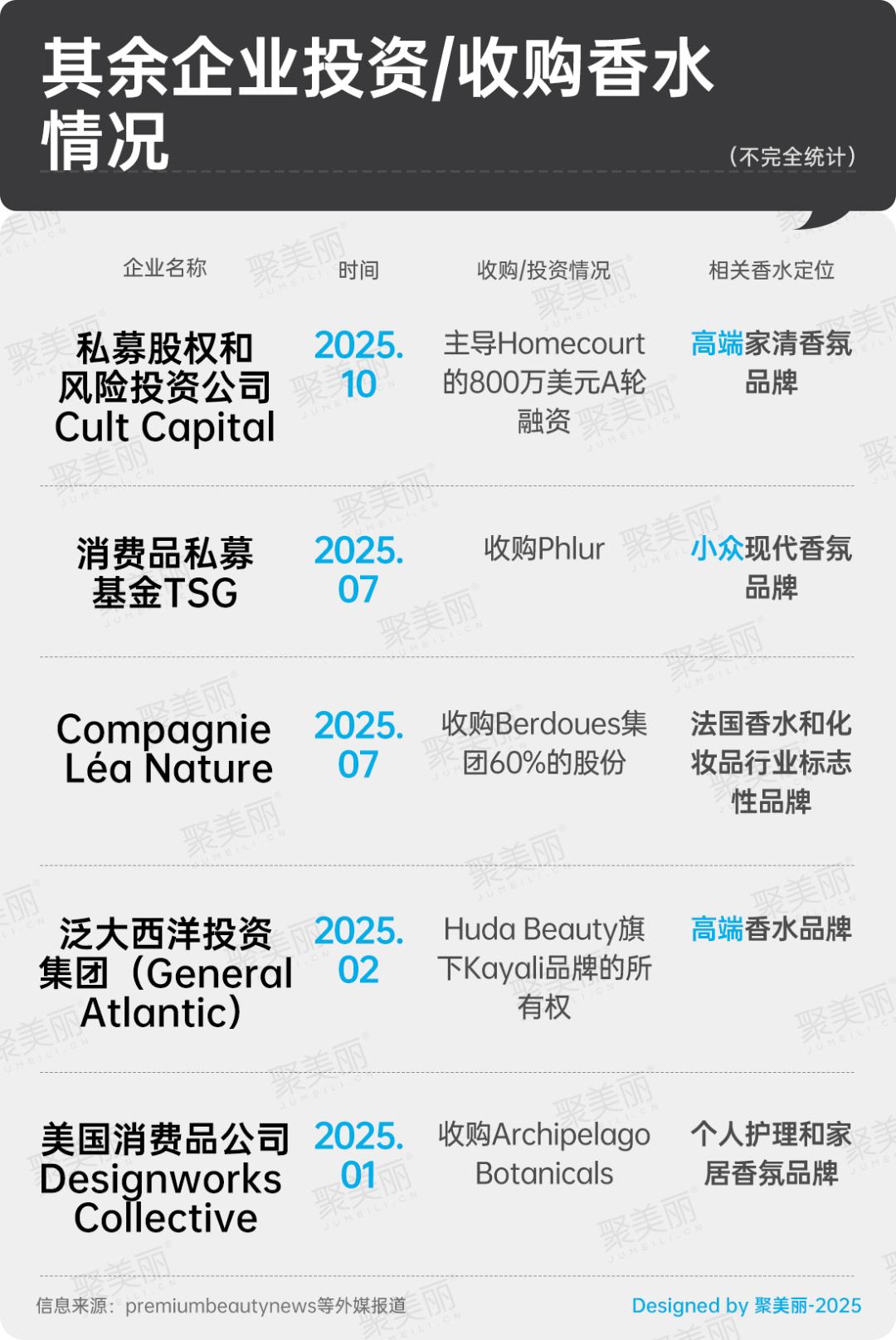
For example, TSG, a consumer private equity fund, acquired Phlur, a niche high - end fragrance brand. In addition to perfume, Phlur's product line also includes body sprays, hand creams, candles, etc.

Source: Phlur official website
Similarly, Homecourt, a high - end home fragrance brand founded by actress Courteney Cox, also received 8 million US dollars (approximately 56.337 million yuan) in Series A financing. Since its establishment in 2022, the brand's product line has expanded from the home field to body care and laundry products.
Behind these intensive investment actions, three core trends can be found:
Firstly, with limited growth in popular mass - market perfumes, capital is flowing more towards niche categories. In essence, against the backdrop of the fading traffic dividend, "niche" high - end perfumes with unique brand stories, rare fragrance types, and niche cultures have become the targets for giants to bet on the future and obtain differential value.
Secondly, the investment logic varies according to the nature of capital. Equity investments by beauty groups aim to complete the brand puzzle and acquire strategic growth points; acquisitions by raw material suppliers aim to control the core supply chain; while private equity funds prefer the extension of product lines for more stable returns.
Thirdly, scene - based consumption is expanding the boundaries of the track. Compared with traditional perfumes, home fragrances have a wider audience and product chain. Due to their higher frequency of use and stronger emotional value, they are attracting new capital to enter the market.
Investing up to 1.2 billion yuan in R & D factories
In addition to investing in promising perfume brands, international giants are looking upstream and focusing on building core capabilities at the R & D end.
Specifically, as a consumer goods giant, Unilever has not made new moves in investing in perfume brands, but in May this year, it invested 80 million pounds (approximately 753 million yuan) to build a new fragrance R & D facility in the UK. Two months later, it opened a new fragrance laboratory in the US. This series of actions shows that building independent and cutting - edge olfactory R & D capabilities has become a key part of leading enterprises in the industry.
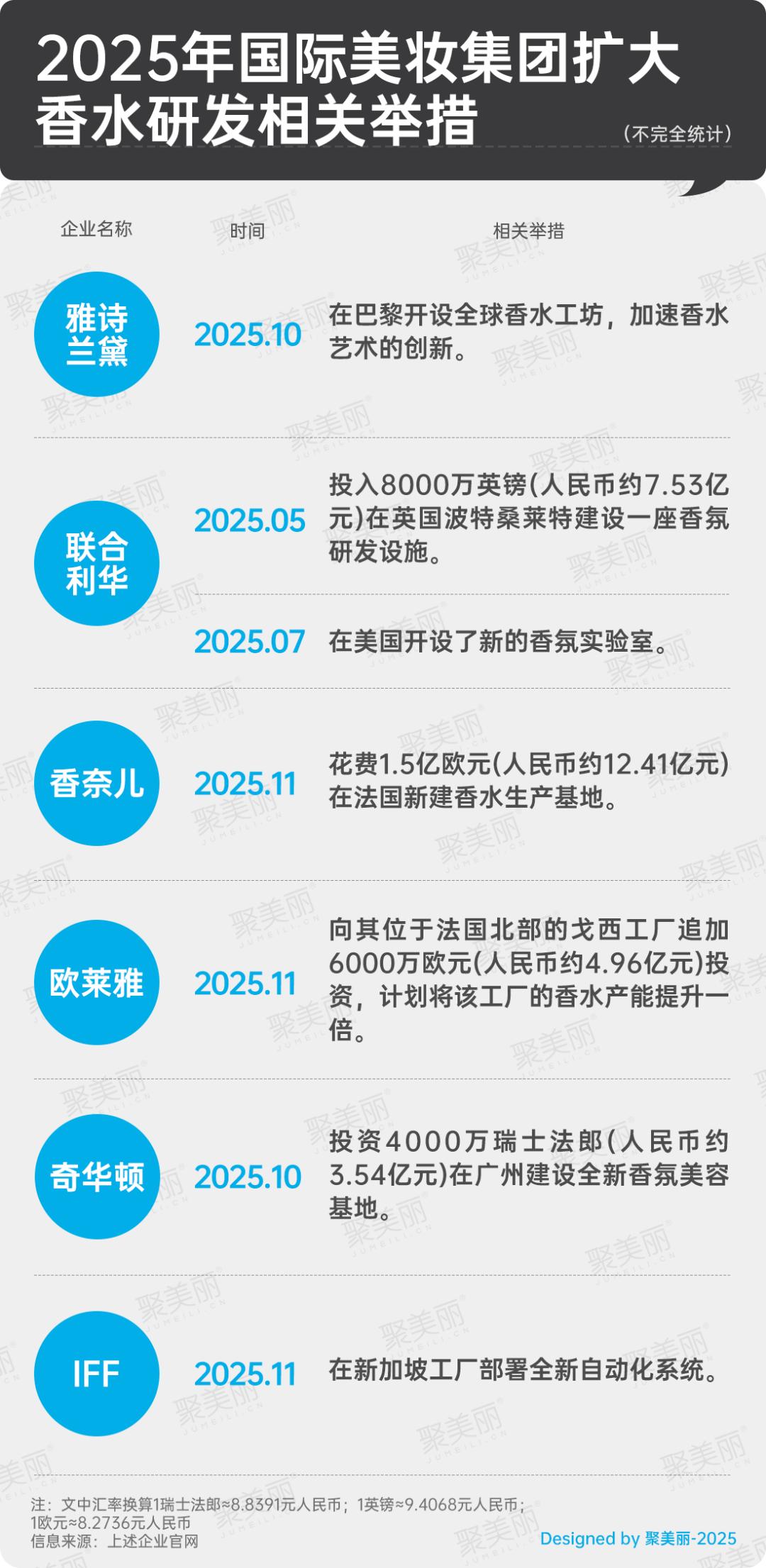
In addition, from a geographical perspective, France, with its long - standing perfume history, has also become the best location for leading enterprises to build factories.
Chanel invested 150 million euros (approximately 1.241 billion yuan) to build a new perfume production base in France to consolidate its perfume industrial chain.
L'Oréal added an investment of 60 million euros (approximately 496 million yuan) to its Gosselies factory in northern France to provide strong manufacturing support for its perfume brands.
Estée Lauder opened a global perfume workshop in Paris, aiming to bring together top perfumers and creative talents to accelerate the innovation and commercialization of perfume art.
From the above, it can be seen that enterprises are no longer satisfied with acquiring ready - made brand stories but are directly investing in the source of creating stories. Meanwhile, future perfume competition is not only about competing for consumers' perception of a single product but also about upgrading R & D technology. Building higher technical barriers and stable production capacity supply has become the key bargaining chip for leading enterprises to consolidate their industry position and seize future growth opportunities.
The talent war: the key engine driving the "olfactory economy"
Beyond strategic investment and supply chain layout, the upgrade of the talent structure has become a key move for leading groups to compete in the high - end perfume market.
In 2025, there were more than 10 changes in perfume business executives in the industry, from Hermès, the LVMH Group to Coty.
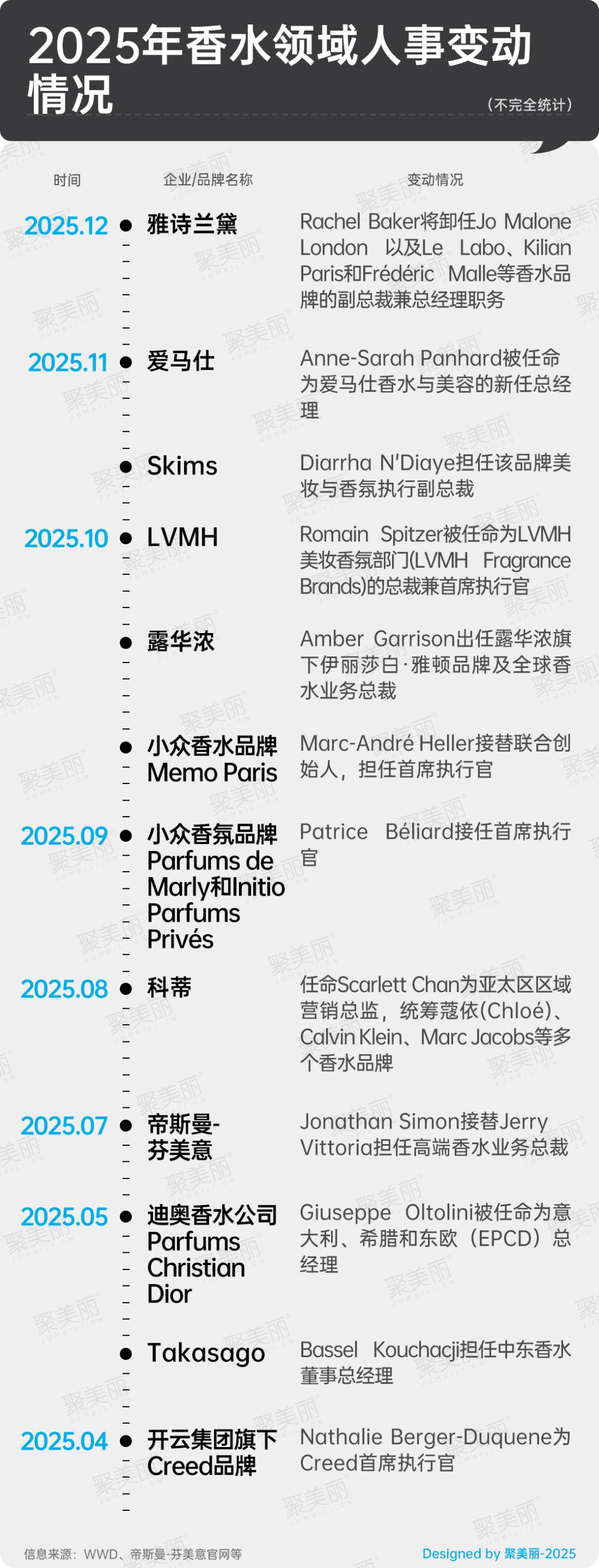
For example, in April this year, Creed, a brand under the Kering Group, appointed a former Estée Lauder executive as its CEO. It is reported that Nathalie Berger - Duquene has more than 20 years of relevant work experience and has held important positions in many international beauty enterprises such as Estée Lauder and L'Oréal.
Similarly, after emerging from bankruptcy, Revlon also poached a former Estée Lauder executive in October. It announced that Amber Garrison would serve as the President of the Elizabeth Arden brand and global perfume business. It is reported that Amber Garrison has rich experience in skin care, perfume, brand transformation, etc. and once served as the Global Brand President of Origins.
In addition, there were changes in the top management of niche perfume brands. For example, Marc - André Heller replaced the co - founder as the CEO of Memo Paris; Patrice Béliard took over as the CEO of niche fragrance brands Parfums de Marly and Initio Parfums Privés.
All of the above indicate that the current competition among leading enterprises in the "olfactory" field has reached a white - hot stage, and the competition in the perfume field has deepened from a game of capital and resources to a core competition of organizational capabilities and strategic thinking.
Although the competition is becoming increasingly fierce, it is certain that perfume will still be a category favored by most enterprises in the future. As Yan Ming, the managing partner of Xiuyuan Capital, also recognized the potential of this market. "The fragrance field is still full of opportunities, especially fragrance products that contain cultural elements and can convey emotional value. Due to the emphasis on emotional value of such products, their growth process may be relatively slow, but once successful, they will also be more stable, and the two are complementary."
Although the growth of single - category products purely centered on fragrance has slowed down, the integrated innovation of "fragrance +" has become the core model for exploring new growth.
As a sensory element, fragrance is being systematically integrated into categories such as skin care, household cleaning, and health care, creating composite products with both functional attributes and emotional resonance. In the future, the growth potential of the "olfactory economy" is expected to be continuously released.
Only one investment: is the Chinese perfume track facing a cold spell?
While international giants have occupied the headlines with their intensive capital actions, the Chinese perfume investment market in 2025 showed a "calm" on the data level. Public information shows that only EvoSensation, a new - style fragrance brand from Yunnan, completed its angel - round financing throughout the year, but neither the investment amount nor the investor was disclosed.
Looking back over time, most domestic perfume track investments occurred around 2022. Among them, the more attention - grabbing ones are Documents and Scentooze, which received investments from L'Oréal in 2022 and 2024 respectively, and Melt Season, which received tens of millions of yuan in strategic investment from the Estée Lauder Group in 2023. It is worth noting that the path for these three brands to gain capital recognition is to build an irreplicable high - end brand value centered on a unique oriental cultural narrative.
