The new subsidy policy is here. Will new energy vehicles be saved in 2026?
On December 30th, the National Development and Reform Commission announced that China will continue the trade - in stimulus policy in 2026. The long - awaited national subsidy for automobile trade - ins in 2026 has finally been implemented:
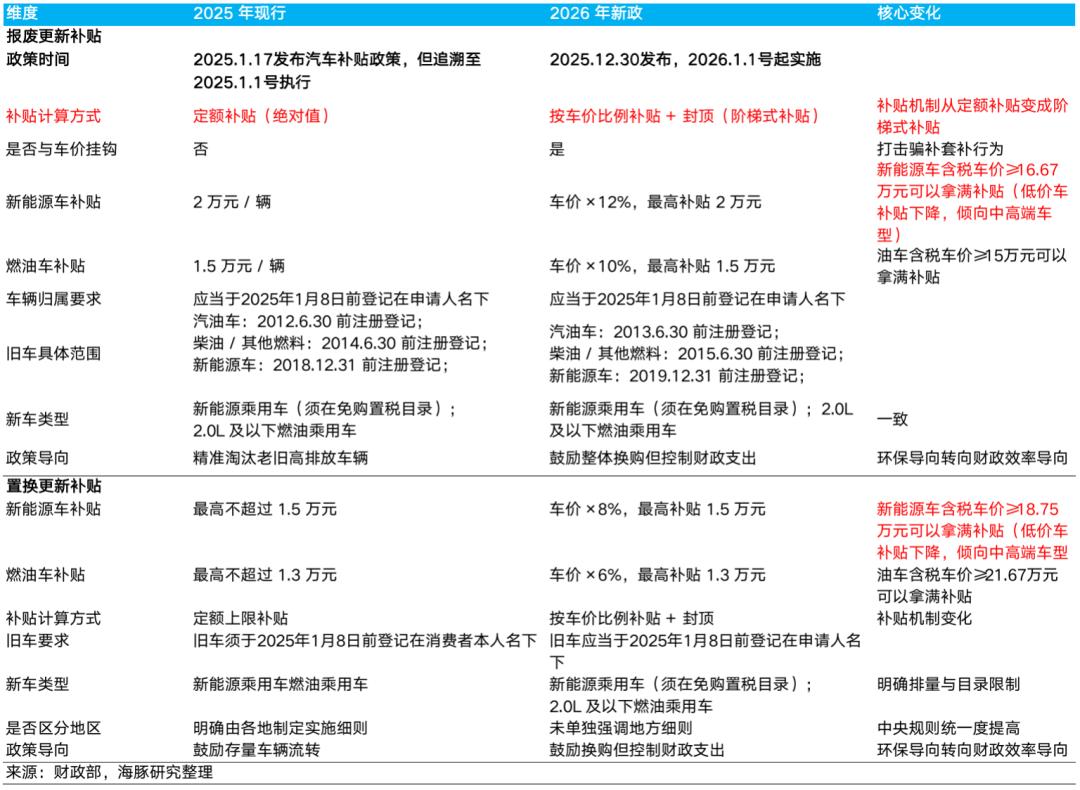
① Scrappage and renewal subsidy: After scrapping an old vehicle, when purchasing a new energy passenger vehicle, a subsidy of 12% of the vehicle price will be provided, with a maximum of 20,000 yuan; when purchasing a fuel - powered passenger vehicle with a displacement of 2.0 liters or less, a subsidy of 10% of the vehicle price will be provided, with a maximum of 15,000 yuan.
This means that after scrapping an old vehicle, when purchasing a new energy vehicle with a price (including tax) ≥ 166,700 yuan, the full subsidy can be obtained; when purchasing a fuel - powered vehicle with a price (including tax) ≥ 150,000 yuan, the full subsidy can be obtained.
② Replacement and renewal subsidy: After transferring an old vehicle, when purchasing a new energy passenger vehicle, a subsidy of 8% of the vehicle price will be provided, with a maximum of 15,000 yuan; when purchasing a fuel - powered passenger vehicle with a displacement of 2.0 liters or less, a subsidy of 6% of the vehicle price will be provided, with a maximum of 13,000 yuan.
Calculated in this way, when trading in an old vehicle for a new energy vehicle with a price (including tax) ≥ 187,500 yuan, the full subsidy can be obtained; when purchasing a fuel - powered vehicle with a price (including tax) ≥ 216,700 yuan, the full subsidy can be obtained.
The following are several issues that Dolphin Jun is concerned about regarding the trade - in policy:
1. Does the automobile trade - in policy meet market expectations?
The national and local subsidy policies are basically consistent with the draft version circulated in the market last week. Although the policy side is still relatively positive, the stock prices of the entire vehicle sector have already reacted to this policy expectation in advance last week. Since the new energy vehicle purchase tax will still be reduced to half - levy in 2026, the demand for the new energy vehicle sector in 2026 is still highly uncertain. Therefore, investors may choose to take event - based profit - taking on this national subsidy policy.
2. How will the total subsidy amount change?
In 2025, the total subsidy pool for the "trade - in" program was 300 billion yuan, which was distributed in 4 batches (the first 2 batches in 2025 were 81 billion yuan, and the last 2 batches were 69 billion yuan). Among them, the subsidy for automobile "trade - in" was 145 billion yuan, accounting for 48.4% of the total pool.
In 2026, although the overall total subsidy amount has not been announced yet, judging from the funds distributed in the first batch of the "trade - in" program, the first - batch funds in 2026 were 62.5 billion yuan (for all industries), a decrease of 23% compared with 81 billion yuan in the first quarter of 2025. Therefore, the total subsidy amount in 2026 may only be about 77% - 80% of that in 2025. Correspondingly, the total automobile subsidy amount may be between 110 billion and 120 billion yuan (also a 20% - 25% reduction compared with 2025).
The total subsidy amount is crucial to the automobile sector. In the fourth quarter of 2025, the automobile market did not show the traditional "end - of - year surge effect." Instead, the sales volume decreased year - on - year: the retail sales volume of passenger vehicles in October and November decreased by 0.5% and 8.1% year - on - year respectively. During the same period, the cumulative number of insured vehicles decreased by 570,000 year - on - year. Among them, models priced below 200,000 yuan contributed to a decline of 545,000 vehicles, becoming the core factor dragging down the market.
The decline was mainly due to the tightening of the trade - in subsidy policies in many places since October - more access restrictions for scrappage and renewal, and the early closure of subsidy application channels in some areas. This was mainly because the national and local "trade - in" subsidy quotas were basically exhausted around October, directly suppressing the replacement demand of the mainstream consumer groups with a budget below 200,000 yuan.
3. What are the main changes in the 2026 trade - in subsidy policy compared with 2025?
① Change in subsidy calculation method: The subsidy form has changed from a one - size - fits - all fixed - amount subsidy in 2025 to a stepped subsidy based on the proportion of the new vehicle price in 2026, but the same single - vehicle subsidy cap as in 2025 has been set (for example, the maximum subsidy for scrapping a new energy vehicle is 20,000 yuan, and the maximum subsidy for replacement is 15,000 yuan).
② The beneficiary structure has shifted from low - priced vehicles to mid - and high - priced vehicles, which is more beneficial to automakers whose main sales are mid - and high - end models: This change has directly led to a structural change in the beneficiary models of the subsidy. In 2025, all eligible vehicles, regardless of price, enjoyed the same fixed - amount subsidy, which had a particularly significant stimulating effect on low - priced models (especially those below 100,000 yuan) (the lower the vehicle price, the higher the ratio of the subsidy amount to the vehicle price).
In 2026, only vehicles with a price reaching a certain threshold can receive the full subsidy (for example, a new energy vehicle needs to be priced above about 167,000 yuan for scrappage and above about 188,000 yuan for replacement). Therefore, mid - and high - end models (especially those in the price range of 150,000 - 200,000 yuan and above) have become the core beneficiaries, and the actual subsidy per vehicle is basically the same as in 2025; for low - priced models below 150,000 yuan, especially those below 100,000 yuan, the subsidy amount they can receive will be significantly reduced compared with 2025.
From the perspective of automakers, this policy is more beneficial to automakers whose main sales are mid - and high - priced models (such as Li Auto, NIO, and Huawei's co - branded vehicles), while it is relatively unfavorable to automakers like BYD and Geely, whose main products are mid - and low - end models, as the subsidy intensity for their main models will be directly weakened.
③ The policy adjustment is mainly aimed at optimizing the efficiency of fiscal fund use and guiding consumption upgrading:
This move aims to optimize the efficiency of fiscal fund use and guide consumption upgrading and industrial upgrading. By setting a price - proportion threshold, excessive subsidies for low - priced models can be reduced (in 2025, there were cases of "subsidy fraud" for some low - priced vehicles or arbitrage through the export of zero - kilometer used cars). It encourages automakers and consumers to shift to higher - value and higher - quality products, which helps to alleviate the "involution - style" price competition in the industry and promotes an increase in the overall industry price level and an improvement in profitability.
At the same time, the new policy in 2026 significantly tightens the requirements for the eligibility of old vehicles, and this adjustment applies to both scrappage and replacement scenarios: the new rule clearly stipulates that the old vehicle used for scrappage or replacement must be registered and actually held in the applicant's name for at least 1 year (the transfer registration must be completed before January 8, 2025, to meet the holding - period requirement); in contrast, the 2025 policy only required the old vehicle to complete the transfer before January 8, 2025, without restricting the actual holding period.
The core purpose of this adjustment is also to severely crack down on the "subsidy fraud" behavior of obtaining subsidies through temporary purchase and transfer of old vehicles, ensuring that the subsidy funds are truly used to stimulate the renewal consumption of existing vehicles and improving the policy's accuracy and the efficiency of fund use.
4. How long will the subsidy last? What impact will it have on the overall automobile market?
In order to meet the consumption demand during peak seasons such as the Double Festivals and the Spring Festival, the state has advanced the first batch of 62.5 billion yuan of ultra - long - term special treasury bond funds to local governments to support the trade - in fund plan. According to the notice jointly issued by the National Development and Reform Commission and the Ministry of Finance on December 30, 2025, the 2026 trade - in policy will be officially implemented on January 1, 2026. This means that consumers can apply for the new national subsidy when purchasing eligible new vehicles from the first day of the new year.
The timely renewal of the policy and the early arrival of funds also help to relieve the downward pressure on the automobile market in the first quarter of 2026, which mainly comes from two aspects:
① The purchase tax for new energy vehicles will be restored from exemption to half - levy (5%) starting from January 1, 2026, directly increasing the vehicle purchase cost;
② In 2025, the subsidy scale of the national "trade - in" policy doubled compared with 2024. Coupled with the purchase tax exemption, it stimulated a large number of consumers to purchase vehicles in advance, pre - empting some of the demand in 2026.
The implementation of the new policy, by providing continuous subsidy support, can stabilize market expectations and avoid a cliff - like decline in sales due to the "policy vacuum period." In essence, it is to smooth out the sales fluctuations caused by the resumption of the purchase tax for new energy vehicles after January 2026.
However, since the subsidy method has changed from "fixed amount" to "proportion of vehicle price", the subsidy conditions have become more stringent. The support for low - priced models has weakened, and the overall subsidy amount for automobiles is expected to decline by 20% compared with 2025. Coupled with the adjustment of the purchase tax, the overall automobile sales volume in 2026 may still face certain challenges year - on - year. However, the fine - tuning of the policy can have a supporting effect, narrowing the decline range, and the market structure will be more inclined to mid - and high - priced models.
This article is from the WeChat official account "Dolphin Investment Research" (ID: haituntouyan), author: Dolphin Jun, published by 36Kr with authorization.