You can rest assured this time. The national subsidy for buying cars will continue in 2026, with a maximum of 20,000 yuan.
The automotive market finally gets a reassurance for next year.
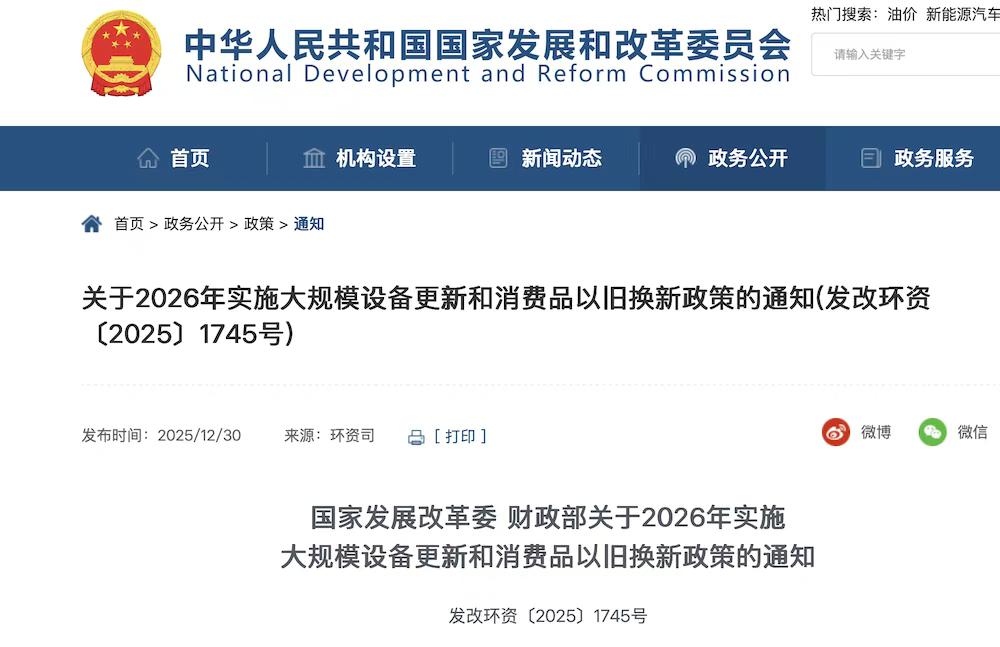
Yesterday, the National Development and Reform Commission and the Ministry of Finance jointly issued a notice on implementing large - scale equipment renewal and trade - in policies for consumer goods in 2026, clearly sending a signal:
In 2026, the national subsidy for automobiles will continue!
The notice clearly states that the trade - in policy for consumer goods will continue, including subsidies for automobile scrapping and replacement and automobile trade - in. However, the subsidy rules have been adjusted. On the basis of keeping the upper limit of automobile subsidies unchanged, the fixed - amount subsidy has been adjusted to a subsidy based on the proportion of the car price.
From January to November this year, the total number of automobile trade - ins nationwide exceeded 11.2 million. With the boost of policies such as the national subsidy, the automotive market is indeed on an upward trend. Domestic automobile sales increased by 11.4% year - on - year. Among them, new energy vehicles performed outstandingly, with sales reaching 14.78 million, a year - on - year increase of 31.2%.
In December this year, it should have been a crucial window period for sales sprint. However, under the "uncertainty" of the tax incentive phase - out and the national subsidy policy, people's attitude towards buying cars began to become delicate, and the expected sales sprint did not occur.
With the official introduction of the 2026 trade - in subsidy policy, automobile manufacturers can finally breathe a sigh of relief.
01
It's getting tough for scalpers
The notice clearly states that the 2026 trade - in policy for consumer goods will continue to provide subsidies for automobile scrapping and replacement, automobile trade - in, home appliance trade - in, and the purchase of new digital and intelligent products.
The detailed rules of the automobile trade - in policy still cover three aspects: automobile scrapping and replacement, automobile trade - in, and improving the implementation system. However, there have been many adjustments in the details of the subsidy scope and subsidy standards compared with this year.
In terms of scrapping old cars and purchasing new ones, individual consumers who scrap passenger cars registered under their own names and purchase new energy passenger cars included in the "Catalogue of New Energy Vehicle Models Exempt from Vehicle Purchase Tax" or fuel - powered passenger cars with a displacement of 2.0 liters or less will be supported by the automobile scrapping and replacement subsidy:
For the purchase of new energy passenger cars, a subsidy of 12% of the car price will be provided, with a maximum of 20,000 yuan; for the purchase of fuel - powered passenger cars with a displacement of 2.0 liters or less, a subsidy of 10% of the car price will be provided, with a maximum of 15,000 yuan.
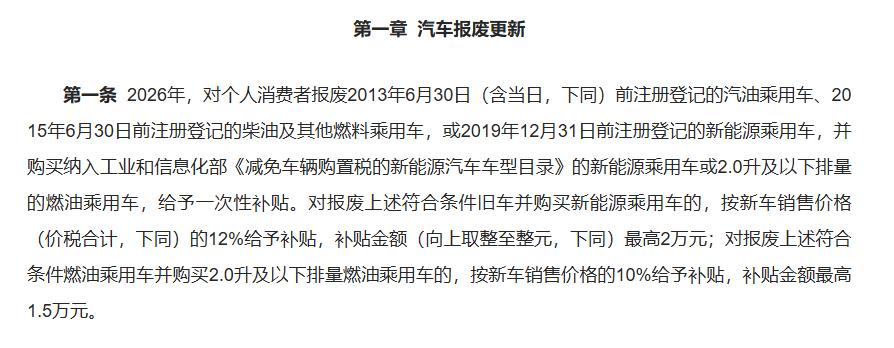
This means that the purchase price needs to reach or exceed 167,000 yuan to enjoy the full 20,000 - yuan subsidy, and the premise is that it is a new energy vehicle in the tax - exempt catalogue. Otherwise, the subsidy amount will be calculated at 12% of the car price. If a fuel - powered car is purchased after scrapping, the purchase price needs to reach or exceed 150,000 yuan to get the full 15,000 - yuan subsidy.
In terms of automobile trade - in, individual consumers who transfer passenger cars registered under their own names and meet the requirements of the tax - exempt catalogue and fuel - powered passenger cars with a displacement of 2.0 liters or less will also be supported by the automobile trade - in subsidy:
For new energy passenger cars, a subsidy of 8% of the new car price will be provided, with a maximum of 15,000 yuan; for the purchase of fuel - powered cars with a displacement of 2.0 liters or less, a subsidy of 6% of the new car price will be provided, with a maximum of 13,000 yuan.

That is to say, the purchase price needs to reach 187,500 yuan or more to enjoy the full - amount trade - in subsidy; while the threshold for the full - amount subsidy for fuel - powered cars has reached 216,700 yuan.
In addition, the policy has also relaxed the conditions for old cars eligible for subsidies. The scrapping age has been postponed by one year. For scrapped old gasoline passenger cars applying for subsidies, the registration time has been extended from 2012 to June 30, 2013. For scrapped old new energy vehicles applying for subsidies, the registration time has also been postponed to before December 31, 2019.
It is not difficult to see that although the maximum subsidy amount has not changed, compared with the fixed - amount subsidy for individual vehicles implemented this year, the new policy has introduced a differential subsidy calculation method linked to the new car price. This also means that the previous mechanism of getting a full 20,000 - yuan subsidy as long as the car is scrapped will no longer work.
And changing the subsidy method from a "one - size - fits - all" approach to a "subsidy based on the new car price" has obviously plugged the loophole of scalpers reselling subsidies, greatly compressing the scalpers' space for "subsidy arbitrage".
The new policy also specifically emphasizes "optimizing the fund allocation method and improving the full - chain implementation details" and clearly proposes to "severely crack down on subsidy fraud and 'price - hike - then - subsidy' and other illegal and irregular behaviors".
To address the possible behavior of dealers raising prices temporarily before the policy is introduced in previous years to dilute the subsidy benefits (i.e., "price - hike - then - subsidy"), the new policy will be curbed by strengthening price monitoring, clarifying the reference benchmark price, and establishing a reporting and verification mechanism.
For behaviors such as scalpers snatching subsidies on behalf of others and illegally obtaining subsidies, the new rule clearly states that subsidies will be distributed through third - party payment platforms (such as Alipay and UnionPay QuickPass) or the official platforms of automobile manufacturers. After the car owner completes the purchase of a new car, the subsidy funds will be directly transferred to the car owner's bank card, completely blocking the previous way of scalpers forging purchase information and claiming subsidies.
In addition, when applying for subsidies, car owners need to complete face recognition and information comparison of ID cards and bank cards, and the real - name information on the old car's driving license and the new car's purchase invoice must be consistent. The principle of "one person, one car, one subsidy" will be strictly enforced.
Previously, scalpers would buy old cars from car owners at low prices, then complete the trade - in and apply for subsidies in their own names, and earn the price difference after deducting the car - buying cost. The "one person, one car, one subsidy" principle of the new rule requires the real - name information of the car owner, the old car, and the new car to be consistent, completely cutting off the scalpers' path of reselling subsidies through car - buying.
Once identified as a scalper snatching subsidies on behalf of others, not only will the current subsidy eligibility be cancelled, but the person will also be included in the government's list of dishonest entities and will not be eligible for any people - benefiting subsidies for three years.
02
Both quantity and quality are required
The continuation of the national subsidy in 2026 also allows major automobile manufacturers to breathe a sigh of relief.
Since October, the "provincial subsidies" and "national subsidies" in 2025 have been suspended or ended successively across the country, making this supposed to be a crucial window period for year - end sales volume sprint a bit deserted.
Previously, the China Automobile Dealers Association announced the sales volume in the first week of December 2025. From December 1st to 7th, the retail sales of the national passenger car market reached 297,000 units, a year - on - year decrease of 32% compared with December last year and an 8% decrease compared with the same period of last month.
Among them, the retail sales in the new energy market reached 185,000 units, a year - on - year decrease of 17% compared with the same period in December last year and a 10% decrease compared with the same period of last month. Such a year - on - year decline rate is the first since 2023. This fully demonstrates the internet meme of "Once the subsidy stops, the passion fades".
Chen Shihua, the deputy secretary - general of the China Association of Automobile Manufacturers, said that after the subsidy policies in many places were gradually withdrawn, many consumers chose to wait and see with money in hand, waiting for the new policies to be introduced next year, which directly led to fluctuations in the performance of the domestic automobile terminal market recently.
Moreover, as the switching point of the vehicle purchase tax policy approaches, starting from January 1, 2026, the purchase tax for new energy vehicles will be adjusted from full exemption to half exemption, and the tax - exemption upper limit will also be reduced from 30,000 yuan to 15,000 yuan.
For the overall market, in the policy transition period of the "certain" phase - out of the purchase tax policy and the "uncertain" national subsidy policy, consumers' decision - making has begun to waver.
Facing the sluggish market situation, various automobile manufacturers have also "dug into their own pockets" to introduce preferential policies. The most prominent manifestation is that many automobile manufacturers have announced to "cover" the purchase tax of new energy vehicles. If consumers place orders before December 31, 2025, but the cars are not delivered, the automobile manufacturers will make up for the additional purchase tax collected at the time of delivery.
Previously, Gui Shengyue, the CEO of Geely, once said that the industry will start a real survival - of - the - fittest process next year, and this new trade - in policy is obviously a catalyst.
Perhaps starting from next year, the era of high - growth driven by subsidies will end, and the industry elimination competition will enter a more brutal stage.
Although eligible car buyers can still enjoy substantial subsidies, it is not difficult to see that policy resources are more inclined to encourage consumers to choose higher - value models, and it has little impact on mid - to - high - end models. It is equivalent to a disguised reduction of the subsidy standards for low - priced models.
This also corresponds to the previous structural problem in the industry of "a sharp increase in the sales volume of low - priced cars but weak growth in industry profits". The support policy has also shifted from "universal car - purchase subsidies" to "structural incentives", emphasizing high - quality development more.
Now, the call for "anti - involution" in the industry is getting louder and louder, and the domestic market should also enter a new development cycle.
This article is from the WeChat official account "SuperEV - Lab" (ID: SuperEV - Lab), written by Wang Lei and edited by Qin Zhangyong. It is published by 36Kr with authorization.