From AI glasses to humanoid robots, why are the new players in the automotive industry so restless?
Recently, a video of Wang Leehom's Chengdu concert featuring Unitree Technology's G1 humanoid robots as backup dancers for the stage performance of "Full Throttle" went viral on social media and even spread across the ocean, earning a like from Elon Musk.
From the "Yangs BOT" at the Spring Festival Gala at the beginning of the year to the energetic dance at the end - of - year concert, humanoid robots have been in the spotlight throughout the year. As a result, more and more enterprises have entered the field, including automakers such as GAC, SAIC, BYD, Changan, Chery, and XPeng.
XPeng even claims that it will mass - produce high - order humanoid robots on a large scale by the end of next year and has set a sales target of one million units by 2030, demonstrating its huge ambition.
In addition to humanoid robots, new car - making forces have also set their sights on AI glasses. Li Auto has launched the intelligent glasses Livis, which integrates functions such as taking photos and videos, open - ear headphones, and car control, and is touted as Li Auto's strongest intelligent accessory.
As new car - making forces attempt to leverage their automotive technology to explore new growth opportunities in the broader intelligent terminal market, a cross - border competition in the intelligent terminal field led by automakers has quietly begun.
AI Deployment: Different Paths, Same Destination
"I bought Li Auto's AI glasses Livis and then returned them." The first batch of users who purchased Livis have made their initial decisions.
After in - depth experiences, some people have drawn a clear user profile for Livis: Li Auto owners who wear glasses or have myopia = recommended to buy; people who are engaged in text - related work and often listen to music or browse Douyin = recommended to buy; non - Li Auto owners who mainly use it for taking photos and don't wear glasses often = not recommended to buy.
Based on the experience feedback from most users, the advantages and disadvantages of Livis are quite obvious. For example, its shooting quality, whether for videos or photos, is not sufficient to meet the basic needs of editing and sharing. Therefore, in most cases, it is better to use a mobile phone or a camera for recording. Also, the photochromic lenses turn from clear to dark quickly but take a long time to turn back from dark to clear. So, when entering a building from outdoors and needing face recognition, users have to take off the glasses.
However, its battery life, sound quality, and call quality are good. So, it is feasible to replace ordinary headphones, glasses, and voice recorders with Livis. More importantly, Livis can be smoothly connected to Li Auto's in - car system. Users can open and close the trunk with Livis outside the car and seamlessly connect to Li Auto's voice assistant to control the car after getting in, which adds a lot of points to the user experience for Li Auto owners.
Some users commented: "The price range of Livis, from 1,700 to 2,500 yuan, is very well - considered."

The starting price of Livis is 1,999 yuan.
The birth of Livis can be traced back to last October when Li Auto held its autumn strategy meeting at Yanqi Lake. At that time, Li Xiang proposed a project plan for AI glasses. However, some major shareholders believed that it was not a wise move to divert energy to a new field, so they clearly rejected the project proposal.
However, Li Xiang never intended to give up the AI glasses project. In January 2025, Li Xiang officially established a second - level department and assigned the AI glasses project to the Wearable Robots Department, with Zhang Wenbo, who previously led the development of "Li Auto's Voice Assistant", as the person - in - charge. Therefore, it is not difficult to understand the smooth interaction between Livis and the in - car system.
As for why AI glasses are a must - stick project for Li Auto, Fan Haoyu, the senior vice - president of the product department of Li Auto, has long given the answer: "Glasses are the most natural human - machine interaction interface at present because they are close to the eyes, ears, and mouth and do not require users to change their habits. Livis will be the best carrier for Li Auto to bring intelligent experiences outside the car."
Similarly, XPeng is also very active in deploying AI terminals.
At the GeekPark Innovation Festival 2026, He Xiaopeng, the chairman and CEO of XPeng, publicly shared three main reasons for XPeng to develop humanoid robots.
First, society is designed for humans, and the humanoid form has the most general adaptability; second, the humanoid form can be trained with a large amount of human behavior data; third, the humanoid form can become more versatile rather than being dedicated to specific scenarios.

IRON has made great efforts in anthropomorphism.
From a more practical perspective, He Xiaopeng also mentioned in a conversation with the media that "the continuous improvement of the business situation has made the company more determined to invest in the R & D of 'physical AI'." He regards AI cars, global expansion, and the in - depth integration of embodied robots and the automotive industry as the three growth curves to drive XPeng's future development.
In fact, robots have also been called "standing smart cars", and the technical architectures of the two are almost the same. The so - called cross - border is essentially the reuse of technology. So, XPeng's development of robots is to achieve a closed - loop intelligent technology ecosystem from cars to robots. The technology and data of cars can help robots be launched more quickly and stably, and the interaction data accumulated by robots in more diverse scenarios can be fed back to cars to optimize intelligent driving data.
In other words, whether it is Li Auto, XPeng, Tesla, NIO, or Xiaomi, new energy automakers are crossing the border into AI to give full play to their AI capabilities, promote the automotive business, and gain an edge in the era of artificial intelligence.
Positioning Competition: Breaking Homogenization
Currently, the competition in the new energy vehicle market has entered a fierce stage of stock game, and homogeneous competition has become the core bottleneck restricting the development of the industry.
In terms of product design, whether it is the appearance, interior layout, power parameters, or intelligent configuration, most models show an obvious "convergence effect". In terms of user experience, the differences in intelligent cockpits and assisted driving functions among different brands are gradually narrowing, and the traditional approach of piling up configurations can no longer form a sustainable core attraction.
Therefore, finding a new breakthrough for differentiated competition is the top priority for every new car - making force at present. Cross - border deployment in intelligent terminals is a key choice for them to deal with the homogeneous dilemma and open up a second growth curve.
The reason why Li Auto chooses AI glasses and XPeng chooses robots is based on their judgment of market gaps and user needs, aiming to avoid the highly competitive red - ocean market and achieve staggered competition.
As early as 2022, NIO launched NIO Air AR Glasses, taking the lead in exploring the integration of "in - car entertainment + AR" scenarios. However, it mainly remained at the level of supplementary in - car accessories and did not make a big splash. The mobile phone market is already monopolized by leading brands, and the market performance of NIO's NIO Phone and the mobile phone jointly developed by Geely and Meizu also proves the high difficulty for automakers to cross into the mobile phone field.
In contrast, the intelligent glasses market is in a period of rapid growth and has broad market potential.
IDC data shows that the global shipments of intelligent glasses reached 4.065 million units in the first half of 2025, a year - on - year increase of 64.2%. IDC predicts that by 2029, the global shipments of intelligent glasses will exceed 40 million units, and the market share of the Chinese market is expected to have a compound annual growth rate of 55.6% in the next five years, ranking first in the world.
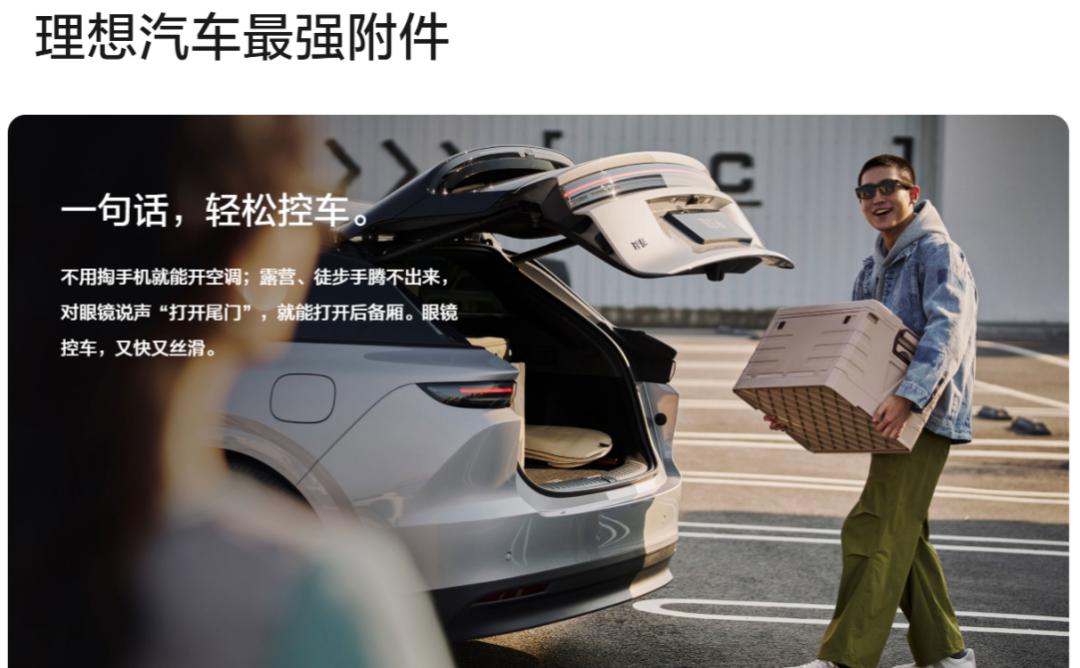
Livis is regarded as Li Auto's strongest accessory.
More importantly, the current intelligent glasses market is characterized by "high - end monopoly and lack of mid - and low - end products". The high - end market is occupied by a few technology giants with over - priced products. Although there are many brands in the mid - and low - end market, they generally lack core AI capabilities and cross - scenario interaction experiences, making it difficult to meet the in - depth needs of users. This provides an opportunity for Li Auto to accurately position itself.
The intelligent robot market is similar. According to the "Research and Forecast Report on the Analysis and Development Prospect of China's Intelligent Robot Industry from 2025 to 2030" released by CIC Industry Research Center, the global market size of intelligent robots increased from 130.2 billion yuan in 2021 to 277.8 billion yuan in 2024, with a compound annual growth rate of 28.7% from 2021 to 2024. Analysts from the CIC Industry Research Center predict that the global market size of intelligent robots will reach 348.8 billion yuan in 2025 and 451.2 billion yuan in 2026.
XPeng has initially targeted the industrial manufacturing field as the core application scenario for its AI humanoid robot IRON, claiming that it can screw 5,000 screws a day, directly addressing the core need of the automotive industry for cost - reduction and efficiency - improvement. In the long run, the improvement of production efficiency and process optimization brought by IRON will become an important part of the company's core competitiveness.
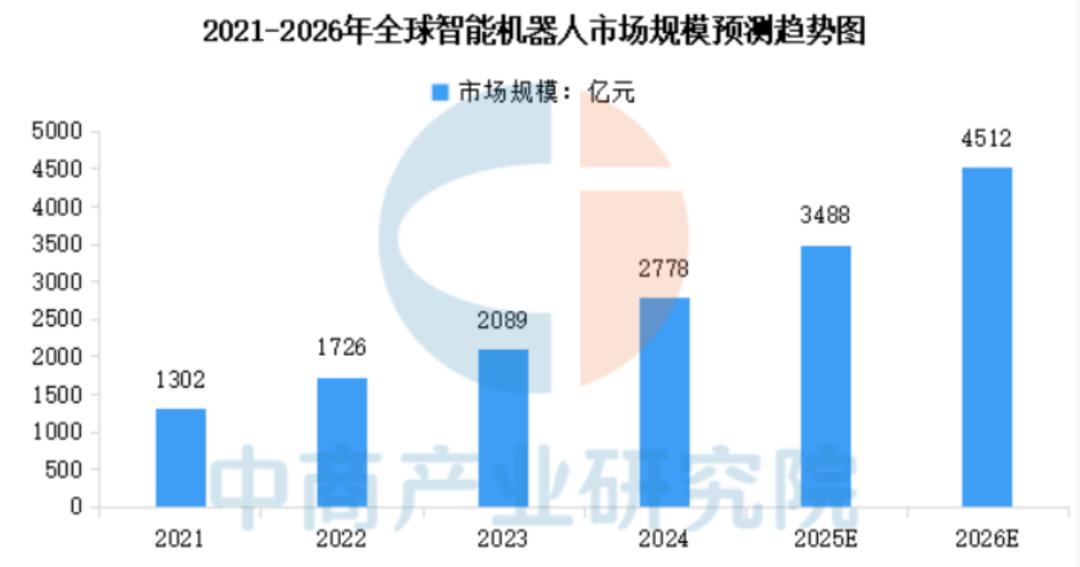
Source: CIC Industry Research Center
If technical foundation is the prerequisite for cross - border development and competitive breakthrough is the driving force, then ecological upgrading is the ultimate goal of new - force automakers' cross - border deployment.
From the perspective of industry development trends, the intelligent ecosystem of "cars + N terminals" has become the inevitable direction for the transformation of automotive enterprises. Tesla's large - scale layout of "cars + robots" has enabled the second - generation Optimus to have practical functions. As it expands to the home scenario in the future, the scale effect will give it an innate advantage in cost control. Although domestic new - force automakers started a little later, they can also take a differentiated path of ecological transformation through precise market selection and technology reuse.
In this transformation, the traditional criterion of "whether to focus solely on car - making" is no longer applicable. With the development of the automotive industry, the nature of cars is changing from a single means of transportation to an intelligent life hub, and the competitive boundaries of enterprises have also expanded, no longer limited to automotive products themselves but extending to the intelligent needs of users in all scenarios.
This seemingly cross - border but actually in - depth strategy is the key for new - force automakers to stand out in the fierce competition.
This article is from the WeChat public account "Zinc Scale" (ID: znkedu), written by Li Jinlin and edited by Chen Dengxin. It is published by 36Kr with permission.