The biggest selling point of the Xiaomi 17 Ultra has become the reason for users to return the product.
Perhaps many people don't know that the latest flagship phone released by Xiaomi, the Xiaomi 17 Ultra Leica Edition, is the first time in history that Leica has authorized the use of its iconic red logo (Coke logo) on a co - branded product.
At this time, some well - informed friends may ask: Didn't the "in - house" product jointly developed by Leica and Sharp, the Leitz Phone, already use the "Coke logo"?
Indeed, it did. However, on that phone, there was only the "Coke logo" on the entire back, and Sharp, the OEM manufacturer, didn't have the right to have its own logo on it. But this time, on the back of the Xiaomi 17 Ultra, not only is there the "Coke logo", but also Xiaomi's own logo is clearly visible.

This is a privilege that Huawei, which had previously collaborated with Leica, never had.
For this new product, Xiaomi must have spent a great deal of effort, time, and perhaps even "financial power" to secure this in - depth cooperation between this generation of Ultra and Leica.
The "Master Zoom Ring" that Xiaomi has been emphasizing during the promotion period is also one of the results of this in - depth cooperation.
In short, Xiaomi has created a rotatable mechanical ring structure on the raised edge of the rear camera module. It can control functions such as camera zoom, exposure compensation, white balance, and focusing speed, providing an operating experience similar to that of a digital camera.
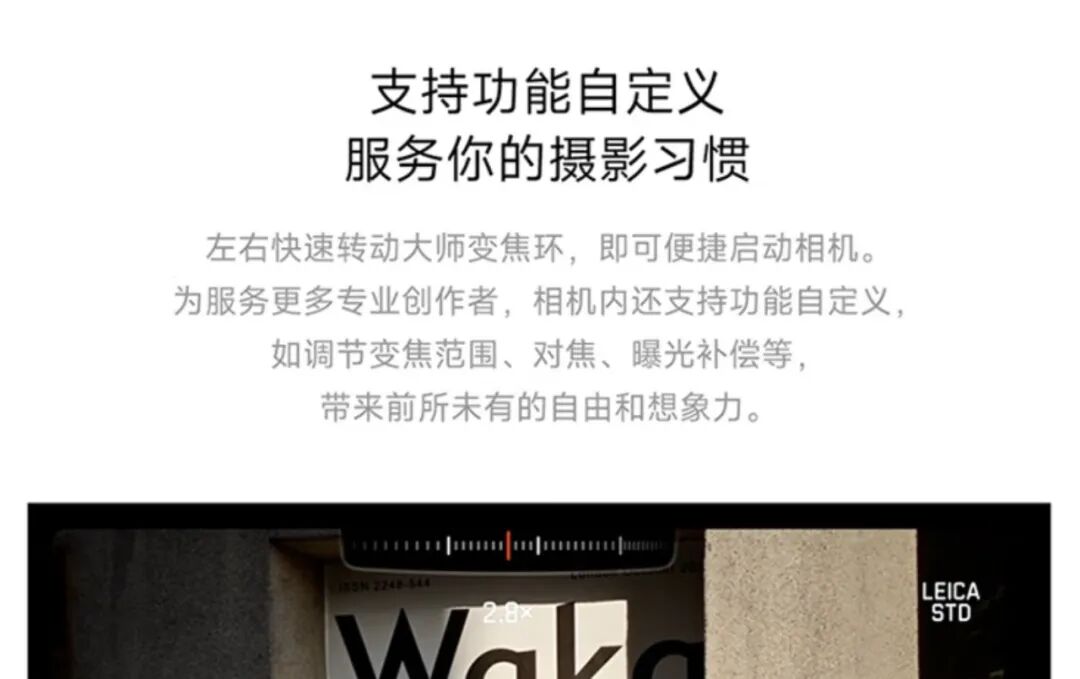
However, when Lu Weibing was passionately introducing this function on stage, he probably couldn't have imagined that in the week after the phone's release, all the public opinion issues that emerged were almost related to this Master Zoom Ring.
A topic that Xiaomi least wants to see: #Xiaomi 17 Ultra Zoom Ring Loose appeared on social platforms.
Unexpected Looseness
The first to discover the looseness problem of the Xiaomi 17 Ultra Master Zoom Ring were a group of hardcore digital bloggers.
According to the official script, turning the Master Zoom Ring on the phone and enjoying the various parameter changes should be one of the greatest pleasures of this phone.
However, when these bloggers actually got their hands on the phone, they found that things were a bit different: Not only was the damping feeling of the zoom ring relatively weak, but there was also an obvious play, that is, a clearance, when the zoom ring was turned. It would shake when gently pushed or moved with a finger.

Image source: Weibo @Lao 6 is me
Some bloggers even reported that when they gently touched the zoom ring on their phones, it would make a "clicking" or "creaking" noise.
For a top - of - the - line flagship phone with a starting price of 8,000 yuan, such a problem is obviously annoying.
In addition to the poor texture, some bloggers also reported that when shooting videos, if they turned or touched the Master Zoom Ring, it might not only accidentally change the video lens parameters, such as focal length and exposure, but also record this noise in the video.

Image source: Weibo @TODO Plus
Moreover, since the Master Zoom Ring is function - bound, for example, it will automatically turn on the camera when turned, and there will be a vibration feedback every time it is turned. When holding the phone vertically with one hand, if you accidentally touch the zoom ring, it will accidentally turn on the camera or give a vibration feedback simulated by the vibration motor, which is very annoying.
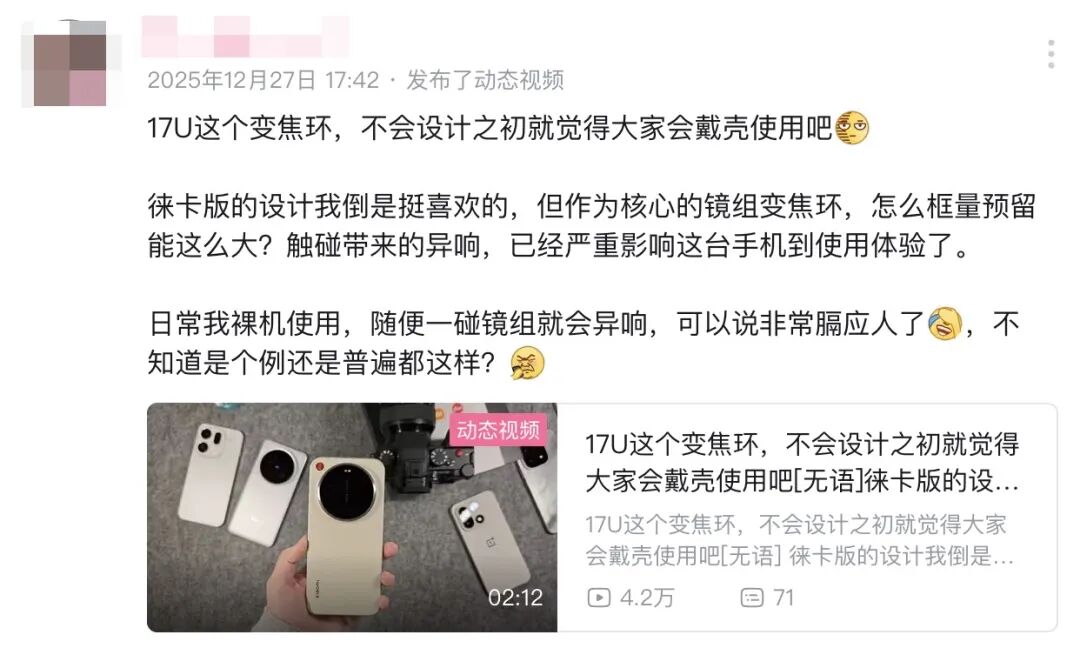
In this way, this looseness problem has escalated from a simple texture issue to an "experience accident".
At first, those who reported this problem were basically consumers from the retail end. Some people speculated that this small problem might be due to different batches, such as poor quality control in the mass - production version?
So, actually, two days before the phones were delivered, some bloggers compared the phones they bought with the display models in offline retail stores and found that some display models' zoom rings were indeed tighter. Later, as the first batch of purchased phones were gradually shipped, more users found that the zoom rings on their phones were loose. After comparison, they confirmed that the display models were also loose.
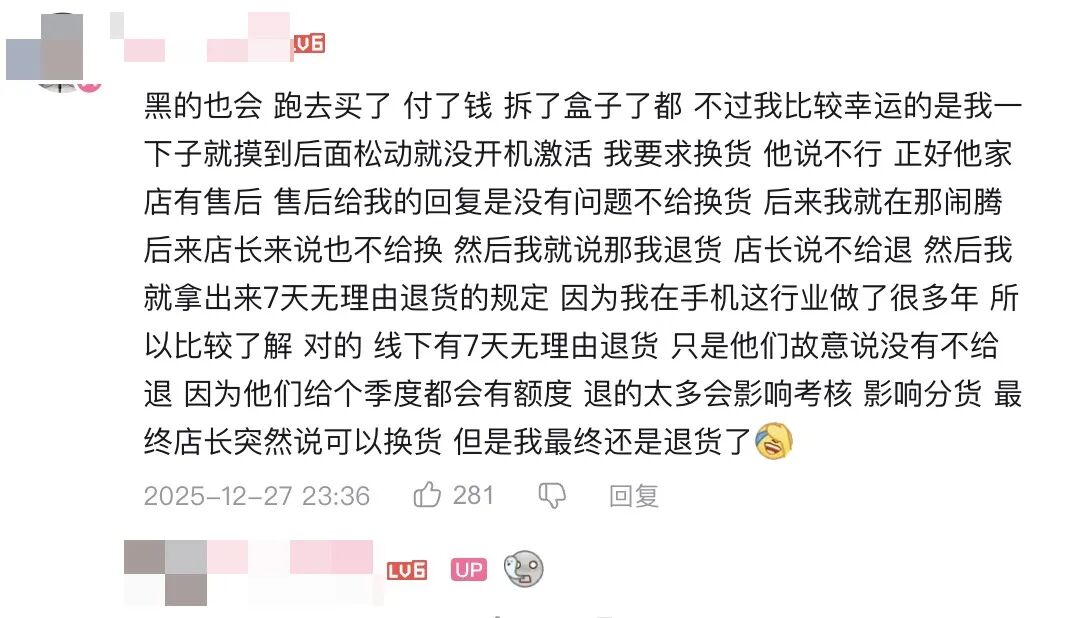
The only "mysterious" difference is that the zoom ring of the black version is a bit tighter than that of the white version. Online, there has been a group of phone owners who have exchanged their phones or even returned them due to the looseness problem.
In response to this problem, five days after the incident fermented, Xiaomi officially responded in an article titled "Answers to Netizens' Questions" on December 30.
However, this response seemed more like an "advertisement". It simply stated that the "slight displacement" and "slight sound" were due to the "reserved movement space".
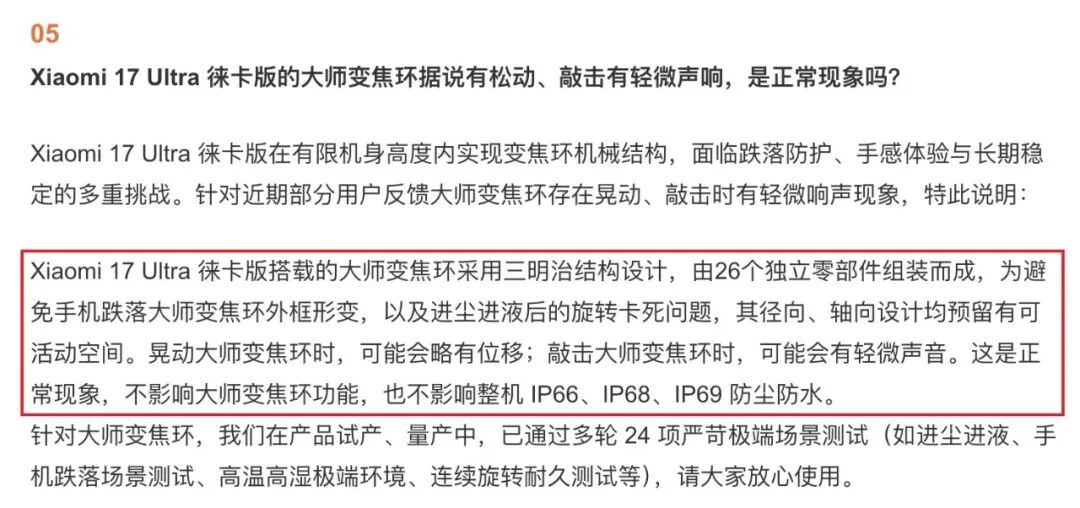
This short passage obviously failed to dispel users' doubts.
Looseness Is Inevitable
So, what is the real reason for the looseness of the Master Focus Ring? Actually, the answer is in the question itself.
To put it simply, the looseness is most likely the result of multiple factors, including the design of the zoom ring structure, the characteristics of the CNC process, and tolerances.
According to Xiaomi's introduction, the inside of the Master Zoom Ring uses a "precision mechanical transmission structure" with an integrated stainless - steel material and 20 high - strength ball bearings for support.
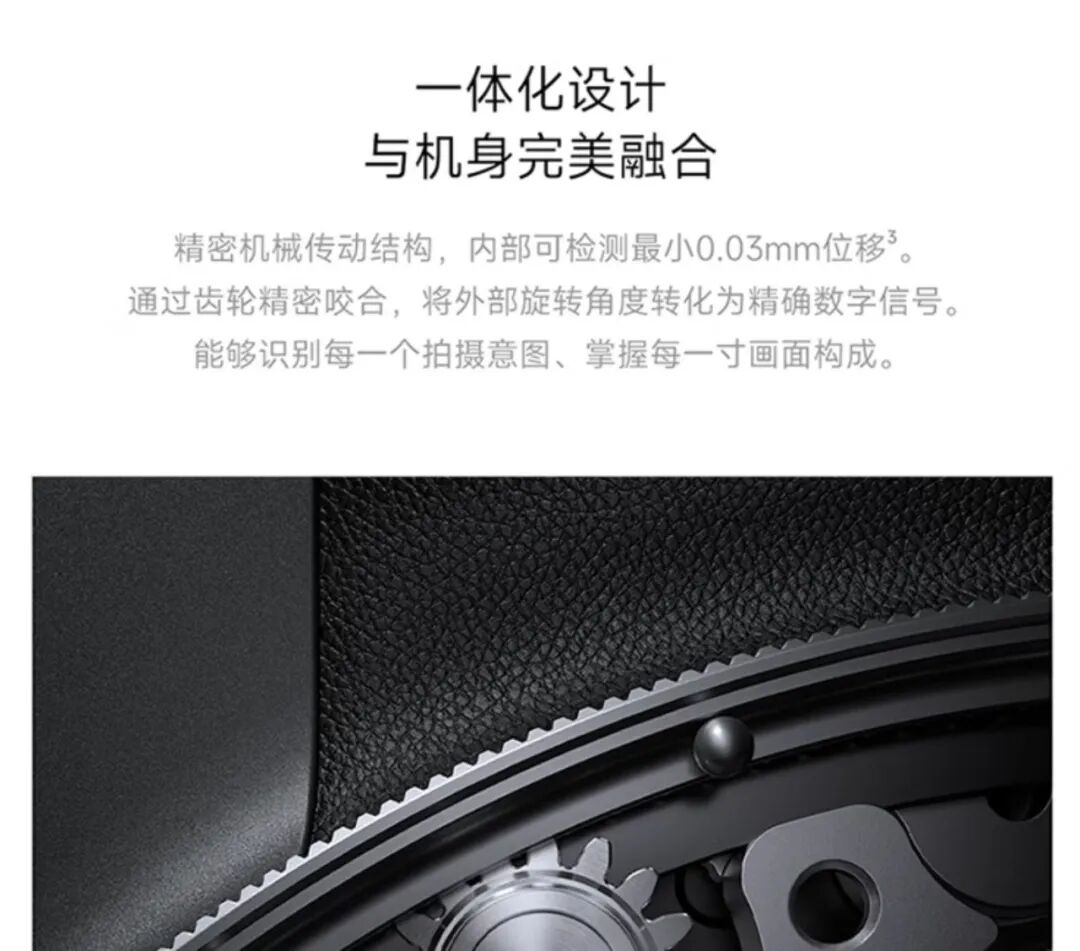
As Xiaomi officially said, from a structural perspective, a physically rotatable mechanical component is more likely to have problems such as slight looseness, insufficient damping, or a sense of clearance during manufacturing, assembly, and daily use compared to the traditional design without mechanical moving parts.
To maintain flexible movement and prevent the structure from getting stuck due to a drop impact, a certain amount of movement space is reserved.
However, the key problem is that the tightness varies with different colors. Even if it is reasonable to reserve movement space, there is no reason for some to be tighter and some to be much looser.
Actually, this is what Xiaomi official didn't mention: manufacturing discreteness, which in plain language means "randomness".
The most core variable comes from the "instantaneous state dependence" of CNC machining. The key dimensions (such as inner diameter and coaxiality) of the metal outer ring highly depend on the thermal stability of the machine tool.
The temperature rise after continuous operation of the machine tool and the periodic jump of tool wear will cause the part dimensions to fluctuate at the micron level. What's more subtle is the consistency of the assembly temperature - when metal parts and plastic parts are combined at different temperatures, the release of residual stress will cause slight deformation.

Once these parts that are qualified in static measurement are installed together under different "thermal states", it creates the "mysterious" difference of "this one is tight, that one is loose".
This difference will ultimately directly affect the product tolerance.
In the high - temperature and high - frequency usage scenarios of mobile phones, the zoom ring involves at least the tolerances of multiple layers of structures, such as the outer ring, support structure, rotating transmission parts, and sensing elements. These tolerances will be superimposed in engineering. Eventually, when the phones reach consumers, some will be looser and some will be tighter.
On this basis, the damping setting further amplifies this perception. Obviously, the Master Zoom Ring doesn't adopt the "oily and heavy - damping" scheme like camera lenses. Instead, to ensure smooth one - hand operation and prevent novices from thinking it's stuck, it chooses the "light - damping" route with a very low starting torque.
Light damping means it can't "absorb" the structural clearance like thick grease. Instead, it makes the idle stroke very obvious and easily detectable by fingers.
In other words, this "looseness incident" is most likely not due to part detachment or quality problems. It is an engineering regret left after making concessions for smoothness, durability, and mass - production yield in an extremely compact space.
The Value of "Copying Homework"
Seeing the core innovation of Xiaomi's annual flagship phone mired in public opinion, one can't help but wonder: In the current technology and digital field, what kind of innovation is good innovation?
Is it judged by public opinion and word - of - mouth? It seems not.
Looking back at October this year, when Xiaomi announced the launch of the Xiaomi 17 Pro with a "rear screen", the online community almost unanimously criticized it, mocking it as "differentiating for the sake of differentiation". But what was the result? The 17 Pro series sold nearly 3 million units in two months with this rear screen that was not well - regarded, outshining the competition.
Then, is it judged by sales data? It seems not either.
The iPhone 16 series still sold tens of millions of units globally, but the newly added "photo button" became the biggest sore point for users. It even forced third - party accessory manufacturers to develop a "useless - button case" to block it, treating it like an appendix to be removed.
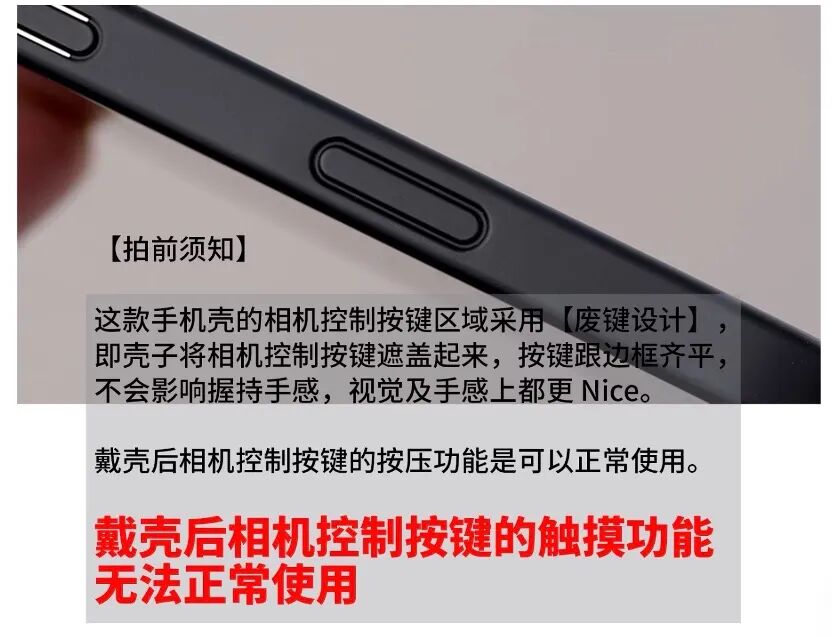
This creates a very paradoxical phenomenon: A product with good sales may have a "poor design", and a product with bad word - of - mouth may meet a "real need". If we use sales or public opinion as the judgment criteria, no one can convince the other.
Perhaps, in the current digital technology market, there is a most honest and real gold standard: Whether competitors follow suit.
Since this year, there have been countless Android phones following Apple's lead in adding a photo button; Huawei's triple - fold design has become the object of Samsung's follow - up and was launched earlier; the much - criticized "fat - fold" design is likely to be the size that Apple's folding - screen phone will follow next year, and Samsung is also preparing to launch a similar "fat - fold" product.

Why do these imperfect innovations still attract competitors?
Because these innovations touch on a more fundamental logic than "functional experience": They attempt to define the next - generation interaction mode or product form.
This kind of innovation can bring not only a short - term increase in sales or an improvement in word - of - mouth. It also has the opportunity to become the "industry - defining power".
And this is exactly what Xiaomi phones need to learn the most at present, and it is also a lesson that Xiaomi cars have already learned well.
When the SU7 was launched, the sun - protection sunroof, the phone holder with pre - drilled screw holes from the factory, and the large front trunk, which were originally looked down upon by traditional car manufacturers, all became strong promoters for the Xiaomi SU7 to sell over 25,000 units per month.
Throughout 2025, these designs have almost become the "standard configuration" for new domestic new - energy vehicles. In future domestic new - energy vehicles, it is very likely that these innovations will continue to shine.
In contrast, there is no news of any competitor following the rear - screen design that helped the Xiaomi 17 Pro sell well. After this public - opinion incident, the future of the zoom - ring innovation is even more uncertain.
So, what Xiaomi phones currently lack may be the kind of penetrating innovation at the level of Xiaomi cars.
To put it more directly, it is the answer that makes competitors "rush to copy".