Hillhouse and Meituan invest in a Shenzhen-based team
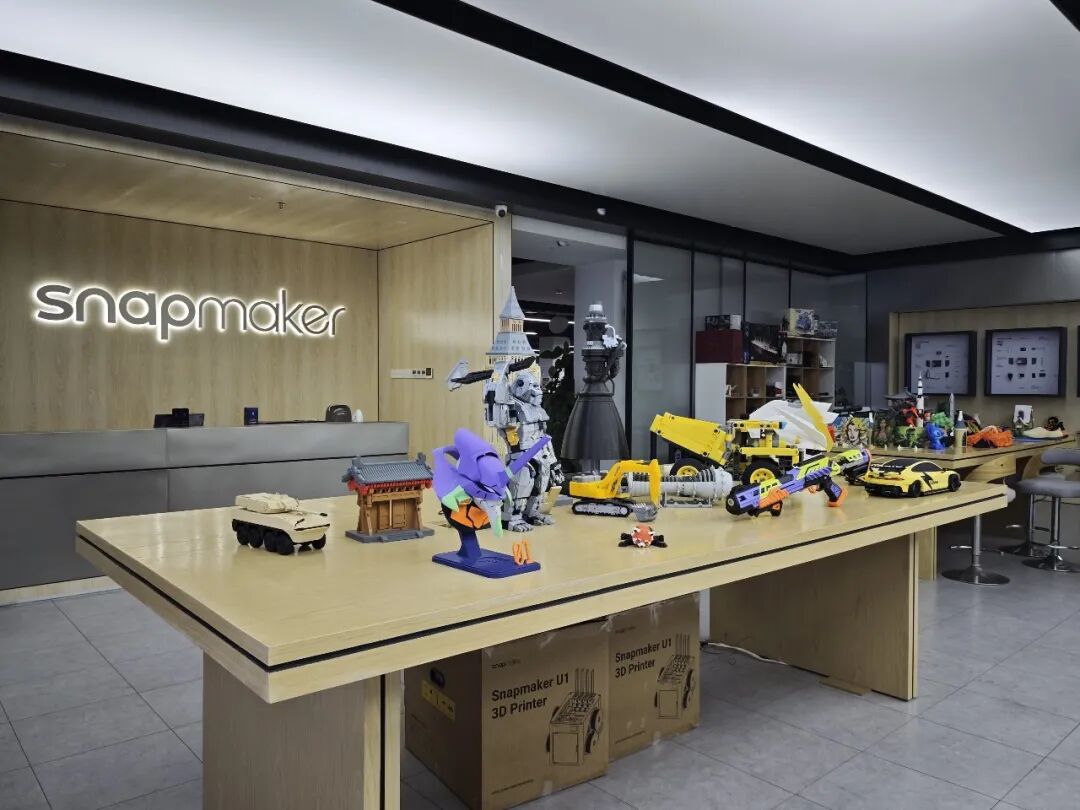
Near the University Town in Nanshan, Shenzhen, taking the elevator directly to the 4th floor, a showroom of about 100 square meters comes into view, filled with various 3D printing and laser engraving works. Walking deeper into the showroom, there is a man in a black short-sleeved shirt at a corner workstation, blending in with the dark background.
The investment community met Chen Xuedong, the founder and CEO of Snapmaker - shy, immersed in work, with various R & D samples and printed models placed on the table.
This is also the rough impression left by the founding team of Snapmaker on us, which is not much different from the geek image in our minds. In contrast, this 3D printing startup team is on the rise. Not long ago, it completed a Series B financing of hundreds of millions of yuan co-led by Hillhouse and Meituan.
This scene has also become the latest portrayal of the booming hardware startups in Shenzhen.
The Rise of a 3D Printing Team
"He is an INTJ - an architect personality. He is not good at speaking, but he knows what he wants and won't easily compromise once he makes a decision." Ke Shuqiang, the co-founder of Snapmaker, talked about Chen Xuedong.
Chen Xuedong is from the same hometown in Quanzhou as Ke Shuqiang and is also his high school senior. Both graduated from Quanzhou No. 7 High School. As early as in school, Chen Xuedong started participating in robot competitions and had the idea of starting a business. Ke Shuqiang remembers that at that time, Chen Xuedong often slept in the stadium for the competitions, and his persistent character was evident even in his student days.
Later, Chen Xuedong won the championship in the WRO International Robot Olympiad and was recommended to study mechanical automation at Xiamen University. After graduation, he joined the Xi'an Research Institute of AVIC; while Ke Shuqiang entered Fudan University to study economics and once worked at Huatai Asset Management.
The idea of starting a business never faded. "I want to create a tool that can meet general creative needs and allow everyone to freely create in the physical world." In 2016, Chen Xuedong gathered several former colleagues from his previous company and officially started the business. Later, the first multi-functional printer was born, integrating 3D printing, laser engraving, and CNC engraving and cutting.
During the Spring Festival in 2019, Chen Xuedong and Ke Shuqiang met in their hometown in Quanzhou. After a conversation, Ke Shuqiang was also impressed by this vision and chose to join. That was the third year after the establishment of Snapmaker, and the team became stable.
Also in that year, Snapmaker received a pre-Series A financing of 20 million yuan from Ceyuan Ventures. In the following years, it received financing from institutions such as Matrix Partners and Orient Securities Capital. So far, few people know the story of Chen Xuedong selling his house in Xiamen for the business, but it is still circulated among familiar investors.
The turning point was in 2023. Snapmaker's revenue hit a bottleneck. If it continued to produce the "three-in-one" product, the R & D speed might not keep up with the market iteration, and the cost - performance ratio of the product would be compromised. The team began to consider whether to adjust the strategy.
"It would be very painful for me if we only made a niche product." At the moment of decision - making, Ke Shuqiang heard Chen Xuedong say. Finally, the team decided to abandon the "three-in-one" concept and focus on 3D printing.
Two years later, the new product U1 was launched. It is the first printer with an independent four - head parallel system. It raised over 150 million yuan in crowdfunding on Kickstarter and became the 3D printing project with the highest crowdfunding amount globally. Since then, Snapmaker became well - known, and the number of visiting investors increased sharply.
In December 2025, Snapmaker received the most luxurious round of financing since its establishment - co-led by Hillhouse Capital and Meituan, with Shunwei Capital, Meituan Longzhu, and Nanshan Strategic New Industry Investment following, and old shareholders Ceyuan Ventures and Orient Securities Capital continuing to increase their investment. This is Snapmaker's Series B financing, with an amount of hundreds of millions of yuan.
"Next year's revenue target will increase several times compared to this year. It's not an aggressive goal. We are moving from products to an ecosystem." The Snapmaker team revealed to the investment community. To some extent, this round of financing is a microcosm of the booming 3D printing track in 2025.
Searching for the Next Tuozhu
"Just in the second half of the year, dozens of waves of investors have come looking for us." Another 3D printing startup also located in Shenzhen told us about this situation.
There was a time when this was not a prominent track. 3D printing technology began to appear in the commercial field in the 1980s, but the popularity of consumer - grade 3D printing has only been in recent years. An industry insider regarded 2022 as a turning point in the industry - this was also the time when Tuozhu truly came into the public view.
In just three years, Tuozhu has leaped from a low - key "small company" to the hottest unicorn with a valuation of over 10 billion US dollars. In the early days, it had a group of investors such as IDG Capital, Temasek, True Light, Wuyuan Capital, and Mingshi Investment. Now, many investors who missed the opportunity regret that they can no longer invest.
"After Tuozhu's success, investors have been looking for projects along this track." A hardware investor in the Greater Bay Area mentioned, "Everyone is looking for the next Tuozhu."
Even DJI has entered the fray and invested in the 3D printing company Smartpie. Few people outside know that Smartpie was founded by Hong Yingsheng, a post - 90s from Chaoshan, in 2015 and later entered the 3D printing track. Previously, the company received a Series A financing from Shenzhen High - tech Investment Group. The recent round of financing also triggered Tao Ye, the founder of Tuozhu, to "protest" against DJI on his WeChat Moments due to a clause related to Tuozhu.
In addition, "Lightweight Manufacturing", founded by Wang Zhiyu, the former head of Anker's 3D printer, also announced the completion of angel - round financing, led by Haixin Capital and followed by Nanshan Strategic New Industry Investment; almost at the same time, the 3D printing service provider "Jinshi 3D" also received a new round of financing from Longchu Fund, Shengshi Investment, Rongyi Investment, etc.
The competition has begun. Creality has submitted a prospectus to the Hong Kong Stock Exchange, with a group of investors such as Tencent, Shenzhen Capital Group, and Qianhai FOF in the background. If it goes public successfully, the Hong Kong Stock Exchange will welcome its first 3D printing IPO.
"Three years ago, when meeting with investors, we were all discussing how big the market was. Now, we basically only discuss the competitive landscape." After meeting many investors, Ke Shuqiang felt the changes in the industry.
Now, Tuozhu Technology stands alone in the first echelon. Creality, Anycubic, and Smartpie are collectively called the "Four Little Dragons of Consumer - Grade 3D Printing" with Tuozhu. Together with a group of rising stars like Snapmaker, which has just received financing, the battle has quietly begun.
"The competition has just started."
In Nanshan, Shenzhen, Tuozhu's first flagship store is hidden behind a water curtain. In the center of the store is a sand table, piecing together a corner of the city. An employee told the investment community that every plant and every object in it comes from a 3D printer. Since its opening, the small cars on the sand table have been constantly shuttling between the city tracks, and the crowd outside the sand table has become more and more crowded.
China's Hardware Silicon Valley
Investors have gradually found that almost every well - known consumer - grade 3D printing enterprise is located in Shenzhen.
This is not a coincidence.
Shenzhen is not only the base for 3D printing but also the gathering place for consumer hardware. When choosing a city to start a business, Ke Shuqiang had two factors to consider - talent and the supply chain. First, there needs to be a diverse supply of talent, and almost any hardware talent can be found in Shenzhen; second, it is the supporting supply chain. Now, no place in the world can compete with the Greater Bay Area.
Not long ago, an intelligent hardware enterprise that grew up inland quickly moved to Shenzhen after receiving a new round of financing. The founder admitted, "When the company reaches the growth stage, this is the only choice." In the communication with the investment community, such stories are happening whether it is a unicorn with a valuation of billions or an early - stage company that has just received angel - round financing.
"Looking at the world, this city is the most complete, perfect, and advanced consumer hardware center. No matter where your company is from, if you are doing hardware for the overseas market, you will inevitably have to deal with Shenzhen." Song Chang, a partner of Qifu Capital, has a deeper feeling about this.
At the same time, Shenzhen is also sparing no effort to attract hardware startup teams.
Just in early December 2025, the "X - Day" Xili Lake Roadshow Club Kickstarter Technology Innovation Globalization Special Session was held at the International Conference Center of Shenzhen University Town. A group of hardware startups such as Benmo Technology, Sunao Technology, Mengli Innovation, Natural Chenji, Laimu Technology, and Ruiman Intelligence all attended.
As an important carrier of the science and technology financial services in Nanshan District, the "X - Day" event has been held 11 times, promoting more than 2,900 institutional connections, helping 17 enterprises obtain a total equity financing of over 530 million yuan, 16 enterprises obtain new bank credit of over 252 million yuan, 7 technology insurance policies have been implemented, providing 80.5 million yuan in product guarantees.
Behind this is the support of the global service center GoGlobal and the creative crowdfunding platform Kickstarter. Not long ago, the first Kickstarter - officially authorized offline space in China jointly launched by the two parties - the INNO100 Global Innovation Flagship Store officially opened for business. A group of hardware products well - known overseas are gathered here, and their headquarters are all in Shenzhen.
"You can easily find a 985 engineering team, and you can find all service providers within a half - hour drive. This is the charm of Shenzhen." On - site that day, a post - 00s hardware founder joked, "This is the only city - where you only have 5 yuan in your pocket, eating a discounted meal, but still can tell your friends in a coffee shop that 'I'm going to earn 1 million next year', and no one will laugh at you."
This article is from the WeChat official account "Investment Community" (ID: pedaily2012), author: Yang Wenjing, published by 36Kr with permission.