One trillion. This year, startup financing in Silicon Valley hit a record high.
According to an industry statistic, the hottest startups in Silicon Valley have raised $150 billion (approximately 1.05 trillion RMB) this year as their financial backers advised them to build "fortress-like" balance sheets to protect them from a potential cooldown in AI investment next year.
PitchBook data shows that in 2025, the financing of the largest unlisted companies in the United States reached a record high, far exceeding the previous record of $92 billion in 2021, as venture capital firms rushed to support top AI companies such as OpenAI and Anthropic.
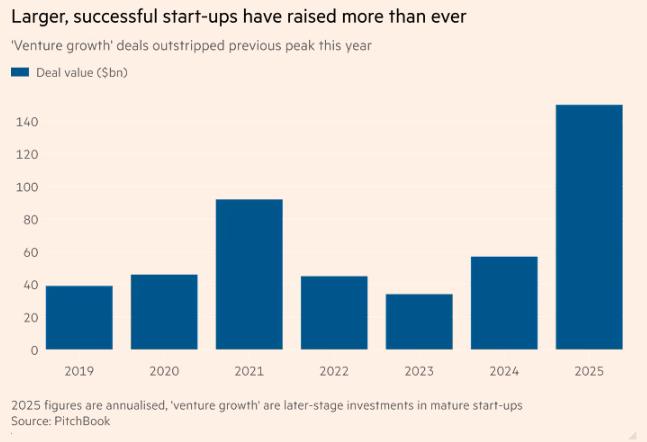
Venture capitalists and industry experts say that this funding will help protect startups from potential future investment downturns - as the public market has begun to worry about the huge spending on AI infrastructure - and will also fuel their growth.
Lucas Swisher, a partner at Coatue, which has invested in OpenAI, Databricks, and SpaceX, said, "You should make hay while the sun shines. There could be unexpected variables in 2026... Build an invincible balance sheet when the market presents an opportunity."
OpenAI and Others Flex Their Financial Muscle
The surge in financing this year is mainly due to several unprecedented large-scale deals. These include a $41 billion financing round for OpenAI led by Japan's SoftBank, a $13 billion financing round completed by Anthropic in September, and Meta's investment of over $14 billion in data annotation startup Scale AI.
Other fast-growing AI companies, such as programming agency Anysphere, search company Perplexity, and AI research startup Thinking Machines Lab, have also raised funds from venture capitalists multiple times this year.
Multiple investors said they have advised startups to build sufficient reserves while people remain highly enthusiastic about the economic potential of AI transformation.
Ryan Biggs, co-head of Franklin Templeton Ventures, pointed out: "For startup founders, the biggest risk is underfunding - once the funding environment dries up, the company's value could go to zero... Or you can accept a small amount of equity dilution, which actually doesn't matter as long as the business is successful: either way, you'll be extremely wealthy."
Data from software group Carta, which tracks the private market, shows that in the past, startups typically raised new funds every two to three years. But recently, the best-performing AI startups are seeking financing again after just a few months - even though the funding channels for many small startups are drying up.
Biggs noted, "Investors are also leaning towards later-stage deals where the winners are more certain - there are only a handful of truly worthy companies, and the rest of the field is full of challenges."
A Direct Reflection of the AI Boom
Another driving force behind the financing boom in 2025 is that the growth rate of top AI companies far exceeds that of previous tech startups.
Take Anysphere, the developer of programming tool Cursor, for example. Its valuation has increased from $2.6 billion at the beginning of the year to $27 billion in November. During the same period, its annual recurring revenue (ARR) - a favorite metric among fast-growing startups - has increased by about 20 times to $1 billion.
Perplexity, an AI search engine company aiming to challenge Google, has raised funds four times in the past year, even though its executives have said they don't currently need more cash.
Cost pressures have also led to an increase in the frequency of financing, especially among companies building "cutting-edge" AI models that require massive computing power and expensive chips. According to people familiar with the matter, OpenAI's revenue in 2025 is expected to reach about $13 billion, but the company's annual investment in model development, product R & D, and infrastructure construction will still result in a loss of billions of dollars this year.
In the context of fierce competition in the AI engineer market, high-profile financing rounds also present an opportunity for startups to showcase their value to potential customers and employees.
"If I were a startup, I'd have to prove that my equity is worth more than a paycheck," Swisher said. He cited fintech group Ramp as an example of a startup using its soaring valuation as a tool to attract talent.
Through four rounds of equity financing this year, Ramp's valuation soared from $13 billion to $32 billion, raising a total of $1 billion in the process.
Notably, the frenzy of startup financing deals has also led to many venture capital firms burning through funds faster than expected. According to public documents and people familiar with the matter, some of the largest venture capital firms have started the process of raising new funds, including well-known private equity funds such as Thrive Capital, Andreessen Horowitz, and Tiger Global Management.
This article is from the WeChat official account "Venture Capital Daily", author: Xiaoxiang, published by 36Kr with authorization.