DingTalk, walking on two legs, needs to work twice as hard.
- After launching its first AI hardware, DingTalk A1, DingTalk released the enterprise-level AI hardware, DingTalk Real. These two products are like the ears and the body of AI DingTalk respectively.
- DingTalk is the only company among the three domestic intelligent office platforms that adopts the "software-hardware integration" approach. Compared with WeCom and Feishu, DingTalk has made large-scale and full-stack investments in the hardware field.
- If the software-hardware integration strategy is successfully implemented, software and hardware can support each other. However, if one lags behind, they may hinder each other. DingTalk, which chooses to develop both software and hardware, needs to work twice as hard.
Four months ago, when the AI version of DingTalk made its debut, Chen Hang (nicknamed Wuzhao), the founder of DingTalk, deliberately dropped a hint about a hardware product in an Easter egg at the end of the press conference.
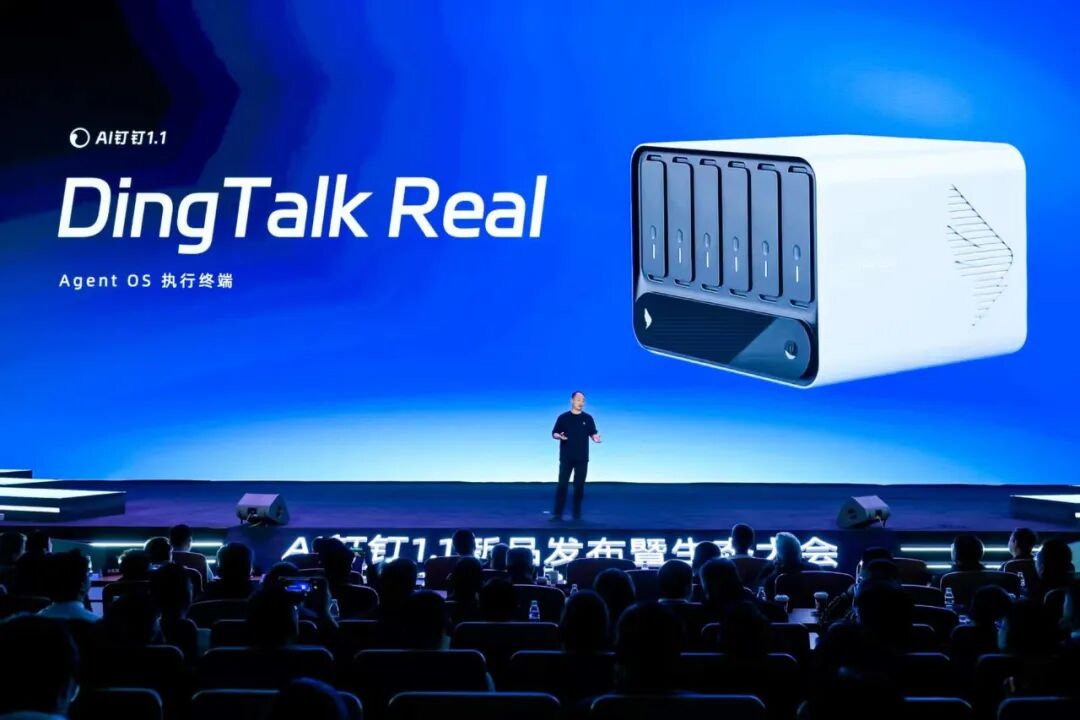
At the DingTalk AI 1.1 press conference on December 23rd, Wuzhao introduced more than 20 new products in over two hours. The enterprise-level AI hardware, DingTalk Real, was the first and the last product to be presented.
DingTalk describes it as the "body of AI".
Among the three major domestic intelligent office platforms, DingTalk is the only company that has injected a large amount of resources into hardware. Its positioning of hardware goes far beyond a simple extension of software functions.
After leaving Alibaba for four years, Wuzhao returned and steered DingTalk in a new direction within eight months. He transformed DingTalk from a function-oriented and process-driven collaborative office tool into an "AI-native product". It has built the Agent OS intelligent operating system, with AI agents as the main body and core, capable of actively understanding enterprise intentions and autonomously executing tasks.
As a result, the concept of "software-hardware integration" that DingTalk proposed eight years ago has reached a new level.
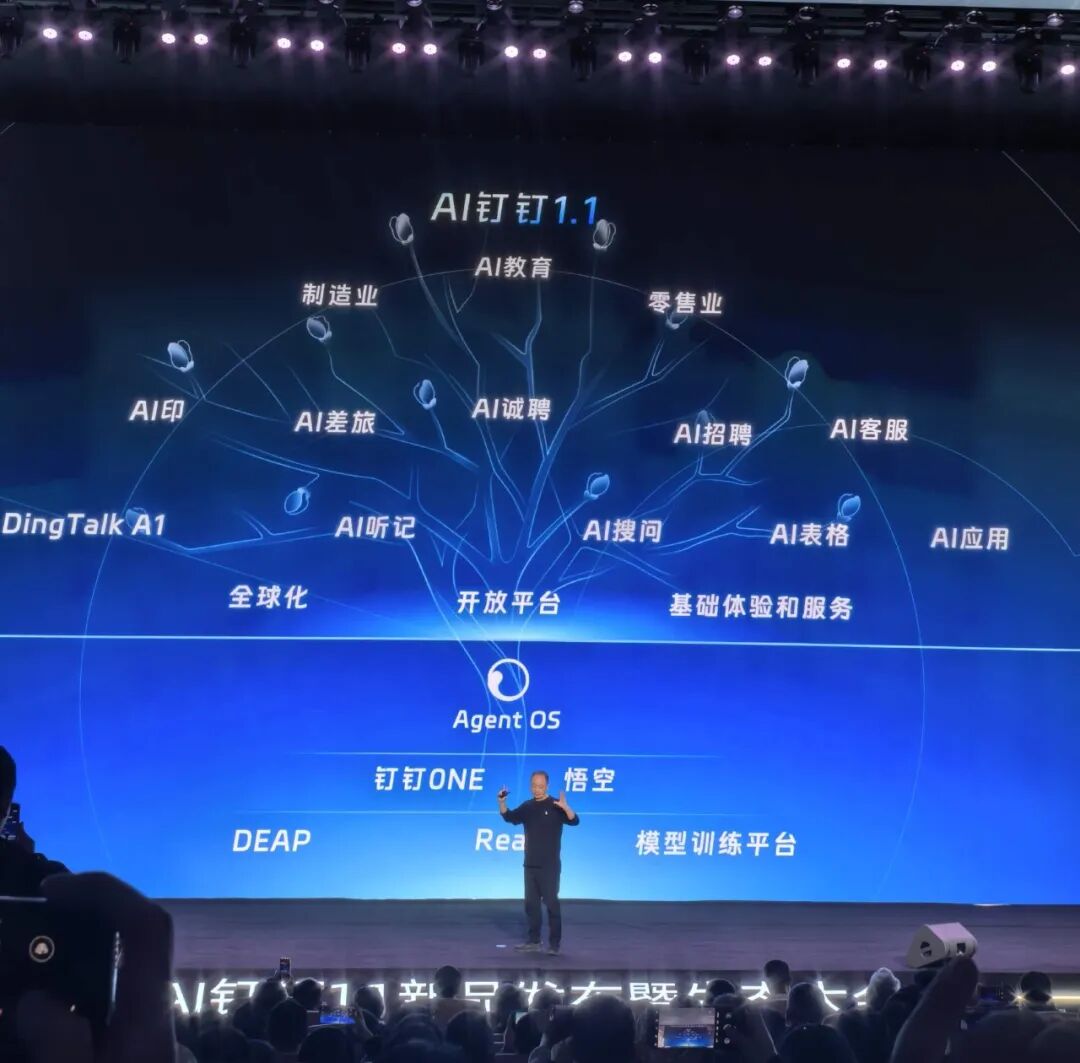
The Ears and Body of AI DingTalk
In 2017, DingTalk started to adopt the "software-hardware integration" strategy.
At that time, the main approach was to combine software capabilities such as attendance management and approval with simple intelligent hardware (such as attendance machines and printers) to solve basic office automation problems. Hardware existed as an extension and supplement to software functions.
In 2025, with DingTalk's rapid reconstruction towards AI, the positioning of hardware has undergone a revolutionary change.
DingTalk's first AI hardware, DingTalk A1, is defined as an AI-driven voice intelligent assistant and the "ears" of AI DingTalk, tasked with "completely changing the way of work recording". It is designed as a card-shaped device that can be attached or pasted on the back of a mobile phone for easy portability and multi-scenario use.
On the surface, DingTalk A1 looks no different from a voice recorder. In real life, users often refer to it as the DingTalk voice recorder because its functions, such as recording, voice-to-text conversion, translation, and meeting minutes generation, highly overlap with those of a voice recorder.
However, as an intelligent hardware derived from B-side needs, the influence of DingTalk A1 is not limited to individuals. In the long run, it is expected to be a "team work assistant", aggregating communication and meeting data of team members to achieve information aggregation, opportunity insight, and form organizational intelligence.
DingTalk Real is the body of AI and the execution terminal of Agent OS. Agent OS is an AI intelligent operating system developed by DingTalk to run and coordinate AI agents. Therefore, DingTalk Real essentially serves agents. With enterprise or user authorization, it can access all external network information and services and read internal network data under permission control, making judgments and executions based on real-time data.
During the operation of agents, DingTalk Real supports the monitoring and auditing of the execution process, the control of permissions, and the secure storage of memory.
"What if an agent goes out of control?" At the press conference, Wuzhao asked and answered himself, "We have an emergency function: unplug it!"
In addition to the "ears" and "body", DingTalk wants to equip AI with more connectors and execution terminals to perceive the physical world.
The educational intelligent hardware, the "AI Homework Grading Machine", looks like a photocopier. It can grade 100 test papers every four minutes, support complex question types such as matching questions, handwriting recognition, and spelling error judgment, and automatically generate student performance analysis reports and wrong question notebooks. DingTalk official claims that the grading accuracy of primary, junior, and senior high school questions can reach over 99%.
As long as there is market demand, it seems that all traditional office equipment can be reinvented.
DingTalk has partnered with Xiaobing Technology to launch the intelligent hardware "AI Receptionist Hi1", which can be on duty 24/7 and actively greet guests. It has also collaborated with Modian Technology to release an intelligent salary calculation and attendance machine. Moreover, it has launched an anti-recording magic box to block all recording devices.
Why Build the Most Comprehensive AI Office Solution?
Among the three major players in the intelligent office market, DingTalk is the only company that adopts the software-hardware integration strategy.
WeCom is deeply rooted in the rich WeChat ecosystem and is an extension of Tencent's social gene in the enterprise sector. Its main battlefield is connection and communication, which is the digitalization of "relationships". Its core "hardware" is actually the mobile phone, along with the connected camera and microphone. It has a relatively low dependence on dedicated office hardware.
Feishu is the productization of ByteDance's concept of efficient collaboration, aiming for an ultimate software experience. It advocates the "All-in-One" approach, targeting to build a comprehensive office suite at the Office level. In terms of hardware, Feishu takes an open-ecosystem approach, not engaging in in-house R & D but relying on third - party hardware manufacturers to adapt to its system, positioning itself like a "universal socket" compatible with various devices.
Only DingTalk has made large-scale and full-stack investments in the hardware field.
Fundamentally, this may be related to the genes of its parent company. The essence of e-commerce is the combination of online information flow, offline logistics, and capital flow. From e-commerce, new retail to local life, Alibaba has always been committed to breaking the boundary between online and offline. This "online-offline integration" gene is naturally manifested as the strategic choice of "software-hardware integration" in the enterprise service field.
As for Wuzhao himself, after leaving Alibaba to found "Liangqing Yiyang", he launched hardware products such as Bluetooth earphones and intelligent cat litter boxes. He has the willingness and practical experience to transform traditional manufacturing with an Internet mindset and build AI hardware.
From a practical perspective, using physical carriers to perceive the world and execute tasks is a challenging but rewarding long - term investment for DingTalk.
Firstly, through hardware, DingTalk can solve some pain points that pure software cannot address, bridging the "last mile" of execution.
For example, as a physical entity deployed in the enterprise internal network, DingTalk Real can keep data within the internal network firewall. In extreme cases, physically cutting off the power can provide the most direct security guarantee, alleviating enterprises' concerns about AI getting out of control. Another example is the AI Homework Grading Machine. By changing the hardware form and embedding AI capabilities, it is extremely easy to operate and does not require complex deployment. Once verified by the market, it can be quickly implemented in primary and secondary schools.
Secondly, hardware terminals are data entry points in the physical world. After AI processing, various types of unstructured data, such as meeting recordings, one - on - one conversations, and primary school students' test papers, can be accumulated as enterprise knowledge bases or used as nutrients for large models, making AI smarter with use. The evolved AI capabilities can in turn enhance the value of hardware, forming a positive cycle of "hardware data collection - AI capability optimization - hardware experience upgrade", which is the core logic of all AI hardware.
Finally, when hardware extends to various physical spaces such as meeting rooms, reception desks, and workshops, widely occupying office scenarios and deeply integrating with enterprise production, operation, and management systems, it means a higher platform switching cost for enterprises and stronger customer stickiness.
Another invisible benefit is that hardware lowers the threshold for AI adoption.
Traditional industries, including manufacturing, are DingTalk's advantageous battlefields. The sensitivity of these industries to cutting - edge technologies is often limited by cognitive barriers and usage habits. A tangible physical hardware allows DingTalk to start from a specific pain point, change the original work mode of enterprises with intuitive efficiency improvement, and unlock broader application space.
DingTalk A1 has the characteristics of a "leading product".
It is not only an independent recording and translation device but also a physical entry point to the DingTalk office ecosystem. It integrates with DingTalk AI note - taking and coordinates with functions such as DingTalk ONE and AI Spreadsheets, supporting the one - click conversion of meeting voices into structured minutes and traceable to - do tasks, realizing that recording is a workflow.
Therefore, although the software - hardware integration model is challenging, it can both pave the way and build a moat for DingTalk.
Wuzhao's "Uncharted Territory"
Developing hardware is a painstaking task that requires repeated refinement and pursuit of excellence.
DingTalk A1, which was officially launched in September this year, has topped the "Best - selling Voice Recorder List" on Tmall and Douyin.
When talking about the product's performance at the time of its launch, Wuzhao did not shy away from the fact that users feedback it was "not user - friendly". In some aspects, DingTalk A1, as a voice recorder, was still inferior to similar products.
Within more than three months, more than 160 functions of DingTalk A1 have been optimized and upgraded. It has co - created and optimized with users face - to - face for 2000 person - times, and the model is iterated every two weeks. DingTalk has also created a group called the "DingTalk A1 User Home", with more than 5000 members. Messages pop up from morning to night, including problem feedback, complaints, and suggestions, and product managers often reply.
Wuzhao sighed that innovation in China is a painful process. "Innovation means that the team has to enter uncharted territory."
When leading the team through the uncharted territory, Wuzhao also has to deal with internal pressure. "Everyone will ask you why you do things this way. I can't give a clear answer either. I just feel it should be done this way."
As the AI - to - B entry point that Alibaba has heavily invested in, DingTalk undertakes the mission of enabling Tongyi's large - model capabilities to be implemented in various industries, closing the loop of "technology - scenario - revenue", and helping Alibaba establish dominance in the next - generation enterprise service market. The judgment of the helmsman often determines the fate of the product.
If the software - hardware integration strategy is successfully implemented, software and hardware can support each other, like players on the court passing the ball to break through the opponent's defense and score. However, if one lags behind, they may hinder each other. Either the software experience will be dragged down by hardware, or the value of hardware will be limited by the software ecosystem and cannot be fully released.
DingTalk, which chooses to develop both software and hardware, needs to work twice as hard.
On the positive side, after experiencing entrepreneurship, Wuzhao has a deeper understanding of the needs and pain points of enterprises, especially small and medium - sized enterprises, and has a stronger cost - awareness. When developing the AI business travel agent, DingTalk's core idea has shifted from focusing on service to "helping enterprises save money". After entrepreneurship, Wuzhao realized that affordability is the key and self - mocked that he had the "big - company disease of Alibaba".
Near the end of the press conference on the 23rd, DingTalk issued a co - creation invitation letter signed by the "CEO of DingTalk", offering 1000 units of DingTalk Real at a monthly price of 199 yuan, inviting partner enterprises for in - depth co - construction.
This software - hardware integrated product that Wuzhao said he was "working desperately on" is a bold attempt by DingTalk in the Agent era. However, in the face of the grand goal of "thousands of agents collaborating with humans", DingTalk is just at the beginning of the sowing period.
This article is from the WeChat official account "Xuebao Finance Society" (ID: xuebaocaijingshe), author: Xuebao Finance Society, published by 36Kr with authorization.