Manus Sells for Billions: The Only Keyword for China's AI Applications | Deep Dive
Text by | Zhou Xinyu
Edited by | Su Jianxun, Yang Xuan
Take AI Products Global: Introverts Need to Be Extroverted, Extroverts Need to Be Bold
In late December in Singapore, the 30°C air still carried a humid and hot smell. In a WeWork near the Funan Mall in Singapore, it's common to encounter Chinese faces speaking Chinese. The working environment here is not much different from that in China. You can have Yoshinoya and hot pot in the basement for less than 5 Singapore dollars (less than 30 yuan), and there's a Pure K on the 4th floor.
The AI star company Manus is located here. This AI company founded by Chinese people has reached a historic moment.
At Beijing time on December 30, 2025, Manus' "Butterfly Effect" was reported by media such as Bloomberg to have been acquired by Meta at a price of over 2 billion US dollars. After the acquisition, Butterfly Effect will continue to operate independently, and its founder, Xiao Hong, will serve as the vice president of Meta.
According to Intelligent Emergence, Xiao Hong will report directly to Meta's COO Javier Olivan and will be mainly responsible for some commercialized products within Meta. While retaining its original business, the Butterfly Effect team will be responsible for developing Agent tools for Meta internally.
The significance of this acquisition lies not only in the extremely short time frame and large capital scale but also in proving that Chinese AI applications have the possibility of bargaining with giants on the global stage. Manus received Meta's third - highest acquisition offer in history in less than a year since its establishment.
Wang Tianfan, a partner at BAI Capital, said bluntly on Jike: "Most likely, the returns for investors after the recent listings of all Hong Kong - listed companies are not as good as this cash acquisition."
Chinese AI applications going global have thus left a glorious footnote.
Over the past year, it can be said that there is only one keyword for Chinese AI applications: Going global.
One autumn in Shenzhen, more than 300 AI entrepreneurs crowded into a meeting room. Xu Ming, the founder of the AI Coding company "Trickle", stood on the podium and shared how to achieve growth in overseas markets. His method is simple and straightforward:
1. Buy a book by a big shot overseas, such as the new book by Marc Andreessen, the founder of A16Z;
2. Take a photo of yourself reading the book and upload it to X, with the caption "The product Trickle I'm working on in my startup is inspired by this book.";
3. @Andreessen himself.
Then it's just a matter of waiting. Shortly after the post was published, Andreessen liked it. Subsequently, many "on - looker users" flocked to the Trickle website.

△ Recently, Xu Ming used Trickle to replicate the AI tool of Andrej Karpathy (former AI director at Tesla and a founding member of OpenAI) and got a like from AK himself on X. Photo source: Provided by the interviewee
"The simplest way to cold - start a product overseas is to ride on the popularity of overseas big shots and try to get close to them," Xu Ming told the audience. "I've done this many times. Big shots will definitely repost your content and give you likes, and then the traffic will come."
That day, Shenzhen was rarely hit by three typhoons in a row. But until the offline salon ended at around six in the evening, almost no one left early.
"They were more serious than when I was in school," a participant that day described.
At this offline salon organized by the overseas - going community Linkloud, a group of AI application entrepreneurs came to learn how to go global and how to find PMF (Product - Market Fit).
In the second half of 2024, AI application entrepreneurs were collectively inspired. The release of models such as Claude 3.5 Sonnet and Gemini 2.0, which have significantly improved reasoning and Agentic abilities, made the industry see the possibility of AI truly becoming a productive force from a "toy".
In an interview, Chen Mian, the founder of Lovart, mentioned that the improvement in the capabilities of models such as Claude allows AI to connect all tools and tasks and execute them.
As we all know, based on models such as Claude and Gemini, Chen Mian developed the AI design Agent Lovart, and these high - performance models have also become the targets of "shell wrapping" and are used in today's AI star applications such as Manus, Genspark, and Youware.
To take advantage of the technological dividends of the world's most advanced models and quickly seek commercialization opportunities, it has become a consensus among AI application entrepreneurs to set sail for markets in Europe, the United States, Japan, etc., which have high - paying customers and a mature M&A ecosystem.
Linkloud conducted several sets of questionnaires among the participants. At the beginning of 2025, 30% of the participants knew little about overseas markets. By the September salon, this proportion had dropped to 5%, and more than one - fifth of the participants even had a certain amount of income overseas.
When a large number of entrepreneurs ride the wave of AI globalization, competition will inevitably intensify.
In the United States, where an average of about 13,000 companies (data source: U.S. Census Bureau) apply for establishment every day, it's easy to imagine how fierce the competition for exposure resources is.
Eric, now the overseas market head of a Chinese AI company, has been in the United States for nearly 20 years. A journalist who moved from China to a San Francisco media told him that the number of pitch books he receives every day in the United States is more than ten times that in China.
For Chinese companies to break into the U.S. public opinion field, they have to make multiplied efforts. Before participating in a technology exhibition in the Bay Area, Eric "played a lot of Texas Hold'em and golf" and spent several years making friends with the organizers.
"To put it bluntly, doing PR in the United States requires you to 'flatter' and take the time to understand what kind of big news the local U.S. media needs," he summarized.
The anxiety about overseas competition has been transformed into the motivation to learn.
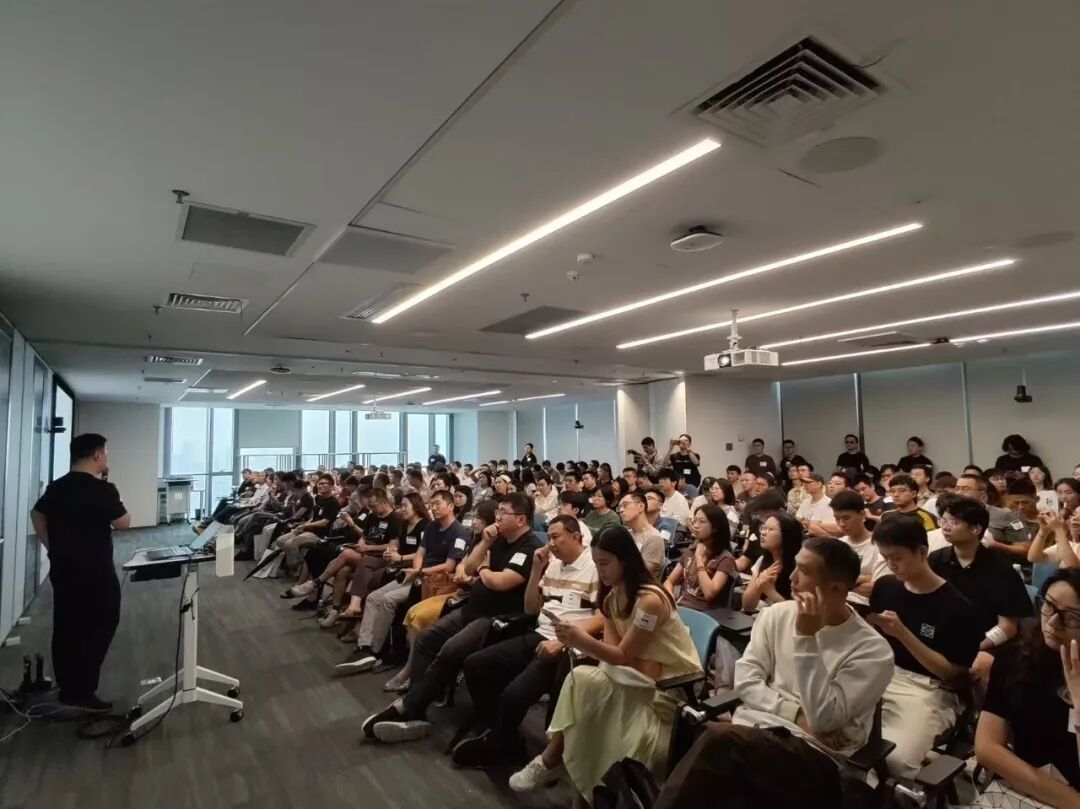
△ The scene of Linkloud's Shenzhen event. Photo source: Linkloud official
Among the more than 300 participants in the Linkloud Shenzhen salon, there are many star teams valued at over 100 million US dollars. For example, Notta, an AI meeting transcription product that earns tens of millions of US dollars annually in Japan, and ONE2X, an AI video creation company founded by Wang Guan, the former product manager of Dark Side of the Moon.
Before the event ended, Qian Jin, the co - founder of Linkloud, shouted to all the AI entrepreneurs present: "In the stage of developing AI products, introverts must become extroverted, and extroverts must be 'bold'."
The audience burst into laughter and applause.
Sandwiches, DeepSeek, and Chinese CEOs Adding WeChat Everywhere in Silicon Valley
This year, a strong consensus has been formed in the AI application startup circle: The future of AI applications is globalization, and the first stop of globalization is Silicon Valley.
After learning together in China, Chinese entrepreneurs don't have much time for practice. They have to immediately board the plane to San Francisco and join the most intense AI battlefield.
Ying, who has been in Silicon Valley for nearly 8 years, is an overseas growth consultant for AI projects such as Manus Fellow (Manus' community project) and Lovart. In June this year, at a Hackathon held at AGI House (a villa rented by 7 AI founders in Silicon Valley), Chen Mian, the founder of Lovart, actively invited Ying to serve as the growth consultant. "He needs someone who is familiar with the Silicon Valley ecosystem and understands the local market and users."
Soon, Ying helped Lovart plan a launch party in Silicon Valley.
If Chinese AI applications want to attract the attention of Silicon Valley, they must have a "Silicon Vibe", an atmosphere that pursues brand and personality. Ying specifically chose a design studio in San Francisco as the venue for the Lovart Launch Party, where participants can communicate freely on the rooftop.
Even the food is carefully selected. Ying chose bite - sized sandwiches, which don't lower the standard of the event and are easy to eat.

△ The Lovart Launch Party. Photo source: Provided by the interviewee
At this launch party, Ying met Xie Yang, the founder of the AI browser Fellou AI, and Xie Yang also got acquainted with Chen Mian, the founder of Lovart.
"When coming to Silicon Valley, you have to force yourself to meet more people," said Xie Yang, an "introvert", to Ying.
Since 2025, Ying has strongly felt that the presence of Chinese AI application entrepreneurs in Silicon Valley has become stronger.
At various Silicon Valley technology events, Ying has met Zhang Tao, the co - founder of Manus, Chen Chunyu, a post - 2000 entrepreneur who dropped out of Tsinghua University, and Hu Yating, the founder of the AI multimodal company AVAR.
In 2025, the attitude of Silicon Valley towards Chinese AI applications took a 180 - degree turn.
Before 2025, Chinese AI applications were considered inferior in Silicon Valley. "Copycat", Eric has heard many Silicon Valley technology circle practitioners directly call Chinese AI products. "It's understandable because at that time, Chinese AI products mainly copied two things: ChatGPT and Character.ai."
All this changed with the emergence of DeepSeek and Manus.
DeepSeek V3 and R1, which innovated the model training architecture, have always been among the top 10 in terms of the number of calls on the model API platform OpenReuter since their release. Due to their extremely low training costs, they once caused NVIDIA's stock price to drop by 17%.
As for Manus, Meta's acquisition price of billions of US dollars is the best proof of its presence in the U.S. capital market.
In the past six months, Eric has met no less than a hundred U.S. investors in Silicon Valley, and eight or nine of them will actively mention DeepSeek and Manus.
Later, he felt that DeepSeek had become a valuable asset for Chinese people to attract attention in the Silicon Valley arena. At a dinner party, he saw a Chinese entrepreneur introducing himself to a group of white people: "My company is in Beijing, only 3 miles away from the DeepSeek office."
More and more successful globalization cases have opened up opportunities for Chinese AI applications this year.
On the product list selected by the famous U.S. venture capital firm A16Z every quarter, in August 2025, there were 22 Chinese AI applications among the top 50 mobile - end applications. But a year and a half ago, the number of Chinese AI applications on the same list was less than 10.
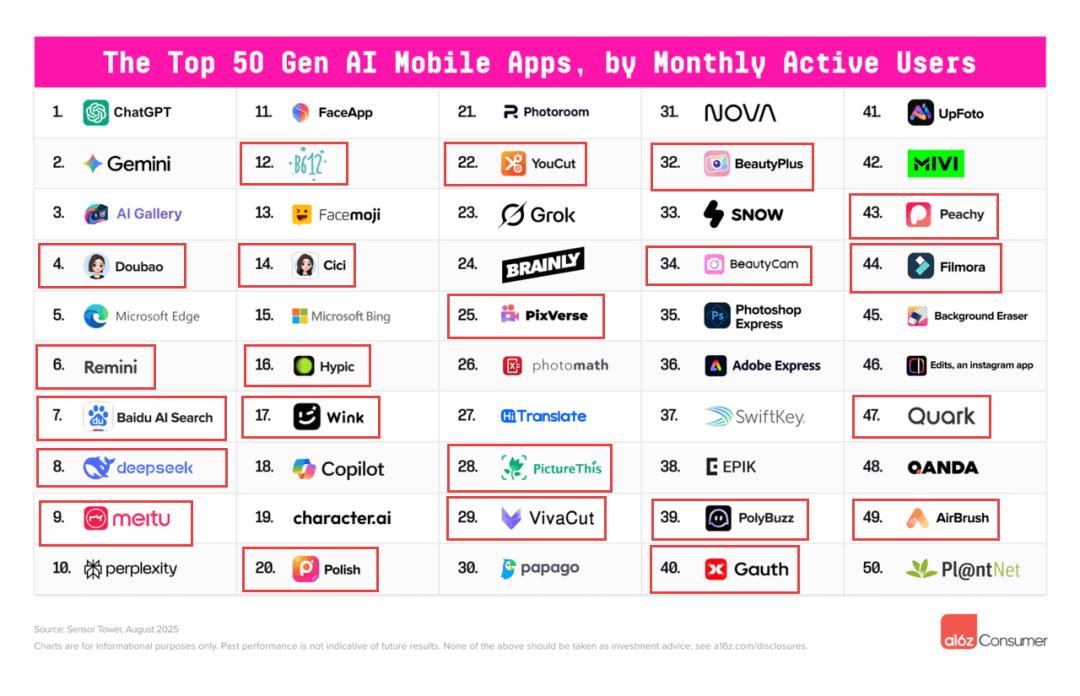
△ A16Z's "The Top 50 Gen AI Mobile Apps" list in August 2025. The ones marked in red are AI applications developed by Chinese teams. Photo source: A16Z
On both sides of the Pacific, Chinese AI application entrepreneurs and the global market are moving towards each other. A Chinese AI entrepreneur told us: "Three years ago, whether to go global was a choice. Now, no one asks this question anymore."
The Global Game: Chinese - Style Competition
The easiest way to identify Chinese AI entrepreneurs who have come from China in Silicon Valley is to look for Asian faces who shuttle between various exhibitions, parties, closed - door meetings, and Hackathons every day.
Neil, an overseas - going intermediary who has been in the United States for nearly 10 years, once saw the same Chinese AI education entrepreneur at three consecutive events in a week. He always carried an iPad with him to show the BP to investors at any time. "It's so competitive. It's not that intense among local U.S. entrepreneurs," Neil commented.
In July 2025, at the VentureBeat Transform technology conference held in San Francisco, Eric saw Jing Kun (former vice president of Baidu Group, CEO of Xiaodu Technology, and founder and CEO of the AI Agent company MainFunc) busy distributing flyers, as well as several members of his product GenSpark.
This A4 paper printed in black and white with "36 Million ARR in 45 Days, 8 Products in 10 Weeks" covered an entire closed - door meeting full of investors and the media.
This somewhat aggressive and showy marketing method was evaluated by Eric as being contrary to the "Silicon Vibe" that values "chill". What U.S. entrepreneurs like to talk about privately is often not business but what projects they've been working on in the gym recently or the gossip of some industry big shots.
In his eyes, Chinese entrepreneurs have an absolute "good - student mentality": "Once they come, they must meet someone and learn some methodology."
But Eric also understands this sense of urgency. Facing a completely unfamiliar market, if Chinese players want to compete on the same stage, they must be more competitive than European and American players or spend time finding their own unique niche.
In this round of AI startup wave this year, many Chinese players are very clear - headed: Don't compete head - on in the vertical fields where European and American players are good at. If they can't penetrate the industrial chain, then compete in general scenarios and product experience.
In the United States, competing with local players in the B - to - B market is like hitting a stone with an egg. Three years ago, when Liu Ning, an overseas - going AI application entrepreneur, explored the B - to - B business in the United States for an AI company, he realized a reality: It's very difficult for Chinese people to break into the U.S. industrial chain. This is not only about resources but also about the trust gap caused by geography and culture.
At that time, Liu Ning led a sales and engineering team of more than 10 people to visit customers, but "they couldn't even enter the lobby". Even after repeatedly emphasizing data localization, U.S. customers still preferred to trust local companies. In the first year, Liu Ning was rejected almost every day.
However, on the other hand, where the B - to - B gene is weak, China's deep foundation in productization has become a sharp weapon for global competition.
"In the past 20 years, China has accumulated a large number of product managers' capabilities in the mobile Internet, and we also keep up with technology very quickly," Huang Mingming, a venture capital partner at Mingshi Capital, mentioned at a conference. "This is precisely the unparalleled advantage and ability of Chinese entrepreneurs globally."
One well - known example is the rise of the image - generation - from - text company Fotor. At the end of 2022, while seizing the opportunity of