Unveiling the Winter Tests of 2025: Which One Has the Longest Range? Which One Is Safer?
In November 2025, the penetration rate of the new energy vehicle market had risen to 59.5%. Six out of every ten vehicles sold were new energy vehicles. It's time to get a new energy vehicle.
However, are new energy vehicles really reliable? Especially in cold winters, will sudden breakdowns occur? Will the cruising range suddenly "disappear"? How to choose a vehicle to avoid pitfalls? The "Insight Report on the Actual Test of the 2025 Auto Home Winter Test" (Follow the WeChat official account "Auto Market Story" and reply "2025 Winter Test" to download the full report) reveals all the answers for you in the form of data.
Significant improvement in low - temperature reliability:
90% passed the test, only 5 vehicles "broke down"
Compared with previous years, the comprehensive reliability of the test vehicles this year has made great progress. High - frequency faults such as non - pop - out door handles, abnormal door closing, and screen malfunctions, which were common in the past, did not occur during this year's winter test.
Under the cross - test of high - intensity testing and outdoor static placement in severe cold within nearly a month, 90% of the test models did not have low - temperature reliability problems. Only 5 vehicles had malfunctions, including serious power loss of the small battery preventing startup, failure of air - conditioning heating, and temporary failure of the air suspension.
Satisfactory cruising performance in extremely cold environments:
The achievement rate of pure - electric vehicles is 42%, and the comprehensive achievement rate of plug - in hybrid/extended - range vehicles is 53%
According to terminal sales data, in the Northwest and Northeast regions with relatively lower average temperatures, the sales proportion of plug - in hybrid and extended - range vehicles in the new energy market exceeds 60%. In the past, in extremely cold environments, the actual cruising range of pure - electric vehicles was not only low but also very unstable.
However, according to this year's test results, the average comprehensive cruising range achievement rate of plug - in/extended - range models exceeds 52%, and that of pure - electric models is 42%. The gap is not very large.
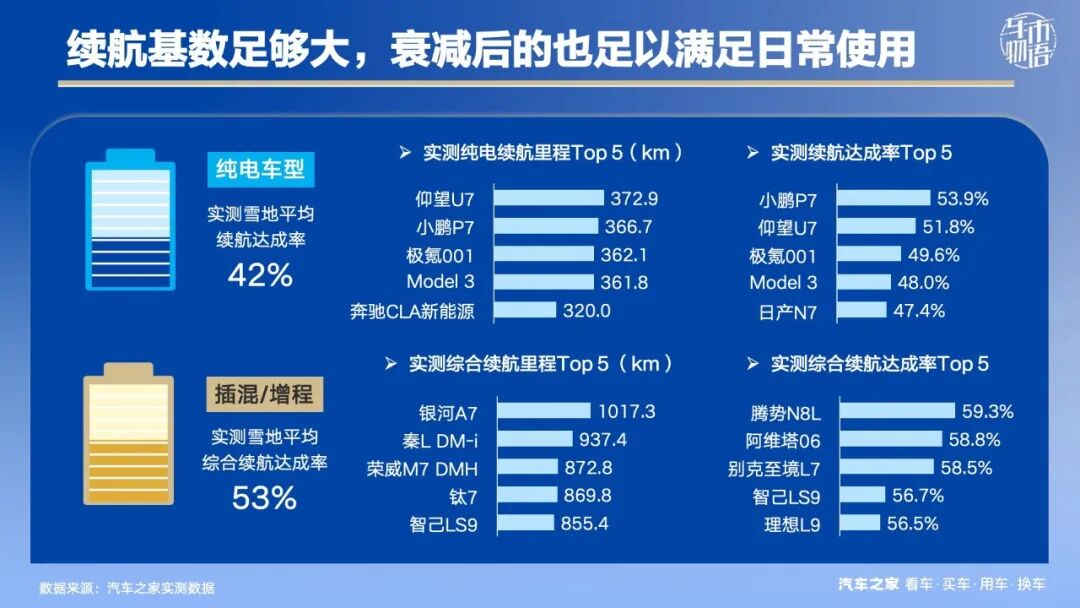
This year, there were 32 pure - electric models participating in the test, with an average battery capacity of 79 kWh. In a severe cold environment (-25~-10°C), the measured average pure - electric cruising range was 257 km.
Among them, the Yangwang U7 had the longest measured pure - electric cruising range, reaching 372.9 kilometers (test temperature -20~-10°C); the XPeng P7 had the highest measured pure - electric cruising range achievement rate, reaching 54% (test temperature -20~-10°C). Thanks to the wider application of large - capacity batteries, even in winter, the attenuated cruising range is sufficient for daily use.
No obvious short - board in the cruising range of lithium iron phosphate batteries in high - cold regions:
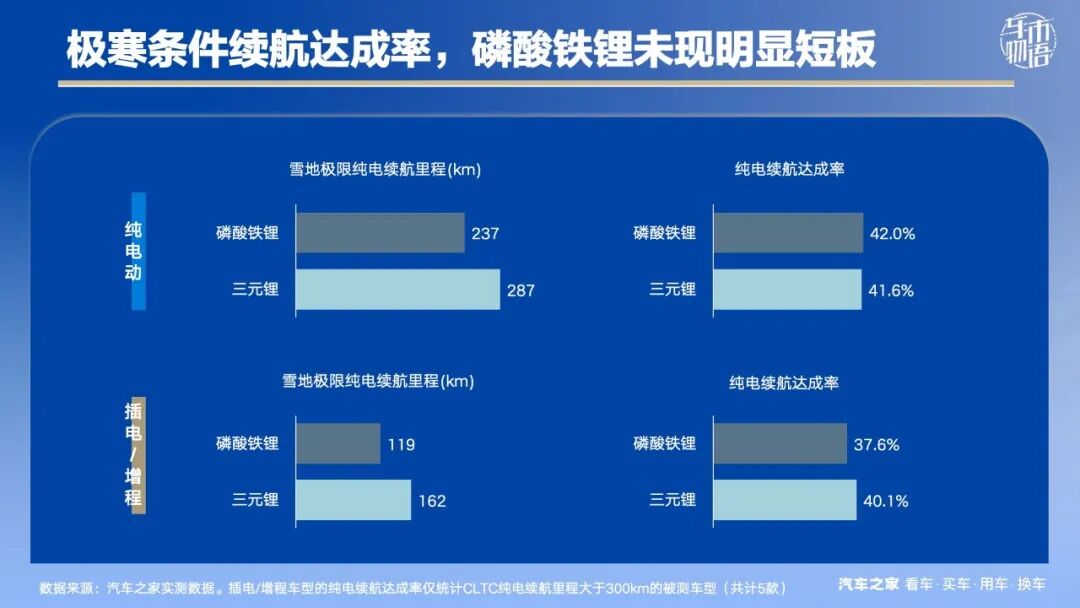
The cruising range achievement rate of pure - electric vehicles with lithium iron phosphate batteries is 42%, even better than that of ternary lithium batteries
According to the data from this winter test, among pure - electric models, the pure - electric cruising range achievement rates of models equipped with lithium iron phosphate and ternary lithium batteries are quite similar. The average pure - electric cruising range achievement rate of models equipped with lithium iron phosphate batteries is 42.0%, and that of ternary lithium batteries is 41.6%. Among plug - in/extended - range models, the advantage of ternary lithium batteries is slightly more prominent, with an average pure - electric cruising range achievement rate of 40.1%, while that of lithium iron phosphate batteries is 37.6%. In terms of "fear of cold" and "short cruising range", lithium iron phosphate batteries did not show obvious disadvantages this time, which is a great improvement.
Outstanding performance of "reverse new joint - venture" products:
Mainstream overseas models have the highest average pure - electric cruising range achievement rate
Relying on the advantages of joint - venture companies, some overseas brands are actively carrying out "reverse new joint - ventures", seeking cooperation and support from Chinese companies in core new energy fields such as three - electric systems, intelligent cockpits, and intelligent driving. What are the actual results? The actual test results tell the truth.
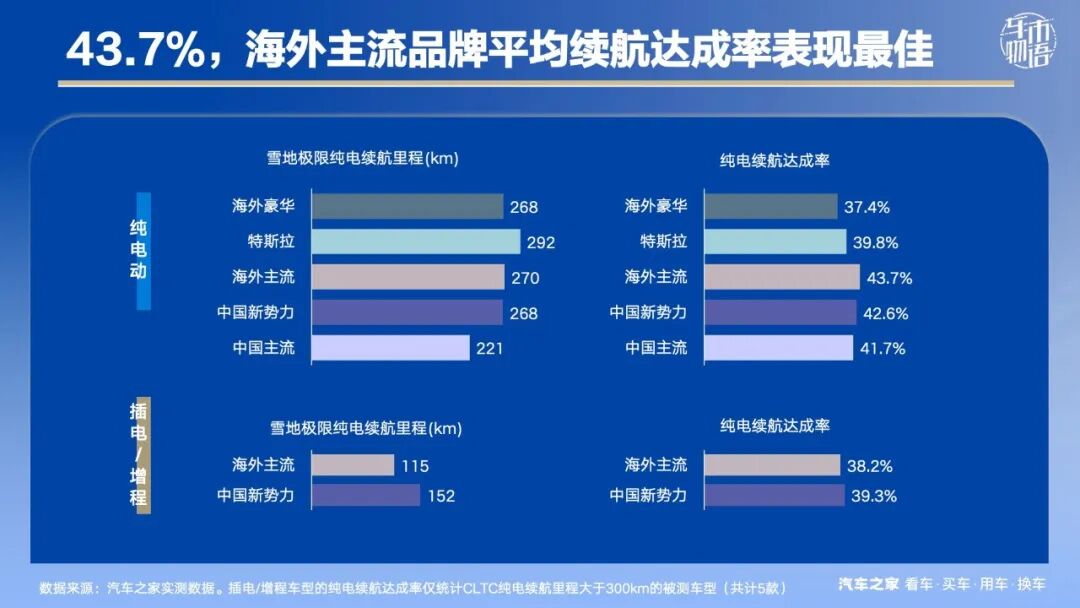
In terms of cruising range, looking at different brand types, the average pure - electric cruising range achievement rate of mainstream overseas pure - electric models is 43.7%, higher than other camps.
Among them, the Nissan N7, which integrates the Chinese new energy supply chain system, also performed well, with a measured pure - electric cruising range of 296.3 kilometers (test temperature -20~-10°C) and a pure - electric cruising range achievement rate of 47.4%. The Toyota bZ3X also achieved a 40% pure - electric cruising range achievement rate. Although the Buick Electra E5 performed relatively poorly, it still achieved a 38% achievement rate.
Although overseas luxury brands have higher pricing levels, they did not show more surprising performance. The Mercedes - Benz CLA New Energy has the highest CLTC cruising range of 866 kilometers in the test, but its measured cruising range is only 320 kilometers, with an achievement rate of 37%. It is the model with the largest gap between the nominal and measured cruising ranges this year.
Room for improvement in the heating efficiency in extremely cold environments:
Only 18% of the tested models can raise the cabin temperature above 18°C
If the air - conditioning efficiency is high enough, it can both save energy and ensure the cruising range. If the air - conditioning keeps "working" but shows no results, the energy consumption waste will be endless. Auto Home conducted an air - conditioning heating test this time. In a severe cold environment (-22~-16°C), after the air - conditioning was turned on in the maximum heating mode for 15 minutes, only 14% of the tested models' front - row temperatures reached the most comfortable range of 18 - 22 degrees for the human body, and 4% had temperatures exceeding 22 degrees, which is still acceptable.
The temperature range of 10 - 18 degrees accounted for the highest proportion, reaching 38%. The feeling is slightly cold, but it can be barely tolerated. The cabin temperature of the "underperforming" models with low heating efficiency in severe cold is still around 0°C, and the heating efficiency still needs to be improved.

AEB function on snow - covered roads:
Among 49 vehicles, only 3 can stop at a speed of 60 km/h!
As a relatively mature and widely - standard active safety configuration, AEB can largely ensure the driving safety of drivers, especially in extreme scenarios where human capabilities are limited. However, all of this is based on the premise that it can avoid risks normally.
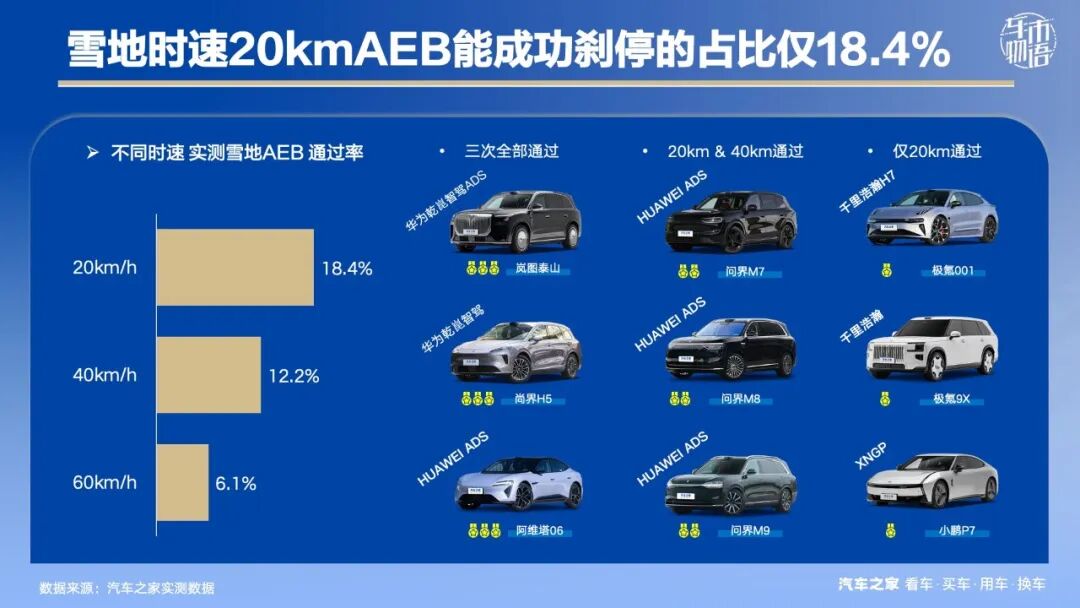
Although 98% of the tested models were standard - equipped with the AEB function, the actual performance was not satisfactory. The passing rate at 20 km/h on snow - covered roads was only 18.4% (a total of 9 vehicles). The AEB functions of most models have not been optimized for icy and snowy roads and can only reduce collisions but cannot avoid them. Among them, the Model 3 performed the worst and showed no reaction in the face of danger.
In the more difficult tests at 40 km/h and 60 km/h, the probability of vehicles successfully stopping became even lower. Among them, at the most difficult speed of 60 km/h, only 6.1% of the models successfully stopped. Huawei's full - scenario and environment - adaptable AEB has shown obvious optimization effects this year. All the models that successfully avoided collisions at 40 km/h and above were equipped with Huawei's intelligent driving assistance system.
It has to be said that this year's popular new energy vehicles have basically given consumers confidence, and there has been great progress in comprehensive reliability. In the harsh test environment of severe cold, high - speed, and snow - covered roads, the highest pure - electric cruising range achievement rate can reach 54%, which is really not easy.
In addition, thanks to the support of high - density and large - capacity batteries, the remaining pure - electric range after depreciation can reach nearly 400 km at most, and the maximum comprehensive cruising range of plug - in/extended - range vehicles even exceeds 1000 km, which is sufficient for daily commuting.
However, the heating capacity of the air - conditioning still needs to be optimized. After all, in extremely cold weather, no matter how much you wear, it's hard to bear in the long run. The AEB function is not as amazing as expected. In cold regions, especially when the roads are covered with ice and snow, you need to drive extra carefully. In short, new energy products are evolving rapidly. It is no longer difficult to choose a suitable and satisfactory product based on your needs.
This article is from the WeChat official account "Auto Market Story" (ID: autostinger), author: Sun Ying. It is published by 36Kr with authorization.