Raised 2.3 billion yuan, Eli Lilly and Temasek escorted this AI company's listing.
Text by | Hu Xiangyun
Edited by | Hai Ruojing
On December 30th, Insilico Medicine was listed on the Hong Kong Stock Exchange, with a closing increase of approximately 25%. On the day before the listing, the grey - market trading price once soared by 200% and closed with a 50% increase. The public offering was over - subscribed by more than 1400 times.
Insilico Medicine raised nearly HK$2.3 billion in this IPO, making it the biotech company with the highest fundraising amount among unprofitable biotech IPOs in the Hong Kong stock market in 2025. Among them, the subscription ratio of 15 cornerstone investors, including Eli Lilly, Temasek, and Schroders, was approximately 39%. The cornerstone investors cover various types such as global pharmaceutical giants, international sovereign funds, large asset management companies, leading public funds, and insurance funds. Notably, the headquarters of Eli Lilly appeared on the list of cornerstone investors for an innovative pharmaceutical company listed on the Hong Kong stock market for the first time this year.
Its ability to attract many investment institutions to take positions in its ecosystem is highly related to Insilico Medicine's AI - driven pharmaceutical nature. From multinational pharmaceutical companies like Eli Lilly and Roche increasing their investment to NVIDIA's aggressive cross - border investment in nearly 20 AI - healthcare concept companies in the past three years, with the advancement of AGI technologies such as AlphaFold3, the tipping point for AI - driven drug discovery is approaching.
Since it started seeking a listing in the Chinese market in 2023, after four listing applications, Insilico Medicine has finally been successfully listed. This is also a microcosm of the capital market's shift from skepticism to recognition of AI - driven drug discovery and finally its confirmation as a definite investment track.
Platform Capability Validation
The all - star cornerstone investor lineup and the scarcity of AI - driven pharmaceutical investment targets have made Insilico Medicine highly attractive to the market. However, what truly supports its market value and stock price performance is its own business fundamentals.
Insilico Medicine's core AI - driven drug discovery and development platform, Pharma.AI, is capable of target discovery, molecule generation, and clinical trial optimization for both small - molecule drugs and biopharmaceuticals.
For example, the difficulty in early - stage drug research lies in finding suitable pre - clinical candidate drugs (PCCs), which are directly related to the smooth progress of subsequent clinical trials.
According to Insilico Medicine, when developing new drugs based on Pharma.AI, in terms of efficiency, the R & D time from target discovery to the selection of PCCs can be shortened to 1 to 1.5 years, approximately one - third of the traditional method; in terms of quality, synthesizing dozens to 200 molecules may yield a PCC eligible for human clinical trials, with a trial - and - error cost only one - tenth of the traditional pharmaceutical model; in terms of cost, it only requires $2 - 3 million, one - fifth of the original cost.
Currently, Insilico Medicine has developed more than 20 clinical/IND - stage assets based on Pharma.AI, initially validating the platform's drug - making capability.
This is also the key to demonstrating the competitiveness of AI - driven pharmaceutical companies. In the past few years, the role of AI in improving the efficiency of new drug R & D has been recognized by the industry. However, the next step is to prove that AI can tackle difficult - to - drug targets, turn them into marketable drugs, and achieve sales, which determines how far AI - driven pharmaceutical companies can go.
In this IPO, nearly half of the raised funds will be invested in advancing the clinical trials of the core pipelines.
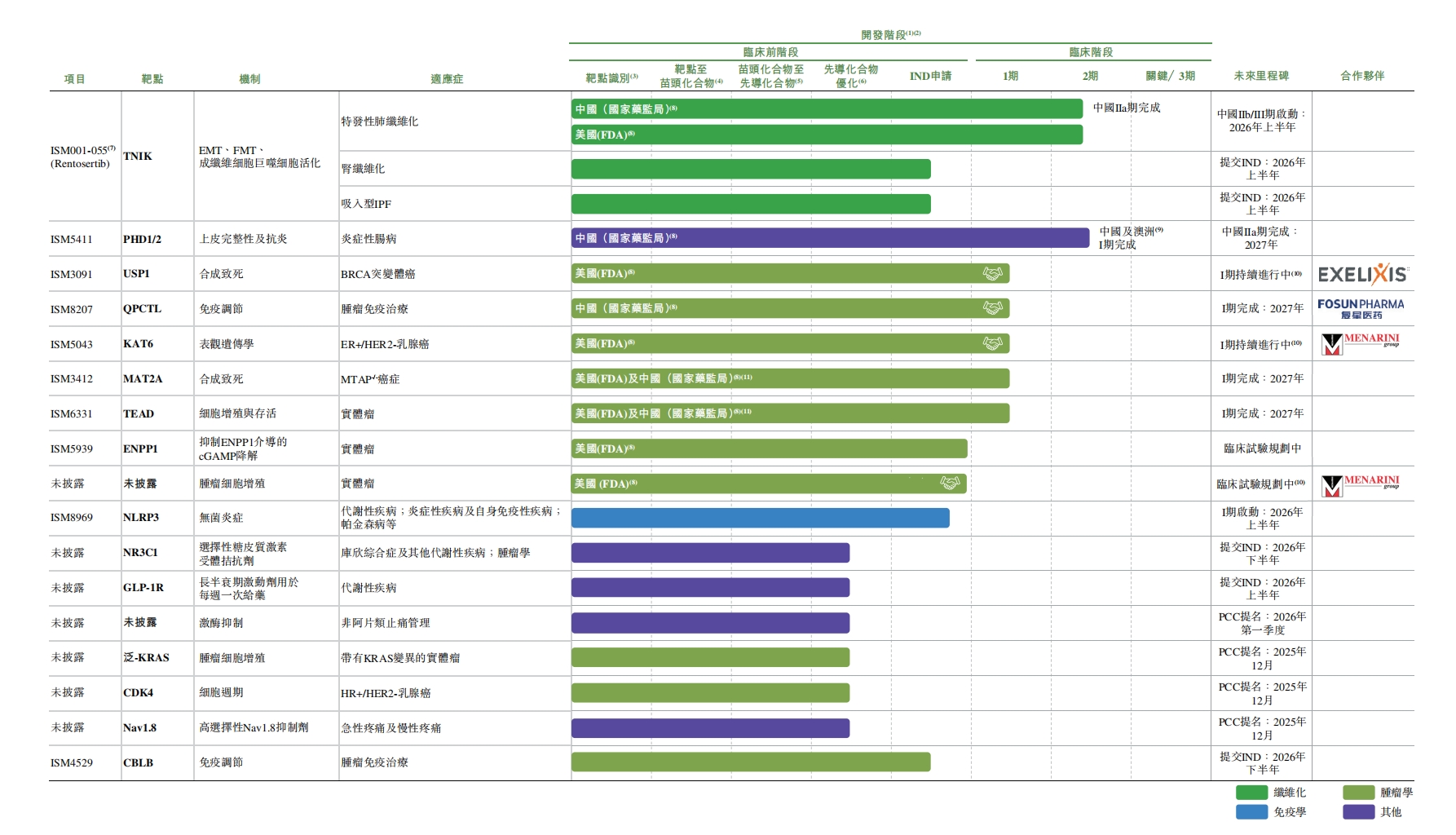
Source: Prospectus of Insilico Medicine
Take the TNIK - targeted small - molecule candidate drug ISM001 - 055 (Rentosertib), which is the most advanced in development, as an example. Its core indication is idiopathic pulmonary fibrosis (IPF), a disease that causes irreversible decline in patients' lung function and can even lead to death in severe cases. However, existing drugs can only slow down the decline of lung function, and the improvement in patients' survival is not significant. Therefore, developing new drugs that can restore lung function and reverse the disease progression is crucial.
In 2023, Rentosertib simultaneously initiated Phase IIa clinical trials in China and the United States. The Phase IIb/III clinical trial in China is expected to start in the first half of next year. The results of the Phase IIa clinical trial showed that patients receiving a daily dose of 60mg had an average improvement of 98.4 ml in forced vital capacity (FVC), which proves that it "has the effect of improving patients' vital capacity and potential anti - fibrotic and anti - inflammatory effects."
Benefiting from this, the drug has obtained the IPF breakthrough therapy designation from the China National Medical Products Administration and the orphan drug designation from the FDA. However, from a market perspective, IPF actually falls into the category of rare diseases, and the applicable patient population may be limited.
Additionally, the competition in new drug R & D through other technological paths during the same period is also extremely fierce. For example, Boehringer Ingelheim's PDB4B inhibitor Namitrestat tablets have been approved in China. In comparison, Rentosertib may still take two to three years to complete Phase III clinical trials and apply for market approval.
In addition to this pipeline, Insilico Medicine still has an abundant reserve of subsequent pipelines. For instance, SM5411, a drug for treating inflammatory bowel disease, has entered Phase II clinical trials, and there are also several Phase I clinical products under business development (BD) or in - house R & D.
According to the prospectus of Insilico Medicine, in the future, it is expected to develop 4 - 5 pre - clinical candidate drugs annually and advance 1 - 2 projects into the clinical development stage.
BD as a Revenue Generator and Business Model Upgrade
From a business model perspective, Insilico Medicine's main businesses include in - house R & D pipelines, AI + CRO services, and software sales. In the prospectus, the BD licensing revenue from the aforementioned in - house R & D pipelines and the revenue from AI + CRO services are grouped together under "Drug Discovery and Pipeline Development" and are distinguished from software sales.
These two major segments constitute Insilico Medicine's core revenue sources. From 2022 to 2024, the revenue of the drug discovery and pipeline development segment was $28.648 million, $47.818 million, and $79.733 million respectively, accounting for 92% - 95% of the total revenue.
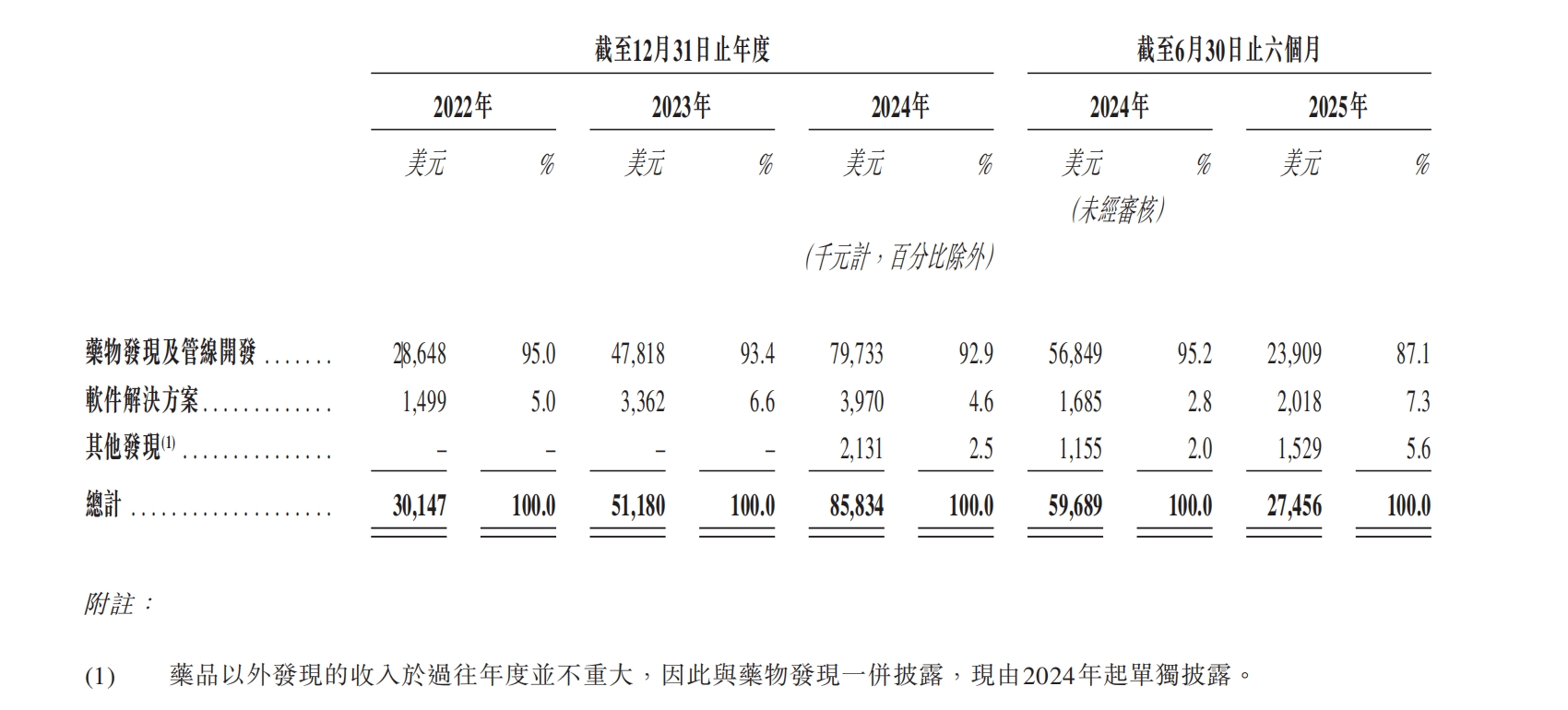
Source: Prospectus of Insilico Medicine
Moreover, Insilico Medicine's software sales mainly serve as an outlet to connect downstream customers. Currently, it has accumulated more than 150 customers. The on - demand subscription and local deployment models have a maximum annual fee of $200,000 and $525,000 respectively, accounting for less than 10% of the company's total revenue.
Some pharmaceutical industry practitioners who follow Insilico Medicine believe that the advantage of Insilico Medicine under the current model lies in "its ability to mass - produce and rapidly generate Pre - IND assets. If its BD capabilities can keep up, theoretically, it can achieve a closed - loop business model."
Just like Harbour BioMed, which also relies on a platform - based strategy to continuously produce early - stage new molecules and conduct BD transactions. The total BD licensing amount disclosed in the past two years has approached $8 billion, and the company's stock price increased by 550% in 2025.
This is also the goal that Insilico Medicine wants to achieve. To this end, instead of using intermediaries for BD, the company has established a BD team of about 10 people covering North America, Europe, and the Asia - Pacific region, led by its founder and CEO, Alex Zhavoronkov.
So far, Insilico Medicine has completed 4 direct BD partnerships. In addition, it has also reached drug discovery - related partnerships based on the Pharma.AI platform with large domestic and international pharmaceutical companies such as Eli Lilly, Sanofi, and Fosun. By June this year, the number of customers had reached 61. Various upfront payments and milestone payments have been the company's core revenue sources in the past few years.
Take the cooperation with Nasdaq - listed Exelixis in 2023 as an example: The subject of the transaction is ISM3091, a USP1 drug targeting synthetic lethal targets in BRCA - mutated tumors, which is also a popular area for new tumor drug development in recent years and has advanced to Phase I clinical trials. As a result, Exelixis became Insilico Medicine's largest customer in 2023 and 2024, with recognized revenues of $39.022 million and $51.995 million respectively, accounting for more than 60% of the total revenue in the same period.
Ren Feng, the co - CEO and Chief Science Officer of Insilico Medicine, once publicly stated that if the company can continue this trend and complete 1 - 2 BD licensing deals annually, its business model will "basically work."
Reflected in the financial performance, Insilico Medicine's post - non - recurring loss decreased from $70.804 million in 2022 to $22.665 million in 2024, and was $15.409 million in the first half of 2025, indicating a downward trend in its expected losses.
However, from a more macro perspective, whether it is conducting BD transactions or applying for market approval, the evaluation methods in the pharmaceutical industry are very mature. At this stage, whether a new drug is designed by AI is no longer the most important concern for buyers. The core still depends on the value of the molecule itself, such as druggability, differentiation, innovation, and clinical progress.
For AI - driven pharmaceutical companies, in the context of drug R & D, the technological value of AI not only lies in forming a meaningful portfolio of drug assets but also in whether AI can improve the overall R & D efficiency and success rate, thereby upgrading the company's business model, enabling it to generate cash flow more quickly, and enhancing the safety and return on capital of drug R & D enterprises.