Silicon Valley Bets $2 Trillion, DeepSeek Tops Nature, but Is Meta the Biggest Loser in 2025?
In 2025, AI transitioned from fantasy to reality. The mystery surrounding AGI was dispelled, and the first signs of ASI emerged. Tech giants are competing to pursue superintelligence, and the world is being torn into two parallel universes: AI adopters and bystanders. There is a surge in investment, and the capabilities of models have leaped... This is not just a technological revolution but also a turning point in human destiny.
In 2025, the global AI field was full of upheaval.
Artificial general intelligence (AGI) started to lose its mystery, and artificial superintelligence (ASI) began to take the stage.
Jack Clark, an executive at Anthropic, warned that a great change is imminent, and AI will tear the world into two parallel universes.
All of this is the result of a long - term development process, a product of the intertwined changes in AI technology, capital, employment, and life.
- The capabilities of AI models have leaped, but there is still controversy about the distance to AGI: Research shows that in 2025, AI models made significant progress in reasoning, multimodal processing, and agents.
- The investment boom has promoted the expansion of infrastructure: Global AI investment has soared. Generative AI has attracted $33.9 billion in funds, and the capital expenditure of tech giants has reached $400 billion, raising concerns about bubbles and discussions about energy consumption.
- The transformation of the labor force is accelerating, presenting both opportunities and challenges: AI is reshaping the workplace, and the use of AI tools may become the key to job hunting.
- The application has expanded to daily life but has not completely disrupted it: AI agents and robots have entered fields such as production and healthcare, seemingly improving efficiency, but many people feel that the changes are limited.
AGI is not the end; superintelligence is the starting point.
When the real AI competition begins after AGI!
One year of AI equals a millennium for humanity
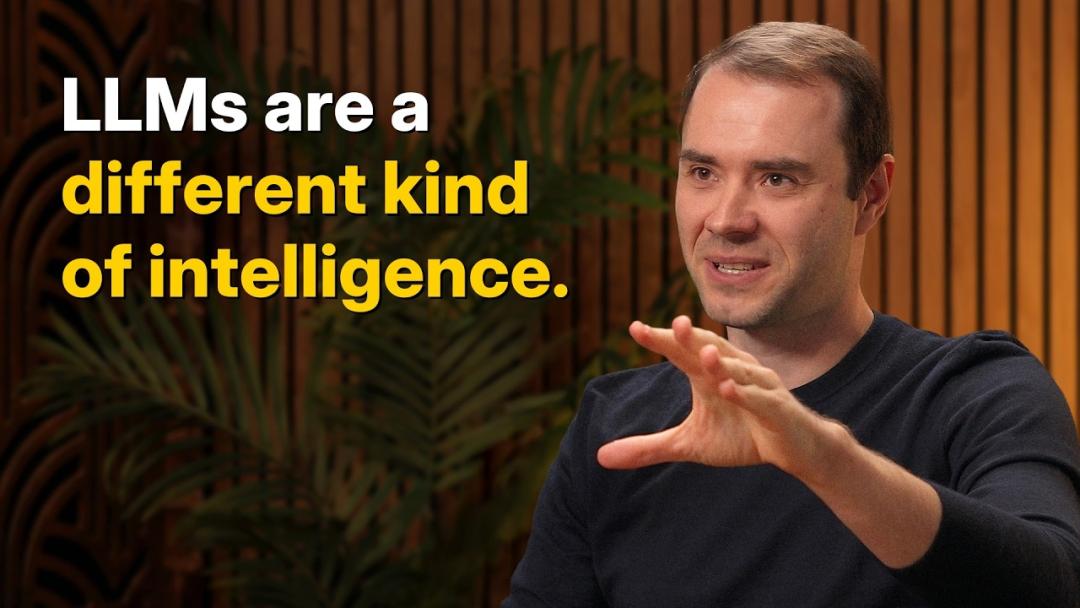
So far, all intelligence in nature is biological intelligence, carbon - based intelligence.
But this year's LLM may be the first new form of intelligence ever created by humans.
In the 2025 annual review, Karpathy said bluntly:
In 2025, I (and I think the entire industry) first began to internally understand the "form" of LLM intelligence in a more intuitive way.
In reasoning, multimodal processing, and agents, AI models made significant progress in 2025, such as OpenAI's o3 series and Google's Gemini 3.
Although there are still limitations in practical applications, the dawn of AGI has become the industry's consensus this year.
In a series of technical tasks, from ChatGPT to Gemini, many world - leading AI models are surpassing human baselines.
According to the "2025 AI Index Report" from Stanford University, AI has surpassed human baselines in 7 tests, and the tasks measured by these tests include:
- Image classification
- Visual reasoning
- Intermediate reading comprehension
- English language understanding
- Multi - task language understanding
- Competition - level mathematics
- Doctorate - level scientific questions
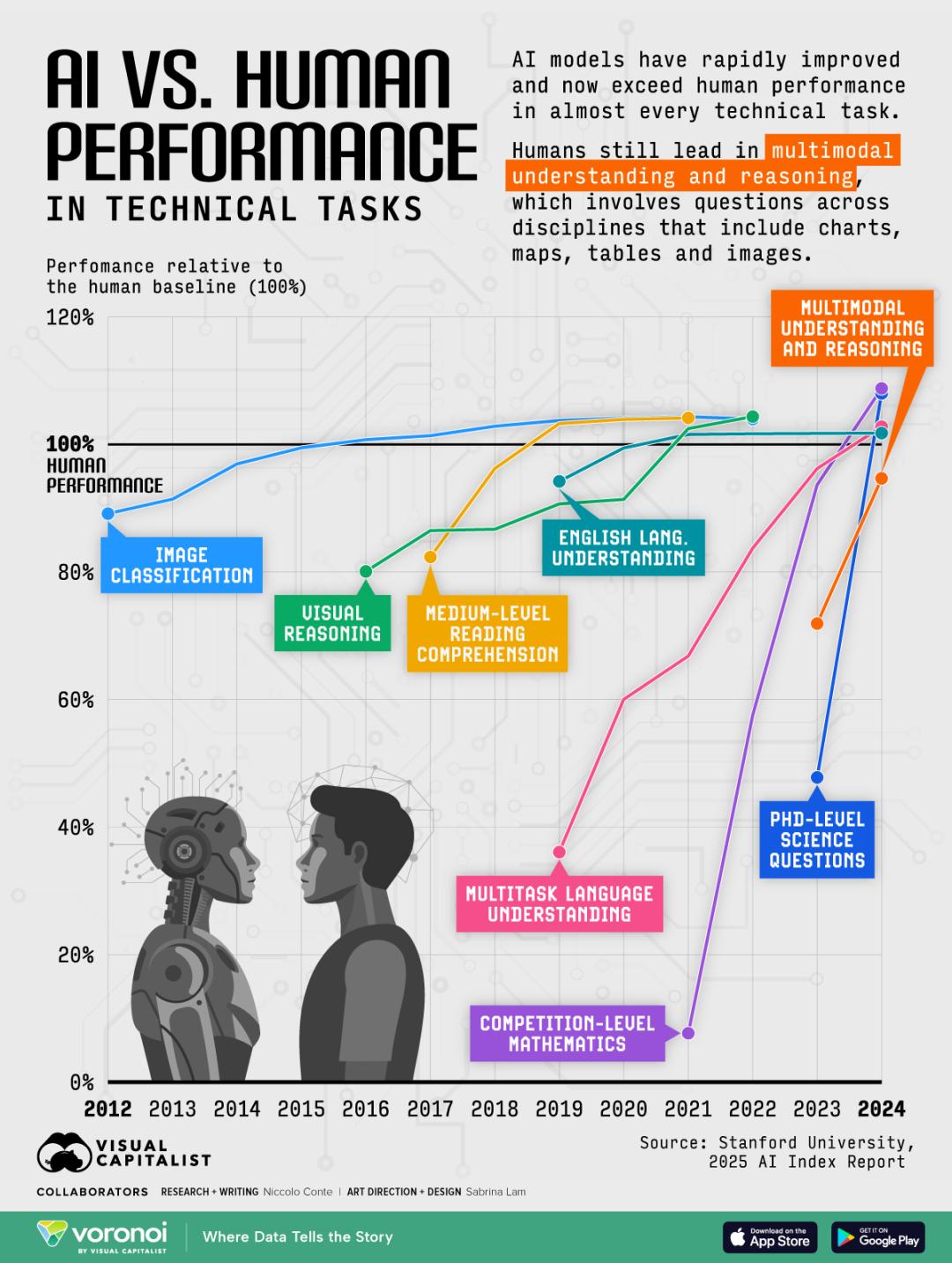
Currently, the only area where AI systems have not caught up with humans is multimodal understanding and reasoning. This task involves processing and reasoning across multiple formats and disciplines (such as images, charts, and diagrams).
However, this gap is rapidly narrowing.
The MMMU benchmark test evaluates the performance of models on interdisciplinary tasks that require university - level subject knowledge.
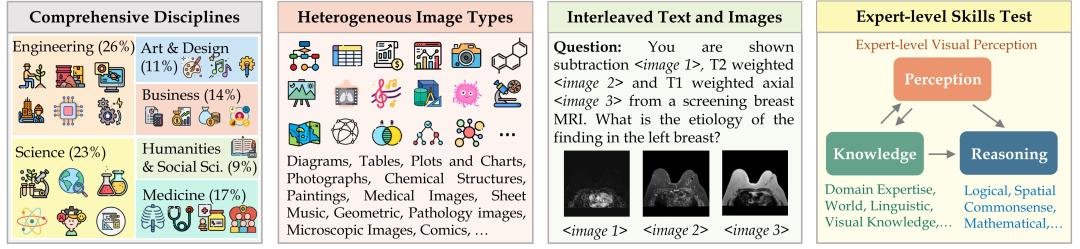
The four major characteristics of the MMMU dataset: (1) Comprehensiveness: Covers six broad disciplinary areas and 30 university subjects, including 11,500 university - level questions; (2) Highly heterogeneous image types: Contains extremely diverse image types; (3) Illustrated with text and images: Text and images are interleaved, requiring cross - modal understanding; (4) Expert - level perception and reasoning: Requires expert - level perception and reasoning abilities rooted in in - depth subject knowledge.
This benchmark test is becoming increasingly saturated:
At the end of 2023, Google's Gemini scored only 59.4%.
In 2024, OpenAI's o1 model achieved a score of 78.2%.
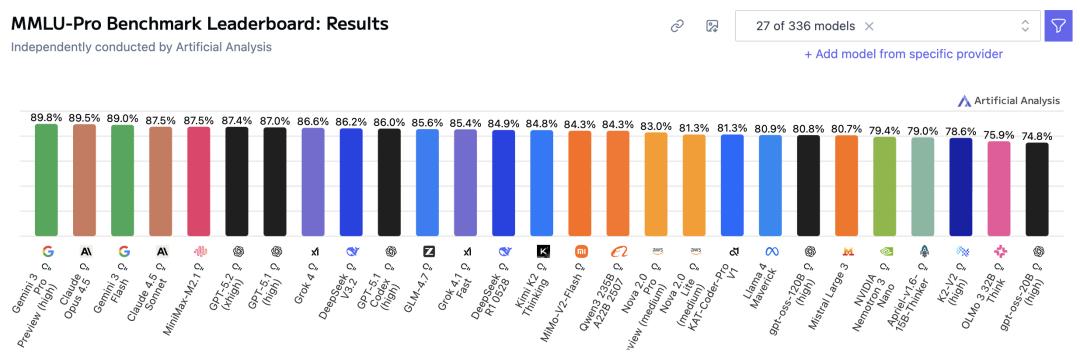
This year, Gemini 3 Pro scored 89.8% on the enhanced MMMU - Pro.
The Stanford AI Index Report shows that investment in generative AI reached $33.9 billion, a year - on - year increase of 18.7%.
Leading laboratories release new models every 8 - 12 weeks. OpenAI's o3 series (including o3 - mini) stands out with a "think first, then answer" reasoning mechanism, using 10 times more tokens to enhance intelligence, but the cost also increases accordingly.
Google's Gemini 3 is hailed as the peak of multimodality, capable of processing text, images, videos, and audio, and achieving in - depth reasoning.
On Reddit, at the beginning of the year, there was a lively discussion about the open access of leading AI models.
DeepSeek - R1 and its open - source distilled version dominated the relevant topics. However, users pointed out that the locally runnable version is the distilled model (8B or 32B parameters) rather than the full 671B version, and its performance is roughly equivalent to that of GPT - 3.5.
The deeper discussion focused on DeepSeek's open - source decision - although it is reported to have achieved a 45 - fold increase in training efficiency.
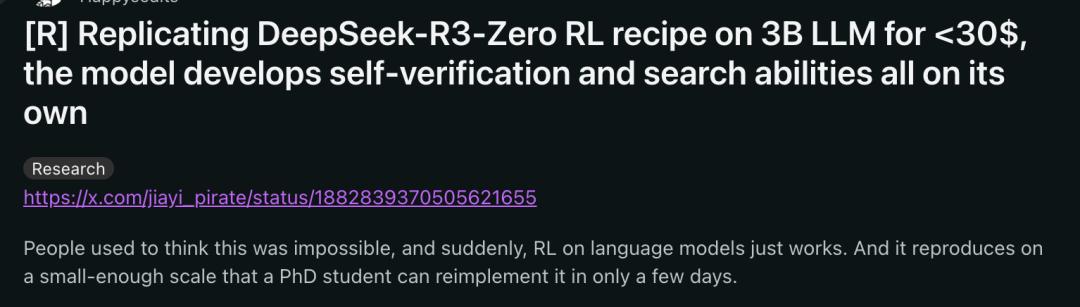
Subsequently, some researchers reproduced the reinforcement learning training scheme of DeepSeek - R1 - Zero on a 3B - parameter model at a cost of less than $30.
In the AGI test benchmark ARC - AGI - 1, the best score exceeded nearly 90%; on ARC - AGI - 2, AI exceeded the human average level.
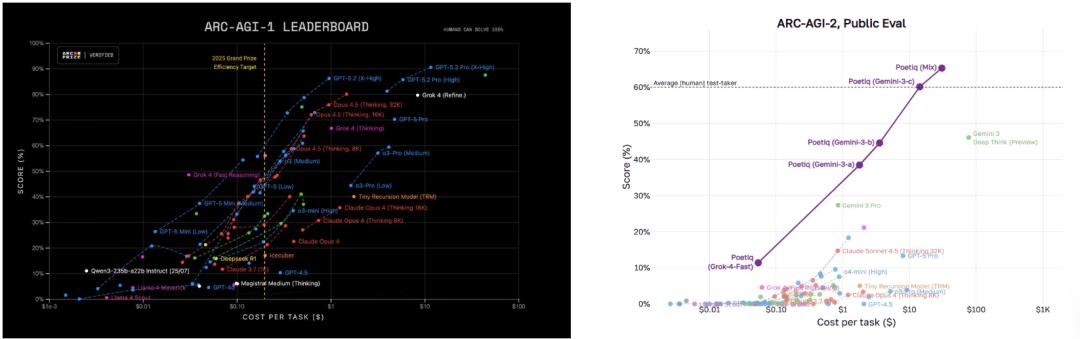
But Yann LeCun pointed out that autoregressive LLMs have limitations and need more sensory data.
Overall, in 2025, AI shifted from "chatbots" to "agents", such as Agentic AI, which can autonomously plan and execute tasks.
The AGI finals will be in the next 2 - 3 years
If the previous years were about "making the models larger", 2025 was more like "implementing the models in practice".
Several foreign AI giants are racing against time and competing for every inch around code, reasoning, multimodality, long context, and enterprise usability.
The discussions about the future of AI have become more and more grand and real. Tech leaders are increasingly talking about pursuing artificial general intelligence (AGI) and ultimately superintelligence.
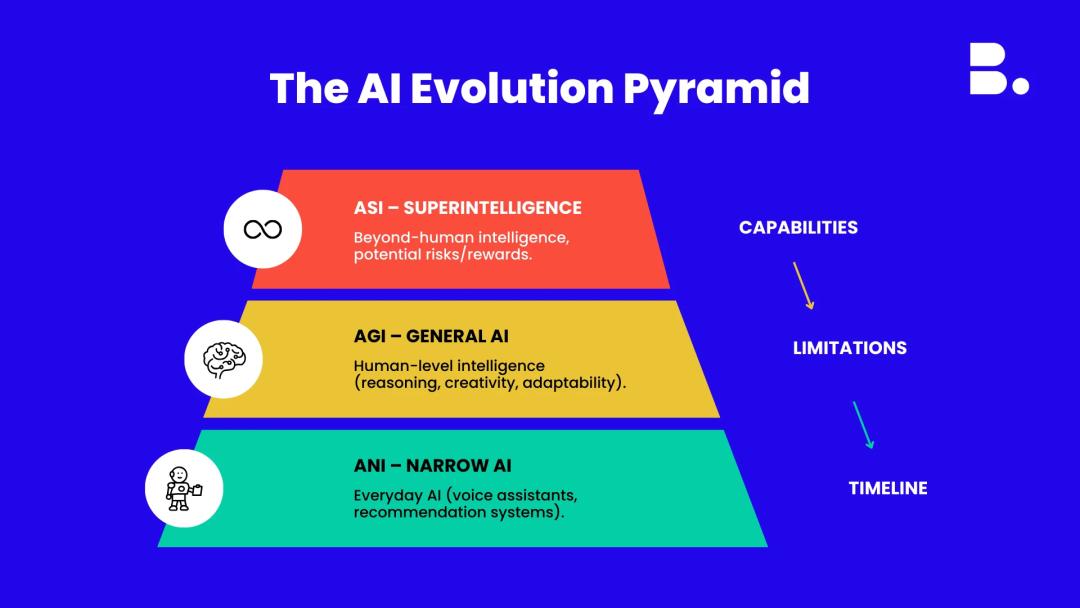
AGI refers to an AI system that can match human intelligence in a wide range of tasks, while ASI refers to a system that surpasses human capabilities.
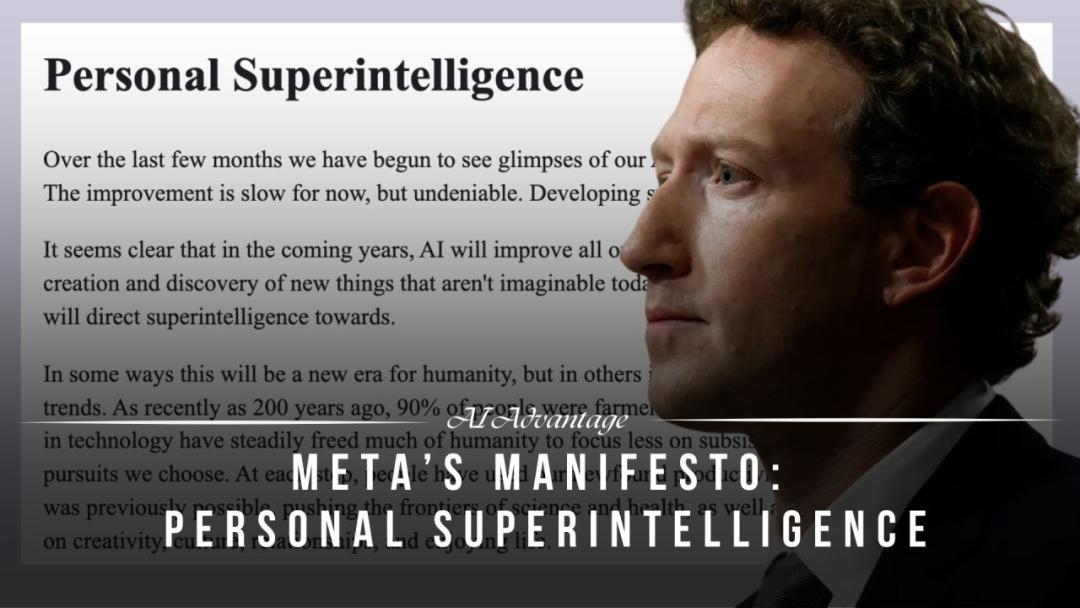
In June, Zuckerberg established Meta's Superintelligence Laboratory, aiming at "personal superintelligence".
In September, Altman said that society needs to be prepared for the possible emergence of ASI before 2030.
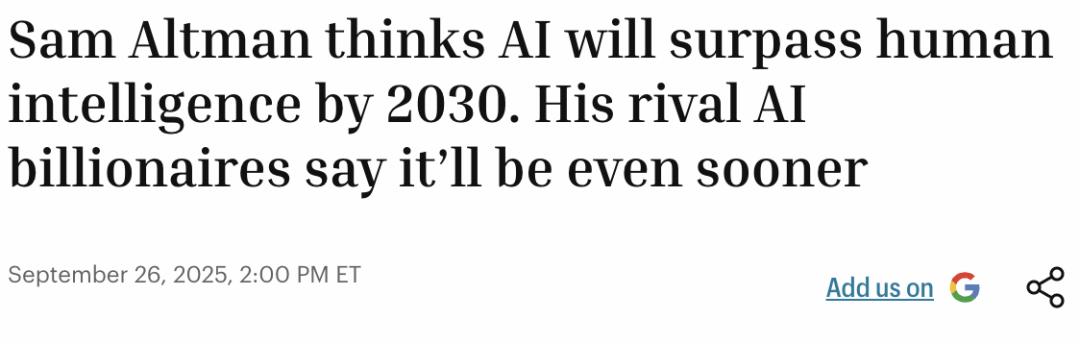
The current CEO of Anthropic firmly believes that by 2027, AI will surpass humans in "almost all fields".
And Musk, known for his optimistic predictions, even asserted that next year, the intelligence of AI will surpass that of the smartest humans.
These tech giants don't want to miss the AI wave.
Zuckerberg said that he would rather "risk misinvesting hundreds of billions of dollars" than fall behind in the era of superintelligence.
After becoming the world's richest man with a net worth of $632 billion, Musk told all the employees of xAI:
If xAI can survive the next two to three years, it is expected to become the winner in AI.
Leaders such as the CEO of Databricks believe that the industry has achieved AGI, while others like Hassabis, the co - founder of DeepMind, are more cautious, saying that AGI may come "in the next five to ten years".
Despite the differences in the timelines, tech leaders generally agree on one point: The progress of AI is accelerating and accumulating.
This acceleration is visible to the naked eye.
In one year, OpenAI released about 30 new products and major updates:
- At the beginning of the year: Efficient models and agents (such as Operator, o3 - mini);
- In the middle of the year: Multimodal and agent tools (such as Sora 2, AgentKit); Launched open - weight models (such as GPT - OSS) and GPT - 5;
- At the end of the year: Optimized professional tasks (such as the GPT - 5.2 series) and creative tools (such as ChatGPT Images).
Google, Anthropic, and xAI also each have their own highlights:
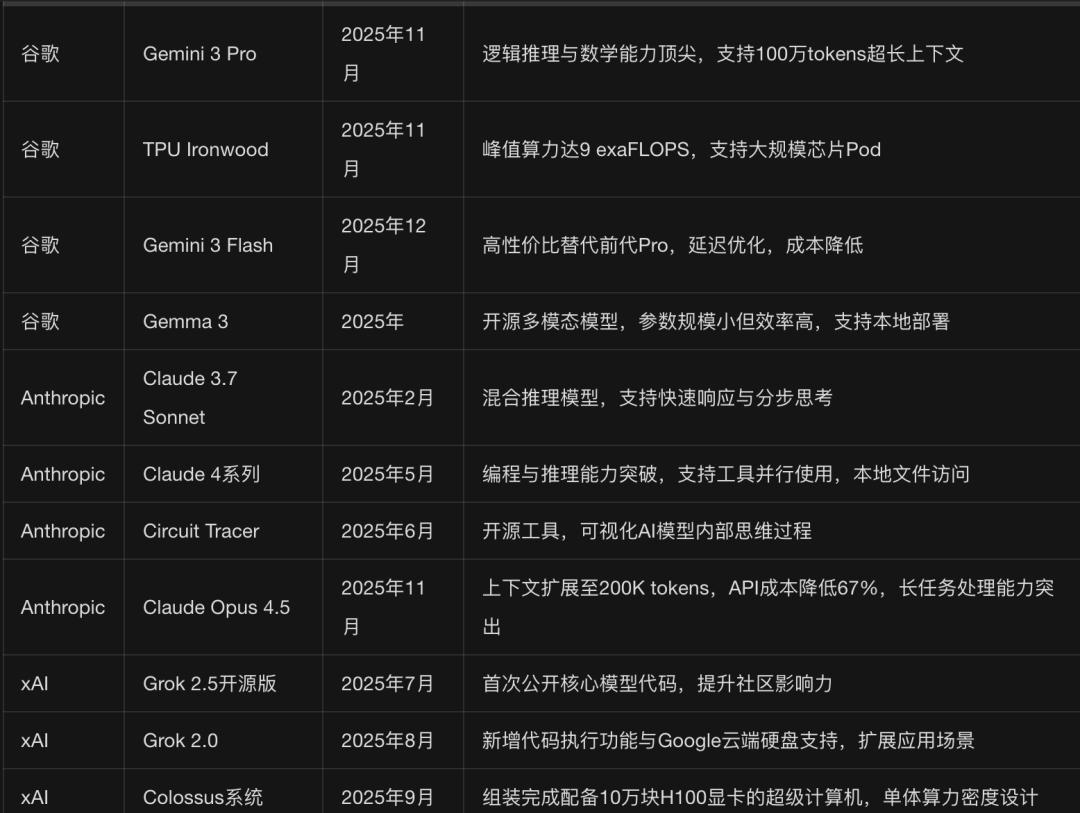
Functions that seemed like magic at the beginning of the year are now commonplace.
The rise of Chinese open - source AI, with DeepSeek being the biggest dark horse of the year
In 2025, the open - source community was also very lively.
There were a large number of engineering toolchains around LLaMA, DeepSeek, Mistral, and various large - model solutions: from fine - tuning frameworks, inference acceleration, to integrated local deployment solutions, and the threshold continued to decrease.
Chinese open - source models have risen, and Llama has been completely out.
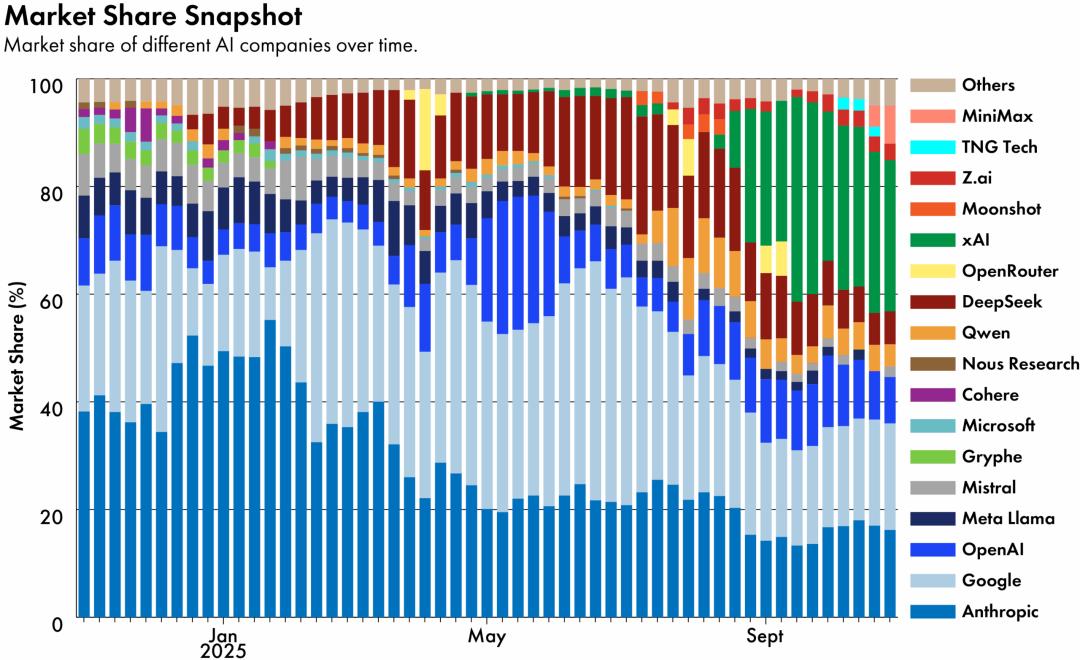
DeepSeek became the biggest dark horse of the year. DeepSeek - R1 became the first large - model to pass peer review in history and made it onto the cover of Nature; its founder, Liang Wenfeng, was selected as one of the top 10 people of the year by Nature.
After attracting much attention in the early stage, Mamba gradually faded from view and lacked practical applications outside of research.
Reddit users pointed out that although