2026, the most promising trend?
In 2025, the humanoid robot sectors of the A-share and Hong Kong stock markets experienced a roller-coaster market.

Investors witnessed the frantic pursuit of the mass - production expectation of Tesla's Optimus at the beginning of the year, the panic selling caused by technological bottlenecks and production - halt rumors in the middle of the year, and the revaluation of value triggered by industrial mergers and acquisitions and order confirmations at the end of the year.
Behind this "N - shaped" trend lies the inevitable pain and cognitive iteration that the market experiences when a disruptive technology evolves from a "PPT vision" to "factory practice".
Although the "Tesla chain" remains the core indicator of the sector's fluctuations, the Chinese humanoid robot track is forging an independent growth curve with pricing power, thanks to policy dividends (new - quality productivity), reduced supply - chain costs, and open application scenarios (China Mobile and various automakers).
01 Financing Boom
This year, the financing in the field of embodied intelligence has been unprecedentedly booming. Driven by technological breakthroughs and industrial policies, the track's popularity has been on the rise.
According to IT Juzi statistics, in the first three quarters of 2025, there were 610 new primary - market financing events in the Chinese mainland's robot industry, doubling the 294 events in the same period last year and reaching a new high in the past three years. In the second half of the year, the trend of capital investment became even more prominent, with 243 financing events in the third quarter alone, a year - on - year increase of 102%.
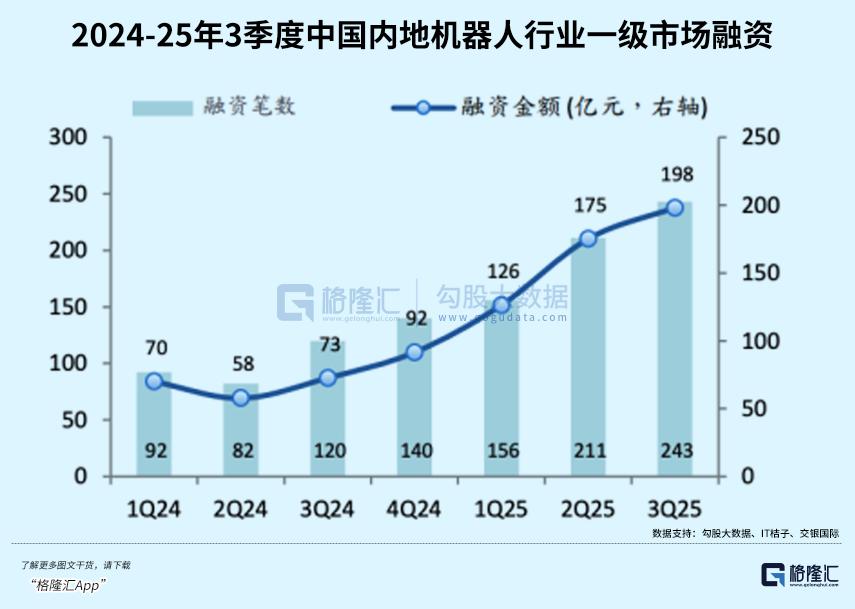
In terms of financing scale, domestic robot startups raised a cumulative total of about 50 billion yuan in the first three quarters of 2025, 2.5 times that of the same period last year, showing a characteristic of "simultaneous growth in the number of events and the amount of funds". Among them, the financing amount in the third quarter reached 19.813 billion yuan, a year - on - year increase of 172%, marking the peak of this round of investment enthusiasm.
The trend of capital concentration is becoming more and more obvious. According to China Venture Capital, the top 10 companies accounted for about 40% of the annual financing amount.
Nine domestic companies completed 13 financings exceeding $100 million. Recently, Galaxy Universal secured a single financing of $300 million, setting a new industry record. The US market is even more crazy. FigureAI's Series C financing skyrocketed its valuation from $2.6 billion to $39 billion. Physical Intelligence, focusing on robot brains, saw its valuation jump from $2.4 billion to $5.6 billion. SkildAI is also in talks with SoftBank and NVIDIA for a financing exceeding $1 billion, with a potential valuation of $14 billion.
The rush for IPOs is almost happening simultaneously, and this year is hailed as the "Year of Securitization" for humanoid robots.
More than a dozen companies have flocked to submit IPO applications. Geek+ and Yunji Technology have successfully listed on the Hong Kong stock market. Unitree Technology is expected to become the "first humanoid robot stock" on the A - share market. Zhipu Robotics acquired Shangwei New Materials to obtain a listing platform and completed management changes. The latter became the first "ten - bagger" in the robot concept this year.
In addition, leading players such as Leju Robotics, Galaxy Universal, and Yun Shenchu are also accelerating their listing processes.
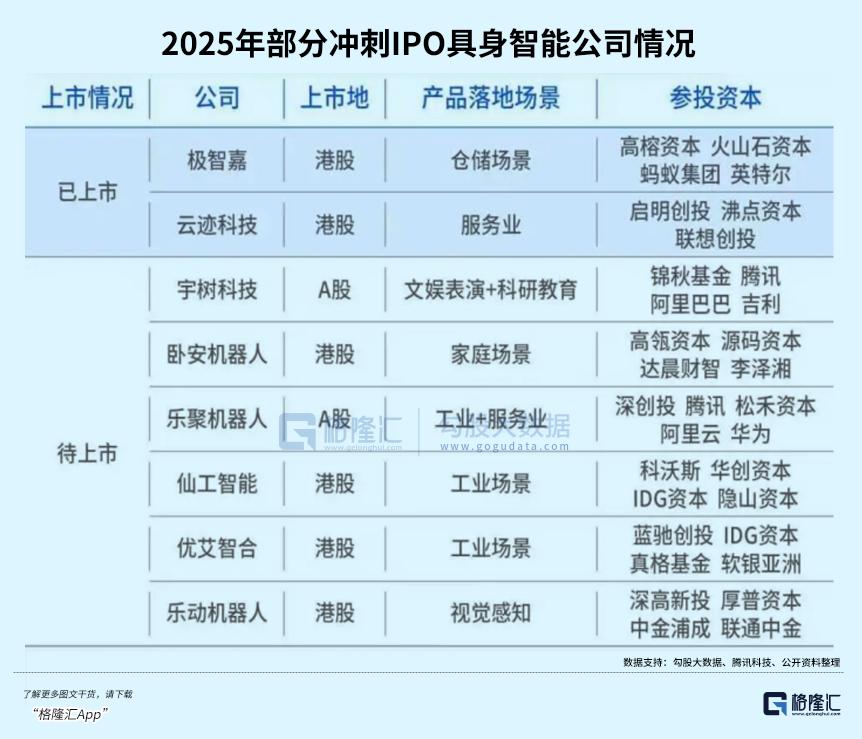
The core difference between listed and unlisted companies mainly lies in the maturity of commercialization and product forms.
For example, Geek+ and Yunji Technology mainly focus on non - humanoid robots, targeting standardized scenarios such as logistics and hotels. They had established stable revenues and cash flows before listing. On the other hand, companies waiting to list or in the preparation stage mostly have humanoid robots as their core products. They are currently in the pilot verification and small - batch delivery stage, with limited revenue scales and reliance on orders. Their application scenarios are concentrated in manufacturing and consumer markets, which have strict requirements for precision and stability, resulting in a relatively slow commercialization process.
The fundamental driving force for humanoid robot players to pursue listing is that the industry has entered a stage of product verification and innovation, and the next focus of competition will be on order acquisition and large - scale mass production.
02 Orders Take Shape
As the end of 2025 approaches, this year is regarded as a crucial turning point for the commercialization of the Chinese robot industry. The long - term accumulation of technology, the continuous decline in costs, and the concentrated emergence of real market demand have jointly pushed the industry over the critical point and onto the fast track of large - scale commercial implementation.
The successive breakthroughs in corporate orders are important milestones in this process.
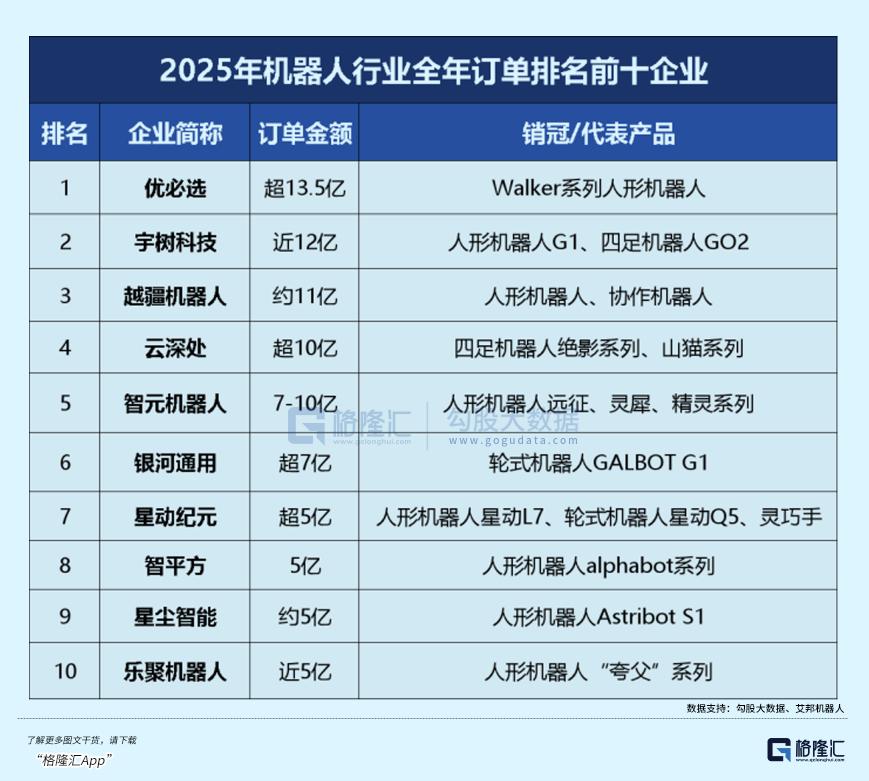
According to Aibang Robot data, in 2025, several companies' annual orders exceeded 1 billion yuan. Among them, Ubtech signed large orders successively in the fourth quarter, with an order amount close to 1.4 billion yuan, ranking first. Unitree Technology's total annual order amount was close to 1.2 billion yuan, with a shipment volume of over 10,000 units. Yuejiang Robot's order amount in 2025 was about 1.1 billion yuan, with an annual shipment volume of about 20,000 units, of which the overseas market contributed nearly half.
03 Mass - Production Turning Point
Both multinational companies and local innovative players are accelerating their industrialization preparations around the key node of 2026. The mass - production scale and cost turning point are expected to occur simultaneously. The humanoid robot industry is moving from "technological competition" to a new stage of "manufacturing competition" and "commercial competition".
Regarding overseas leaders, Tesla has adjusted its plan to produce 5,000 Optimus units in 2025. The latest plan shows that it will release the third - generation Optimus in the first quarter of 2026 and simultaneously build a dedicated production line with an annual capacity of one million units, planning to start formal production by the end of 2026.
The initial annual production capacity of the US startup Figure03 is expected to be 12,000 units, and it plans to produce a cumulative total of 100,000 units in the next four years, indicating its rapid progress towards the goal of "feasible commercial scale".
Many domestic and foreign companies are also compressing the R & D cycle and accelerating the mass - production process. XPeng Motors has clearly stated that it will achieve mass production of IRON by the end of 2026. The hardware and software will enter the mass - production preparation stage in April 2026 and achieve large - scale production by the end of the year.
In the Chinese mainland ecosystem, companies such as Unitree, Zhipu, and Leju have all initiated the listing process and have mass - production plans.
The main difficulties in mass production still focus on cost, hardware, and engineering challenges.
For example, hand - control ability. Although the motion - control ability of humanoid robots has been greatly improved in the past year, most application scenarios are still limited to cultural and entertainment performances. Most wheeled robots used more frequently in factories still adopt the gripper solution.
The dexterous hand is the key breakthrough for scenarios such as industrial assembly, medical care, and household services, directly determining the upper limit of a robot's working ability. However, the industry still lacks a dexterous hand that is good enough and balances cost and performance.
This year, foreign media and the supply chain reported that Tesla's Optimus suspended its production line due to the complexity of the dexterous hand and the yield rate problem of actuators. The report pointed out that its hand not only lacks tactile feedback when performing fine operations but also frequently malfunctions due to overheating of the motor.
Domestically, a complete industrial chain for dexterous hands has been established, significantly reducing the cost of a single hand from hundreds of thousands of yuan to 30,000 - 80,000 yuan, laying the foundation for large - scale commercial use.
The ultimate goal of dexterous - hand technology iteration is to achieve "as flexible as a human hand and more durable than a human hand".
The future development of dexterous hands will focus on several major directions. One is to solve the current pain point of "high cost and short lifespan". Secondly, it is necessary to integrate higher - precision tactile and force sensors at the fingertips to achieve more delicate operation feedback in combination with large models. Finally, it is to promote the transformation from single - hardware cost reduction to standardized intelligent execution units.
04 Physicalization of AI
In the architecture of embodied intelligence, large models, especially the Vision - Language - Action (VLA) model, play a crucial "smart brain" role.
In the past, robots required engineers to write thousands of lines of code to define each movement trajectory. Now, the combination of large language models (LLMs) and vision - language models (VLMs) enables robots to understand natural - language instructions (such as "Pass me that bottle of water") and automatically decompose them into a series of complex physical actions.
Currently, a number of representative embodied - intelligence large models have emerged globally.

However, the lack of data is the main bottleneck for embodied intelligence. There are trillions of text data on the Internet for training LLMs, but there is a lack of high - quality data on the interaction between robots and the physical world.
The solution in 2025 is "simulated data + real data + open - source data sets". The so - called Sim - to - Real approach uses high - quality simulation environments for large - scale, low - cost training and seamlessly migrates to the real world, thereby significantly reducing data - collection costs and accelerating the evolution of robots.
Real - world data is still indispensable. A new business model, the "data factory", has emerged in China and the United States. For example, Zhipu Robotics has established a large - scale data - collection center in Shanghai, hiring "robot trainers" to remotely control robots through VR devices and tactile gloves to perform complex tasks (such as peeling eggs and threading a needle). These data are used for fine - tuning end - to - end neural networks.
Generalization ability will be a major indicator for evaluating the intelligence of humanoid robots in the future. With the leap in multi - modal alignment and generalization ability, large models will no longer be limited to specific scenarios but will achieve cross - scenario and cross - task general operation capabilities through massive data training.
05 Supply - Chain Revolution and Domestic Breakthrough
According to Morgan Stanley, in 2025, the Bill of Materials (BOM) cost of manufacturing a humanoid robot using the Chinese supply chain was about $46,000, while that of the non - Chinese supply chain was about $130,000.
That is to say, manufacturing humanoid robots without the Chinese supply chain would cost nearly three times more. The report predicts that with the continuous optimization of the Chinese supply chain, the BOM cost is expected to drop to $16,000 by 2034.
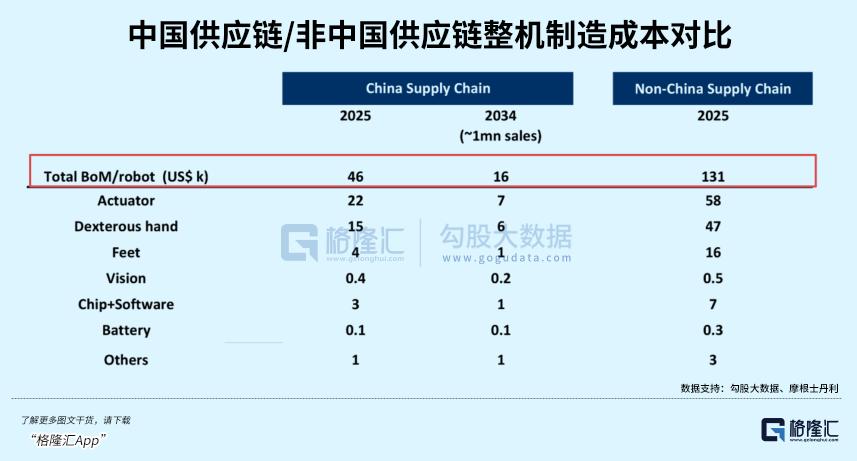
Driven by policy dividends, technological iteration, and supply - chain localization, the Chinese mainland's humanoid robot industry has witnessed a price decline. New products from many leading companies have addressed the pain points of the consumer market. The cost - reduction effect of the industrial chain is accelerating, opening a breakthrough for the mass - consumer market.
For example, Unitree Technology launched the Unitree R1 AIR in July, priced at only 29,900 yuan. This "athletic" humanoid robot, standing 1.23 meters tall and weighing only 25 kg, integrates 26 intelligent joints, dual six - axis IMUs, and proprietary high - torque actuators. It supports downhill sprints, side flips, and quick recovery from falls, far surpassing the agility of its predecessor, the G1.
SONYAN Power's "Xiaobumi", released in October, has for the first time brought humanoid robots into the "ten - thousand - yuan era".
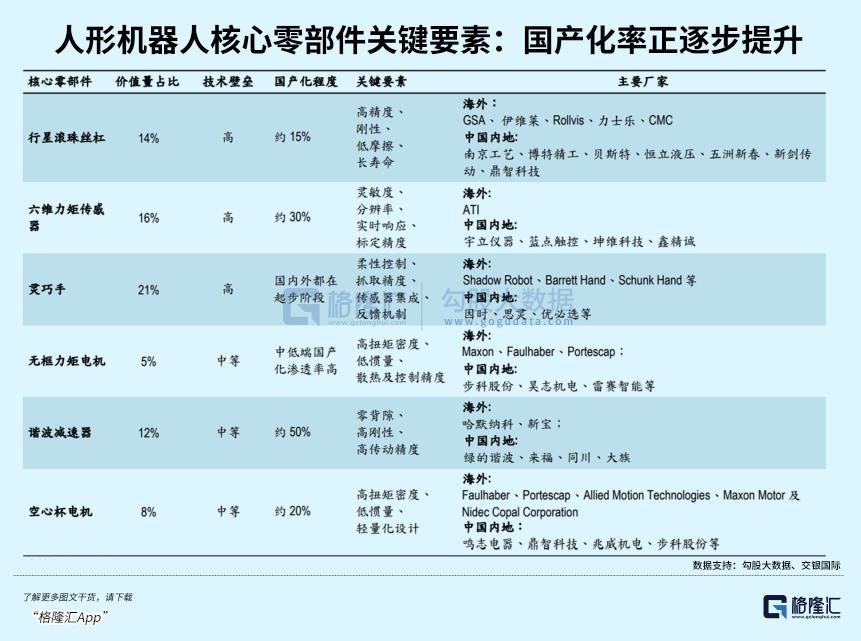
The price decline is essentially due to the breakthrough in the localization rate of some core components. Key components such as harmonic reducers (Green Harmonic), planetary roller screws (Wuzhou Spring), and six - axis force sensors (Hanwei Technology) have achieved technological breakthroughs, with a localization rate of over 90%. Coupled with the open - source software ecosystem driven by large AI models, the single - unit BOM (Bill of Materials) cost has dropped significantly.
06 Epilogue
At the end of the year, the listing pace of many robot whole - machine manufacturers has significantly accelerated. It is expected that more companies will enter the capital market in the future, continuously boosting market sentiment.
Standing at the end of 2025 and looking forward to 2026, the humanoid robot industry is at a stage similar to that of the new - energy vehicle industry in 2015 - 2016. The industrial singularity has arrived, but as the technological routes converge and initial large - scale mass production is put on the agenda, differentiation is also approaching.
Although the listing process, order confirmations, and technological breakthroughs of local companies may all be important catalysts for driving the sector's sentiment, compared with 2025, investors' focus in 2026 is expected to gradually shift from sentiment - driven to the actual progress of companies, concentrating on three dimensions: order confirmations, capacity release, and technological breakthroughs.
Glonhui's statement: The views in this article are all from the original author and do not represent the views and positions of Glonhui. It is particularly reminded that investment decisions should be based on independent thinking. The content of this article is for reference only and is not intended as any actual operation advice.