CAR Inc.: Dream Big and Stay Grounded
In the domestic travel market landscape, car rental has long occupied a delicate position.
It is not a new sector. More often, it is regarded as a kind of social infrastructure - based commercial service: stable, reliable, and widely - covered, but rarely held with additional expectations.
Meanwhile, its moat is relatively heavy. Fleet density, network coverage, operation and maintenance systems, performance stability, and standardized processes - all are built on the efficiency of large - scale operations. However, in such an industry, the risks of leading players often do not come from competitors, but from the solidification of their own roles.
Against this backdrop, CAR Inc. has demonstrated an "unconventional" example through its own practice: How can a leading player in the car rental industry build a dynamic moat to unlock its own and the industry's business imagination?
Lifting Upwards: Unleashing the Imagination of Rental Travel Narrative with Technology
It is not easy to stay ahead in a highly mature industry.
By observing CAR Inc., it is not difficult to find that a stable fleet size, a dense network of outlets, and a mature performance system form a highly engineered operating foundation. However, when the foundation is stable enough, new challenges truly emerge: As the times roll on, the marginal benefits of efficiency and scale become more prominent. How can the moat continue to exist?
At this time, CAR Inc.'s choice is thought - provoking. In addition to continuing to increase scale and efficiency to maintain its leading position, it is also exploring the leap from car rental to travel rental, seeking new narrative imagination.
The breakthrough lies first in the dual upward movement at the technological and strategic levels.
Since this year, CAR Inc. has made frequent strategic moves. In July, it partnered with Baidu Apollo to launch the world's first mass - market autonomous driving car rental product, transforming L4 - level autonomous driving technology into tangible travel services. However, from the user's perspective, the entire process hardly changed.
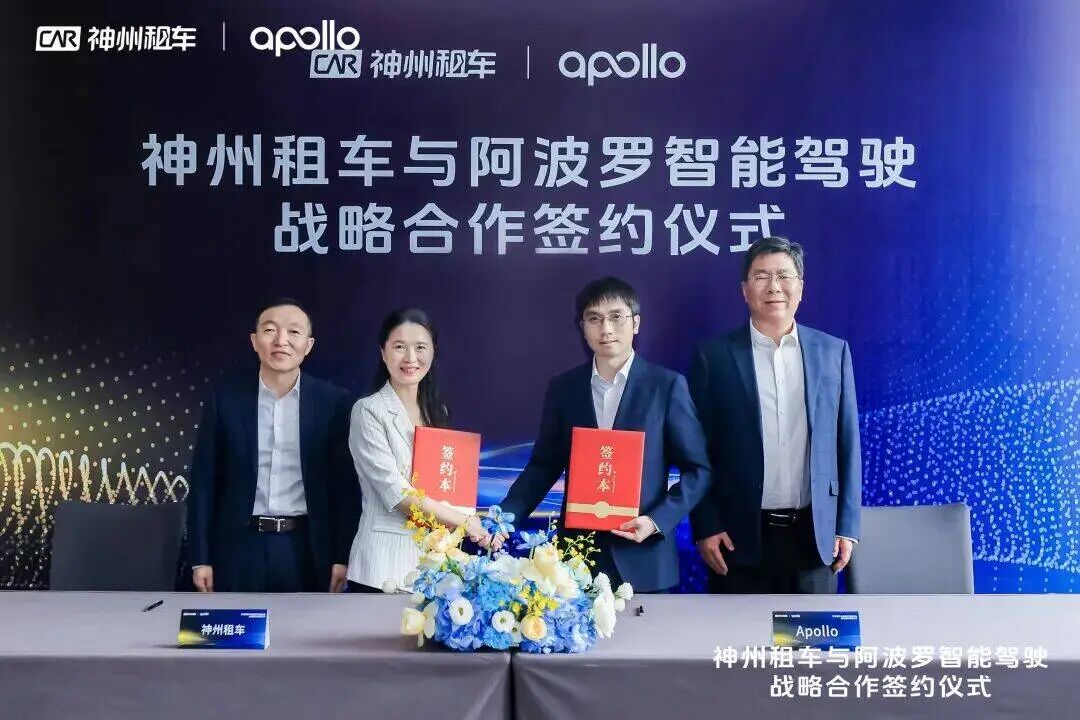
The picture is from CAR Inc.'s official source
Meanwhile, CAR Inc. is also accelerating the large - scale implementation of intelligent travel with fully autonomous driving and full - process self - service experience. The judgment behind this is very clear. The core of new sectors such as autonomous driving car rental lies in technology + scenarios. After introducing third - party technology cooperation, CAR Inc. has obviously found the perfect matching scenario for new technologies and new demands.
The layout of the low - altitude economy is the same. In November, CAR Inc. and Volant released a ground - air integrated solution. Focusing on "ground car rental + air commuting/sightseeing", they explored the possibility of a three - dimensional travel network and simultaneously promoted the concept of large - scale operation of eVTOL fleets.
This move is more like an early occupation. A brand that has long been deeply involved in the ground travel network is starting to reserve interfaces for changes in travel radius and dimensions, ensuring that it still has the qualification to participate when travel modes are redefined.
And this restrained technological narrative continues. On the one hand, in the face of the current rise of new energy vehicles, CAR Inc. has joined hands with many enterprises such as CATL, Times Electric Service, and CMB Financial Leasing to explore a new era of new energy vehicle battery - swapping travel.
On the other hand, in December, CAR Inc. reached cooperation with many brands, including leading technology companies in the technology field such as Unitree Technology, known for its high - performance intelligent robots, and iFlytek, known for consumer - grade AI. This releases a more notable signal: CAR Inc. is not eager to define "where technology will take itself", but actively enters an open co - creation space to find more possibilities for technological innovation in the travel rental field.
Overall, these actions are CAR Inc.'s dynamic adjustment of its corporate moat - that is, on the basis of maintaining its leading position in existing fleet size, network density, and operational experience, it continuously uses technology as an amplifier to expand its boundaries and achieve an upward breakthrough at the strategic level.
Spillover of Demand: The Transformation from Efficiency Competition to Scenario Definition
The decision - making logic of users in the travel rental industry is very different from that in general industries.
Car rental is not an immediate consumption. It often requires a longer - chain decision - making process: for example, how to plan the itinerary? How to choose the destination? Is this trip "worth it"?
This is also a change that is most easily overlooked by players when the industry enters the mature stage.
For a long time in the past, the competition logic in travel rental was extremely clear: efficiency determines everything.
The number of cars, the density of outlets, the smoothness of processes, and the controllability of risks are the most direct and effective judgment criteria from the user's perspective. However, when these capabilities gradually become the general "lower limit" of the industry, users are no longer just comparing "who is more convenient", but "why should I choose you".
Against this backdrop, CAR Inc.'s brand actions in recent years have shown a different meaning from traditional efficiency competition. Its "CAR Inc. - Explore the Wonders of China" series of brand campaigns is a good observation window.
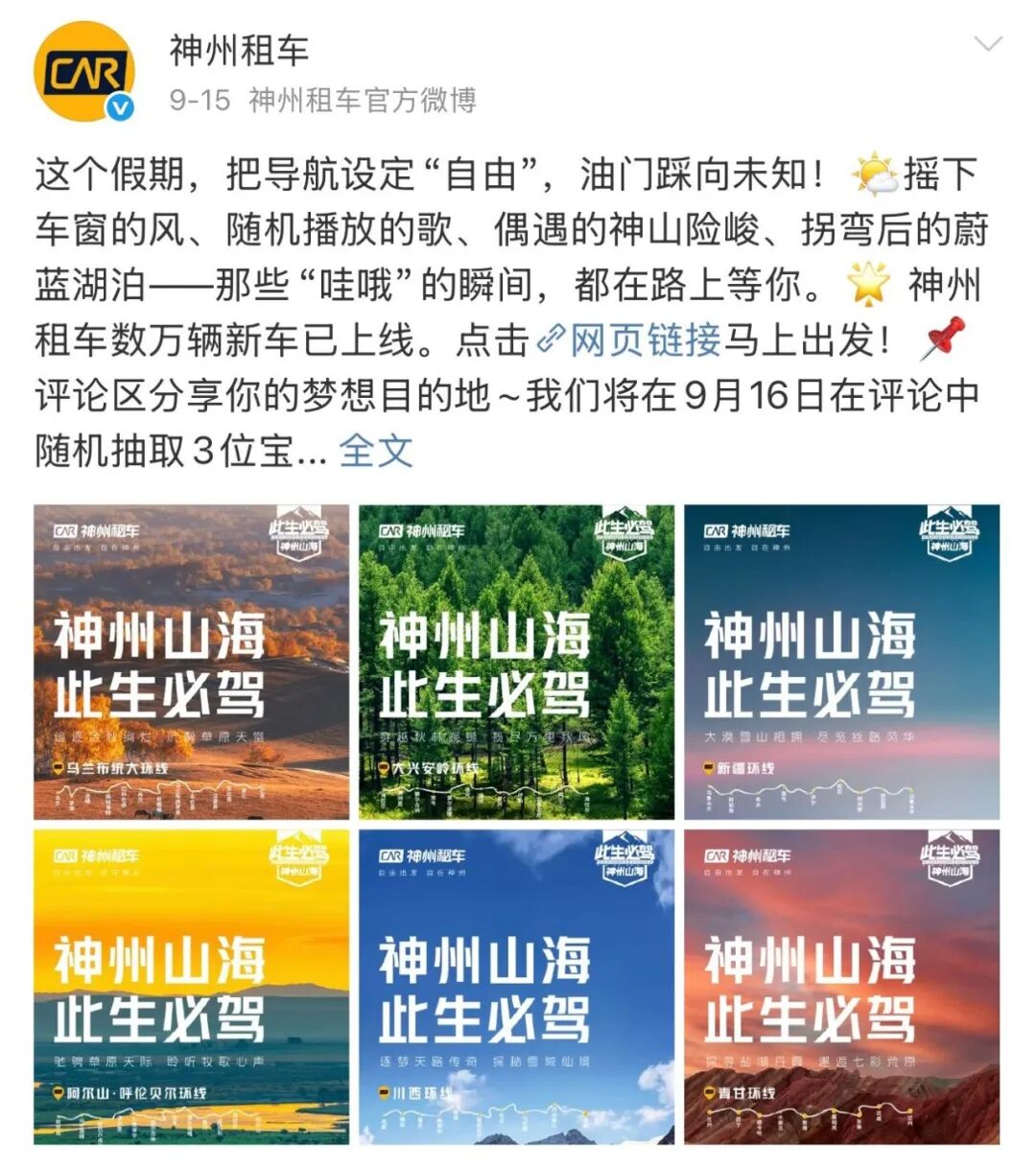
The picture is from a screenshot of CAR Inc.'s Weibo
In the past two years, this series of activities has created and continuously amplified a number of popular self - driving destinations and routes. It can be seen that this is a continuous output of a judgment on lifestyle: truly worthwhile journeys are often not within standardized tourist routes and require active exploration.
This is a very precise "demand creation". It does not compete for the travel plans of existing users but infinitely expands the applicable boundaries of car rental by defining the scarce experience of cultural and tourism scenarios.
More importantly, the demand it creates is highly in sync with the real needs of the general public. Whether the public's travel experience can constitute a form of self - expression is the key to the hot discussions on social media such as Weibo and Xiaohongshu.
In this process, CAR Inc. steps back from the spotlight. It blends in "naturally", accompanying users through grasslands, deserts, and coastlines. This restraint allows the brand to be more naturally embedded in users' travel imagination.
Correspondingly, there are also more practical on - site experiences. Public information shows that CAR Inc. has reached strategic cooperation with many government departments to achieve full - chain integration of the cultural and tourism industry. In addition, it has also cooperated with Bailuyuan Film and Television City to explore a new model of combining the cultural and tourism industry with travel rental within the scope of large - scale cultural and tourism.
This also means that when car rental is no longer just a tool to meet existing needs but becomes a prerequisite for entering these lifestyles, CAR Inc. has naturally completed the transformation from efficiency competition to scenario definition.
This means that the moat it builds is no longer completely based on service efficiency but extends to the long - term influence on lifestyles and cultural and tourism scenarios, making it a definer of demand scenarios.
Emotional Renewal: Embracing the Value Anchor of the Youth
As an enterprise with 18 years of history, CAR Inc. is also facing a common process in the business world: rejuvenation.
Research institutions release reports, and platforms analyze user portraits. From lifestyles and consumption preferences to emotional structures, more and more detailed labels are attached to young people. Enterprises adjust their ways of expression accordingly, using a lighter tone, more frequent interactions, and more proactive emotional output, trying to become the "ideal type" of young people.
The problem is that when all brands use the same method to approach young people, it becomes very "stereotypical".
CAR Inc.'s choice in this regard is to "look inward" and become a part of users again, thereby shifting the value anchor of the young consumer group towards the enterprise.
Whether it is the user recruitment campaign "The First Hundred Kilometers of Life" for the new car launch or the life attitude and proposition of "Don't just rush, explore the road" put forward during the graduation season, these contents do not rush to give value propositions. They record some real but often overlooked moments. The reason these contents work is not because of clever expression techniques but because they recognize the fact that young people are in a stage of continuous trial and error and choice.
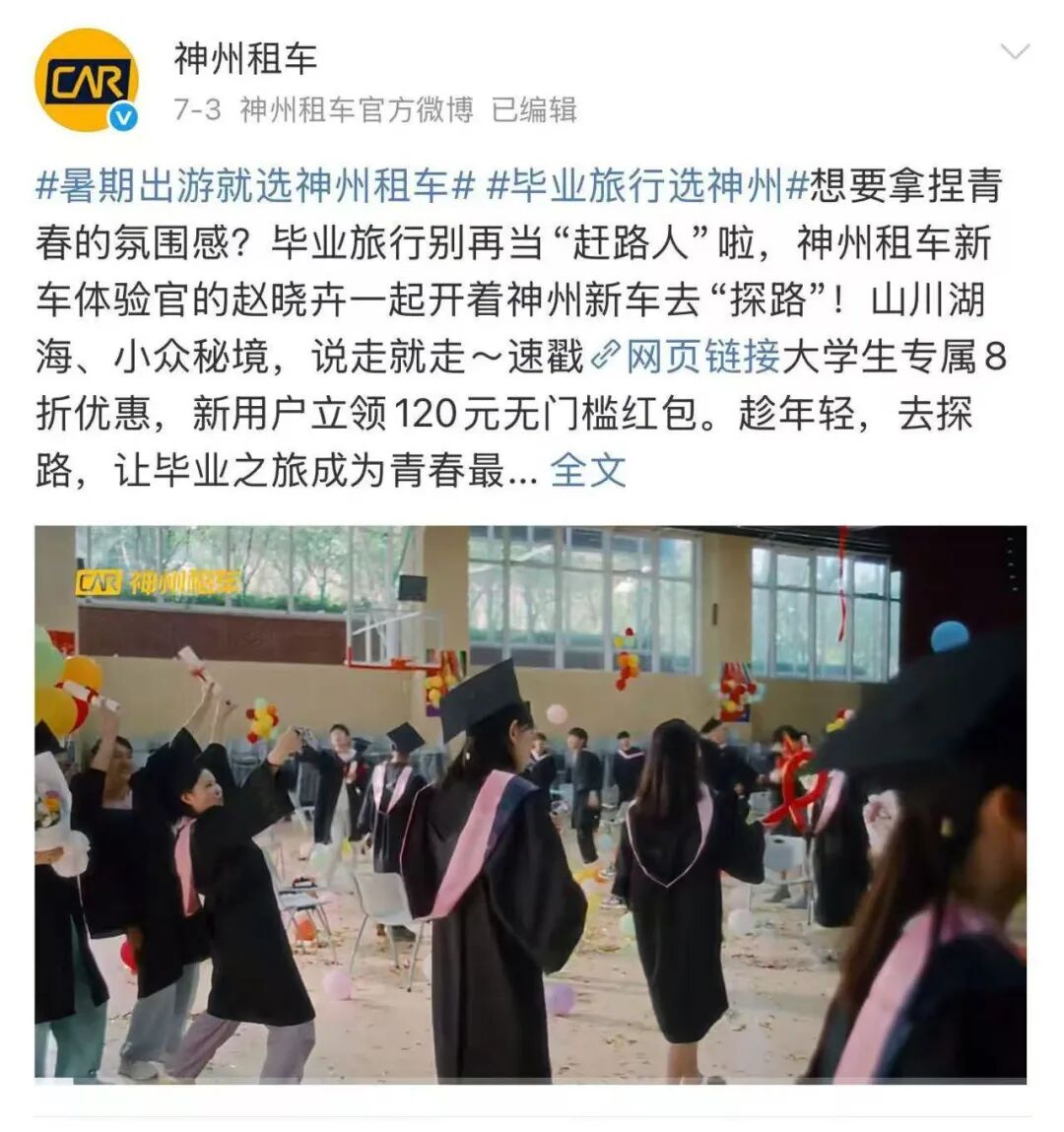
The picture is from a screenshot of CAR Inc.'s Weibo
The brand does not need to summarize the meaning for young people or point out the direction for them. It only needs to maintain respect and equality in these real situations.
This judgment determines the fundamental difference in CAR Inc.'s rejuvenation path. It is not a "spokesperson" but a "companion".
This strategic difference is particularly evident in scenario selection. In the year - end event "Play Together at CAR Inc.", CAR Inc. avoided traditional "high - end" international chains and instead connected with accommodation and lifestyle brands that young people are highly involved in, such as Meituan Homestay, MUNIU Homestay, Tujia, and Qiuguo Hotel.
In essence, this is a scenario - parasitic strategy. It plays the role of a companion who can receive emotions and carry impromptu happiness. Thus, it has completed the transfer of the enterprise's value anchor in both cognitive and emotional dimensions.
It is not difficult to find that this value anchor, along with technological layout and cultural and tourism expansion, has enabled the dynamic extension of CAR Inc.'s moat in multiple dimensions such as strategy, circles, and cognition. Beyond efficiency and scale, it is continuously entering users' life imagination, relationship networks, and decision - making structures.
A Dynamic Moat for a Mature Brand
If we put all of CAR Inc.'s actions in 2025 on the same logical map, we will find that they are not scattered attempts but are answering the question at the beginning of this article: How to build a dynamic moat that can unlock its own and the industry's business imagination?
Upward, through technological layouts such as autonomous driving and low - altitude economy, it keeps itself in the interface of the next - generation travel form. These actions do not aim for immediate realization but ensure that CAR Inc. still has the qualification to participate when travel modes change.
Outward, through continuous involvement in large - scale cultural and tourism scenarios, it pushes car rental from a tool for "responding to demand" to a position of "participating in demand generation". When travel is re - understood as a lifestyle choice, car rental is no longer just an issue of efficiency but becomes the infrastructure for entering specific experiences.
Inward, it remains restrained in communication with the youth. It does not try to shape a persona or rush to output an attitude. Instead, it enters the real life scenarios where young people are highly involved and becomes the default option that needs no explanation, thus effectively transferring the value anchor.
These actions may not translate into a clear growth curve in the short term, but the ability to continuously renew itself behind them is exactly what makes CAR Inc. remarkable.
On the eve of the era change, players who can enter the next stage need exactly this ability to continuously adjust their positions and participate in the definition of the future.
It requires enterprises to continuously update their positions rather than repeatedly prove the correctness of the past.