Hong Kong is no longer the "City of the Li Family".
Author | Wang Hanyu
Editor | Zhang Fan
Hong Kong's commercial office market has welcomed another major mainland investor as a property owner.
On December 10, Lai Sun International and Lai Sun Development issued a joint announcement stating that JD.com Group, through its investment entity, acquired several floors of the China Construction Bank Tower at No. 3 Connaught Road Central in Hong Kong for HK$3.498 billion.
The property is a 27 - story Grade A office building with a total area of approximately 111,600 square meters. A relevant person from JD.com told the outside world that the purpose of the acquisition is for "self - use" and emphasized that it will continue to invest in the supply chain to integrate businesses such as retail, logistics, and technology R & D into the Hong Kong market.
This undoubtedly becomes another landmark event for Internet giants to purchase properties in Hong Kong.
In the past, there was a saying in Hong Kong that "Hong Kong is the city of the Li family." This reflects that Hong Kong - funded enterprises represented by the Li Ka - shing family have occupied important market shares in local real estate, infrastructure, energy, retail, and other aspects. The economic model dominated by real estate and capital operations became an epitome of Hong Kong's financial and real - estate - based economy during that period.
Now, the collective southward expansion of mainland Internet giants is changing this pattern.
Enterprises such as JD.com, Alibaba, and Meituan are gradually penetrating into multiple niche markets in Hong Kong by acquiring properties, deploying retail and logistics, and applying for financial licenses. Hong Kong is also transforming from a "transfer station" for international brands to enter the mainland into a "testing ground" for the mainland's supply chain to go global.
Why do Internet giants buy buildings in Hong Kong?
JD.com's "property purchase" this time coincides with the dual nodes of the adjustment of Hong Kong's asset prices and the explosion of the mainland enterprises' demand to go global.
A recent report released by JLL shows that after a six - year correction starting from the second half of 2019, Hong Kong's Grade A office leasing market is expected to bottom out in 2026. Central and Tsim Sha Tsui will lead the recovery first, recording rent increases of 0.5% and 0.2% respectively in the second half of the year.
Research by Savills also shows that although interest - rate pressure and weak demand pose short - term challenges to the office leasing market, new growth drivers are emerging in Hong Kong's office sector. The recovery of the financial sector and strong purchasing activities by end - users are jointly driving the market to show signs of increasing demand. It is expected that office rents in the Central area will start to rise in the next few years.
This means that the current purchase cost of office properties in Hong Kong may be lower than long - term leasing.
Specifically, the unit price of the CCB Tower property acquired by JD.com is about HK$31,200 per square meter, about 4.59% lower than the recent transaction of a 43 - story landmark skyscraper in Central. Locking in core properties at the asset low point can not only avoid the risk of rent fluctuations but also reserve room for future asset appreciation.
Looking ahead, Chan Kwok - cheung, head of JLL's Capital Markets in Hong Kong, analyzed that the active performance of the IPO market will drive office leasing activities and is expected to attract investors to reinvest in the office investment market.
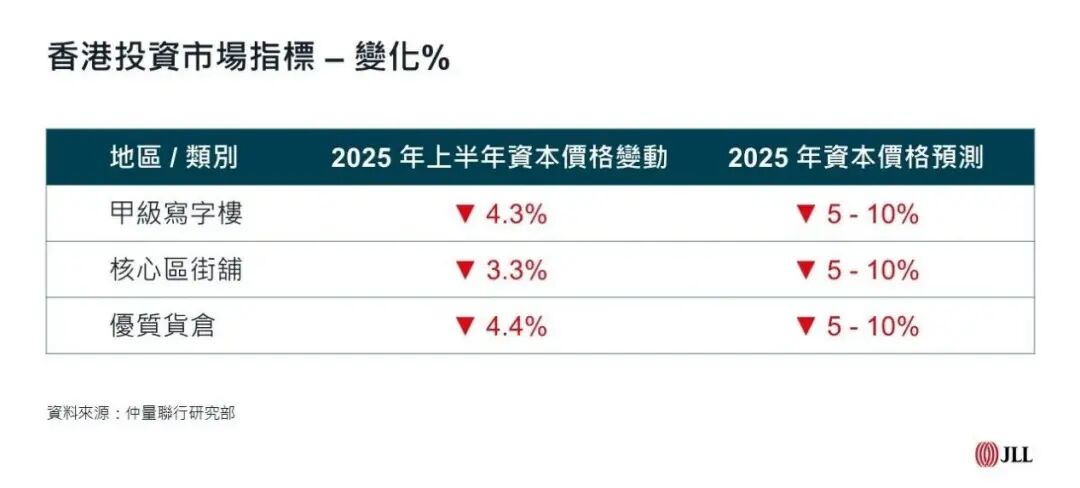
Source: JLL
Therefore, it is also during the period when asset prices have bottomed out and market demand is picking up again that mainland giants have seized this window period to flock to Hong Kong to purchase properties.
Previously, in October this year, Alibaba and Ant Group purchased the top 13 floors of One Island South in Causeway Bay for about RMB 6.6 billion as the Hong Kong headquarters of the two companies; even earlier, in June, Xiaohongshu also set up its first office outside the Chinese mainland in Hong Kong.
In relation to the residential market, Centaline Property in Hong Kong pointed out that in the first 11 months of this year, buyers registered with Mandarin Pinyin completed a total of 12,550 transactions in the Hong Kong property market, involving a total amount of HK$125.6 billion, exceeding the full - year record of 11,631 transactions in 2024 and hitting a new high since records began in 1995.
This shows that in the residential market, mainland capital has once again become an important force in bottom - fishing Hong Kong's real estate. Previously, Cheung Kong Group was one of the major developers in Hong Kong, but now its business share in Hong Kong has decreased. According to a report in July 2025, the business focus of the Cheung Kong Group (including Cheung Kong) is shifting towards globalization, and the proportion of Hong Kong assets has dropped to less than 20%.
In addition, from the perspective of asset appreciation, the Hong Kong residential market has also released a signal of recovery in advance.
According to data from the Rating and Valuation Department, the private residential price index in October 2025 rebounded 7.5% from the low point in May. Given that commercial real estate usually lags behind by 6 - 12 months in the rebound, this change once again shows that JD.com, Alibaba, etc. purchasing commercial office properties at this time has both the intention of financial optimization and strategic positioning.
On the other hand, from the perspective of the business needs of mainland - funded enterprises, the advantages of Hong Kong as a "bridgehead" for mainland enterprises to go global are further highlighted: its common law system, free flow of capital, and geographical location adjacent to the Greater Bay Area can reduce the cross - border compliance costs of enterprises.
Reflected in the financial data, taking JD.com as an example, its Q3 2025 financial report shows that the new revenue including overseas business increased by nearly 214% year - on - year, highlighting to some extent that the role of Hong Kong as a supply - chain hub in Southeast Asia is continuously expanding.
Digging deeper into the business level, JD.com has previously penetrated into multiple industries such as retail, logistics, and finance in Hong Kong by applying for a Hong Kong insurance brokerage license, opening JD Mall, acquiring Jasons Food & Living, and operating the JD Express Island Operations Center. This also requires a centralized office space to integrate resources.
From this perspective, JD.com's property purchase in Hong Kong seems on the surface to be a cost - optimization choice after weighing bottom - fishing for self - owned office space and long - term leasing. Behind it is a long - term investment in the cross - border supply - chain model, using the 7.5 million population and high - frequency consumption data in Hong Kong as a "miniature testing ground" for the Southeast Asian market.
Deep penetration of mainland capital and Hong Kong's transformation
In fact, mainland - funded enterprises using Hong Kong as a "bridgehead" for overseas layout is, on the one hand, based on their own business needs, and on the other hand, is changing Hong Kong's past industrial pattern.
Taking JD.com's acquisition of Jasons Food & Living as an example, after the transaction is completed, all of its more than 90 stores in Hong Kong will be connected to the JD Logistics network. After the official operation of the JD Express Island Operations Center in March this year, more than 100 new couriers have been added locally. Data from JD Express shows that the average daily parcel collection volume in Hong Kong has increased by more than 50 times since 2023.
Before this, Hong Kong's retail market has long been dominated by two major chain supermarket brands, ParknShop under Li Ka - shing's control and Wellcome with British - funded background. ParknShop belongs to the Watson's Group, which is one of the core assets of CK Hutchison Holdings; Wellcome is affiliated with Dairy Farm International Holdings, which is controlled by the British - funded Jardine Matheson Group.
According to data from Euromonitor, in 2020, the ParknShop series had a market share of 37.4% in Hong Kong's retail industry, and the Wellcome series had a 31.4% share. Another mainland - funded enterprise, Vanguard, ranked third, but its market share was only 1.1%, and Aeon only accounted for 0.7%.
That is to say, around 2020, ParknShop and Wellcome jointly controlled nearly 70% of Hong Kong's retail market.
The highly concentrated market structure not only has long made Hong Kong consumers face high prices and limited choices. A survey shows that the prices of similar products in Hong Kong are 30% - 50% higher than those in Shenzhen. In recent years, the phenomenon of "shopping in Shenzhen and picking up goods in Hong Kong" has also become a daily routine for many Hong Kong residents. It also sets extremely high entry barriers for new entrants.
Now, the digital supply chain brought by mainland Internet enterprises such as JD.com is breaking the above barriers.
For example, the "Jasons Food & Living Flagship Store" on the JD Hong Kong APP provides customers with the service of "free shipping for orders over HK$299 + next - day delivery". During this year's 618 Shopping Festival, the sales volume in Hong Kong and Macau increased by 300%. Keeta, the food - delivery platform under Meituan, has also increased its Hong Kong market share based on order volume to 44% within a year.
In addition, in October this year, a company under JD.com obtained a Hong Kong insurance brokerage license, which is another example of mainland technology enterprises entering Hong Kong's financial industry.
Previously, a research report from HSBC predicted that Hong Kong is expected to become the world's largest cross - border wealth management center in 2028. Mainland - funded enterprises, especially e - commerce platforms, can expand their services to comprehensive services covering commodity trading, logistics security, and risk management by obtaining Hong Kong insurance licenses.
Extending to the secondary market, mainland - funded enterprises have been more active in listing in Hong Kong in recent years. According to Hong Kong's IPO data in 2025, mainland - funded enterprises (including mainland enterprises and "A + H" dual - listed companies) dominate the total fundraising amount. As of November 2025, the total fundraising amount of Hong Kong IPOs was HK$259.889 billion. Among them, mainland enterprises accounted for 86%, and "A + H" dual - listed companies contributed more than 60% of the fundraising amount.
According to Deloitte China, it is expected that 114 new stocks will be listed in Hong Kong in 2025, raising about HK$286.3 billion. Among them, in the list of the top ten global IPOs in terms of fundraising amount in 2025, the four IPOs from the Hong Kong Stock Exchange are all from mainland - funded backgrounds, namely CATL, Zijin Gold International, Sany Heavy Industry, and Seres, with fundraising amounts of HK$41 billion, HK$28.7 billion, HK$15.2 billion, and HK$14.3 billion respectively.
It is also worth noting that the fundraising amount of the 19 A + H share listing projects on the Hong Kong Stock Exchange in 2025 accounted for half of its total annual new - stock fundraising amount.
This shows that mainland - funded enterprises have become the "majority" in the Hong Kong stock market.
From Hong Kong's own perspective, the deep penetration of mainland giants is promoting Hong Kong's transformation from a "capital hub" to an "industrial ecosystem hub". Mainland capital brings not only capital but also technology, business models, and employment opportunities to Hong Kong, which may increase Hong Kong's added value in the global industrial chain.
However, the challenges in the process cannot be ignored. The recovery of Hong Kong's commercial real estate is still restricted by global economic fluctuations. A survey released by Airwallex in September this year shows that in the short term, rising operating costs and exchange - rate fluctuations affecting profit margins are also the main challenges faced by Hong Kong enterprises.
How to balance short - term investment and long - term returns will be a test that mainland - funded enterprises must face in Hong Kong.
*Disclaimer:
The content of this article only represents the author's views.
The market is risky, and investment should be cautious. In any case, the information in this article or the opinions expressed do not constitute investment advice to anyone. Before making an investment decision, if necessary, investors must consult professionals and make decisions carefully. We have no intention to provide underwriting services or any services that require specific qualifications or licenses for the trading parties.

Follow for more information