JD.com's 200 "Steps Forward"
During this year's Double 12 period, Li Xin purchased a chair for her new home on JD.com. After receiving the chair, she found that its size didn't match the table at home. When she clicked on the "Return/Exchange/After-sales" page, she unexpectedly found that in addition to being able to exchange for the same item in different colors or models, there were also "Popular Items in the Store" and "Hot-selling Items on the Platform". There was even a separate option that allowed her to directly select items from her shopping cart. She immediately spotted the ergonomic chair she had added to the cart before. Below each item, the specific price and the "Estimated Refund/Additional Payment for the Single Item" were clearly displayed.

The next day, the old chair was picked up, and the new one was shipped at the same time. Li Xin said, "I didn't expect that exchanging goods could be so convenient and user-friendly now."
What Li Xin doesn't know is that JD.com has made more than 200 improvements in details like the "Exchange with Price Difference" experience in 2025. This is not an accident but part of a "silent war" that has been going on for several years and is still deepening.
Recently, 36Kr had conversations with several project leaders and merchants of JD.com's platform services. We found that the term "supply chain", often mentioned by e-commerce professionals, has a much broader meaning within JD.com than the narrow concepts of "product selection and procurement" and "logistics and distribution". It has penetrated into every aspect of retail, from pre-sales to after-sales. They have even extended it to the concept of "service supply chain" - JD.com not only delivers goods but also hopes to provide users with a "certain" shopping experience.
A Battle to Eliminate "Experience Pain Points"
The idea of the "Exchange with Price Difference" originated from a "naive" question.
At an internal review meeting of experience cases at JD.com, the issue of "no stock for exchanging popular items" was put on the table. When users wanted to exchange but there was no stock in the warehouse, the regular practice was to comfort them, offer compensation, and guide them to return the goods. When the discussion got stuck in the rut of process optimization, someone asked, "Why can't we let users exchange for other items? We have so many goods. Maybe users can find a more suitable option."
This idea didn't come out of nowhere. In the daily mining of a large amount of user feedback, the project team found that requests like "Can I exchange it for that by paying the price difference?" often appeared. At the same time, in an internal "Surprise Service" idea voting activity open to all employees at JD.com, the concept of "Exchange with Price Difference" stood out, which made the team more certain about the existence of such needs.
However, from that "naive question" to the actual launch, it was far from just adding a few options on the page.
"Just taking the initial promotion of consensus among various business departments as an example, when a user may exchange from Store A to Store B, it means the sales volume of the original order will 'flow away'. It's difficult to coordinate with merchants, and there are also problems with how to transfer orders across internal departments. There are many details to communicate. At first, people argued fiercely about this," the project leader Meng Zhao (pseudonym) told 36Kr.
What finally promoted the implementation of the "Exchange with Price Difference" project was a more macroscopic judgment: If a poor exchange experience leads to a user returning the goods and never coming back, the loss is far greater than the transfer of an order within the platform. Compared with the gain or loss of a single order, the user experience is more important.
This is not the first time JD.com has challenged the industry convention in "exchanging goods". Since the establishment of its own logistics in 2007, JD.com has launched the "On-site Exchange" service. After more than a decade, there are still few platforms that have fully caught up with this service. In a sense, the current "Exchange with Price Difference" is another evolution of JD.com's "pioneering spirit" in its service gene.
If the "Exchange with Price Difference" is a precise shot targeting the pain point of "difficulty in exchanging goods", then the "Service without Dead Ends" project carried out by JD.com is a systematic check of the entire battlefield.
In September 2024, JD.com officially launched the "Service without Dead Ends" project, aiming to shift from passively responding to complaints to proactively scanning all the "rough edges" that affect the experience in the entire service chain. These "dead ends" usually have a common feature: they don't block the process but damage the user experience.
In JD.com's office area, the slogan "Don't forget the users when making decisions" can be seen everywhere. This is not just a slogan but a mechanism - in 2025, JD.com fixed more than 200 "service dead ends".
Eliminating these "experience pain points" may seem like an increase in cost on the surface, but JD.com sees a deeper business logic in it. The "Exchange with Price Difference" project team found that it is much easier for users to make a decision to "pay a price difference of 20 yuan" than to make a decision to "spend 120 yuan to buy a new item". The decision-making threshold for the former is extremely low, while the latter requires users to re-evaluate their needs, compare prices, and tie up funds, which may all be reasons for users to abandon their purchases.

Judging from the backend data, the after-sales satisfaction rate of the "Exchange with Price Difference" is much higher than that of the "ordinary exchange", and this satisfaction actually further benefits merchants, forming a positive cycle of "high satisfaction - traffic tilt - business growth". Similarly, other measures of the "Service without Dead Ends" project have also brought business growth to merchants. To some extent, this is a reward for the business world's return to the origin of demand.
Liu Qiangdong, the founder and chairman of JD.com Group, once said, "All the businesses of JD.com Group revolve around the supply chain." Now, the continuous optimization of the post - sales experience in retail has been clearly included in JD.com's "super supply chain" capability map. And this "service supply chain" is trying to transform the "troubles at the backend" into "advantages at the frontend".
Expanding the "Free - Shipping Area" to the Edge of the Map
In the traditional e - commerce business model, there is a clear economic dividing line: in remote areas, due to scattered orders, low population density, and long logistics routes, the delivery cost is extremely high. These areas are often regarded as "unprofitable markets". Merchants set high shipping fees or do not support delivery at all, while consumers have to endure a lack of choices and the "shock of shipping fees" in their shopping carts.
JD.com decided to challenge this "common sense", starting with Xinjiang.
The vast territory and unique logistics network in Xinjiang make it the ultimate test field for testing supply chain capabilities. JD.com's solution is a systematic "consolidated shipping" model: after consumers place an order, merchants only need to send the goods to a transit warehouse in Xi'an designated by JD.com. After that, JD.com Logistics will be responsible for the "second - half" delivery across thousands of kilometers, and JD.com will fully subsidize the shipping cost for this section.
In essence, this is an extreme "spill - over of capabilities" and precise scheduling of JD.com's national logistics backbone network and regional warehousing and distribution capabilities, which have been built through heavy - asset investment over the past two decades. Through the seamless connection of trunk and branch lines and the cargo - collection effect of transit warehouses, the long - distance, high - cost, and scattered end - delivery has been integrated into a controllable, efficient, and large - scale service with certainty.
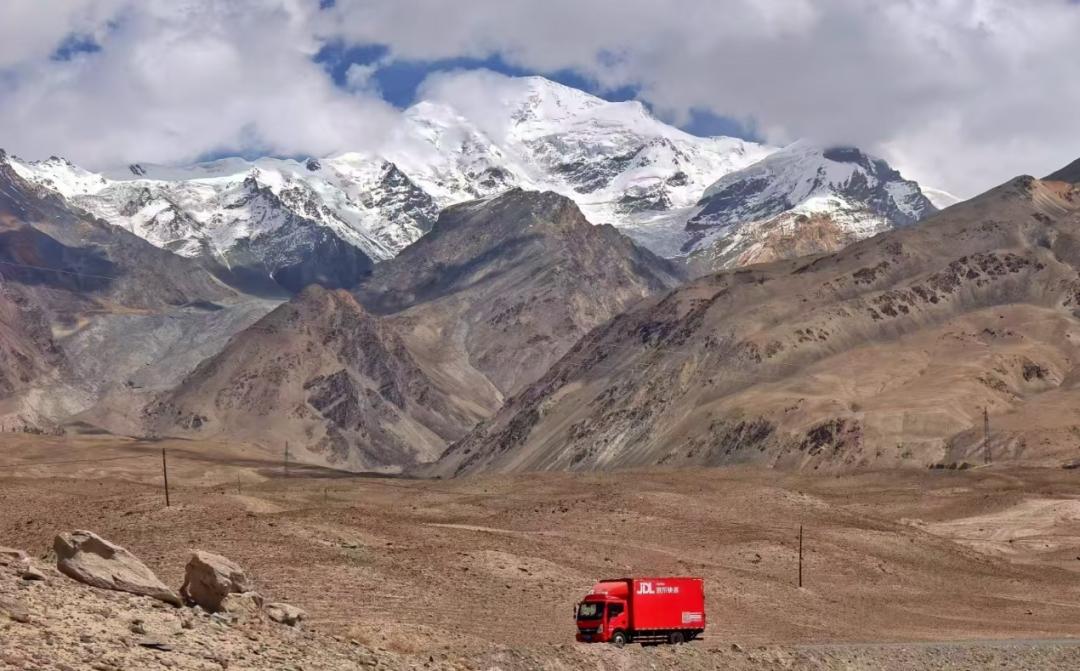
The data proves its value - after the launch of the consolidated shipping and free - shipping service in Xinjiang, the order volume increased by more than 100% year - on - year. This figure reveals that the so - called "unprofitability" is sometimes due to the lack of supply suppressing the real demand.
The success in Xinjiang has also given JD.com the confidence to expand the "free - shipping in remote areas" project strategically.
During the 2025 November 11 shopping festival, JD.com announced that it would extend the "free - shipping in remote areas" service to five regions: Tibet, Inner Mongolia, Gansu, Ningxia, and Qinghai, achieving full coverage of free - shipping in remote areas. This is not just a simple expansion of the region but a large - scale replication of a proven systematic solution. The underlying value proposition is clear and firm: to break the consumption inequality caused by geography and ensure that users, no matter where they are, can access the same reliable products and services.
For Wei Wei (pseudonym), a 90 - year - old owner of a skincare product store, previously, the shipping fee for an order to Xinjiang often reached 30 to 40 yuan. "I'm an individual agent, and this almost eats up my profit," she said. She had to set shipping fees for orders from remote areas or even close transactions directly. "Most of the time, it's not that I don't want to offer free shipping, but I can't afford it."
After connecting to JD.com's consolidated shipping service, Wei Wei's cost structure has completely changed. Since the 2025 November 11 shopping festival, the order volume from regions such as Qinghai, Tibet, Gansu, and Xinjiang in her store has increased by more than 300% year - on - year.
Qian Fangli is the person - in - charge of the imomoto brand under Shanghai Jinfan Trading Co., Ltd. After choosing to participate in the "free - shipping in Xinjiang" program at the first opportunity, imomoto's sales volume in Xinjiang increased by 44%, and its GMV increased by 24%.
This year, when JD.com expanded its "free - shipping area", Qian Fangli was still one of the first participants. "This is not only about sales growth but also an early layout for brand awareness and market competitiveness. It's a great thing for the long - term construction of the brand," she said.
In JD.com's "service supply chain", the "Exchange with Price Difference" optimizes the single - point decision - making link, while the "free - shipping in remote areas" reconstructs the regional business infrastructure. Although they are different in scale, they share the same core: by creating a certain and ultimate experience, they aim to activate the existing but hidden demand or explore new incremental markets.
"Trust" is the Shortest Business Path
Whether it's solving 200 experience pain points or expanding the "free - shipping area" to the edge of the map, what supports these actions is a "listening" system deeply rooted in JD.com's organizational structure.
Every day, a large amount of user feedback is collected through customer service calls; the technology team conducts text analysis on product reviews to quantify keywords such as "don't like the taste" and "wrong size"; the procurement, sales, and service operation teams in each category, based on their in - depth industry experience, identify those non - standard pain points.
These information flows converge to form the initial data that drives the operation of the "service supply chain". And what ensures that the data is valued and translated into action is the decision - making logic repeatedly emphasized within JD.com - Liu Qiangdong requires that any business decision at JD.com should start from the "Three Strategic Questions": "Who are your customers? What value can you create for them? What is your core competitiveness?"
Starting from the origin of value, bypassing complex business calculations, has also helped JD.com build a deeper level of "trust" with merchants.
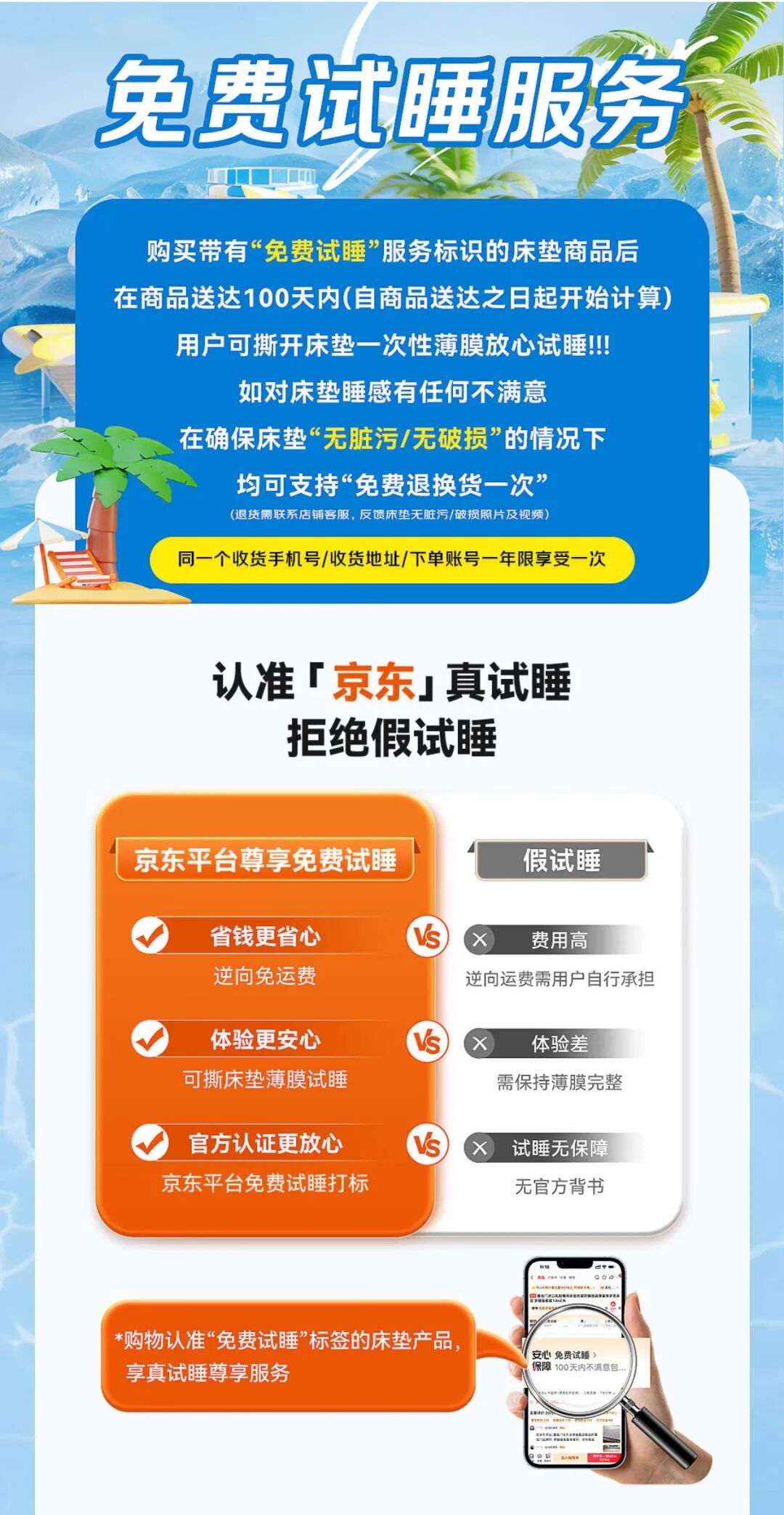
In June last year, Xiao Wei (pseudonym), the person - in - charge of the e - commerce department of a mattress brand, received a proposal from JD.com's procurement and sales team to launch a "free trial sleep" service. In the meeting room, the team was unanimous in their opposition. "Once the plastic protective film is removed and the mattress is returned, how can we sell it again?"
As a brand operating on multiple platforms, Xiao Wei was well - aware of the industry rules: a trial sleep was acceptable, but the mattress film must not be damaged. Moreover, it was during the most intense price - war period at that time. JD.com's proposal of "supporting a trial sleep after removing the film" sounded like a "loss notice" to them.
Instead of applying pressure, JD.com adopted a "risk - sharing" approach: during the trial operation period, relying on its own logistics network and fulfillment capabilities, JD.com would first bear the reverse delivery cost caused by dissatisfaction with the trial sleep and provide subsidies for the depreciation, scrapping, and warehousing costs of the returned goods. This agreement transformed the game relationship between the two parties into an alliance to jointly improve the experience boundary.
With their concerns removed, Xiao Wei's team began to optimize every detail of the "trial sleep" service, such as achieving "next - day delivery" of mattresses through JD.com's self - operated warehouse and JD.com Logistics, and ensuring seamless connection for users who wanted to exchange the mattress with the "pick - up of old and delivery of new" service. A dramatic reversal soon occurred: the customer's decision - making process was significantly shortened, the store's conversion rate increased by 30%, and the order volume increased by more than 50%. The most worrying "return rate after removing the film" was far lower than the team's initial panicked estimate. A highly - praised review read, "Daring to let people sleep on it for 100 days after removing the film shows how confident they are in their product. I'll take a chance on it."
"This is not at all what we initially imagined," Xiao Wei told 36Kr. "A 'bold gamble' on service upgrade has become our strongest growth engine and has also driven the improvement of the brand's return throughout its life cycle."
Currently, the competition in e - commerce has penetrated into the core of "trust density". Advantages in price, traffic, and functions can be easily imitated. Only the systematic "trustworthiness" based on numerous real experiences is the most difficult to replicate. This requires long - termism that doesn't care about short - term gains and losses.
JD.com's "service supply chain" is the practice of this long - termism. It has transformed after - sales from a cost center into a growth engine, turned its logistics advantage into an inclusive consumer infrastructure, and forged users' "pain points" into "trust currency".
When "certainty" itself becomes the most attractive product and "trust" becomes the most widely - circulated hard currency in the platform ecosystem, JD.com's long - term investment in service has evolved into a "value system" that drives healthy growth: ultimate experience deepens trust, trust drives growth, and growth feeds back into a better experience.
This may be the essential goal that JD.com wants to achieve in every "unprofitable" detail. This "super supply chain" built with the participation of "service" has become JD.com's most unique and unshakable ecological niche at present.