In Beijing, Shanghai, and Guangzhou, a group of robots started working on Christmas Day.
Text by | Fu Chong
Edited by | Su Jianxun
As the end of the year approaches, a batch of embodied intelligence companies have started to deliver products, and there are new scenarios for "robots to do work".
On December 25th, Christmas Day, the embodied intelligence startup "Stardust Intelligence" told "Intelligent Emergence" that they have started mass - delivering products to their partners "Golden Horse Amusement" and "Lewa Entertainment". The robots delivered this time are selling trendy blind boxes at Beijing Chaoyang Hesheng Mall, Shanghai Oriental Pearl Square, and Guangzhou Huacheng Plaza Bona Cinema.
In this retail vehicle called the "Intelligent Adoption Store", the robot independently completes a series of tasks, including voice reception, order taking and payment collection, blind box grabbing, and product delivery.

△ Customers are experiencing the "Intelligent Adoption Store" at Beijing Chaoyang Hesheng Mall. Video: Provided by the interviewee
It is reported that the retail store "Robot MART" jointly launched by Stardust Intelligence and Golden Horse Amusement will gradually enter scenarios such as commercial areas, amusement parks, blocks, and parks. In November 2025, the "Robot MART" jointly developed by the two has opened in the Time Adventure Amusement Park in Zhongshan City, Guangdong Province, providing services for selling popcorn snacks and beverages.
The reason why Stardust Intelligence's robots can enter diverse scenarios is related to their technical approach.
"Cable - driven body" is the core R & D direction of Stardust Intelligence. The resulting flexibility of movement and precise force control enable the robot to quickly complete delicate hand operations such as grabbing and filling in a human - like manner. In addition, because cable - driven robots are lighter in weight and their joints have a flexible buffer mechanism, they can effectively resolve the collision force in case of accidental contact, thus ensuring the safety of human - robot interaction.
The accumulation of cable - driven robot technology was foreshadowed when the founder, Lai Jie, was still in Tencent Robotics X Laboratory.
Tencent Robotics X Laboratory was established in 2018. As the first employee of the laboratory, Lai Jie set his sights on cable - driven robots at that time. He found that as a flexible transmission medium, the cable can play a role similar to human muscles when pulling the robot - not only making the movement more flexible but also enabling more precise force control.
More importantly, he originally thought that cable - driven technology was a new technology. However, during the research, he found that the mature elevator system relies on cables for transmission, which confirms the load - bearing capacity of cable - driven technology from an engineering perspective.
At the end of 2022, Lai Jie, together with his colleagues from the Robotics X period, such as Dai Yuan, founded the embodied intelligence company Stardust Intelligence. They abandoned the more widely used direct - drive and linkage transmission solutions in the industry and promoted their years of research on cable - driven technology to the industrial level.
According to Lai Jie, currently, there are only two robot companies in the world focusing on cable - driven transmission bodies. Stardust Intelligence is the world's first company to mass - produce cable - driven humanoid robots. The other one is the American company "1X", which is invested by OpenAI and plans to mass - produce robots for household use in 2026.
The technical features of Stardust Intelligence have been initially realized in multiple orders. Since the second half of 2025, the company has successively received cooperation and orders from different fields such as industry, commercial services, and scientific research, including Seer Industry (thousands - level order), Lingyi Precision Industry, Golden Horse Amusement (thousands - level order), CCTV.com, the Massachusetts Institute of Technology, and Shenzhen Elderly Care and Nursing Home.
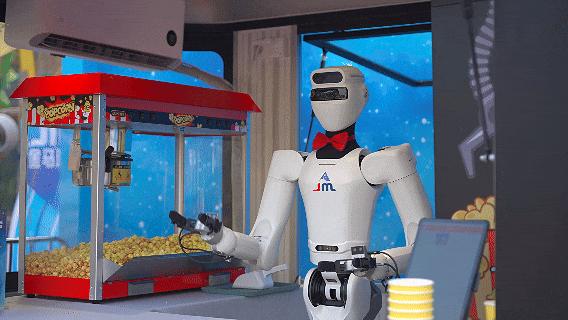
△ A Stardust Intelligence robot is filling popcorn in the robot retail service store at Golden Horse Amusement Park. Picture: Provided by the interviewee
When it comes to the methodology of receiving orders in diverse scenarios, Lai Jie summarized two core points.
Firstly, from a technical perspective, the force control ability and flexibility brought by the cable - driven body make the robot more proficient in hand - related tasks and perform well in "tele - operation" tasks.
The "muscle - like traction" effect produced by cable - driven technology allows the robot to sense the change in force when performing hand movements such as pushing, pulling, and twisting, just like a human being, and adjust the force and movement in real - time accordingly.
For example, when dealing with the task of opening a room door, a robot guided purely by vision can hardly "see" whether the doorknob has been turned properly and the state of the door's opening or closing. However, a robot with force control can know through force feedback that the handle has been turned to the end and then push or pull the door.
Lai Jie believes that with the "tactile sensation" brought by force, many hand - related tasks can be completed better. This way of working, similar to that of a "blind person", conforms more to the first - principle of human hand - work. Therefore, Stardust Intelligence's robots can enter industrial, assembly, and service - retail scenarios that require more upper - body capabilities.
At the same time, cable - driven technology also makes the robot's "hand" lighter, with faster and smoother movements, and more "responsive" in tele - operation tasks.
Specifically, currently, most robots generally use rigid traditional structures such as direct - drive and linkages. There is friction and clearance between the motor and the gears, making it difficult to transmit and express subtle forces, and the movements may be rigid and jerky. However, the flexible nature of cable - driven technology can retain and transmit continuous force signals through the slight deformation of the cable, thus providing a more real and smooth movement performance and collecting coherent high - quality data in tele - operation.
The cable - driven design also allows the motor to be placed at the rear. For example, the hand - driving motor can be placed near the elbow, and then the cable can drive the end gripper like a tendon, greatly reducing the weight of the hand end, making the movement lighter and the response more agile.
Based on this "responsive" ability, Stardust Intelligence proposed the concept of "Avatar Intelligence": Before artificial intelligence can work completely autonomously, let the robot enter the real - world scenario through human tele - operation first.
One of Stardust Intelligence's customers allows the staff to control the robot to replace humans and complete scientific research work synchronously in a toxic laboratory where wearing protective clothing was originally required.
The second point of the commercial implementation methodology lies in the product logic. Lai Jie's practical idea is to "avoid creating robots with excessive performance". This means rejecting the stacking of hardware and only creating product functions that the existing AI can control well and that meet the actual application requirements.
For example, when he and his team were training the model, they found that the five - fingered dexterous hand was a bit difficult for the current AI to control. However, after simplifying it to a three - fingered structure, it can still complete the main human hand - related tasks, and the model is easier to control and learn, with significantly improved training efficiency and task success rate.
The restraint on hardware has also accelerated the commercialization process of Stardust Intelligence.
Stardust Intelligence sells its half - body robot S1 - U, which is good at dexterous hand - related operations, as a half - body robot. By combining it with the mature mobile chassis of its customer Seer Industry, a wheeled dual - arm robot suitable for industrial scenarios can be created.
As a robot controller company, Seer Industry has accumulated technologies related to positioning, navigation, and motion control in the past decade. The combination of the two focuses Stardust Intelligence's core AI capabilities on the more proficient upper - body operations instead of dispersing them into fields such as mobile navigation, which are more proficient for partners. It also saves Seer Industry from repeated procurement. This has promoted Stardust Intelligence to obtain a thousands - level order from Seer Industry.
Recently, Lai Jie was interviewed by "Intelligent Emergence" after a sharing session. The following content is from the interview and has been sorted out by the author:
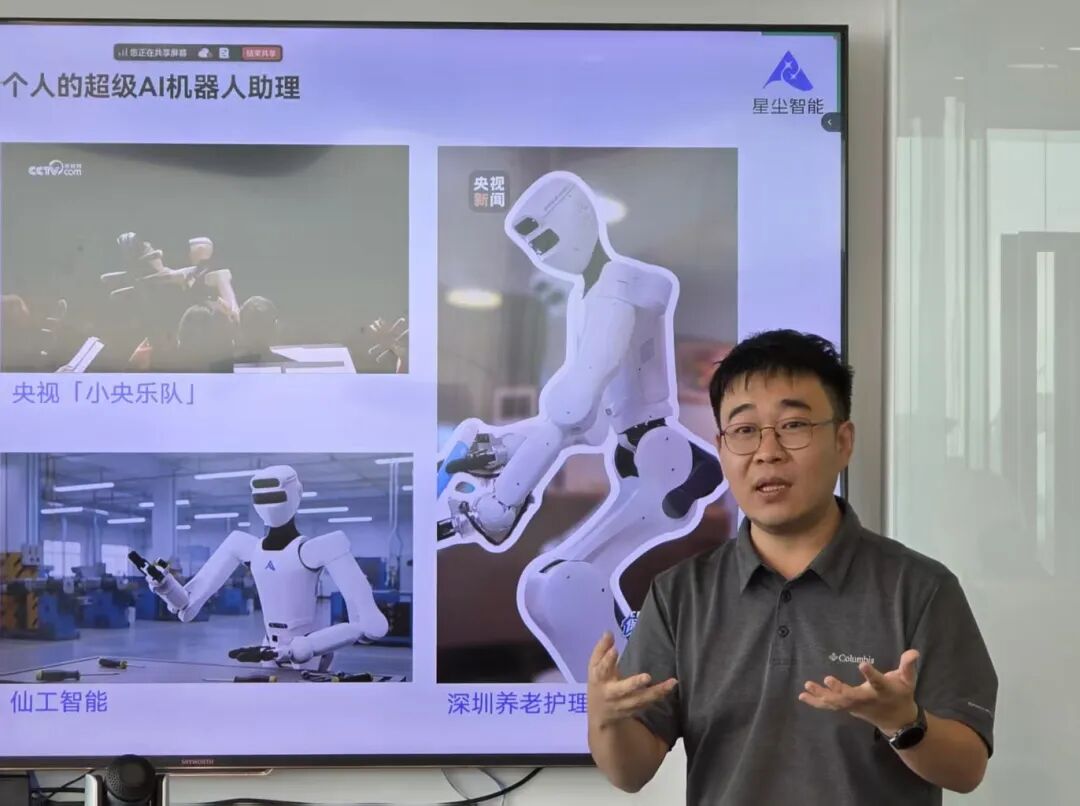
△ A working photo of Lai Jie. Picture: Provided by the interviewee
Tele - operation: The "Avatar Intelligence" productivity of humans before the arrival of AGI
Intelligent Emergence: You proposed the concept of "Avatar Intelligence", which seems to upgrade tele - operation from a "data collection tool" to a "productivity tool for extending human capabilities". Before the arrival of fully autonomous AGI, how is tele - operation used in actual production?
Lai Jie: "Avatar Intelligence" means enabling the robot to complete a part of the work like a human's avatar. It has two aspects of value: on the one hand, it can complete medium - and long - distance and remote work; on the other hand, it can enter the environment one wants to reach and conduct some emotional expressions.
For example, some toxic working environments that require wearing chemical protective suits are dangerous and uncomfortable for scientific researchers. In this case, the tele - operated robot can enter the above - mentioned scenarios to complete the work. Currently, some of our customers hire human employees in third - world countries to tele - operate robots located in developed countries for work, which can reduce the hourly wage cost of the customers' employees.
We have also tried allowing business travelers to wear VR devices in the hotel to tele - operate the robot to feed and water their cats at home. In this way, the person operating the tele - operation can also enjoy the interaction with the pet.
Intelligent Emergence: At events such as WAIC, the feedback about Stardust Intelligence is that many people feel that the tele - operation is very "responsive" after experiencing it, and the synchronization between humans and robots is very good. So, what are the technical difficulties in achieving good tele - operation?
Lai Jie: There are two key points for good tele - operation: synchronization and isomorphism.
Synchronization means that the robot replicates the operator's actions one - to - one, with a high degree of consistency in time, space, and force during execution.
When a person is tele - operating, even a delay of dozens of milliseconds or inconsistent action mapping will immediately create a sense of "disconnection". For example, when I raise my hand, the robot moves half a beat later or does not move enough. This mismatch will seriously interfere with the operation intuition and then affect the efficiency and effect of the action.
We have optimized the end - to - end low - latency in the system. From sensor data collection, data transmission, control calculation to robot driving, the entire link needs to be optimized to the extreme. More importantly, it is not only about speed but also about "stability" and "accuracy". The amplitude, speed, and rhythm of the action must be strictly aligned with the person's intention, making people feel as if they are directly operating with their own body rather than "remotely controlling" a machine. Only by achieving such seamless synchronization will users feel that the operation is "responsive".
Isomorphism means that regardless of the operator's physical characteristics such as height and arm length, they can accurately control the robot.
For example, there was a 6 - year - old boy wearing a tele - operation device. When he stretched out his arms, the robot only stretched out half of its arms. This is because the boy's arm length is almost half that of an adult, and the robot judged it as a half - stretched arm accordingly.
Therefore, we cannot simply focus on the end - form but need to consider the user experience and accurately map the entire human calibration to the robot. Only when the isomorphism is well - done can the operation be accurate.
Intelligent Emergence: Is there a significant correlation between the performance of tele - operation and the cable - driven technology adhered to by Stardust Intelligence?
Lai Jie: Yes, the cable - driven technology has two major advantages, which bring the advantages of flexibility, good force control, and more human - like movements to our robots, supporting good tele - operation performance.
The first is the controllability of force. Since the cable is a flexible force - transmitting medium that mainly relies on pulling, it is naturally more suitable for force perception and compliant control, making the collision safer and the tactile sensation more similar to that of a human.
Why do we emphasize "force control"? Because for many real - world tasks, vision alone is not enough.
For example, when a robot without force feedback tries to open a door based on vision alone, it cannot complete the task directly. However, a robot with force control can sense the resistance after placing its hand on the doorknob, then press it down, and then pull the door after pressing it to the end. This is consistent with the logic of a blind person opening a door.
This also conforms to the working principle of humans and is a prerequisite for providing safe and delicate human - robot interaction.
Secondly, it has bionic high - dynamic performance.
The cable - driven design allows us to place the motor at the rear. For example, the hand motor can be placed near the elbow, and the upper - arm motor can be placed near the shoulder, and then the cable can drive the joints to move like human tendons.
This greatly reduces the weight of the end - effector, making the end of the robot's arm very light and achieving high - dynamic response.
Intelligent Emergence: Is the BOM cost higher or lower with cable - driven technology?
Lai Jie: Cable - driven technology can reduce the BOM cost in the following aspects.
Acting as a reducer: In the direct - drive or high - precision reducer system, the reducer is one of the more expensive components. Cable - driven technology uses a "flexible medium + wiring mechanism" to amplify the torque, which is equivalent to having a "reducer function" naturally.
No need for sensors: The cable - driven system has low friction, small backlash, and a simple force - transmission link, giving the system a natural high force transparency. The higher the transparency, the easier it is for the control system to accurately reconstruct the external force, eliminating the need to add expensive components such as a six - axis force sensor at the end.
Motor and structural efficiency: The common differential drive structure of cable - driven technology allows multiple motors to share the torque output in parallel, improving the power density. This means that smaller - sized or fewer motors can be selected.
Lightweight benefits: The "remote placement + lightweight end" structure of cable - driven technology allows the joint end to be significantly reduced in weight. The lightweight design has a chain effect: the smaller inertia at the end reduces the control requirements for the motor; at the same time, the required structural strength of the joint also decreases, which further reduces the cost of materials, processing, and support structures.
Design for AI, avoid excessive robot performance
Intelligent Emergence: You repeatedly mentioned that robots should be "Design for AI" and avoid excessive performance. What does this specifically mean? How does it guide your technical strategy?
Lai Jie: "Design for AI" is our core product philosophy. It means that the hardware design must serve the learning ability and data efficiency of AI, rather than blindly pursuing the ultimate parameters. A hardware that cannot be effectively learned by AI and cannot efficiently produce high - quality data is ineffective, no matter how cool its performance is.
Based on our understanding of the essence of human grasping, we found that a three - fingered structure can also complete many grasping tasks. After simplifying the design to a three - fingered structure that is easier to learn, the training efficiency and task success rate of AI have been significantly improved.
Similarly, we have not blindly stacked tactile sensors because we found that the existing AI models do not handle multi - source and inconsistent tactile data well. Based on the first - principle of "Design for AI", we do not stack hardware but only create product functions that the existing AI can control well and that meet the actual application requirements.