Speeding on the capital track, stalling at the dark intersection: The paradox of Waymo's expansion in 2025
Behind the capital pursuit and rapid business expansion, Waymo proved in 2025 that the ultimate test of autonomous driving is not the technology itself, but whether it can find a reliable balance between the chaos and order of the real world.
On December 20th, San Francisco experienced a rare large - scale power outage. A sudden fire at a substation of the Pacific Gas and Electric Company caused traffic lights to go out in 30% of the city.
However, in this urban emergency, what attracted the most attention was not the chaotic response of human drivers, but rather the collective "shutdown" of Waymo's autonomous driving fleet.
In the videos circulated on social media, multiple white Waymo vehicles were stuck at a dark intersection, with their red taillights flashing in the night, creating long queues of cars behind them.
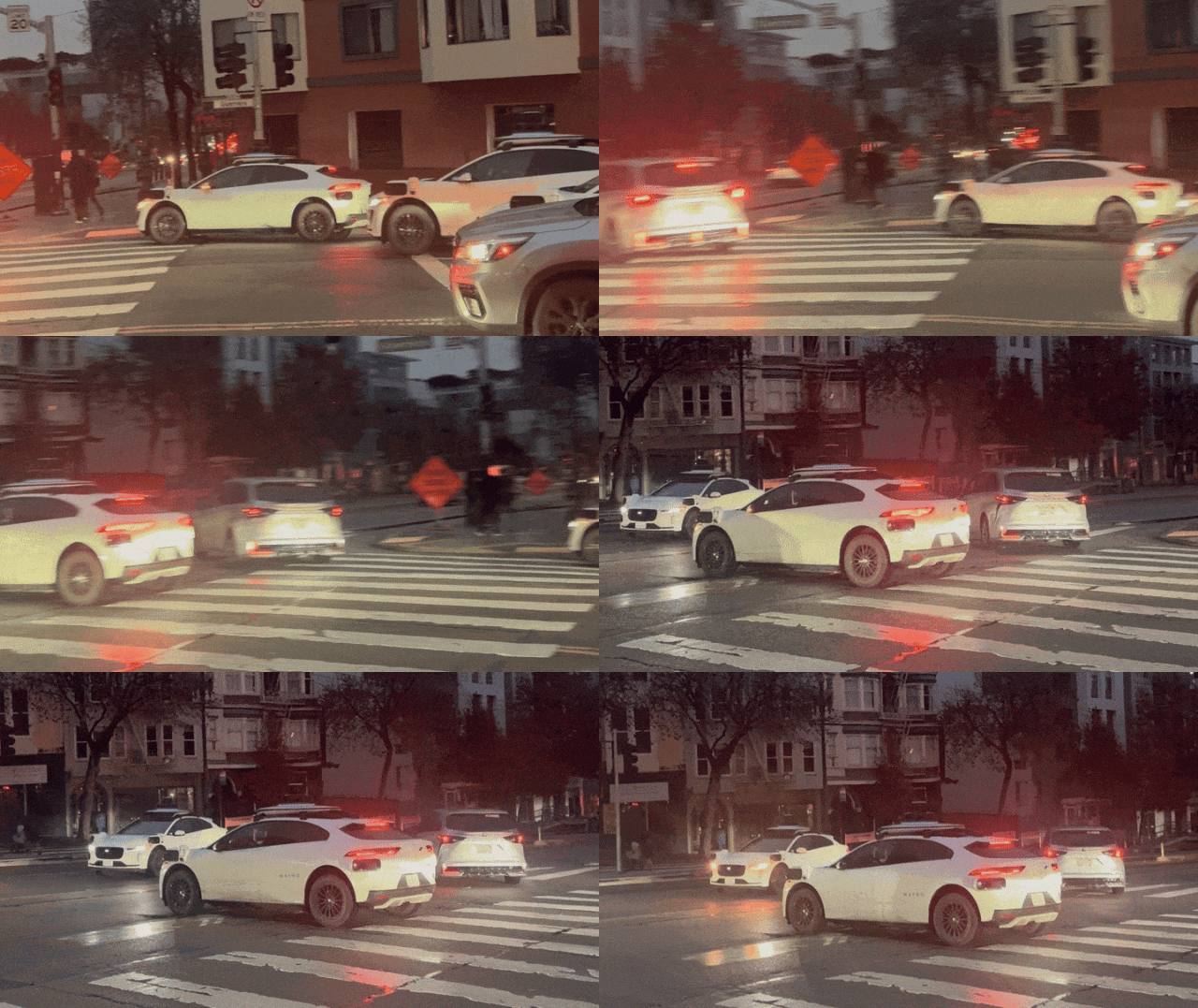
Traffic jams caused by the standstill of Waymo vehicles
Just a few days ago, foreign media The Information reported that Waymo is in talks with potential investors about financing, and the company's valuation is expected to reach at least $100 billion. The newspaper cited sources familiar with the matter as saying that the financing scale of Waymo may exceed $10 billion, and it is expected to be finalized early next year.
From the talks of multi - billion - dollar financing, the achievement of tens of millions of orders, to the cross - city and cross - border business layout, and then to the unexpected accidents and safety disputes, 2025 was a year for Waymo, an autonomous driving subsidiary of Google's parent company Alphabet, when the commercial expansion accelerated and the capital attention soared, and also a year when the technology implementation encountered multiple real - world challenges.
Waymo's journey in the autonomous driving field is full of breakthroughs and setbacks, which also outlines the real picture of the world's top autonomous driving companies moving towards large - scale implementation.
01
Capital Injection: Doubled Valuation, and a New Expansion Cycle with Hundreds of Billions in Financing
More than a year ago, in October 2024, when Waymo completed its last round of financing, the company's valuation had just exceeded $45 billion.
In the blink of an eye, its market value has doubled.
According to information disclosed by The Information, citing sources familiar with the matter, Waymo is in talks with potential investors about financing, with a valuation expected to reach $100 billion, and the financing scale may exceed $10 billion.
The sources also revealed that this round of financing is led by the parent company Alphabet and will attract external investors to jointly conduct equity financing.
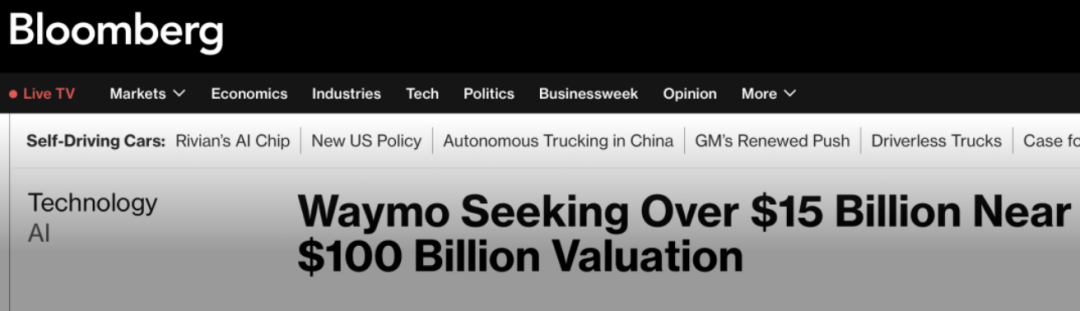
Bloomberg reported that Waymo plans to raise more than $15 billion in a new round of financing led by Alphabet
Bloomberg reported that Waymo plans to raise more than $15 billion in a new round of financing led by its parent company Alphabet. The company's valuation is expected to reach at least $100 billion, with a potential high of over $110 billion.
Waymo has not responded to this. However, in November this year, Waymo hired a new chief financial officer to prepare for the next stage of development. The outside world speculates that it may seek more external investment in the future.
As the global leader in the field of autonomous driving, Waymo has always been regarded as an industry benchmark and has attracted the attention of many top - tier capital.
However, it wasn't until March 2020 that Waymo conducted its first round of external financing, raising $2.25 billion and setting a single - financing record in the field.
At that time, according to Waymo, this round of investment was mainly led by Silver Lake, the Canada Pension Plan Investment Board, and the Abu Dhabi sovereign wealth fund Mubadala. Other investors included auto parts supplier Magna International, Andreessen Horowitz, auto retail giant AutoNation, and Alphabet.
Judging from this list, the first batch of external investors was quite impressive.
In May of the same year, Waymo announced that it had received an additional investment of $750 million from new investors. The investor group was still powerful, consisting of well - known global investment institutions such as T. Rowe Price Associates, Perry Creek Capital, and Fidelity Management & Research.
In two months, it received $3 billion in financing, but this was not the end.
In 2021, Waymo carried out a second round of external financing and successfully secured $2.5 billion. The investors included Alphabet, Andreessen Horowitz, Fidelity, Silver Lake, T. Rowe Price, Temasek, and Tiger Global.
After that, the global autonomous driving investment and financing market entered a relatively sluggish period, and single - financing of such a large scale rarely occurred in the industry.
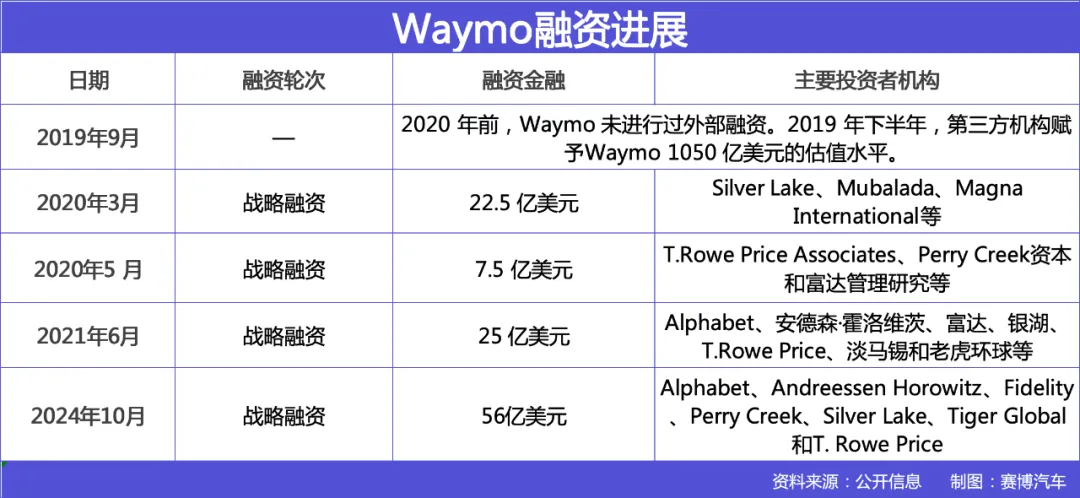
It wasn't until October 2024 that Alphabet, along with many "old friends", increased their investment in Waymo again, contributing $5.6 billion, another huge sum. Led by Alphabet, Andreessen Horowitz, Fidelity, Perry Creek, Silver Lake, Tiger Global, and T. Rowe Price continued to participate, and the valuation exceeded $45 billion.
If Waymo can complete the financing with a valuation of $100 billion, it will become the company with the highest valuation in the Robotaxi field. In the future, this financing will be mainly used to expand the operation network, improve technological capabilities, and promote commercial implementation.
02
Business Explosion: Scale Expansion, Surge in Orders, and Accelerated Global Layout
Behind the huge financing and soaring valuation is the substantial explosion of Waymo's Robotaxi business.
2025 was an "explosive year" for Waymo's business expansion. Breakthroughs were achieved in terms of service scope, order volume, and global layout.
In terms of order volume and operational efficiency, Waymo achieved leap - forward growth.
According to data released by Waymo in early December, its Robotaxi business had accumulated 14 million paid orders in 2025, a three - fold increase compared to 2024. By the end of the year, the weekly paid order volume had exceeded 450,000, and each vehicle received an average of about 26 orders per day, indicating the initial formation of a commercial scale.
By the end of 2025, the cumulative order volume of Waymo's service since its launch in 2020 is expected to exceed 20 million, and the total passenger - carrying time will exceed 380 million hours.
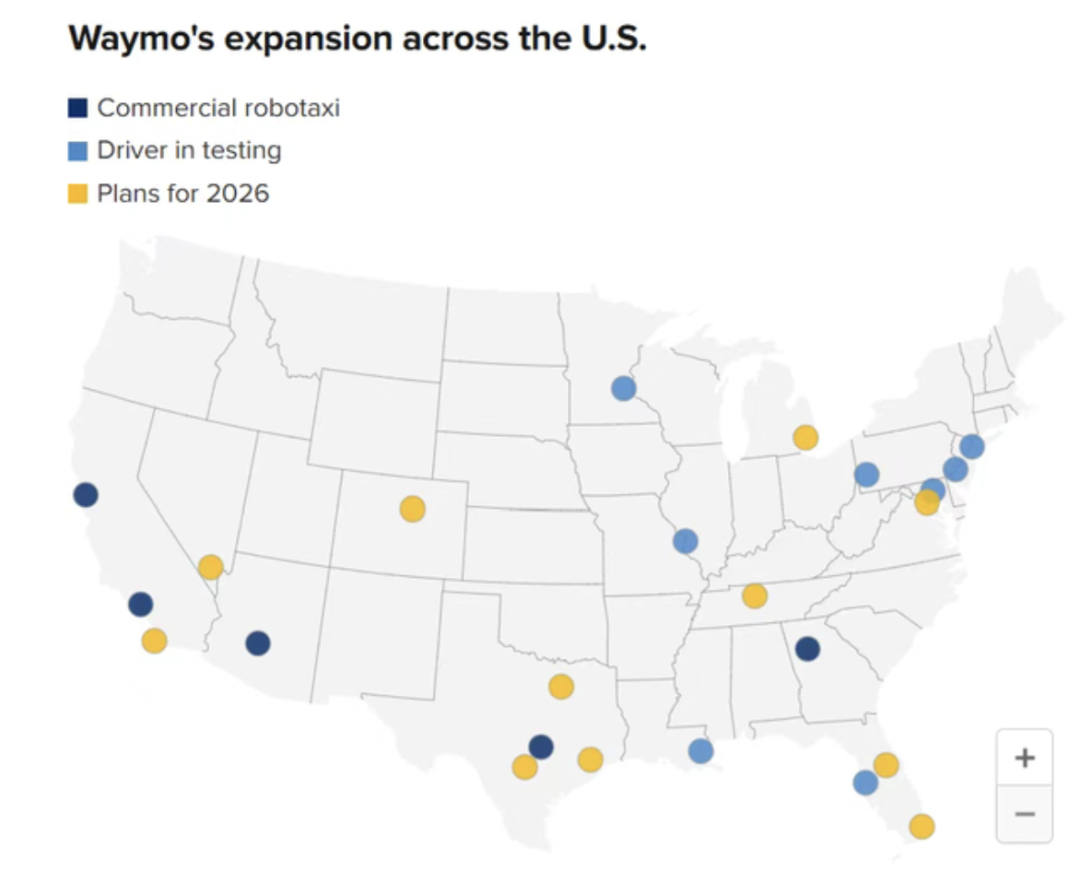
Waymo's service network in the United States
In the US domestic market, Waymo's service network continued to expand. Currently, Waymo provides fully autonomous driving services in five US cities: San Francisco, Los Angeles, Phoenix, Austin, and Atlanta.
Among them, November was a critical period for expansion. On November 12th, it opened 24 - hour autonomous driving services on highway sections to some passengers in San Francisco, Phoenix, and Los Angeles, marking Waymo's official entry into the commercial high - speed travel field. At the end of November, it launched Robotaxi operations in Miami and plans to open services in Dallas, Houston, San Antonio, and Orlando to employees in the coming weeks, and will fully open to the public in 2026.
In addition, Waymo plans to expand its services to 11 US cities such as Denver, Detroit, Las Vegas, and Nashville next year.
Moreover, Waymo has also started vehicle testing in New York to explore its operational capabilities in super - large cities, but it has not yet announced the service launch schedule for this market.
In terms of global layout, Waymo has also taken key steps.
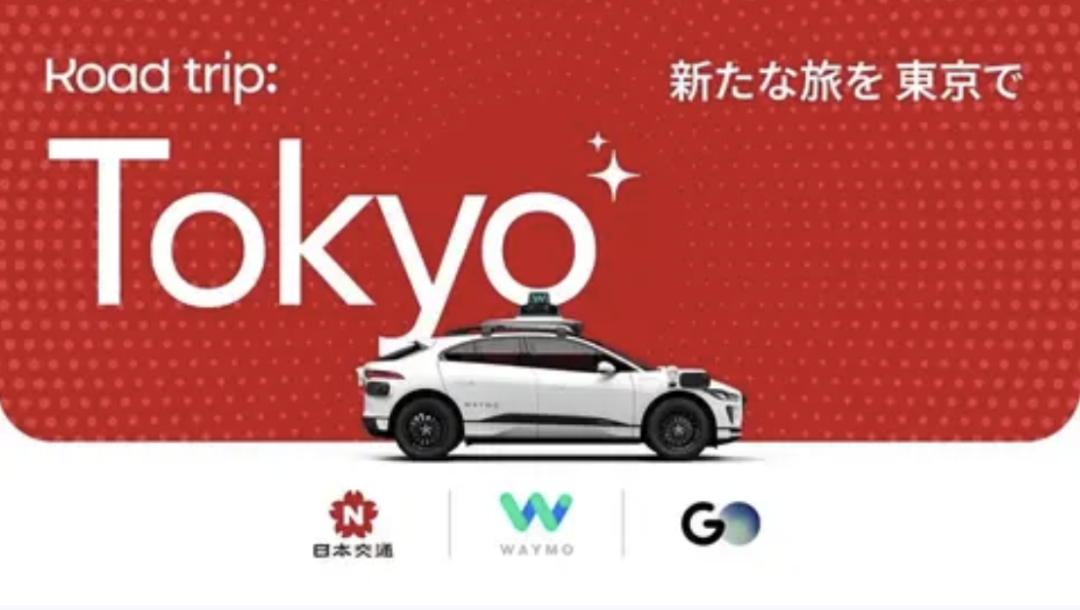
Waymo starts road testing in Tokyo
In April, Waymo conducted its first public road test outside the United States. It collected data in Tokyo, Japan, through test vehicles with human drivers to adapt to the local road environment. In the same month, Waymo reached a preliminary agreement with Toyota and jointly explored the development and deployment of autonomous driving technology with Toyota's Woven By Toyota.
In October, Waymo announced that it plans to start road testing in London in the coming months, initially with human safety drivers on board. If it gets regulatory approval, it will launch driverless taxi services in London in 2026, which will be its first overseas service area.
From the surge in orders, the expansion of the road network to the cross - continental layout, Waymo showed a clear path to scale in 2025.
03
Safety Challenges: Frequent Accidents and Sudden Failures Expose Technological and Operational Deficiencies
With the rapid expansion of its business territory, Waymo has also faced more complex challenges in the field of safe operation. A series of accidents and system failures have pushed the ability of autonomous driving technology to handle "long - tail scenarios" in the real world to the center of public opinion.
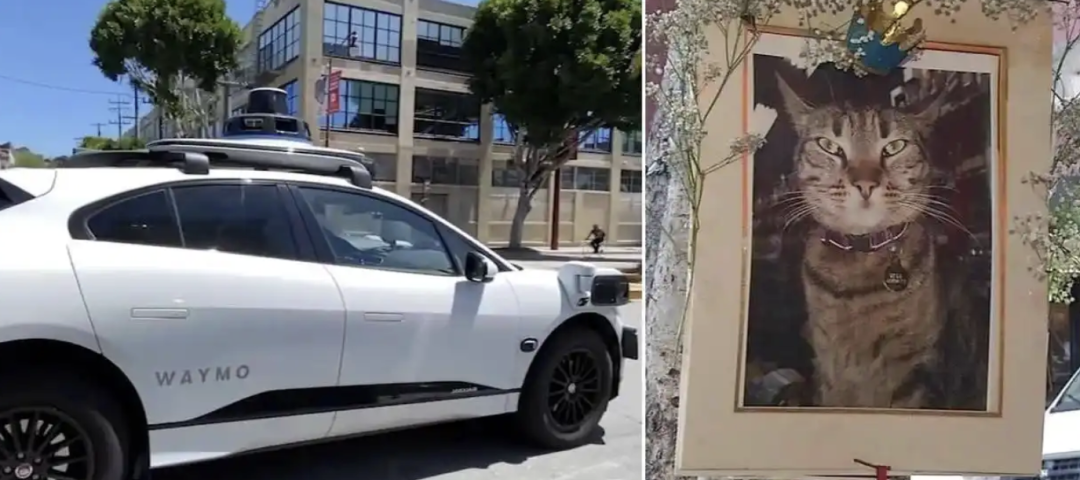
A Waymo vehicle hit and killed a well - known cat in San Francisco
During the year, Waymo had consecutive traffic accidents involving animals: in October, it hit and killed a convenience - store cat beloved by local community residents in San Francisco, and in November, it collided with an unleashed dog. Although no human casualties were caused in these two incidents, they attracted continuous attention from animal protection organizations and local communities, and also reflected the controversy over the sensitivity of the system in identifying small moving objects and its decision - making mechanism.
What is even more alarming are the operational loopholes related to public safety. Texas regulatory documents revealed that since the start of the new school year in 2025, Waymo vehicles have exceeded school buses at least 19 times in violation of regulations, and the company subsequently initiated a software recall. In November, a Waymo vehicle in Los Angeles drove into a police - blocked confrontation area, exposing the lack of dynamic perception and response capabilities of the system in complex urban scenarios.
The sudden failure at the end of the year triggered even more extensive controversy.
On December 21st, a large - scale power outage occurred in San Francisco, USA, due to a fire at a substation, causing traffic signals to fail in about 30% of the city. Waymo's fleet "shutdown" collectively at a dark intersection - the system activated a protection mechanism because it couldn't recognize the failed traffic lights, and the vehicles stopped with their hazard lights on, causing blockages on multiple roads and requiring manual traffic control by the police.
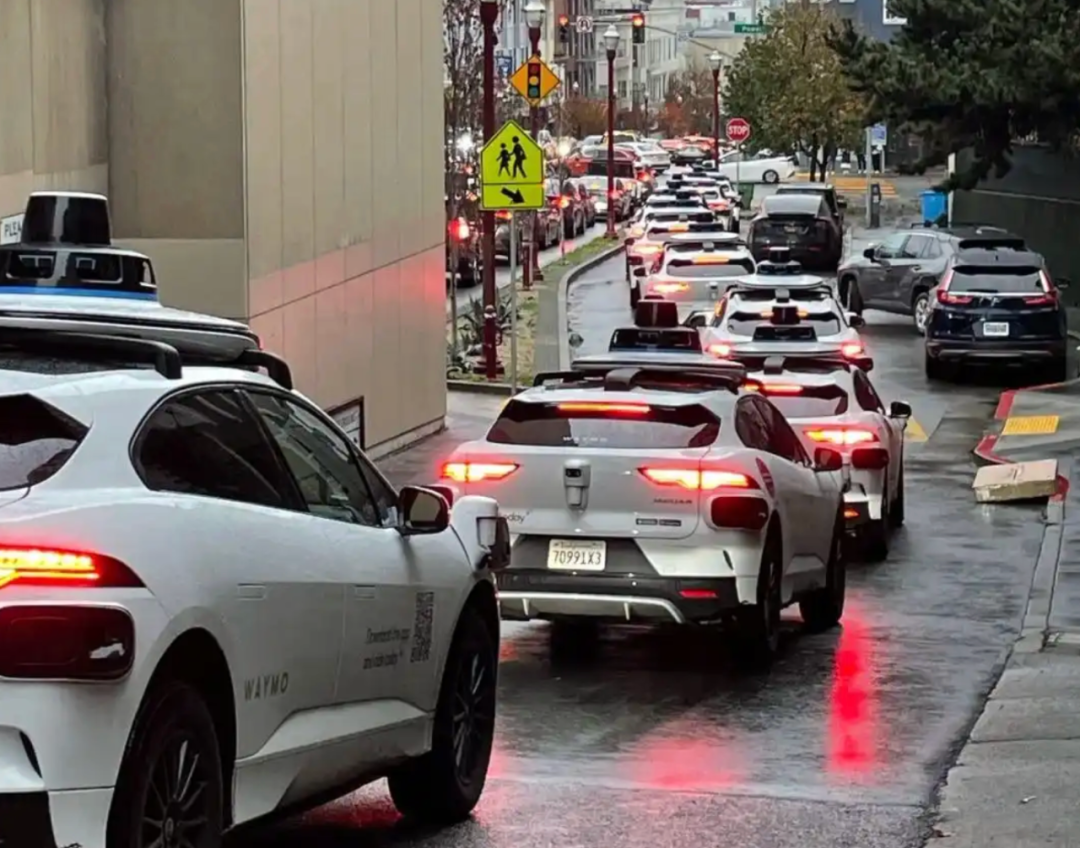
Waymo later explained that "the service suspension was for safety reasons," but this accident clearly revealed that its algorithm still highly depends on structured road information and lacks pre - set response plans for non - standard scenarios such as intersections without traffic lights. At the same time, the remote support system failed to respond promptly to large - scale concurrent anomalies. This is not only a challenge for Waymo but also a common shortcoming in the industry's adaptability to extreme scenarios.
Despite the continuous safety disputes, Waymo further consolidated its leading position in the US autonomous driving travel market in 2025. Tesla CEO Elon Musk also admitted at the November earnings conference that Waymo "paved the way for the industry in promoting the opening of regulatory policies."
However, behind the impressive business expansion, Waymo still has a long way to go to achieve financial profitability.
Alphabet's earnings report shows that the losses of its "Other Bets" segment, which includes Waymo, widened from $1.12 billion last year to $1.43 billion in the third quarter of 2025, while the revenue slightly declined from $388 million to $344 million. This indicates that while continuing to expand, how to improve the operational efficiency of each vehicle and control costs has become a more urgent issue than simply pursuing order volume.
Looking forward to 2026, its services will extend to more than 20 cities around the world, including Tokyo and London, its first overseas destinations, and it has set a goal of "exceeding one million weekly orders." However, before venturing into more intersections and more complex urban landscapes, it must present the public with a more reliable safety record.
The power outage in San Francisco sounded an alarm for the entire industry: The large - scale implementation of autonomous driving technology cannot rely solely on idealized road conditions. It must be fully prepared for the chaos and anomalies of the real world. This requires companies not only to strengthen their ability to handle "edge cases" in algorithms but also to establish a more powerful remote support and emergency response mechanism in the operation system.
From a broader perspective, Waymo's experience in 2025 epitomizes the key stage characteristics of the autonomous