Despite giving 1 billion yuan in "red envelopes" to dealers, Lei Jun still faces multiple challenges.
Near the end of the year, Xiaomi has launched a "cash - giving" campaign by spending 100 million yuan to provide financial subsidies to its national dealers.
It is reported that the "red - envelope" subsidies issued by Xiaomi this time are mainly targeted at car - integrated stores, which are comprehensive stores that sell both cars and mobile phones as well as large household appliances.
Specifically, for stores built in 2024, each store can receive a subsidy of 100,000 yuan; for stores newly built before December 15, 2025, the subsidy is even more generous, reaching up to 500,000 yuan per store. Some large dealer groups can even receive subsidies of over 4 million yuan in a single batch.
However, while offering such generous subsidies, Xiaomi still faces many challenges. In the third quarter, the revenues of the company's smartphone business and smart large - household - appliance business both declined. Under the pressure of rising storage costs, the sales performance of Xiaomi smartphones next year may be affected.
Looking at the innovative business segments such as smart electric vehicles and AI, although this business achieved its first single - quarter operating profit in the third quarter, and the gross profit margin climbed to 25.5%, issues such as delivery disputes and trust crises continue to intensify.
According to Tianyancha, Lei Jun currently serves as the Chairman and CEO of Xiaomi Group. In October this year, Lei Jun ranked fifth on the "Hurun Rich List 2025" with a fortune of 326 billion yuan. However, as of the close on December 24, the share price of Xiaomi Group has fallen by about 36% from its high this year.
Xiaomi Spends 100 Million Yuan to Give "Red Envelopes" to Dealers
"Xiaomi really did a decent job this time. The 500,000 - yuan cash can basically support the offline operation for more than two months. Some of our competitors were really caught off guard by this move of Xiaomi," a Xiaomi dealer said in an interview with the media.
It is reported that Xiaomi's large - scale subsidies this time are mainly focused on car - integrated stores. The specific subsidy policy is as follows: for stores built in 2024, a subsidy of 100,000 yuan will be given to each store; for stores newly built from January 1 to December 15, 2025, a subsidy of 500,000 yuan will be given to each store.
According to Jiemian News, the total amount of subsidies given by Xiaomi to its national dealers this time exceeds 100 million yuan. A person familiar with the matter revealed that the subsidies were issued in the form of red envelopes, and some dealers operating multiple stores received subsidies of over 4 million yuan at one time.
In addition, the aforementioned person also said that Xiaomi is preparing a new round of policy adjustment plans, which will further increase incentives for Xiaomi cars and loosen the assessment and management rules at the front - line. This policy is likely to be launched after the new year, which will effectively relieve the current short - term pressure faced by the offline market.
Looking back to January last year, Xiaomi Auto announced through its official account that its sales, delivery, and service channels will adopt the "1 + N" model, giving priority to covering the top domestic markets and gradually expanding across the country in batches.
Specifically, "1" represents the self - built and self - operated delivery centers of Xiaomi Auto, which not only undertake the delivery function but also provide sales, after - sales service, and other services. "N" represents dealers, user services, etc.
According to the official data disclosed by Xiaomi Auto, as of November 30 this year, Xiaomi Auto has 441 stores in 131 cities across the country, and 249 service outlets cover 144 cities across the country.
Currently, Xiaomi Auto is still accelerating the expansion of its channels to build a more extensive sales and service system. According to Xiaomi Auto, it plans to add 36 new stores in December this year, covering 7 cities such as Hengyang and Mianyang.
It is worth noting that in early December, Xiaomi's China region carried out a new round of personnel adjustments, involving multiple core operational positions such as mobile phones, cars, and large household appliances.
Among them, Wang Xiaoyan, an able assistant of Lei Jun, the senior vice - president of Xiaomi Group and the president of the China region, will personally serve as the general manager of the First Sales and Operations Department. This move is interpreted by the industry as a signal that he will personally focus on improving performance.
In addition, in November, a picture of a notice from Wang Xiaoyan to the dealer group was leaked. The notice pointed out that based on a prudent assessment of the current business environment, Xiaomi Home has clearly stated that the core of its development in 2026 will shift from "scale expansion" to "quality improvement." Xiaomi will launch an important structural adjustment: orderly closing some inefficient and loss - making stores to help partners stop losses in a timely manner and focus resources on high - potential stores.
Specifically, Xiaomi will orderly close some inefficient and loss - making stores opened before January 1, 2025, to help stop losses in a timely manner and focus resources on high - potential stores.
For stores that operate efficiently but continue to lose money, and stores newly built in 2025 that are difficult to turn a profit, an application channel for "one - store - one - discussion" will be retained. Stores in urgent situations can get special approval this time, and the remaining stores will be included in the subsequent batches in 2026 for processing.
If a store in the retention pool is selected, Xiaomi will withdraw the store manager starting from January 1, 2026, and the dealer will need to supplement the store staff by themselves to ensure normal operation.
It is worth noting that this adjustment is a centralized treatment. If a store applies to close later, it needs to compensate Xiaomi for losses according to the normal process, and the relevant team will not enjoy performance reduction.
It is reported that through this adjustment, Xiaomi will actively bear a one - time loss of about 27 million yuan, aiming to help its partners reduce losses of over 72 million yuan per year.
Soaring Storage Costs May Further Pressure the Smartphone Business
In the first three quarters of this year, Xiaomi Group delivered a performance report with impressive growth.
According to iFinD data from Flush, in the first three quarters, Xiaomi Group's total revenue reached 340.37 billion yuan, a year - on - year increase of 32.49%; the net profit attributable to the parent company was 35.1 billion yuan, a year - on - year increase of 139.87%.
Specifically in the third quarter, Xiaomi Group achieved a single - quarter revenue of 113.121 billion yuan, a year - on - year increase of 22.28%; the net profit attributable to the parent company was 12.271 billion yuan, a year - on - year increase of 129.26%.
Despite its excellent overall performance, Xiaomi still has many performance concerns. In the third quarter, the revenue of the company's smartphone business decreased by 3.1% from 47.5 billion yuan in the third quarter of 2024 to 46 billion yuan.
This change is mainly due to the decrease in the average selling price (ASP) of smartphones, although it was partially offset by the increase in smartphone shipments.
The ASP of Xiaomi smartphones decreased by 3.6% from 1,102.2 yuan per unit in the third quarter of 2024 to 1,062.8 yuan per unit.
The decrease in the ASP in overseas markets was the main reason. However, the increase in the proportion of high - end smartphone shipments in the Chinese mainland market drove up the ASP to a certain extent, providing a certain buffer.
At the same time, due to intensified competition in the Chinese mainland market, the gross profit margin of Xiaomi Group's smartphones decreased from 11.7% in the third quarter of 2024 to 11.1% in the third quarter of 2025.
It is worth noting that the smartphone industry in which Xiaomi operates is facing the severe challenge of rising storage costs.
According to the 21st Century Business Herald, on October 23, SK Hynix officially announced that the contract prices of DRAM and NAND in the fourth quarter would be increased by up to 30%. On November 9, SanDisk significantly increased the contract price of NAND flash memory by about 50%, which was the largest single - price adjustment in this round of NAND price increases. According to data from TrendForce, the DRAM price in the third quarter of 2025 increased by 171.8% compared with the same period last year.
This cost pressure, like an invisible force, quickly affects the product pricing strategies of smartphone manufacturers.
According to Guancha.cn, a preliminary review shows that since October this year, the new models launched by manufacturers such as Xiaomi, OPPO, vivo, and Honor have seen price increases ranging from 100 to 600 yuan for different configurations compared with the previous models.
On December 21, Lu Weibing posted on Weibo that the costs of the three major components (processor, camera, and memory) of the Xiaomi 17 Ultra have increased significantly, and a price increase is certain, but the product will definitely be worth the price.
Lu Weibing pointed out that "due to the sharp increase in the demand for high - performance computing and data centers and the lag in capacity expansion, this round of memory cost increase is characterized by a sharp rise and a long - term cycle. Products such as memory sticks will react more quickly and almost directly reflect the price increase. Secondly, products with a relatively high proportion of memory costs, such as mobile phones, tablets, and laptops, will react more slowly."
The price increase will undoubtedly put more pressure on price - sensitive users and may also prompt some consumers to extend the usage cycle of high - end models, which may further have an adverse impact on the subsequent sales performance of Xiaomi phones.
On December 16, market research firm Counterpoint Research pointed out in a report that due to the soaring component costs that may affect demand, the global smartphone shipments are expected to decline by 2.1% in 2026.
In addition to the smartphone business, Xiaomi's smart large - household - appliance business also faced the challenge of revenue decline in the third quarter.
In the third quarter, the revenue of Xiaomi's smart large - household appliances decreased by 15.7% year - on - year, mainly due to the reduction of national subsidies and intensified competition; and decreased by 64.8% quarter - on - quarter, mainly due to the seasonal decrease in air - conditioner shipments in the Chinese mainland, the reduction of national subsidies, and intensified competition.
Xiaomi's Auto Business Achieves First - Time Profit but Still Faces Multiple Tests
As for Xiaomi's much - anticipated auto business, it achieved its first profit in the third quarter.
The financial report shows that in the third quarter, the revenue of Xiaomi's innovative business segments such as smart electric vehicles and AI reached 29 billion yuan, a record high. Among them, the revenue of smart electric vehicles was 28.3 billion yuan, and the revenue of other related businesses was 700 million yuan.
In the third quarter, the operating income of Xiaomi's innovative business segments such as smart electric vehicles and AI was 700 million yuan.
The gross profit margin of this segment increased from 17.1% in the third quarter of 2024 to 25.5% in the third quarter of 2025. This significant increase is mainly due to the decrease in the cost of core components, the reduction of unit manufacturing costs, the start of delivery of the Xiaomi SU7 Ultra since March 2025, and the increase in the gross profit margin of other related businesses.
However, behind the seemingly bright situation, Xiaomi Auto still faces considerable pressure in the future.
At the third - quarter earnings conference call, Lu Weibing admitted that Xiaomi Auto will basically remain stable in the fourth quarter of this year, but 2026 will be very challenging, and it is expected that the gross profit margin of Xiaomi Auto may decline next year compared with this year.
Lu Weibing explained that the main reasons include the impact of the halving of the purchase - tax subsidy policy faced by all car manufacturers next year and the large number of players in the auto industry, and the industry is still in its early stage of development. "It will take a period of fierce competition for the industry to stabilize, and Xiaomi Auto needs to adapt to the industry changes."
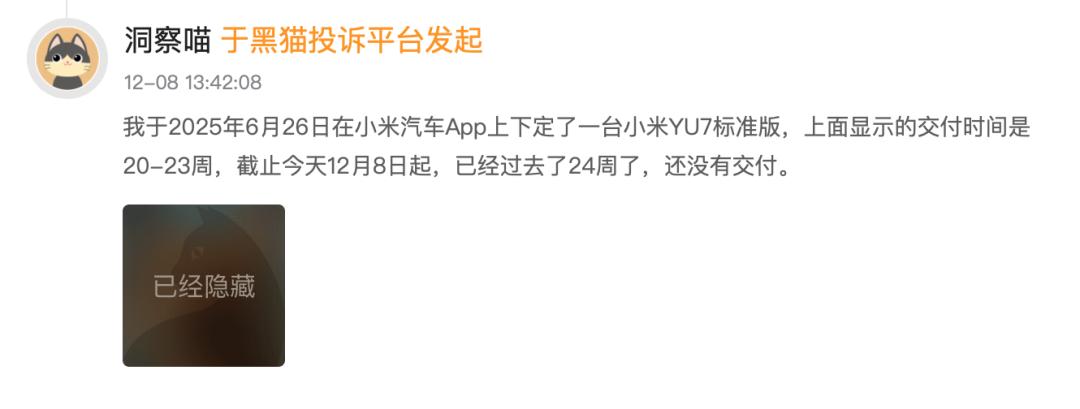
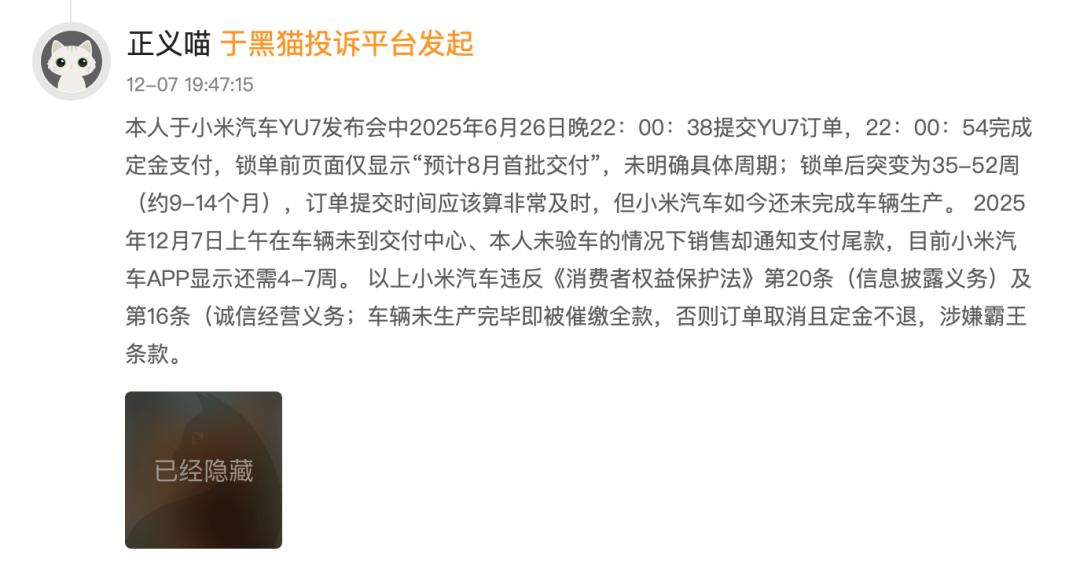
The long delivery cycle has always been a major problem for Xiaomi Auto. Currently, on the Black Cat Complaint platform, many users have filed complaints about the delivery issues of Xiaomi cars.
A user filed a complaint on December 8, saying that he placed an order for a Xiaomi YU7 standard version on the Xiaomi Auto App on June 26, and the displayed delivery time was 20 - 23 weeks. However, as of December 8, 24 weeks had passed, and the car had not been delivered yet.
Another user also filed a complaint in December, saying that "on the morning of December 7, 2025, the salesperson notified me to pay the balance before the car arrived at the delivery center and I had not inspected the car. Currently, the Xiaomi Auto App shows that it will take another 4 - 7 weeks."
On December 3, Xiaomi Auto officially announced the launch of the "In - stock Car Selection" service. Users who lock their orders before 24:00 on December 26 are expected to pick up their cars before the end of the year.
On December 12, Xiaomi Auto posted a message on its official Weibo account, saying that at 11:00 that day, "near - new cars" were added to the "In - stock Car Selection" for sale.
According to Xiaomi Auto, "in - stock cars" include brand - new cars, official exhibition cars, and near - new cars. They have passed strict quality inspections, and users can enjoy fast car pick - up, complete original factory warranties, and after - sales services. Some models can enjoy discounts. This service is open to all users, and users who have locked their orders but have not received their cars can change their configurations.
At around 15:30 on December 24, when Radar Finance checked the Xiaomi Auto App, it was found that after locking the order for different models, the shortest delivery cycle was 6 - 9 weeks, and the longest was 35 - 38 weeks.
In addition to the delivery issues, the trust crisis caused by traffic accidents is also a severe challenge that Xiaomi Auto must face. In 2025, there were two widely - concerned traffic accidents involving Xiaomi cars, namely the "Anhui Tongling Highway Accident" in March and the "Chengdu Tianfu Avenue Accident" in October.
Affected by these two accidents, the remarks about Xiaomi Auto "not paying attention to safety" have been intensifying on social platforms, and the doubts about Xiaomi's marketing methods have also emerged.
In mid - November, Lei Jun posted several Weibo posts in a row to clarify and respond to the safety issues of Xiaomi cars. Lei Jun emphasized that since the beginning of car - making, Xiaomi has always attached great importance to safety and refuted the outside world's interpretation of "emphasizing appearance over safety."
In fact, in recent years, Lei Jun has carefully built his personal IP through platforms such as Weibo, Douyin, and Bilibili. He frequently appears at press conferences, in short - videos, and in interactions with users, creating a friendly image and winning wide attention for the Xiaomi brand. However, as Xiaomi Auto becomes the focus of public opinion, Lei Jun also faces the risk of reputation fluctuations.
In the capital market, Xiaomi also faces severe challenges. As of the close on December 24, the market value of Xiaomi Group was about HK$1.02 trillion. Compared with the record high of HK$1.6 trillion set in June this year, Xiaomi's market value has evaporated by nearly HK$600 billion.