Foundries are eyeing the lucrative silicon photonics market covetously.
Recently, UMC announced a technology licensing agreement with imec to acquire imec's iSiPP300 silicon photonics process. This process is compatible with Co-Packaged Optics (CPO), which will accelerate UMC's silicon photonics technology development blueprint. Currently, UMC is collaborating with several new customers and plans to provide photonic chips for optical transceivers on this platform, with risk production scheduled to begin in 2026 and 2027.
Following GlobalFoundries and Tower, wafer foundry UMC has also set its sights on silicon photonics foundry services.
The Silicon Photonics Market: A Real "Tasty Treat"
As AI workloads surge, the demand for computing power grows four to five times annually, but data transmission efficiency has not kept pace. Traditional copper cable transmission uses electrical signals and performs stably in short-distance and low-speed transmissions. However, as the transmission rate breaks through 400Gbps and evolves towards 800Gbps and even 1.6Tbps, the physical characteristics of copper wires lead to severe signal attenuation and a sharp increase in energy consumption.
The industry generally believes that silicon photonics technology, which uses photons instead of electrons for data transmission, is an important means to solve the problems of high energy consumption and signal delay.
According to the analysis of market research firm TrendForce, the boom in building AI server clusters is accelerating the evolution of high-speed interconnection technologies, driving the global optical communication market into a new capacity expansion cycle. As the data transmission bottleneck extends from between servers to within racks and even between chips, silicon photonics technology has become the key to breaking through the interconnection limit.
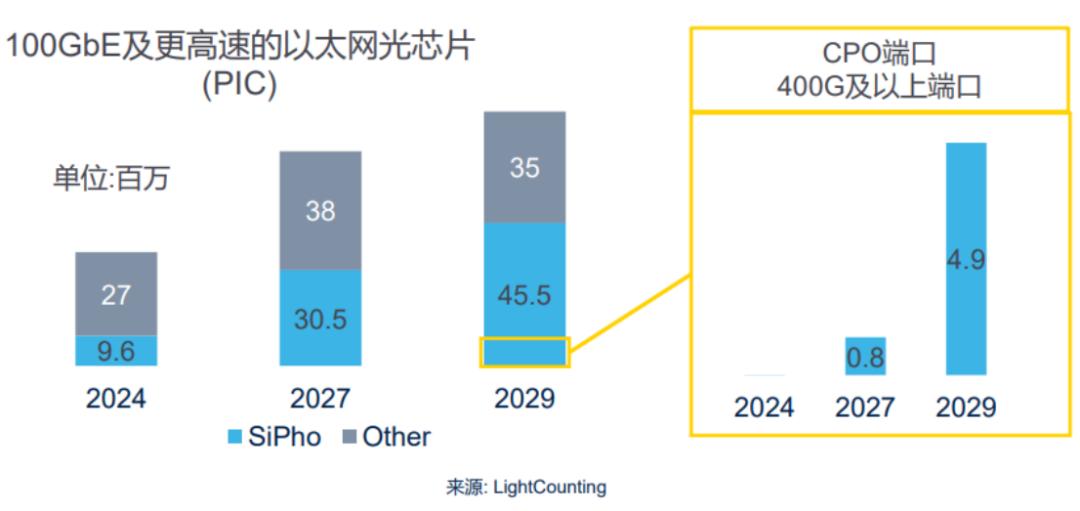
According to the prediction of optical communication industry market research firm LightCounting, the number of 100 GbE and higher-speed Ethernet optical chips will grow rapidly, from 36.6 million in 2024 to 80.5 million in 2029. Among them, silicon photonics (SiPho) chips will grow the fastest, from 9.6 million in 2024 to 45.5 million in 2029.
Therefore, the rapid growth of the silicon photonics market is giving rise to a huge number of silicon photonics chip foundry orders. Industry insiders said: "After 2030, when silicon photonics technology is applied to individual chips in artificial intelligence servers, it will determine the competitiveness of the foundry market."
In addition, the process of silicon photonics foundry has strong adaptability. Silicon photonics foundry can directly utilize the global mature CMOS wafer fab infrastructure and use standardized semiconductor processes such as photolithography and etching for production. This compatibility eliminates the huge investment in building new dedicated production lines, and wafer-level mass manufacturing can significantly reduce the unit production cost.
Finally, silicon photonics foundry also has a technological barrier. Silicon photonics is not simply "drawing" optical paths on silicon. It requires a series of collaborative processes such as optical waveguides, modulators, detectors, laser integration (such as InP-on-Si focused by AMF), and low-loss coupling (such as the edge coupling used by ST PIC100). These capabilities cannot be achieved overnight and must be accumulated through long-term investment and customer iteration.
It can be said that silicon photonics foundry will become a "tasty treat" in the eyes of major foundry manufacturers.
The Profit Path of Foundries
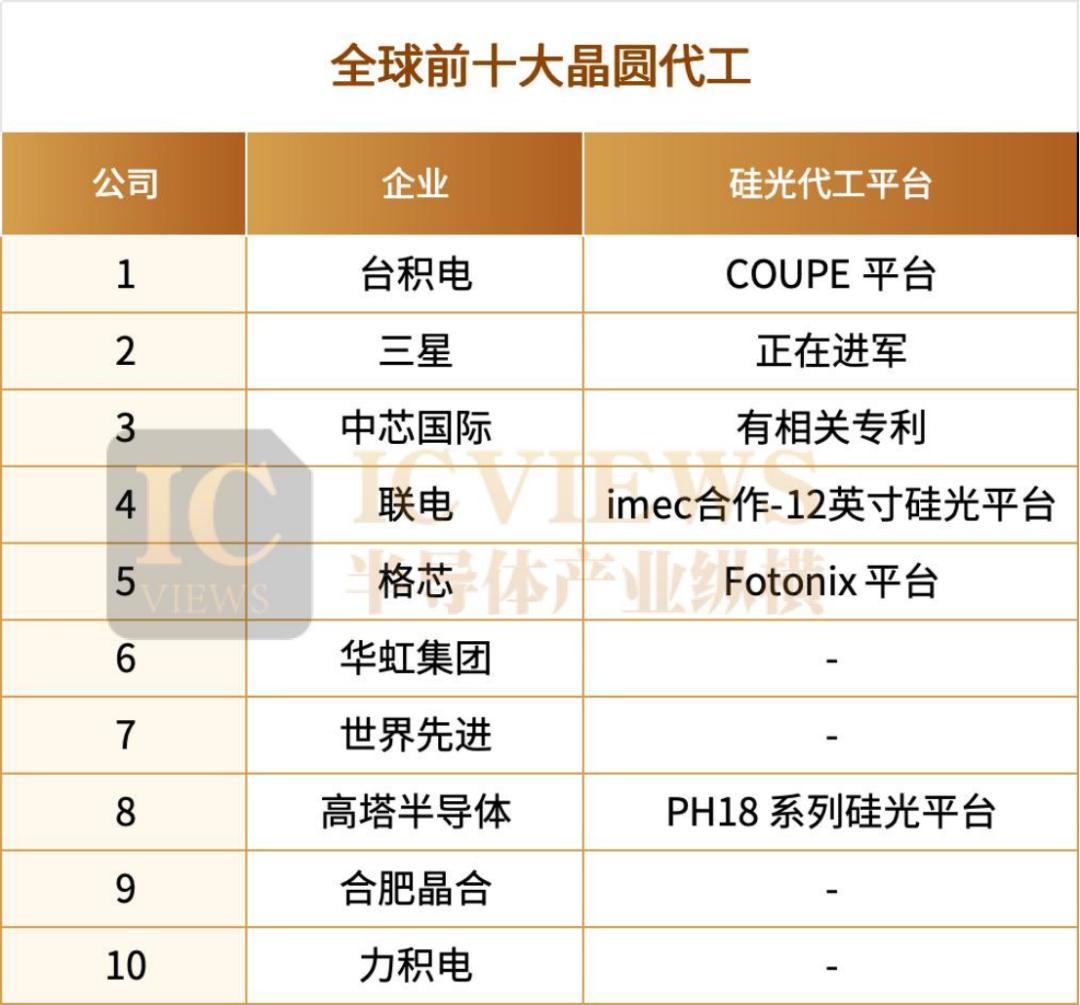
Wafer foundries have been very active this year.
First is TSMC. In silicon photonics foundry, TSMC said last year that it was developing a compact common photonics engine (COUPE) technology to support the explosive growth of data transmission brought about by the AI boom. It is expected to integrate CoWoS packaging into a co-packaged optical component in 2026, directly introducing optical links into the package. Compared with copper interconnection, TSMC's silicon photonics technology reduces power consumption by more than 10 times and shortens the delay to 1/20. It is mainly used for data transmission in AI servers and high-performance computing. NVIDIA has played a key role in promoting the commercialization of the technology. Its Quantum-X switch platform will be the first to introduce COUPE technology, and the next-generation Rubin platform is also expected to widely adopt silicon photonics.
Second is Tower Semiconductor. This year, Tower announced that it will double its silicon photonics manufacturing capacity and triple it by the middle of 2026. It operates 200mm silicon photonics wafer fabs in the United States and Israel and a 300mm silicon photonics wafer fab in Japan.
Tower CEO Russell Ellwanger said: "We are a leader in the industry in the silicon germanium (SiGe) and silicon photonics (SiPho) technologies required for optical modules. Coupled with the strong increase in data center demand, Tower has unprecedented growth potential in both revenue and profit."
Tower's market value has doubled. The core reason is the strong demand for production capacity in the silicon photonics field and the significant increase in market demand. In the third quarter of 2025, Tower's revenue was $396 million, a 6% quarter-on-quarter increase. It is expected that the revenue in the fourth quarter will reach $440 million, a 14% year-on-year increase and an 11% quarter-on-quarter increase.
In November, Tower also announced the launch of CPO Foundry, expanding its 300mm wafer bonding technology developed for CIS.
GlobalFoundries, after cutting the research and development of advanced processes, has turned to specialty processes such as radio frequency, power management, and silicon photonics. GlobalFoundries entered the silicon photonics foundry early. In 2022, it launched the silicon photonics platform Fotonix, becoming the industry's first platform to integrate 300mm photonics characteristics and 300Ghz-level RF-CMOS processes on a silicon wafer.
Recently, GlobalFoundries acquired the silicon photonics foundry Advanced Micro Foundry (AMF) in Singapore. GlobalFoundries said that this is a key step in the company's innovation strategy and leading position in the silicon photonics field. GlobalFoundries will integrate AMF's manufacturing assets, intellectual property, and professional talents to expand its silicon photonics technology portfolio, production capacity, and R & D capabilities in Singapore, supplementing its existing technological capabilities in the United States. After the acquisition, GlobalFoundries will become the world's largest pure silicon photonics chip foundry in terms of revenue.
AMF has been researching new optical modulation materials and is committed to integrating InP laser chips into silicon-based platforms. In the past 15 years, AMF's team has served more than 300 customers. GlobalFoundries revealed that it plans to upgrade AMF's 200mm silicon photonics production line to 300mm in the future.
In addition, Samsung also wants to fully invest in silicon photonics technology to get a share of the "silicon photonics foundry" market.
South Korean media reported that Samsung Electronics' Device Solutions (DS) division has selected silicon photonics as a core technology for the future and has started recruiting experienced experts for its exclusive R & D center in Singapore. The Singapore R & D center, led by Vice President and former TSMC employee Choi Kyung-geon, is closely cooperating with the headquarters' technology development office (led by Foundry Division President and Chief Technology Officer Nam Si-woo) to jointly promote the development of this technology.
Currently, Samsung is mobilizing its global R & D network across South Korea, Singapore, India, the United States, and Japan to focus on the R & D of silicon photonics technology. Samsung recently promoted senior executive Lee Kang-ho, who is in charge of silicon photonics technology R & D, to vice president and hired former Intel Chief Product Officer researcher Park Hyun-dae.
It's not just wafer foundry manufacturers that are targeting silicon photonics foundry, but also IDM companies with manufacturing capabilities.
Ten years ago, STMicroelectronics began to get involved in silicon photonics technology. This year, ST launched the new PIC100 technology, which is currently the only pure silicon technology platform on the market that can support 300mm wafers for single-channel 200Gbps transmission.
In essence, the advantage of silicon photonics PIC100 lies in its compactness and integration. Because it can integrate receivers and transceivers into a single chip, including the modulators of transceivers and the photodiodes of receivers. If multiple wavelengths are used to transmit data on optical fibers, multiplexers (MUX) and demultiplexers (DMUX) can also be included.
In addition, PIC100 uses a new material stack to achieve efficient edge coupling between optical fibers and optical chips, replacing the traditional vertical coupling technology to reduce system loss. System loss has always been a problem that troubles all transmission technology developers.
It is reported that PIC100 has been adopted by the world's largest hyperscale data center operators and leading companies in the optical transceiver field. PIC100 will be produced at ST's 300mm wafer fab in Crolles, France, and mass production is planned to start in the second half of 2025.
To attract customers, ST said that it will not develop its own products to avoid competing with customers.
What about Chinese Silicon Photonics Foundries?
In terms of silicon photonics technology, China has entered the international first echelon and has achieved parity in some research and applications. Silicon photonics foundry is also actively developing in China.
As early as 2023, the Hubei provincial government issued a notice on printing and distributing the action plan for accelerating the construction of the "World Optics Valley". The plan proposed to support units such as Wuhan Xinxin, the National Information Optoelectronics Innovation Center, Jiufengshan Laboratory, and Jiangcheng Laboratory to build China's first 12-inch commercial silicon photonics chip innovation platform, build a leading domestic and world-class silicon photonics chip supply capacity, and achieve mass production of silicon photonics products. At the same time, it will accelerate the application of silicon-based compound heterogeneous integration capabilities and establish a world-leading technology system in this field. By the end of 2024, complete the silicon photonics process platform connection and the development of the process design kit (PDK). By 2025, complete the development of the 12-inch basic silicon photonics tape-out process and form an internationally leading silicon photonics wafer foundry and manufacturing capacity. By 2030, build a 12-inch silicon-based optoelectronic integration process line and build the world's top three silicon photonics chip specialty process lines, with device performance reaching the international leading level and forming extensive optoelectronic chip processing capabilities.
In the field of silicon photonics foundry in China, it can be roughly divided into three types: professional silicon photonics foundry platforms, self-built foundry lines by optical module and optical device enterprises, and silicon photonics foundry extensions by semiconductor manufacturing enterprises.
Professional silicon photonics foundry platforms include the National Information Optoelectronics Innovation Center (NOEIC), the Chongqing United Microelectronics Center (CUMEC), the Shanghai Institute of Microsystem and Information Technology (SIMIT), and the Shaanxi Optoelectronics Innovation Center. Among them, the National Information Optoelectronics Innovation Center (NOEIC) in Wuhan has built the most complete 8-inch and 12-inch silicon photonics PDK and MPW service platform in China, providing one-stop services such as silicon photonics chip design, tape-out, and testing, and supporting the R & D of high-end products such as 1.6T silicon photonics interconnection chips.
Optical module and optical device enterprises with self-built foundry lines include Infinera, Accelink Technologies, Huagong Technology, and New Fiber Optic Technology. Infinera is the global leader in optical modules. It self-develops silicon photonics chips and builds foundry capabilities, and its products cover 400G, 800G, and 1.6T silicon photonics modules. Accelink Technologies has a mature silicon photonics platform, mass-produces 400G and 800G silicon photonics modules, and has silicon photonics chip foundry capabilities.
Among semiconductor manufacturing enterprises extending into silicon photonics foundry, Yandong Microelectronics has completed the development of some key processes on its 12-inch SOI process platform. Beijing Silex Microsystems continues to promote the process development and wafer manufacturing layout of silicon photonics series chips. Its domestic production line can currently provide silicon photonics process development and small-scale trial production services for customers in the fields of optical communication, optical interconnection, and optical computing. The MEMS-OCS products have achieved small-scale trial production.
Conclusion
Silicon photonics technology will bring fundamental changes to the optical module industry, and its impact goes far beyond process improvement. The core value of silicon photonics technology lies in chip design and wafer manufacturing, which shifts the industry paradigm from "package-led" to "chip design-led".
Currently, the silicon photonics industry is in a stage of rapid development. On the one hand, technology giants (such as Intel, NVIDIA, Cisco, and IBM) are actively deploying and investing a large amount of resources in technology R & D and production line construction. On the other hand, relevant corporate mergers and acquisitions and industrial chain integrations are also accelerating, and the competition is becoming increasingly fierce.
The future is here, but it is not evenly distributed yet. The silicon photonics market is a "tasty treat" that foundry manufacturers are eyeing.
This article is from the WeChat public account "Semiconductor Industry Insights" (ID: ICViews). Author: Jiulin. Republished by 36Kr with permission.