Bei dem lukrativen Geschäft der Siliziumphotonik beobachten die Subcontracting-Hersteller mit gierigen Augen.
Recently, UMC announced that it will sign a technology licensing agreement with imec and acquire imec's iSiPP300 silicon photonics processing. This process is compatible with Co - Packaged Optics (CPO) and will accelerate the development of UMC's silicon photonics technology. Currently, UMC is collaborating with several new customers and plans to offer photonic chips for optical transceivers on this platform and start risk production in 2026 and 2027.
Following GlobalFoundries and Tower, the wafer foundry implementer UMC has also set its sights on the silicon photonics foundry business.
The silicon photonics market, a real "race"
With the sharp increase in AI workloads, the demand for computing power increases four - to five - fold every year, while the efficiency of data transmission does not increase at the same rate. Traditional copper cable transmission uses electrical signals and is stable over short distances and at low transmission speeds. However, when the transmission rate exceeds the 400 Gbps mark and develops towards 800 Gbps or even 1.6 Tbps, due to the physical properties of copper conductors, there will be strong signal attenuation and a significant increase in energy consumption.
The industry agrees that silicon photonics technology, which uses photons instead of electrons for data transmission, is an important means to solve the problems of high energy consumption and signal delay.
According to an analysis by market research firm TrendForce, the boom in the construction of AI server clusters accelerates the development of high - speed interconnectivity technology and drives the global optical communication market into a new growth cycle. Since the data transmission bottlenecks have extended from between servers to within racks and even between chips, silicon photonics technology has become the key to overcoming the interconnectivity limitations.
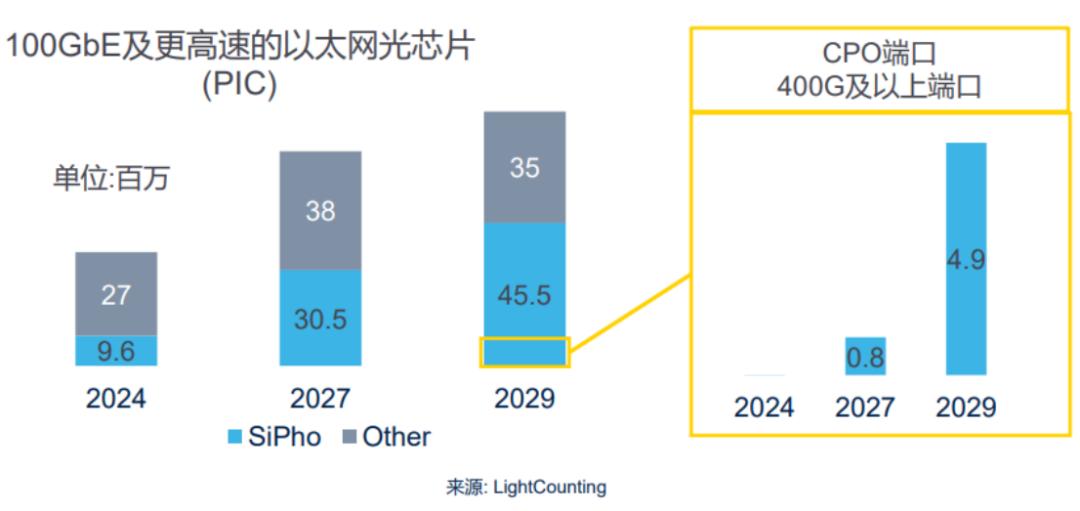
According to a forecast by optical communication market analysis firm LightCounting, the number of optical Ethernet chips with 100 GbE and higher speeds will increase rapidly. It is predicted that it will rise from 36.6 million in 2024 to 80.5 million in 2029. Silicon photonics chips (SiPho) will grow the fastest, from 9.6 million in 2024 to 45.5 million in 2029.
Therefore, the rapid growth of the silicon photonics market has generated a huge number of orders for the production of silicon photonics chips. Industry insiders say: "After 2030, when silicon photonics technology is applied to individual chips in artificial intelligence servers, it will determine the competitiveness of the foundry market."
In addition, silicon photonics manufacturing is well - adapted to the technology. Silicon photonics manufacturing can directly utilize the globally developed CMOS wafer fab infrastructures and apply standardized semiconductor technologies such as photolithography and etching. This compatibility saves the huge investment in building a special production line, and wafer - level mass production can significantly reduce unit costs.
Finally, silicon photonics manufacturing is also a business with technological barriers. Silicon photonics is not simply "drawing" light paths on silicon. It requires a series of synergistic technologies such as optical waveguides, modulators, detectors, laser integration (e.g., InP - on - Si, which AMF focuses on) and low - loss coupling (e.g., the edge coupling used by ST PIC100). These capabilities cannot be acquired quickly and must be built through long - term investment and iteration with customers.
It can be said that silicon photonics manufacturing will be a "race" for large foundry companies.
The profit path of foundries
Wafer foundries have carried out many activities this year.
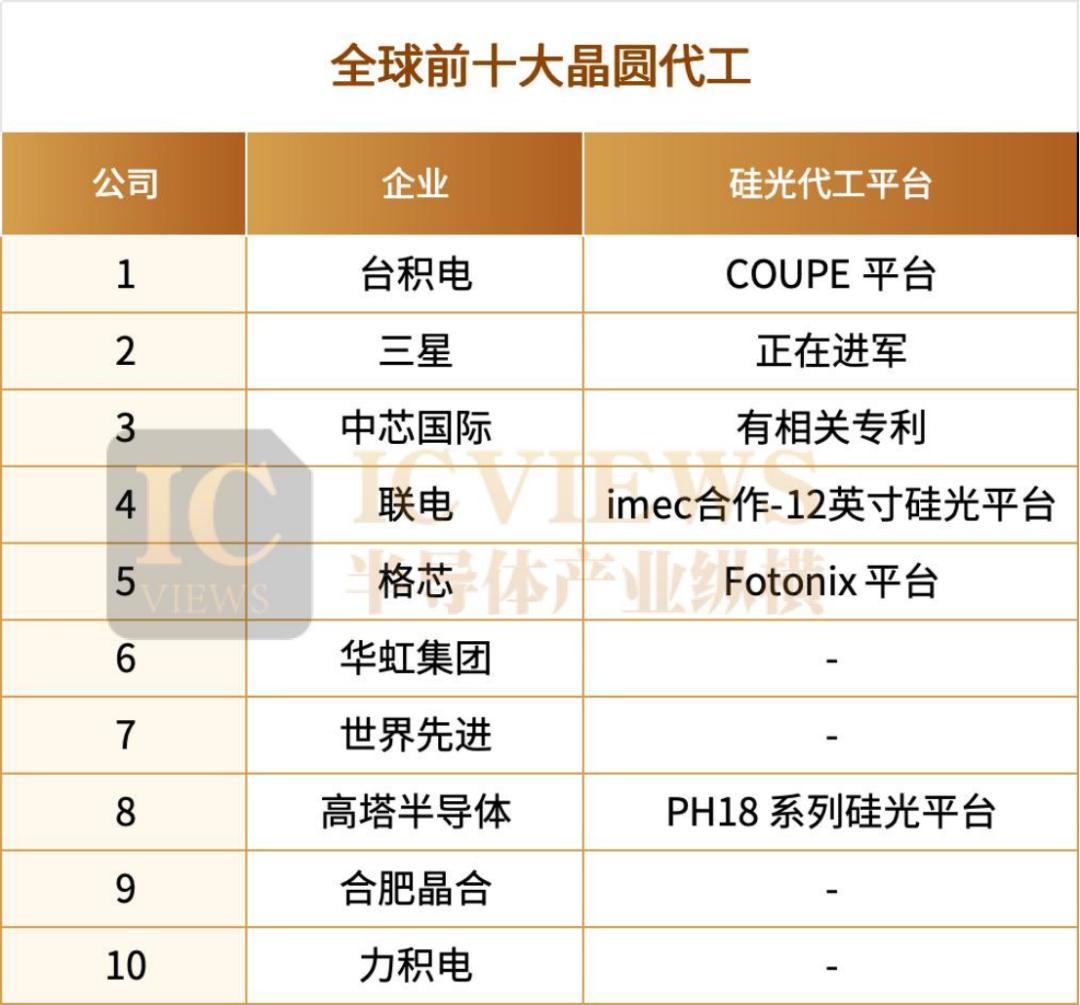
First is TSMC. In silicon photonics manufacturing, TSMC announced last year that it will develop the technology of the compact universal photon engine (COUPE) to meet the explosive growth of data transmission caused by the AI boom. It is predicted that COUPE will be integrated into the CoWoS package in 2026 to form a Co - Packaged Optics element and introduce optical connections directly into the package. Compared with copper interconnectivity, TSMC's silicon photonics technology reduces power consumption by more than ten times and delay to 1/20. It is mainly used for data transmission in AI servers and high - performance computers. Nvidia plays a key role in the marketing of this technology. Its Quantum - X - Switch platform will first introduce the COUPE technology, and the next Rubin platform is also likely to use a lot of silicon photonics.
Next is Tower Semiconductor. This year, Tower announced that it will double its silicon photonics manufacturing capacity and triple it by mid - 2026. It operates 200 - mm silicon photonics wafer fabs in the United States and Israel and a 300 - mm silicon photonics wafer fab in Japan.
Russell Ellwanger, the CEO of Tower, said: "We are leading in the industry in the technologies of silicon - germanium (SiGe) and silicon photonics (SiPho) required for optical modules. Along with the sharp increase in demand from the data center industry, Tower has unprecedented growth potential in both revenues and profits."
Tower's market value has doubled, and the core reason is the high demand for capacity and the sharp increase in market needs in the field of silicon photonics. In the third quarter of 2025, Tower's revenues were $396 million, representing a 6% increase compared to the previous quarter. It is predicted that the revenues in the fourth quarter will be $440 million, representing a 14% increase compared to the previous year and an 11% increase compared to the previous quarter.
In November, Tower also announced the launch of CPO Foundry and expanded its 300 - mm wafer bonding technology developed for CIS.
GlobalFoundries has shifted from the research and development of advanced technologies to specialized technologies such as RF, power management, and silicon photonics. In silicon photonics manufacturing, GlobalFoundries also got involved early. In 2022, it introduced the silicon photonics platform Fotonix, becoming the world's first platform to integrate 300 - mm photonic properties and RF - CMOS technologies in the 300 - GHz range on a silicon wafer.
Recently, GlobalFoundries acquired the silicon photonics foundry Advanced Micro Foundry in Singapore. GlobalFoundries said that this is a key step in implementing its innovation strategy and strengthening its leading position in the field of silicon photonics. GlobalFoundries will integrate the manufacturing facilities, intellectual property, and professional personnel of Advanced Micro Foundry, expand its silicon photonics technology portfolio, production capacity, and research and development capacity in Singapore, and thus complement its existing technological capabilities in the United States. After the acquisition is completed, GlobalFoundries will be the world's largest pure - play silicon photonics chip foundry in terms of revenues.
Advanced Micro Foundry has been working on the development of new optical modulation materials and has been trying to integrate InP laser chips on a silicon basis. In the past 15 years, the AMF team has served over 300 customers. GlobalFoundries has revealed that it wants to upgrade AMF's 200 - mm silicon photonics production line to 300 mm in the future.
In addition, Samsung also wants to fully devote itself to silicon photonics technology and wants to have a share in the "silicon photonics foundry" market.
According to media reports in South Korea, Samsung Electronics' Business Unit Device Solutions (DS) has selected silicon photonics as a future core technology and has begun to recruit experienced experts for its own research and development center in Singapore. This research and development center in Singapore is led by Vice - President Choi Kyung - kwan, a former employee of TSMC, and works closely with the technological development department at the headquarters (led by Nam Seok - woo, President and Chief Technology Scientist of the Wafer Foundry Business Unit) to promote the development of this technology.
Currently, Samsung is mobilizing its global research and development system, which is distributed in South Korea, Singapore, India, the United States, and Japan, and is working on the development of silicon photonics technology. Recently, Samsung appointed Lee Kang - ho, the leading expert in the research and development of silicon photonics technology, as vice - president and hired Park Hyun - dae, a former head of product research at Intel.
It's not only wafer foundries that are betting on silicon photonics manufacturing, but also IDM companies with manufacturing capabilities.
Ten years ago, STMicroelectronics already started with silicon photonics technology. This year, ST introduced the new technology PIC100, which is currently the only pure silicon technology platform on the market that supports 300 - mm wafers and a single - channel transmission rate of 200 Gbps.
Essentially, the advantage of the silicon photonics PIC100 lies in its compactness and integration ability. Since it is possible to integrate the receiver and the transceiver on a single chip, the modulators of the transceiver and the photodiodes of the receiver can also be integrated. When multiple wavelengths are used for data transmission on an optical fiber, multiplexers (MUX) and demultiplexers (DMUX) can also be integrated.
In addition, PIC100 uses a new material stack to achieve efficient edge coupling between the optical fiber and the optical chip and replace the traditional vertical coupling technology to reduce system losses. System losses have always been a problem for all developers of transmission technologies.
It is known that PIC100 is used by the world's largest hyperscale data center operators and leading companies in the optical transceiver industry. PIC100 is manufactured in ST's 300 - mm wafer fab in Crolles, France, and mass production is scheduled to start in the second half of 2025.
To win customers, ST has stated that it will not develop its own products to avoid competing with customers.
Which silicon photonics foundries are there in China?
Considering only silicon photonics technology, China has already sneaked into the international top group and reached the level of the world's leading players in some research and application fields. Silicon photonics manufacturing is also actively developing in China.
As early as 2023, the Hubei provincial government issued a notice on the plan to accelerate the construction of the "World Optical Valley". The plan stipulates that institutions such as Yangtze Memory Technologies Co., Ltd., the National Innovation Center for Optical Information Electronics, the Jiufeng Laboratory, and the Jiangcheng Laboratory should be supported to build the first 12 - inch commercial silicon photonics chip innovation center in China to create a leading silicon photonics chip supply capacity in China and internationally and achieve mass production of silicon photonics products. At the same time, the application of the heterogeneous integration ability of silicon compounds should be accelerated to build a world - leading technology system in this area. By the end of 2024, the silicon photonics process platform should be completed and the process design kit (PDK) should be developed. By 2025, the 12 - inch basic silicon photonics flow process development should be completed to form an internationally leading silicon photonics wafer foundry and manufacturing capacity. By 2030, a 12 - inch silicon - optoelectronic integration process line should be built to create a world - leading silicon photonics chip special process line whose device properties should be internationally leading and to form a broad processing capacity for optoelectronic chips.
In the field of silicon photonics manufacturing in China, it can be roughly divided into three categories: special silicon photonics foundry platforms, independent production lines of optical module and optical element companies, and the expansion of silicon photonics manufacturing by semiconductor manufacturers.
The special silicon photonics foundry platforms are the National Innovation Center for Optical Information Electronics (NOEIC), the Chongqing United Microelectronics Center (CUMEC), the Shanghai Institute of Microsystem and Information Technology (SITRI), and the Shaanxi Institute of Optoelectronics Innovation.