Shenzhen AI Scanners Sold to the US Congress, Annual Global Sales Exceed 100 Million | Insight Global
Editor's note: As going global becomes an increasingly core strategy for Chinese companies, how to conquer the global market has become an extremely professional topic. In the evolution of globalization, many Chinese brands have stood at the forefront. In view of this, 36Kr's Hardcore Krypton has launched the "Insight Global" column to explore the cutting - edge directions and timely opportunities for Chinese brands going global from the perspective of brand growth and change, providing inspiration and food for thought for players in the global market and the industry.
This is the 57th issue of our column - CZUR, an AI office hardware company from Shenzhen. It entered the global government and enterprise market with an AI scanner and has ranked first in its category on Amazon for eight consecutive years, covering 107 countries and regions around the world. However, the uniqueness of its story lies in that it didn't stop at the success of a single blockbuster product. Instead, it chose to invest nearly 200 million yuan in R & D and bet on creating "AI conference products". Amidst numerous industry giants, it has forged a differentiated path relying on "full - stack self - research" and "technological innovation".
Author | Ou Xue
Editor | Yuan Silai
If you pay attention in the US Congress, the Dubai Department of Human Resources, and the Land Reform Commission of Sri Lanka, you'll find that the scanned materials all come from the products of CZUR, a Shenzhen - based company.
In the global wave of intelligent transformation, although the intelligent transformation of the office scenario is not as eye - catching as that of the consumer - grade market, it is becoming an increasingly large "cake".
CZUR is one of the players in this under - the - radar market. Founded in 2013, it started with AI scanners and has now expanded into fields such as AI projectors, AI intelligent conference terminals, and AI image processing tool software. Currently, CZUR's business covers 107 countries and regions around the world, serving over millions of government and enterprise customers. In addition to the US Congress, its large - scale government and enterprise customers also include IBM, Siemens, and the Bank of Armenia.
Scanners are not a new category. However, through its self - developed AI image processing technology, CZUR has achieved revolutionary functions such as curved surface flattening and automatic finger removal, creating a new sub - category - the AI scanner.
"We have no intention of following existing and mature product categories. We are more inclined to create new product categories that can help users improve efficiency in the wave of technological generational upgrades, providing more powerful productivity tools for users who pursue innovation and ultimate efficiency," said Zhou Kang, the founder of CZUR. This is also the key reason for the success of the AI scanner, as this product directly met the market demand at that time.
Currently, the AI scanner still contributes the vast majority of CZUR's revenue, driving the company's annual revenue to nearly 150 million yuan and maintaining a growth rate of over 30% annually. CZUR's AI scanner has ranked first in both sales volume and positive review rate in its category on Amazon for eight consecutive years.
In the current era where AI capabilities are becoming increasingly standardized, the competition in the office hardware market is moving from "function stacking" to the deep - water area of "scenario reconstruction".
Facing the barriers built by technology giants with their ecological advantages, only by creating a system - level experience through "full - stack self - research" and offering differentiated solutions can enterprises like CZUR seize their share in the AI office market. Although this path is difficult, it is currently the key for most enterprises to break through the homogenized competition.

Creating the AI Scanner Category
Before CZUR introduced the AI scanner, traditional scanners had many pain points. When dealing with thick books or bound documents, they were inefficient, had shadows in the images, or captured fingers in the frame, and the subsequent OCR recognition rate was not high.
"Before we developed the AI scanner, the relevant pain points in the industry had never been solved," said Zhou Kang. The difference brought by CZUR's AI scanner is not just at the demand level but truly at the category level.
36Kr's Hardcore Krypton learned that by deeply integrating self - developed AI technologies such as the "CZUR Vision™" OCR text recognition engine, CZUR has upgraded the scanner from a simple image - capturing device to an "intelligent information processing terminal" with capabilities such as automatic skew correction, finger removal, intelligent cropping, and high - precision text recognition.
This technology precisely addresses the problems faced by B - and G - end customers, such as governments, enterprises, libraries, and archives, in the process of document digitization. Meanwhile, the "category innovation" strategy allowed CZUR to have almost no direct competitors globally at that time, effectively bypassing the competition with traditional scanner giants.
Beyond technology, different from the C - end hardware track that pursues blockbuster products, the AI office hardware track emphasizes service, strong channels, and has a long cycle.
CZUR is simultaneously developing both online and offline markets. Zhou Kang said, "We operate both online and offline overseas. Online, we mainly focus on Amazon and independent websites, while offline, we rely on agents to provide more timely services."
In addition, apart from traditional government and enterprise customers, CZUR's AI scanner has found an unexpected growth point in the overseas market. Zhou Kang revealed, "According to our overall overseas data, individual users may account for nearly 30%."
This proportion challenges the traditional perception that scanners are purely B - end products. This group of users mainly comes from the "personal home office" scenario.
In recent years, more and more overseas users have started to have home office spaces, and they have a strong demand for efficient and professional document digitization processing. Therefore, the AI scanner product is no longer limited to traditional B2B and G2G procurement. It has successfully entered the vast B2C market, expanding the revenue base and providing confidence for subsequent category expansion.
Currently, the AI scanner is undoubtedly the company's "cash cow". Zhou Kang said that in the expected revenue of 150 million yuan this year, the scanner contributes the vast majority.
At the same time, for mature products like the AI scanner, the company's upgrade strategy will focus more on "iterative optimization". Zhou Kang said that they completed the iterative upgrade of the AI scanner hardware at the beginning of this year and plan to release the relevant new - version software next month, and for the first time, they will try to sell it as an independent product.
This indicates that CZUR is gradually upgrading the scanner from a single hardware device to a comprehensive ecosystem of "hardware + software + service", which will deeply tap into the value of existing users and open up a new revenue growth curve.

Disruptive Competition in the AI Conference Scenario
After initially establishing a foothold in the scanner market, CZUR set its sights on the larger conference market.
Reports from various data research companies generally show that by 2025, the number of meeting rooms globally will exceed 100 million, with a market scale in the trillions. In China alone, the number of meeting rooms will exceed 20 million, with a market scale of over 200 billion.
After four years of R & D and an investment of over 200 million yuan, CZUR has drawn its second growth curve - the globally - first projection - type AI conference all - in - one device, StarryHub. It solves the pain point that multiple accessories such as projectors, octopus microphones, speakers, and displays are required for office meetings.
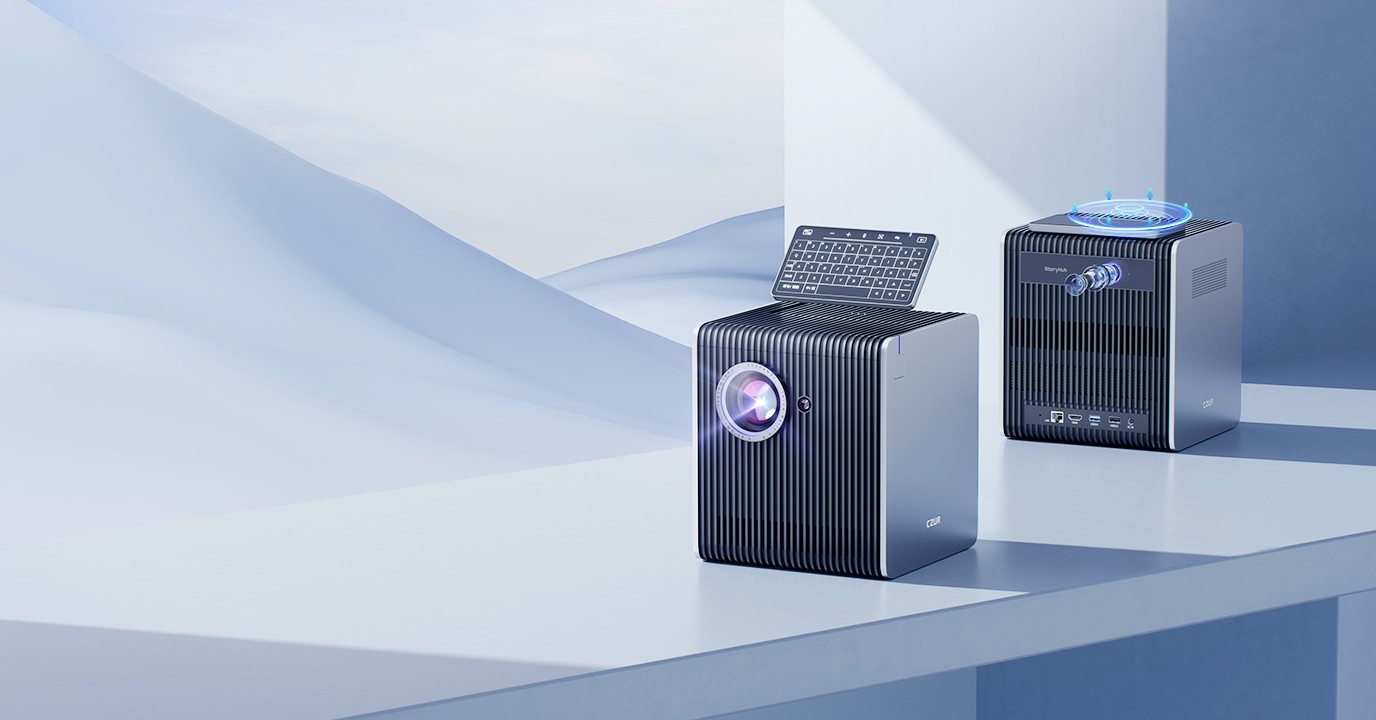
StarryHub (Image source/Enterprise)
However, the success path of the AI scanner is difficult to replicate. When CZUR entered the conference track, products such as meeting tablets (e.g., MAXHUB, Huawei IdeaHub) were already very mature. In Zhou Kang's words, "The competition is extremely fierce, the products have excellent reputations, but the conversion rate is lower than expected."
Although StarryHub has its differentiating features, in the conference scenario, users care more about price than convenience. Overall, the sales of the first - generation StarryHub did not meet expectations. Zhou Kang admitted that the core reason was its vague positioning in the competition with meeting tablets and the lack of price advantage in the upstream industry.
Based on the market feedback of the first - generation StarryHub, CZUR is rapidly promoting the release of the second - generation product line. This time, the company is giving up the direct competition with meeting tablets in the mainstream market and instead adopting a disruptive competition strategy.
Targeting the high - end market, CZUR will launch the second - generation StarryHub in January 2026, targeting the market for screens over 100 inches. It supports large - screen laser conference displays, avoiding the cut - throat price competition of meeting tablets in the market for screens under 80 inches. It has a powerful conference board and AI audio - video capabilities and supports the original "writing on the wall" interaction.
For the mass market, CZUR has launched an AI conference robot without a display, priced at 3000 - 4000 yuan. It targets the "reusing existing equipment" market and can transform existing TVs or monitors into intelligent devices.
Among them, the "AI conference robot" is regarded by Zhou Kang as a product with great explosive potential, defining a new category for future AI minimalist meeting rooms. Despite its small size, it integrates a camera, microphone, speaker, system, and AI functions, is compatible with all mainstream conference software, and is more like a fully - functional Android chassis.

AI conference robot (Image source/Enterprise)
More importantly, Zhou Kang said that the scale of the "reusing existing equipment" market is about four times that of the new - equipment market. Especially overseas, due to high logistics costs and slow equipment updates, this solution is more attractive.
What supports this disruptive competition strategy is the technological barrier that CZUR has built in the field of AI audio - video over the years.
It is reported that its self - developed "CZUR Quiet™" AI sound - pickup system can achieve clear sound collection within 8 - 10 meters; the AI camera has intelligent functions such as speaker tracking, gesture recognition, and automatic whiteboard content capture. The globally - original "air - writing" technology allows users to directly make annotations on any projected image with a special pen.
"These system - level functional innovations could not be achieved without full - stack self - research," Zhou Kang emphasized. "Having full control from the hardware bottom layer to system applications and then to intelligent interaction enables us to create products that are different from others."
This also reveals CZUR's underlying survival logic in the intelligent office market: when hardware configurations are gradually becoming similar and AI functions are becoming more and more common, competitiveness no longer lies in the leadership of a single technology but in the in - depth understanding of scenarios and system - level integrated innovation.