The automotive market is racing at two extremes, and intelligent driving has entered the era of trust | Shiyan Consumer Index Brand List Vol.92
The current new energy vehicle market presents a significant "dumbbell-shaped" differentiation pattern. In the high-end market, companies build technological moats through ecological interconnection and top-notch intelligent driving technologies, achieving breakthroughs with differentiated experiences. In the entry-level market, there is a wave of "technological inclusiveness," reshaping value perception with extreme cost-effectiveness. Meanwhile, the competition in intelligent driving has shifted from hardware stacking to a dual-drive model of "large AI models + liability guarantee," and user trust has become the key to success. This polarization trend is profoundly reshaping the industry's competitive landscape and future development direction.
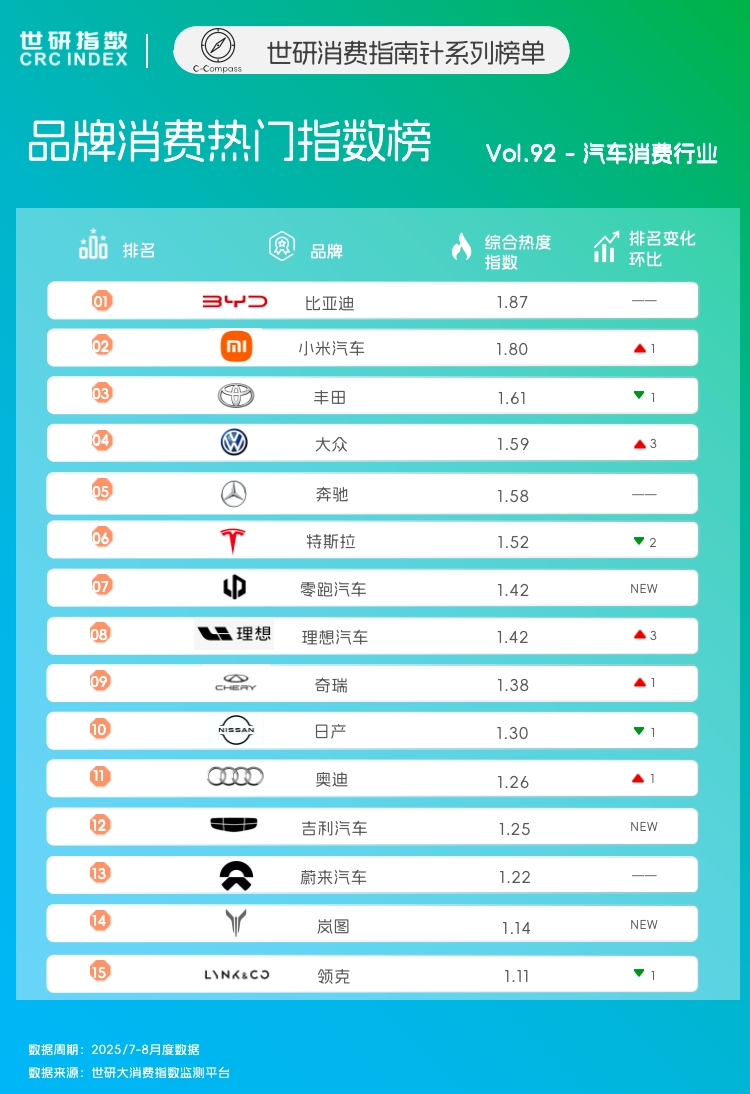
Image source: Shiyan Index
During this monitoring period, BYD, Xiaomi Auto, and Toyota ranked in the top three of the list with comprehensive popularity scores of 1.87, 1.80, and 1.61 respectively.
The polarization in the pure-electric vehicle segment is accelerating, with high-end ecological intelligent driving and entry-level technological inclusiveness jointly driving growth
Looking at the segmented market, the "polarization between high-end and entry-level" pattern in the pure-electric vehicle segment has further solidified, and the mid-price range continues to face pressure. In the high-end market (250,000 - 450,000 yuan), leading brands focus on differentiated strategies to build moats. Some drive high-end conversions through user ecosystems, while others strengthen technological trust with top-notch intelligent driving technologies. The core lies in transforming the brand's unique advantages into irreplicable user experiences.
For example, Xiaomi Auto recently launched the YU7 model, highlighting its self-developed Xiaomi Pilot high-order intelligent driving technology and the Pengpai OS "full-scenario interconnection of people, vehicles, and homes" technology. It has connected the ecosystems of mobile phones, home appliances, and cars, achieving efficient user conversions. In July, its monthly delivery volume exceeded 30,000 units for the first time, successfully seizing a position in the high-end market with the potential of its technology brand.
VOYAH has taken the path of "technological cooperation + scenario experience." The brand has leveraged Huawei's Kunlun ADS 4.0 and its self-developed magic carpet chassis, focusing on the real needs of "intelligent and comfortable long-distance family travel." It launched the FREE+ model, strengthening its trust among high-end family users.
At the entry level, there is a wave of "intelligent equality." Leapmotor and Geely are reshaping brand value through technological inclusiveness: Leapmotor, with its full-domain self-development and platform-based cost reduction, enables the B01 to come standard with a lidar at a price of 89,800 yuan; Geely has consolidated the position of the Xingyuan in the 70,000-yuan market with its Flyme Auto ecosystem and long-range capabilities.
This "dumbbell-shaped" structure indicates that consumers either pay for extreme experiences or choose extreme cost-effectiveness, while pure-electric vehicles priced between 150,000 and 200,000 yuan, lacking distinct features, face sluggish growth.
Intelligent driving is moving towards a trust economy, and the competition logic has shifted to a dual-drive model of large AI models and liability guarantee
Intelligent driving has officially entered a new stage dominated by the "trust economy," and the competition logic has shifted from "stacking hardware and comparing computing power" to a dual-drive model of "empowerment by large AI models + guarantee of safety liability."
Technologically, Tesla's Grok4 has been installed in vehicles, BYD's "God's Eye" relies on a data closed-loop iteration of over one million vehicles, and Huawei's Kunlun ADS 3.0/4.0 has become standard in high-end models. This marks that intelligent driving systems have gone beyond basic route planning and are moving towards high-order intelligence with risk prediction, scenario-based interaction, and human-like decision-making.
Especially in the high-frequency and essential scenario of intelligent parking, BYD has recently achieved L4-level intelligent parking through centimeter-level mapping and full redundancy design, and has pioneered the commitment of "full compensation for parking accidents by the manufacturer," directly addressing the core pain point of users' "reluctance to use."
Users no longer simply believe in hardware indicators such as the number of sensors but now consider liability attribution, data security, and actual experience as the key factors in decision-making.
GAC Toyota's bZ3X has followed up with a major commitment: the manufacturer will be responsible for spontaneous combustion and intelligent parking, providing lifelong "spontaneous combustion insurance" and "parking insurance" for new and old users, which is also a quick response to this trend.
In the future, only brands with both top-notch large AI model technology capabilities and a clear and enforceable liability mechanism can truly win user trust and build sustainable competitive barriers in the second half of the intelligent driving era.
Explanation of the list
The Shiyan Consumer Compass Series Index Report is a consumer index evaluation system independently developed by the Shiyan Index. This series includes major lists such as the "Brand Consumption Popularity Index List," "Industry Consumption Heat Index List," "Product Consumption Wave Index List," and "Consumption Popular Event List," as well as extended list reports in corresponding areas. The aim is to objectively and truly present the trend characteristics of the consumer world through index evaluation, helping the industry and brand owners continuously track consumer market trends, providing references for enterprise operations, and enhancing comprehensive business competitiveness.
The Shiyan Consumer Compass Series Index List continuously monitors the following industries:
3C digital products, footwear and apparel accessories, food and fresh products, household appliances, sports and outdoor products, beauty and cleaning products, maternal and baby products, home decoration, automobile consumption, toys and musical instruments, pet products, and medical and health products, a total of 12 major industries.
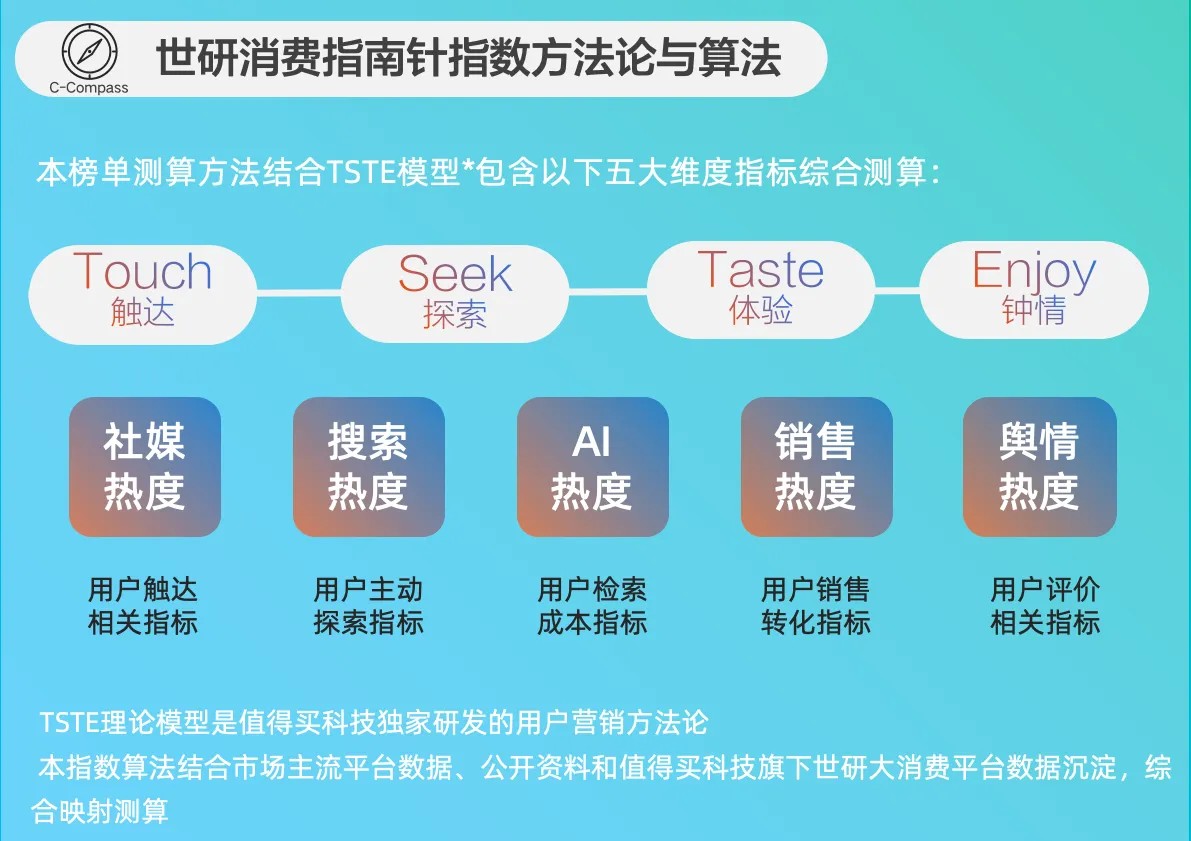
Image source: Shiyan Index
Disclaimer
This list is independently compiled by the Shiyan Index. The views, conclusions, and suggestions in the list are for reference only and do not represent any specific investment advice or decision-making basis.
The list data is calculated by combining publicly available data from mainstream platforms and data accumulated on the Shiyan Big Consumer Platform under the ZDM Group. We have taken reasonable measures to ensure the reliability and accuracy of the data provided, but we cannot rule out some errors or deviations due to the limitations of the data itself. In addition, some of the data in this report has not been formally audited by an independent third-party auditing institution, so there may be unrecognized errors or omissions. It is particularly noted that the market situation may change at any time, so the predictions, analyses, and conclusions in the report may differ from the actual situation.
Any third-party names, brands, or products mentioned in the report are for illustrative purposes only and do not constitute an endorsement or recommendation. Any mention of these third parties should not be regarded as an endorsement or recommendation in any form. The copyright of the report belongs to the ZDM Group and the Shiyan Index, and it may not be reproduced or distributed without permission. The ZDM Group and the Shiyan Index shall not be liable for any losses or damages caused by the use of the information in this report.