New energy heavy trucks have received a large number of orders. In November, sales increased by 178% year-on-year. Even with two shifts of work, the supply still couldn't meet the demand. Customers even went directly to the factory to urge the delivery of orders. Such a scenario is rarely seen in a decade.
“Currently, the orders are in short supply. Customers even come directly to the factory to urge the delivery, which was rarely seen before.” When talking about this year's sales volume, Chen Ke (a pseudonym), a sales director of Sinotruk, could hardly hide his joy.
Data also confirms this. The latest data from the China Association of Automobile Manufacturers shows that in November, the sales volume of heavy-duty trucks in China reached 113,000 units, a year-on-year increase of 65.4%, achieving eight consecutive months of growth.
In this sales boom, new energy heavy trucks have become the new engine.
Public data shows that in November, the domestic new energy heavy truck market sold a total of 28,000 units, a year-on-year increase of 178%. In the first three quarters, the sales volume increased by 184% year-on-year.
Why has the sales volume of heavy trucks increased so significantly? Why are new energy heavy trucks the “star” in this round of market? Around these questions, reporters from NBD (hereinafter referred to as NBD reporters) conducted an in-depth investigation.
1
Too many orders and insufficient production capacity, customers go directly to the factory to urge delivery
“There are too many orders, but the production capacity can't keep up. We can only give priority to meeting the needs of core customers.” Chen Ke clearly remembers that the change in the heavy truck market started last year.
He told NBD reporters: “From October 2024 to now, we haven't had a moment of leisure. The original single-shift production couldn't meet the demand, so the production workshops in some areas have been changed to two-shift production.”
The same scene is also happening in a gear company under Sinotruk. Under the high production pressure in peak months, the company increased its production capacity. The installation volume of gearbox assemblies increased by 66% year-on-year, and the single-shift output of assemblies exceeded 610 units.
The bustling scene in the workshop is also directly reflected in the company's sales volume. Data from the First Commercial Vehicle Network shows that in November, Sinotruk sold 25,000 heavy trucks of various types, a year-on-year increase of 23%; the sales volume of FAW Jiefang heavy trucks increased by nearly 80% year-on-year; the sales volume of Dongfeng Company's heavy trucks increased by nearly 70% year-on-year; the sales volume of XCMG and Beiqi Foton heavy trucks increased by about 1.5 times year-on-year.
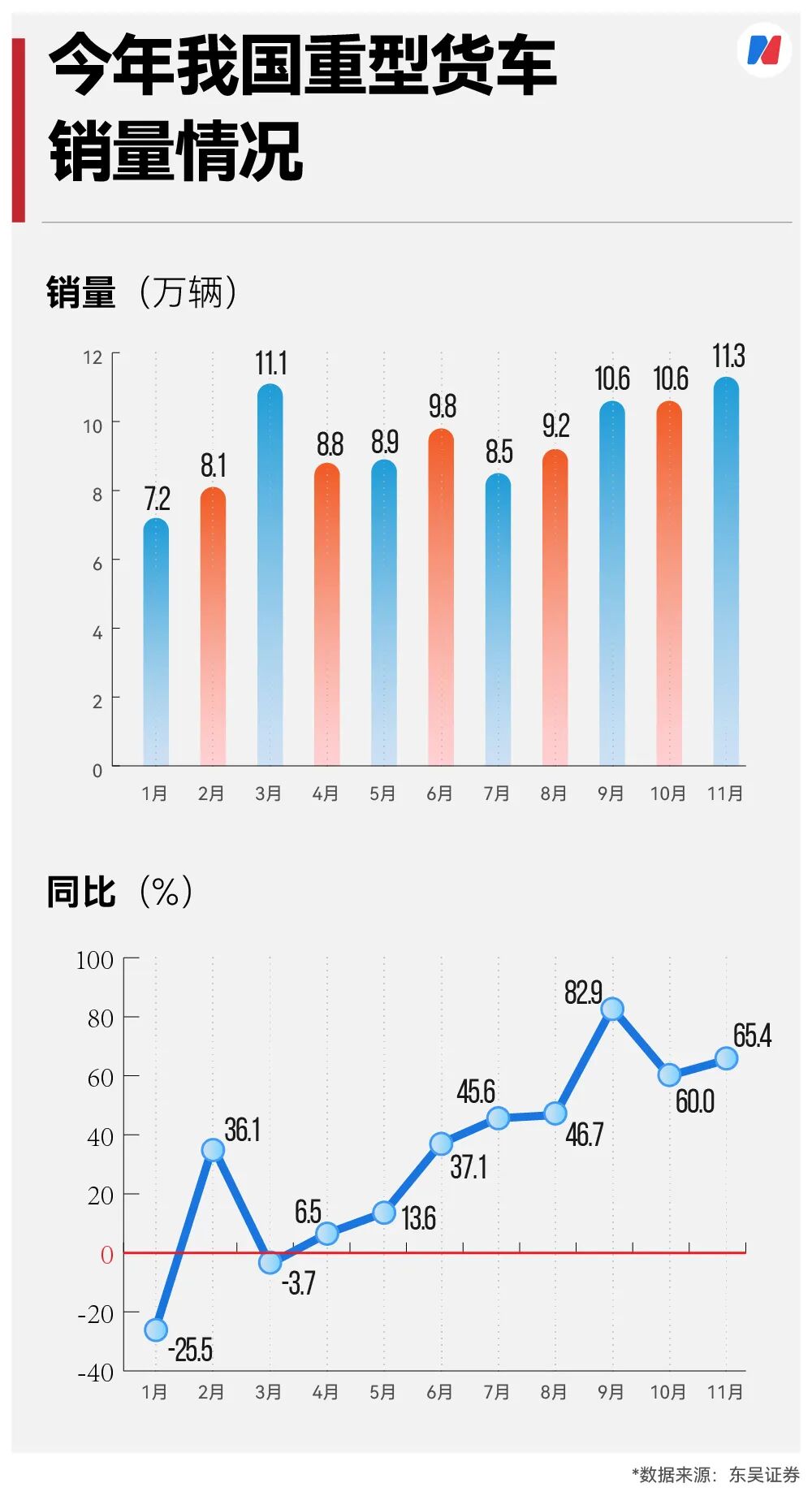
“Except for a sales boom in 2020 affected by policies, looking back nearly a decade, there has never been such a situation,” Chen Ke said.
But he also felt the difference between the two booms: compared with 2020, the market is more “lively” this time, and the market pattern has also changed significantly. The sales boom in 2020 occurred in the traditional energy market, including fuel heavy trucks and natural gas heavy trucks. “In this round of boom, new energy heavy trucks have become the new engine, and many new players have entered the market,” Chen Ke introduced.
A relevant person in charge of FAW Jiefang's new energy product line told reporters: “As of the end of October this year, the sales volume of FAW Jiefang's new energy medium and heavy trucks reached 20,400 units, and it is expected to reach 34,000 units for the whole year, nearly quadrupling year-on-year.”
Actually, in the new energy heavy truck market, the tractor segment is the most competitive and has the highest technical requirements. “Heavy tractors have a relatively high threshold for electrification. However, even so, with the encouragement of the 'two new' policies, the new energy penetration rate in this segment has reached 30%,” Peng Peimin, the Chief Marketing Officer of the Commercial Vehicle Group of Bosch Intelligent Mobility Group in China, told reporters. In the domestic medium and heavy truck market, diverse powertrains will coexist, but by 2030, the electrification route will become the mainstream.
When electrification becomes a market consensus, car companies and suppliers are sparing no effort in their layout. According to the relevant person in charge of FAW Jiefang's new energy product line, “By the end of this year, FAW Jiefang will launch its new energy 3.0 products, which are not only suitable for various scenarios such as coal, steel mills, sand and gravel, ports, express delivery, etc., but also cover different configurations such as pure electric, P2 hybrid (a hybrid architecture), and battery-swapping range extension.”
2
Most are bulk purchases by large customers, buying 20 - 50 vehicles at a time
As the “trade-in” policy is approaching its end, coupled with the advance overdraft effect brought about by the change of the new energy vehicle purchase tax exemption to a 50% reduction starting from January 1st next year, in November, the domestic new energy heavy truck market sold a total of 28,000 units, a month-on-month increase of 39% compared with October this year and a year-on-year increase of 178%. In the first three quarters of 2025, the sales volume of new energy heavy trucks increased by 184% year-on-year, and the penetration rate rose to 24.21%.
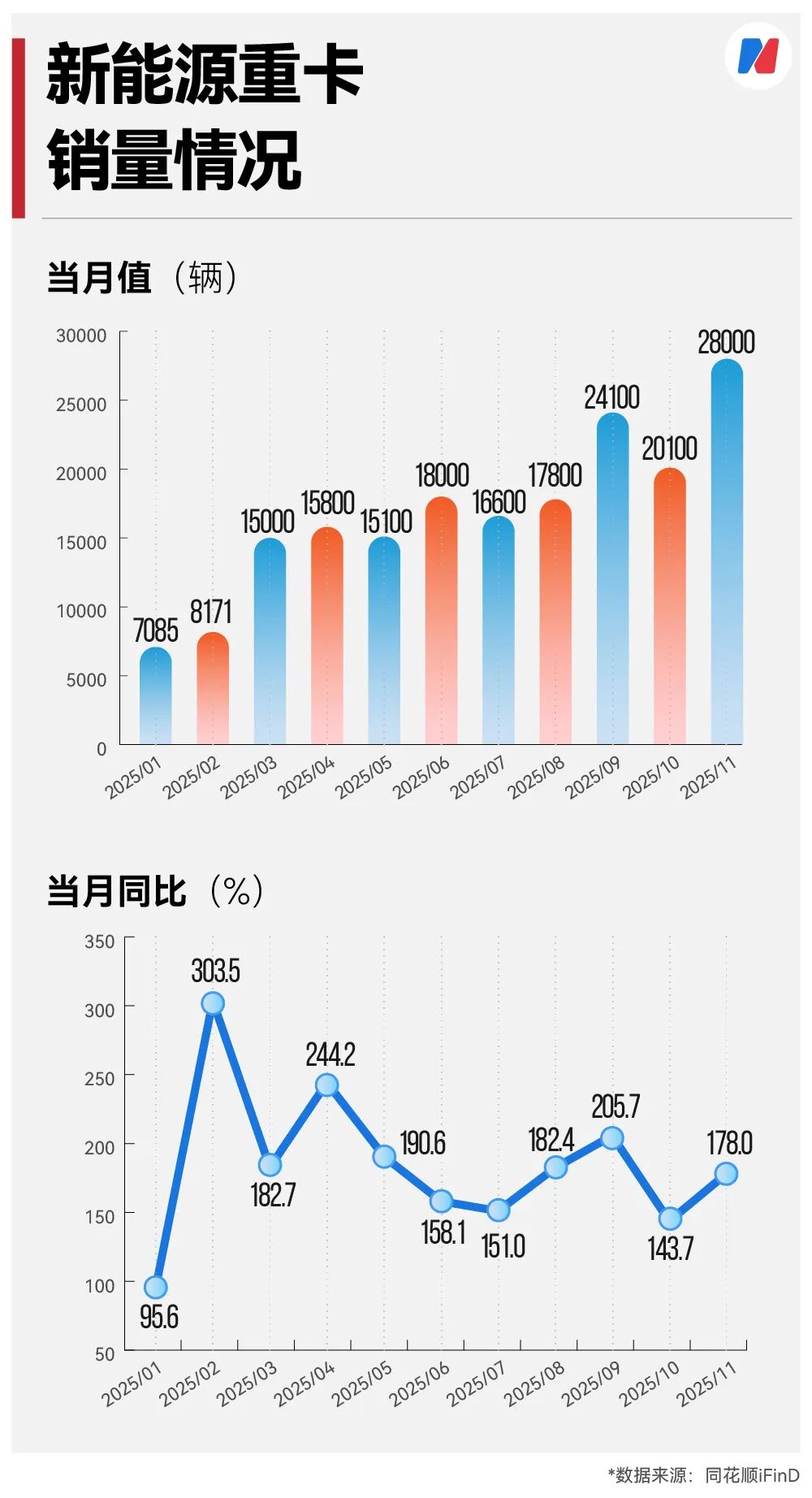
Many industry insiders analyzed to NBD reporters that the rapid increase in the sales volume of new energy heavy trucks is mainly due to the superposition of multiple favorable factors such as the rigid demand for natural replacement, the “trade-in” subsidy policy, and the improvement of product economy.
NBD reporters found that this year's subsidy policy originated in March. The Ministry of Transport, the National Development and Reform Commission, and the Ministry of Finance issued the “Notice on the Implementation of the Scrapping and Updating of Old Operating Trucks,” including operating trucks meeting the National III and National IV emission standards in the subsidy scope. Owners who scrap heavy trucks in advance can get a maximum subsidy of 45,000 yuan, and those who replace them with new energy heavy trucks can get a maximum subsidy of 95,000 yuan. The two subsidies combined can reach a maximum of 140,000 yuan per vehicle.
“If a new energy heavy truck is priced at about 600,000 yuan, getting the full 140,000 yuan subsidy is equivalent to a 23% discount,” Chen Ke calculated the subsidy account for NBD reporters.
He revealed that currently, most of the customers with high replacement demand are institutional customers. These customers mainly make bulk purchases, with a single order size ranging from 20 to 50 vehicles, and the capital involved is quite large. Such a large subsidy is indeed very attractive for them to reduce costs.
In addition to the pull of policy subsidies, the operating cost advantage of new energy heavy trucks is also an important factor for the increase in sales volume.
Compared with traditional heavy trucks, the energy cost of new energy heavy trucks is only 20% - 30% of the former. This core advantage is particularly prominent in the medium and short-distance freight market within 400 kilometers.
Chen Ke admitted that in recent years, the competition in the domestic freight industry has become increasingly fierce. The operating cost of new energy heavy trucks is lower than that of traditional heavy trucks, which can further reduce the freight cost and make it easier for enterprises to win bids at lower prices. This is also the key reason why institutional customers have more motivation to replace than individual customers.
“Heavy trucks are means of production, so users pay extremely high attention to TCO (Total Cost of Ownership),” Peng Peimin further said.
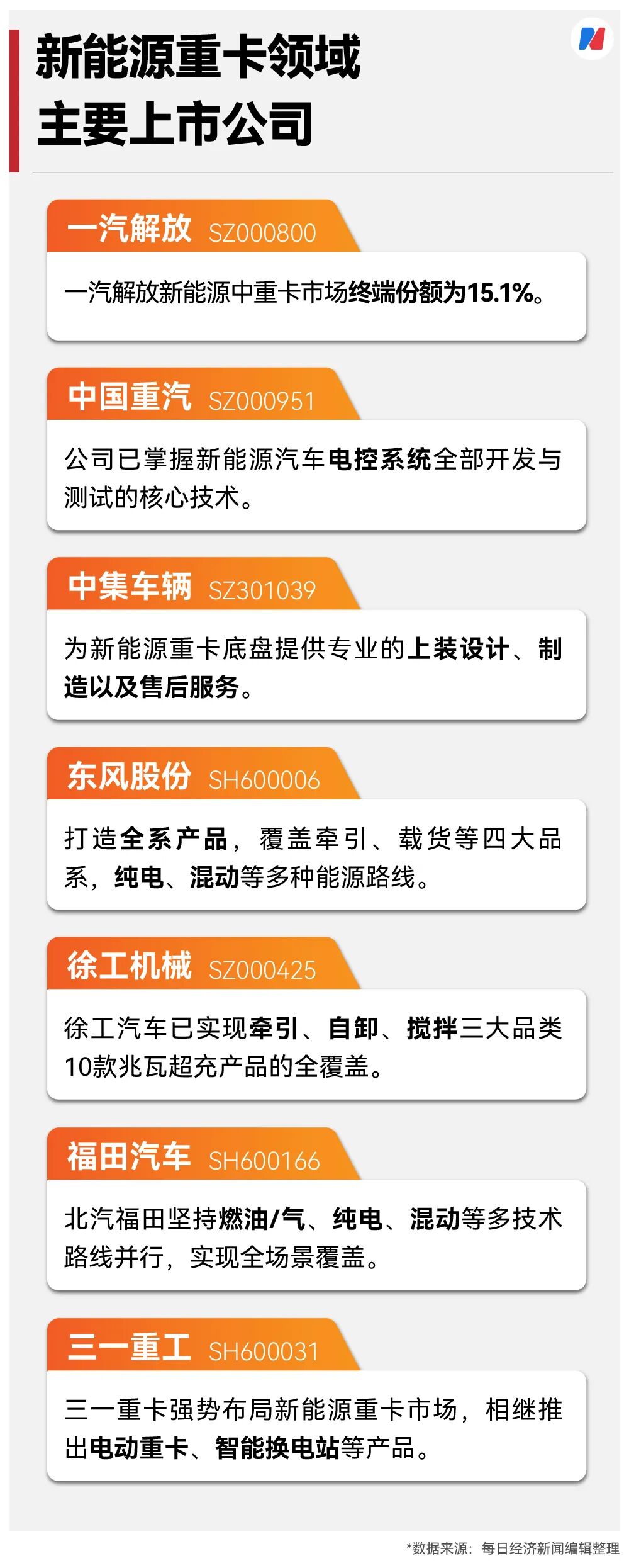
However, there are also some problems in the development process of new energy heavy trucks.
“What new energy heavy truck users care most about is that the vehicle should carry more, run more, cost less, be used more, and not break down,” a relevant person in charge of Yutong Heavy Trucks told NBD reporters. Currently, the main concerns of users about new energy heavy trucks are insufficient range, slow and inconvenient charging, battery range attenuation in winter, and high failure rates. The person in charge told reporters that insufficient range is the primary concern of users, especially the prominent problem of range attenuation in long-distance and extreme working conditions. At the same time, problems such as low charging efficiency and poor compatibility with public charging piles also exist.
Therefore, only by further improving the energy replenishment infrastructure for new energy heavy trucks and promoting the in-depth integration of vehicles, charging piles, and the network can commercial vehicles catch up with the new energy wave.
3
What are the reasons behind the strong increase in heavy truck sales?
The production of engineering heavy trucks belongs to a cyclical industry, and its sales volume fluctuations are highly related to the macro - economy, replacement and renewal demand, subsidy (elimination) policies, etc.
Is the continuous increase in heavy truck sales a signal of the recovery of investment, especially infrastructure investment? Is it the freight demand that has driven the sales growth?
An automotive industry analyst told NBD reporters that there is a possibility of recovery. However, to make an accurate judgment on this trend, it is necessary to combine the operating conditions of construction machinery, especially the excavation machine utilization rate.
Construction machinery is the basic equipment industry of the national economy and is more closely related to infrastructure investment and the real estate cycle. As a “standard equipment” for infrastructure construction, excavators are a barometer reflecting the infrastructure situation and observing economic changes such as fixed - asset investment.
NBD reporters sorted out the “CCTV Financial Excavator Index” and found that in the first half of this year, infrastructure investment across the country showed a multi - point blooming situation, continuously providing impetus for economic development. In the first half of the year, the sales volumes of excavators and loaders, the two representative products in the domestic construction machinery industry, both increased by more than 10%.
In the third quarter, various infrastructure projects advanced steadily. Road surface equipment and port equipment performed well. The total working hours of various types of equipment such as stackers, reach stackers, and road rollers increased both year - on - year and month - on - month.
In November, although restricted by the winter construction conditions in the north, it still couldn't stop the enthusiasm for project construction. Many places launched a “year - end sprint” boom. In November, the average utilization rate and workload of construction machinery across the country both increased month - on - month.
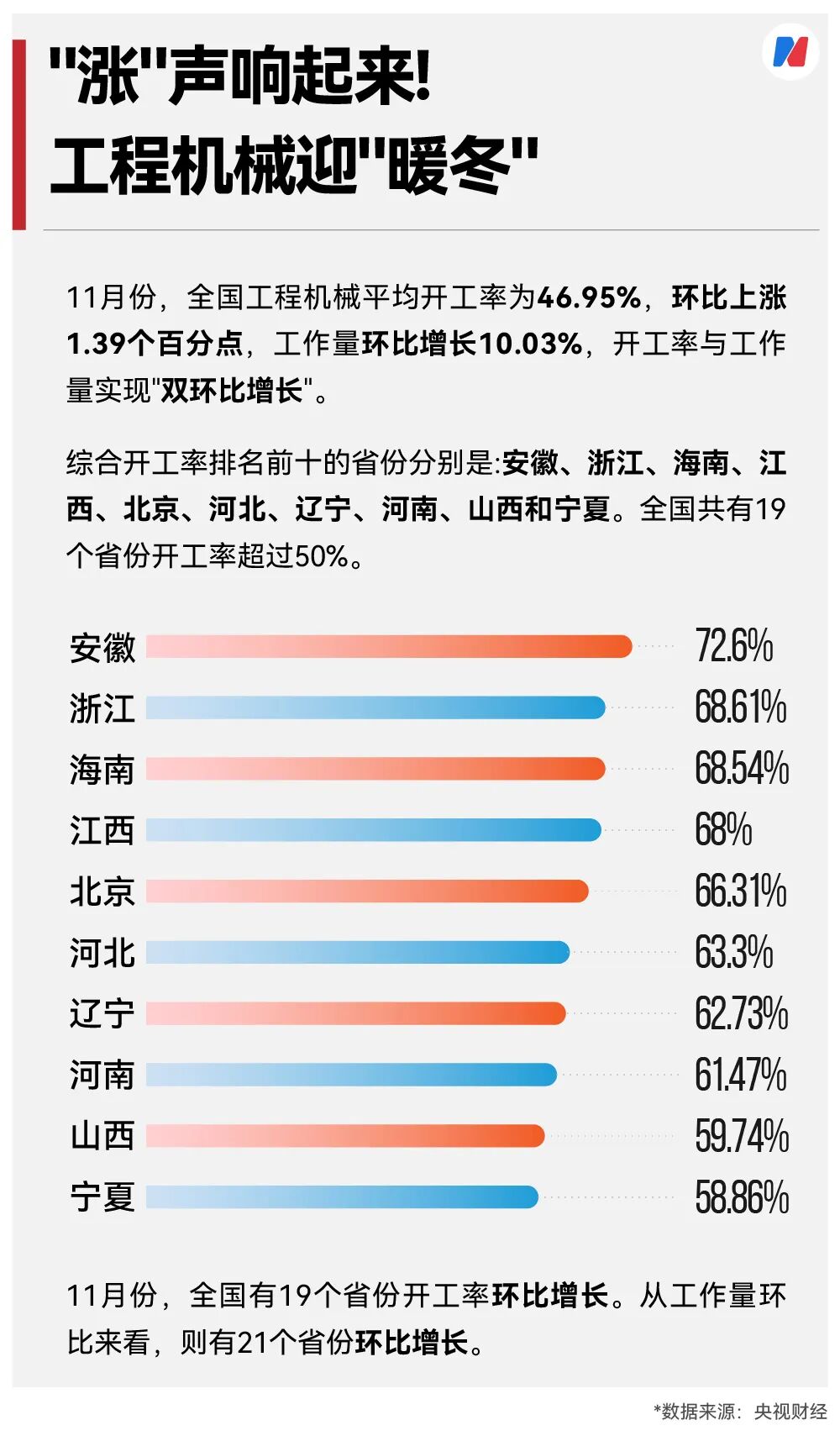
A research report from Dongguan Securities pointed out that in the long run, the successive start of major national projects, the accelerated implementation of funds, and replacement policies will effectively support the demand for construction machinery.
Zhang Xiang, the Secretary - General of the International Association of Intelligent Vehicle Technology and a researcher at the Automobile Industry Innovation Research Center of North China University of Technology, said in a WeChat interview with NBD reporters that currently, the country is vigorously promoting infrastructure construction, significantly increasing the transportation demand for building materials such as cement and sand. In addition, factors such as the demand from the express delivery and logistics industry and the “trade - in” policy for heavy trucks have all provided growth impetus for the heavy truck industry.
Zhang Xiang emphasized that currently, China has implemented a series of preferential policies for the heavy truck industry, including exemption from purchase tax, purchase subsidies, and free passage on expressways during operation. There are also parking preferential policies for electric heavy trucks. These policies have greatly promoted the development of the electric heavy truck industry.
With the continuous improvement of environmental awareness and increasingly strict carbon emission requirements, the demand for electric heavy trucks in many countries and regions has increased rapidly. The export market of China's electric heavy trucks has shown a strong growth trend, playing an important role in enhancing the competitiveness of China's commercial vehicles in the international market.
Overall, electric heavy trucks are in a stage of rapid growth, and the growth rate has exceeded the average growth rate of new energy vehicles. If the “two new” policies can maintain the current state next year, it will be very beneficial for the electric heavy truck industry.
This article is from the WeChat public account “NBD Headlines”, author: Zhou Yifei, Duan Siyao, editor: Chen Xing. Republished by 36Kr with authorization.