Did Luminar, the last hope after someone just said to phase out Chinese lidar, go bankrupt?
Many years later, when facing the bank, Austin Russell, the founder of Luminar, will surely recall that distant afternoon when he rang the bell at the NASDAQ...
Remember not long ago, an American congressman once raised his arm and shouted: We must eliminate Chinese lidars!
The reason is that if a real conflict breaks out between China and the United States, China could control these sensors in the United States in a matter of minutes, paralyzing the country. How could this be allowed? This loyal minister will surely turn the tide and save the situation, completely reversing this state of affairs.

However, as soon as these words were uttered, a major event occurred in the industry.
Luminar, known as the "last hope in the United States," suddenly filed for bankruptcy. Now, if Chinese lidars are banned, it might really be the case that there will be no troops to deploy and no one to use among the officials in the United States...
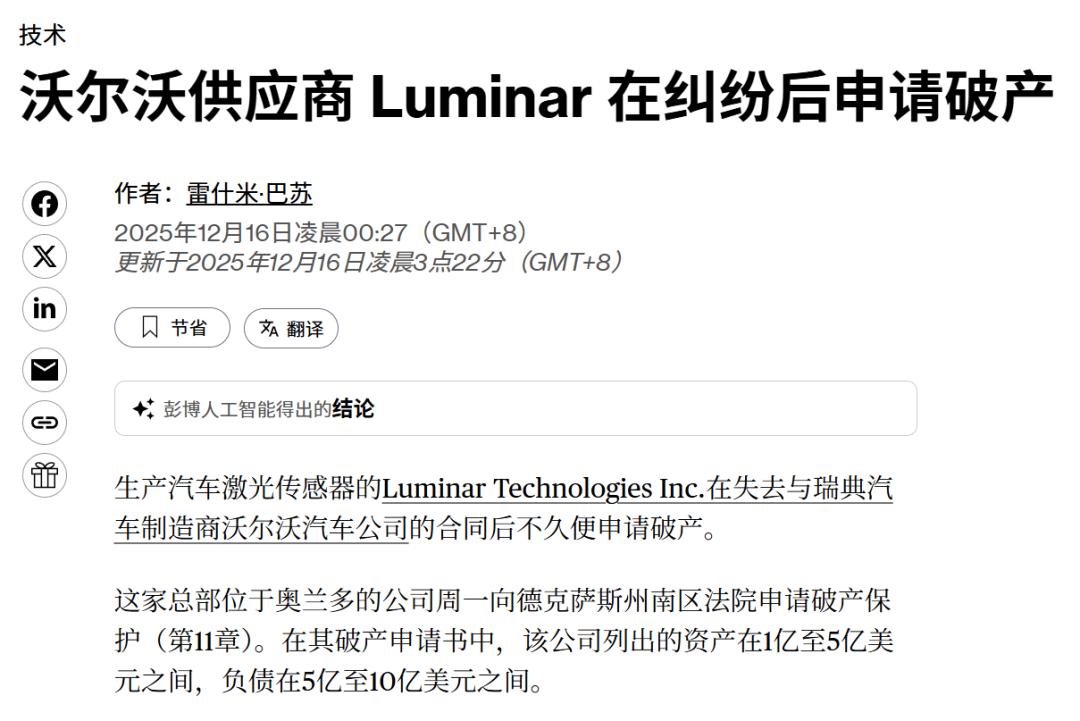
Why did this happen? On the surface, it was because the deal between Luminar and Volvo didn't go through, resulting in the loss of business. In fact, behind this is the fact that the lidar industry, the pearl on the crown of intelligent driving, has been monopolized by Chinese enterprises.
It's truly a miracle that Luminar has survived until now.
Of course, many of you here may not know about Luminar yet and have no idea of its status. Let me briefly introduce the background.
The lidar industry itself was created by the United States. Twenty years ago, the casualties in the Afghanistan War pained the United States deeply. So, the military hoped to develop military unmanned vehicles.
It's a pity that the military scientists on the government payroll made no progress. So, the United States came up with another idea. Instead, they decided to draw wisdom from the public and organized the DARPA Grand Challenge for Autonomous Vehicles, which is equivalent to the American version of "I Love Inventions."
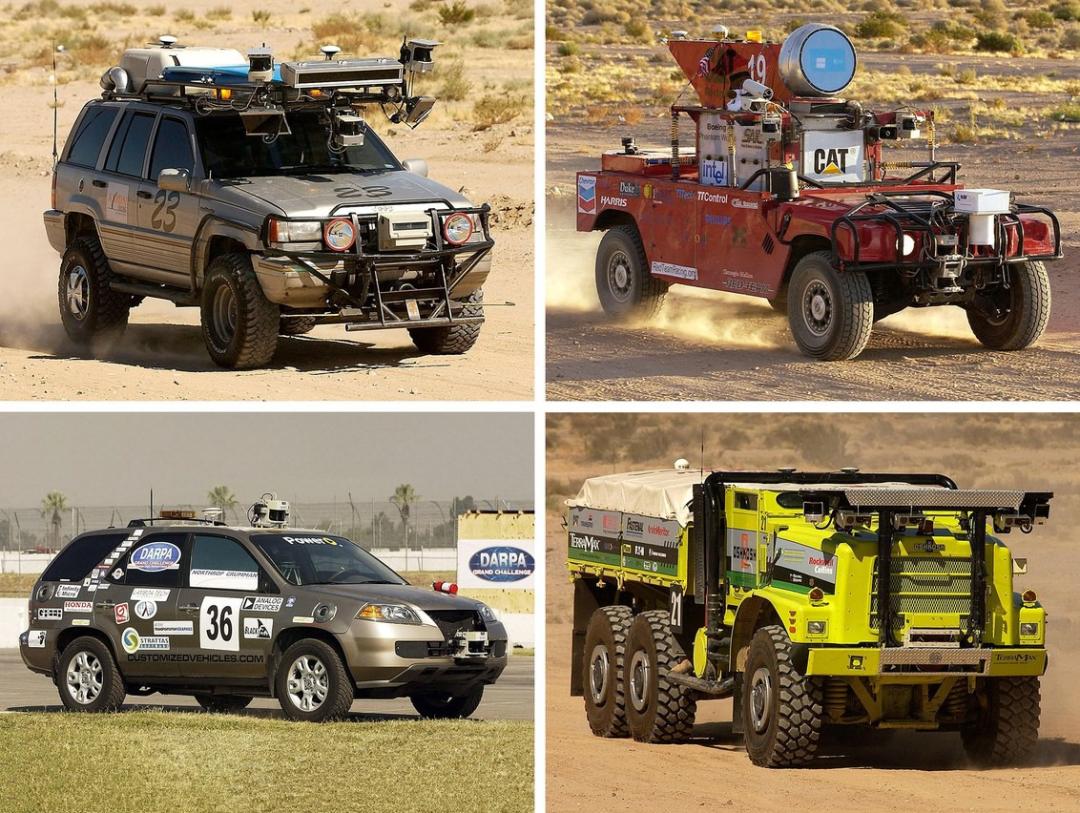
Coincidentally, this effort succeeded. An audio company called Velodyne managed to "go off - topic" and hand - crafted a 64 - channel lidar, ultimately winning the competition. This was the first shot fired in the American lidar industry.
After 2012, the industry began to mature, and more lidar companies emerged like mushrooms after a rain. The vibrant and competitive scene is still vivid in our memory.

Compared with Velodyne's expensive and bulky mechanical lidars, later entrants were more advanced. For example, Quanergy and Ouster focused on solid - state radars, specializing in optical phased arrays and digital laser technology respectively. Aeva developed 4D lidars, and Cepton created micro - motion technology.
Among these enterprises, there was a 17 - year - old genius named Austin Russell. He emulated Bill Gates, Steve Jobs, Mark Zuckerberg, and Elon Musk, dropped out of college directly, and started a business with a $100,000 scholarship. This company is Luminar.

So, what's its advantage? The answer is wavelength. Ordinary lidars use 905nm, while Luminar is unique, using 1550nm.
As is well - known, light is both a particle and a wave. Luminar lengthens the wavelength of the laser to make it "softer," which brings three benefits. First, it won't damage the eyes. Second, it can detect at a longer distance. Third, the image is clearer.
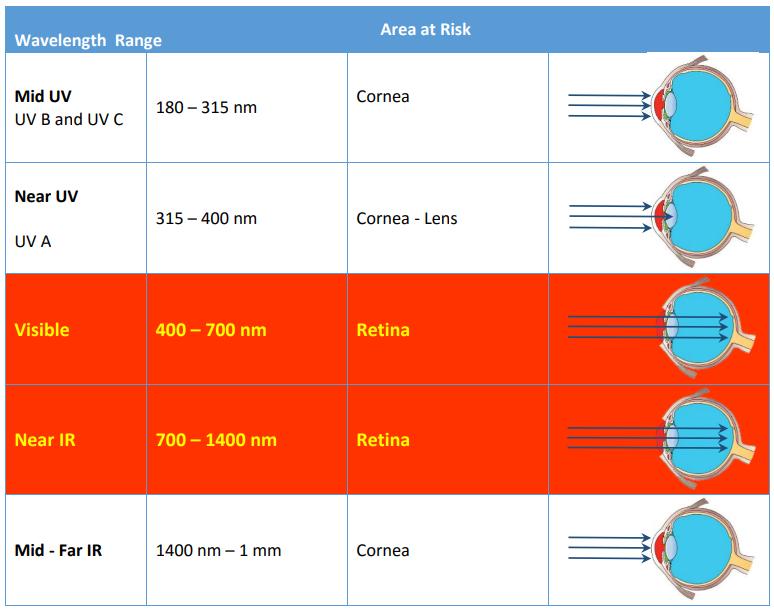
Let's start with the fact that it won't damage the eyes. In fact, wavelengths in the range of 400 - 1400nm belong to the retinal danger zone. Laser light can reach the retina directly. That is to say, if the power is a bit higher, it could burn through one's eyes.
In the 1400 - 3000nm band, laser light is basically absorbed by the cornea and aqueous humor and can't reach the retina at all, so it's safer.
So, does it mean that lidars should use 1550nm? Not really.
Regardless of the wavelength, they all meet safety standards. The key lies in the power, right? In essence, the advantage of 1550nm is that it can output more power while meeting safety standards.
According to the common view in the industry, the upper limit of the safe power for 905nm is 0.5mW, while 1550nm can reach more than 20mW, which is 40 times that of the former. So, it does have an advantage. But when some people claim that 1550nm is safer, they're missing the point.
This higher power actually brings the second benefit, a longer detection distance.
Theoretically, if the power of a lidar is increased by 17 times, the detection distance can be increased by 4 times (the actual situation is lower). For example, referring to some products, we can find that at a 10% reflectivity, the detection distance of 905nm is about 150m, while 1550nm can reach 300m, which will surely greatly enhance the intelligent driving ability.
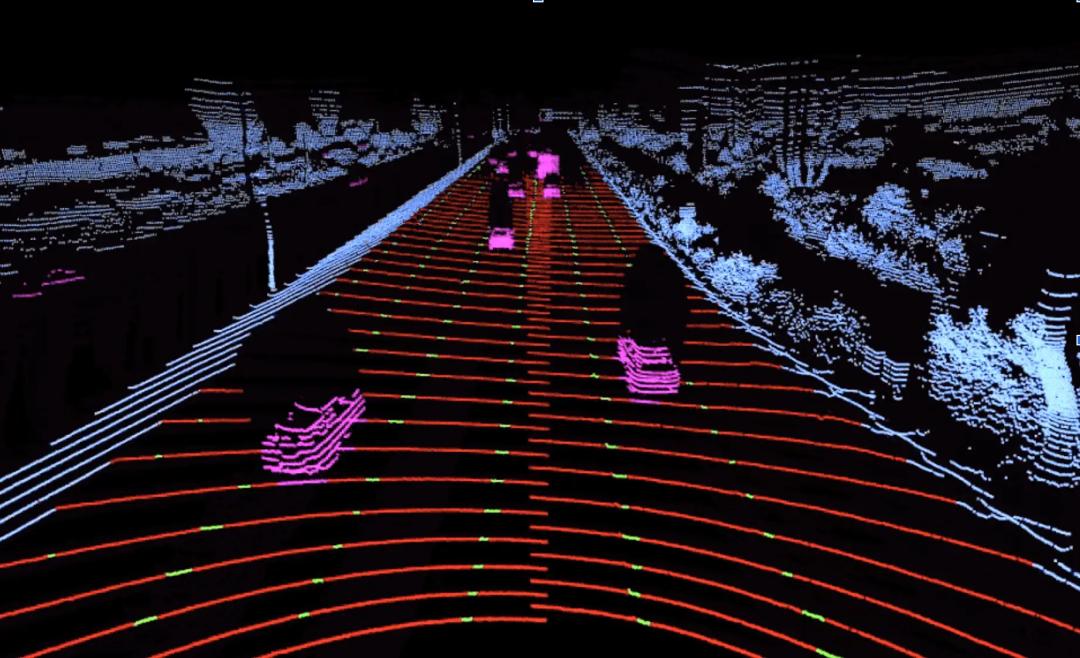
At the same time, the fiber lasers used in 1550nm can make the emitted laser thinner, with a higher point - cloud density, and thus the image looks clearer.
By now, you should understand. Luminar's technology is relatively practical. Compared with the terrifying cost and low yield rate of its peers, it can achieve commercialization quickly and can engage in differential competition by bypassing the mainstream market. So, its approach is quite popular in the capital market.
In 2020, Luminar went public on the NASDAQ through SPAC (a fast - track method). Compared with many of its peers whose stock prices fell below the issue price upon listing, Luminar could rely on storytelling and hyping concepts, and its market value once soared to $12 billion.
However, the good days soon came to an end. Under the impact of Chinese manufacturers, American brands have experienced a "collective collapse."
For example, for semi - solid - state lidars of the same level, the price of Luminar Iris is now $500, while the Hesai AT128 can be sold for $200. Although Luminar's performance is indeed better, its cost - performance ratio is far behind.
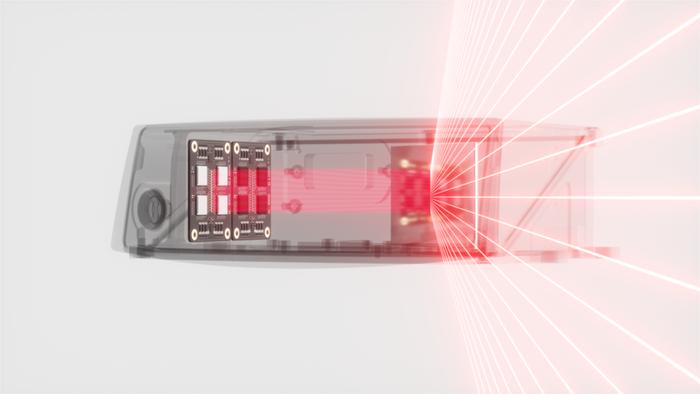
We've also discussed this in our previous articles. The main reasons are the "chip - based approach" and economies of scale in our domestic market, which have significantly reduced the cost of lidars. Luminar can still hold on with the funds earned from the stock market before, while other American brands have no choice but to fail.
Another point is that Luminar's 1550nm route also makes it difficult to reduce costs. Because this technology requires a key material, indium gallium arsenide (InGaAs). Just the indium itself is as rare as silver, and the cost can be imagined.
At the same time, Luminar has always adhered to the "two - dimensional galvanometer" technology, but its assembly is very difficult, and the yield rate has always been less than 70%. So, Luminar can only target the high - end market.
For example, from its listing to bankruptcy, it has always relied on one major client, Volvo, which accounts for almost 70% of Luminar's revenue. But even with such a discerning client, Luminar still failed to live up to expectations and couldn't match Volvo's requirements.
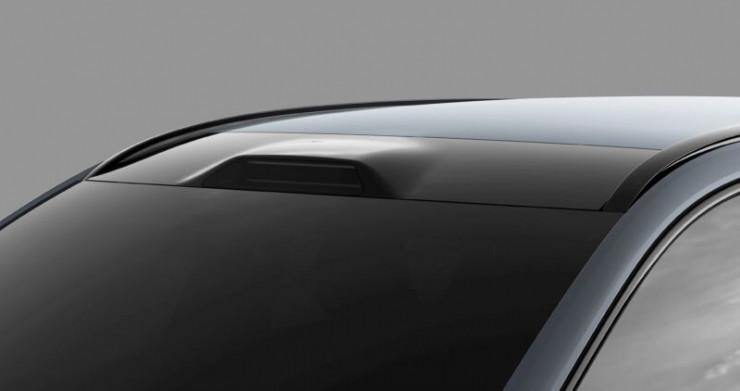
The mass production of the EX90, originally scheduled for the end of 2023, had to be postponed to June 2024 due to the algorithm conflict between Luminar and Volvo. Then, due to the production capacity issues at the Mexican factory, the schedule was postponed several times, which really annoyed Volvo.
This year, Volvo directly terminated the contract on the grounds that "Luminar failed to fulfill its contractual obligations and the supply - chain risk was too high." Luminar didn't have much of a market in the first place and relied entirely on Volvo. Without Volvo's support, I have no choice but to fail...
In this regard, I can only say that this is the general trend. Don't blame the Chinese for being too "bad" and snatching American brands' customers. The key is that the market won't pay for your unique technology. The market always looks at cost - performance.
Compared with the practical logic prevalent in the domestic market, most American brands are very ambitious. Although their technologies are forward - looking, they often stick to one path and won't compromise on cost and reality.
Is it because of the true nature of these "genius teenagers," or are they just aiming to make money in the capital market?
In short, in today's lidar market, basically only domestic brands such as Hesai, RoboSense, and Huawei remain.
If the United States wants to eliminate Chinese lidar products, then it can only join hands with Tesla and rely on pure vision technology.
Sources of pictures and materials:
bloomberg | Volvo Supplier Luminar Files Bankruptcy After Dispute
reuters | US bill seeks phase - out of Chinese sensors in self - driving cars, after space hack fears
Intelligent Vehicle Reference | The United States Loses Ground in the Lidar Market, and Its Last Hope Goes Bankrupt
Lidar Design Laboratory: Wavelength
This article is from the WeChat official account "ChaPingX.PIN", author: TC, editor: MianXian. It is published by 36Kr with authorization.