OpenAI, 65 times, $830 billion
The hype around SpaceX's IPO hasn't faded yet, and now OpenAI has pulled off another major move:
It plans to raise $100 billion in a new round of financing.
If it can raise the target amount, OpenAI's valuation could soar to $830 billion.
Just two days ago, this figure was $500 billion.
In just 48 hours, it increased by $330 billion...
This is OpenAI.
In 2023, you thought a valuation of $29 billion was expensive. In 2024, you thought a valuation of $157 billion was a bubble...
What will you say when faced with a valuation of $830 billion by the end of 2025?
01
A 65-fold "Premium"
The valuation of traditional SaaS companies usually depends on the price-to-sales ratio or price-to-earnings ratio.
According to reports from Techloy and WSJ, OpenAI's estimated revenue in 2025 is about $12.7 billion.
Based on a valuation of $830 billion, its price-to-sales ratio is as high as 65 times.
In comparison, in 2021, the craziest year for SaaS, Snowflake's price-to-sales ratio was around 50 - 80 times. Now, most mature SaaS companies have fallen back to the range of 10 - 15 times.
So, what enables Sam Altman to convince investors to accept a 65-fold valuation?
Firstly, it has a technological moat.
Different from GPT-4, which simply piles up parameters to achieve results, GPT-5 uses an adaptive multi-model system. Through the dual-track design of the gpt-5-main fast model and the gpt-5-thinking deep reasoning model, and with the real-time router dynamically allocating computing resources, it reduces computing power waste by 40%.
This directly leads to a 50% reduction in the price of input tokens compared to GPT-4o. Coupled with a 90% discount on the token caching mechanism, the API call cost for B-side customers is directly halved, causing the usage of the Codex code model to skyrocket tenfold within two months.
More importantly, the technological barrier is continuously thickening.
The "recursive self-improvement" technology that OpenAI is developing is like a perpetual motion machine: it allows the model to optimize and upgrade autonomously without human annotation for iteration.
Barclays Bank estimates that after this technology is implemented, the training efficiency of GPT-6 will increase tenfold, but it requires a computing power reserve of $43 billion in the early stage, which is one of the core purposes of the tens of billions in financing.
Just like SpaceX's rockets, although they burn a lot of money, once they successfully break free from Earth's gravity, investors are really willing to pay the bill.
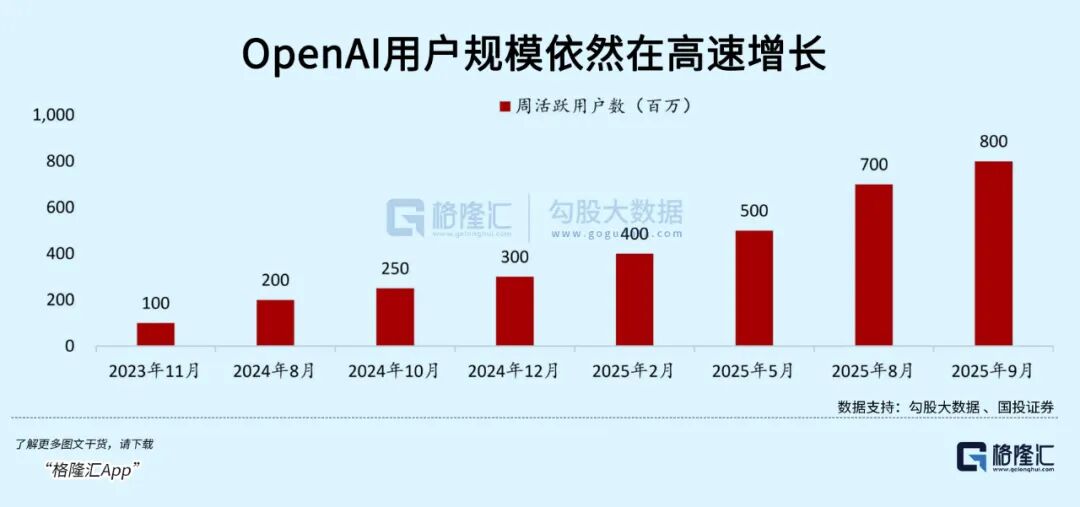
Secondly, its monetization ability has entered an explosive period.
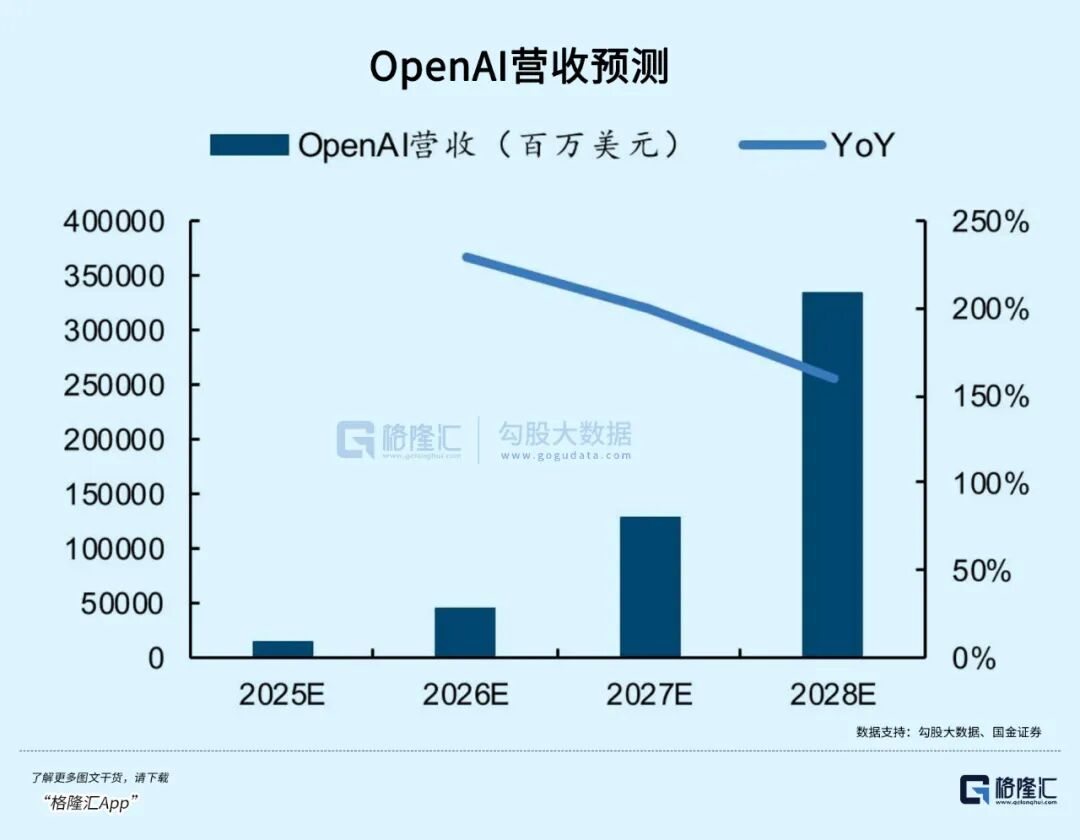
OpenAI's revenue in 2024 was $3.7 billion, and a conservative estimate for 2025 is $12.7 billion, a year-on-year increase of 243%.
Looking at the breakdown of the revenue structure, it's a comprehensive success:
C-side subscriptions: Among the 810 million monthly active users, a 5% payment rate contributes nearly $8 billion in revenue.
As long as the technology continues to be updated, the payment rate will surely increase.
Especially for the 73 million daily active free users in the Indian market we talked about yesterday, if 10% of them convert to paying users in the future, the annual revenue can increase by another $1.75 billion.
B-side services: There are one million enterprise customers and seven million business seats, a ninefold year-on-year increase.
Cisco used the Codex model to reduce code review time by 50%, and Carlyle increased due diligence efficiency by 30% through AgentKit. These cases have caused the enterprise version's pricing to soar from $20,000 per year to $200,000 per year, yet it's still in short supply.
Ecosystem commissions: The biggest highlight is ChatGPT's instant checkout function. Users can shop directly in the chat window, and OpenAI takes a 1% - 3% commission.
According to the plan, from 2026 - 2030, the business commissions from free users alone can reach $110 billion.
Optimistically, with the popularization of Agentic AI (agent intelligence), the revenue will reach $100 billion by 2029.
KGI Asia's prediction is even more exaggerated. By 2030, OpenAI's revenue will reach $200 billion.
If we go by the 2029 forecast, then the $830 billion valuation only corresponds to an 8.3 times price-to-sales ratio, which is obviously an undervaluation.
In addition, the premium of AGI must also be considered.
Although OpenAI may not be the first company to achieve AGI, it is definitely one of the most promising ones.
Once AGI truly emerges, OpenAI will no longer be just selling software but "digital labor."
At that time, the anchor for its valuation will change to the total compensation of the global labor market.
From this perspective, investors are not buying a software service company but betting on a ticket to the last industrial revolution for humanity.
This is a typical "buying the future" logic.
02
The Money Pit
Let's go back to the present.
Even if OpenAI is truly worth $830 billion in the future, does the current OpenAI really need to raise as much as $100 billion?
Not only does it need it, but it may not be enough.
Firstly, due to computing power inflation and the ineffectiveness of Moore's Law...
In 2025, the cost of training a cutting-edge model is no longer a few hundred million dollars but has soared to billions or even tens of billions of dollars.
Hardware cost: The cost of a supercomputer equipped with an NVIDIA Blackwell B200 cluster is calculated in billions of dollars.
Power cost: It requires gigawatt-level power and may even need to restart nuclear power plants (refer to the deal between Microsoft and Constellation Energy).
The goal of GPT-6 is AGI, and its computing power requirement is five times that of GPT-5, needing at least 125,000 H200 GPUs, with a hardware cost as high as $5 billion.
For the Sora 3 video model to achieve "4K 60fps real-time generation," the training data volume will increase from the current 10 million hours to 100 million hours, and the data procurement cost is at least $8 billion.
The bigger expense is the aforementioned "recursive self-improvement" technology.
Barclays predicts that after this technology is implemented from 2027 - 2028, the model iteration cycle will be shortened from 18 months to 3 months, and the R & D cost will be reduced by 60%.
For this reason, OpenAI has reserved a special fund of $43 billion, accounting for 43% of this round of financing.
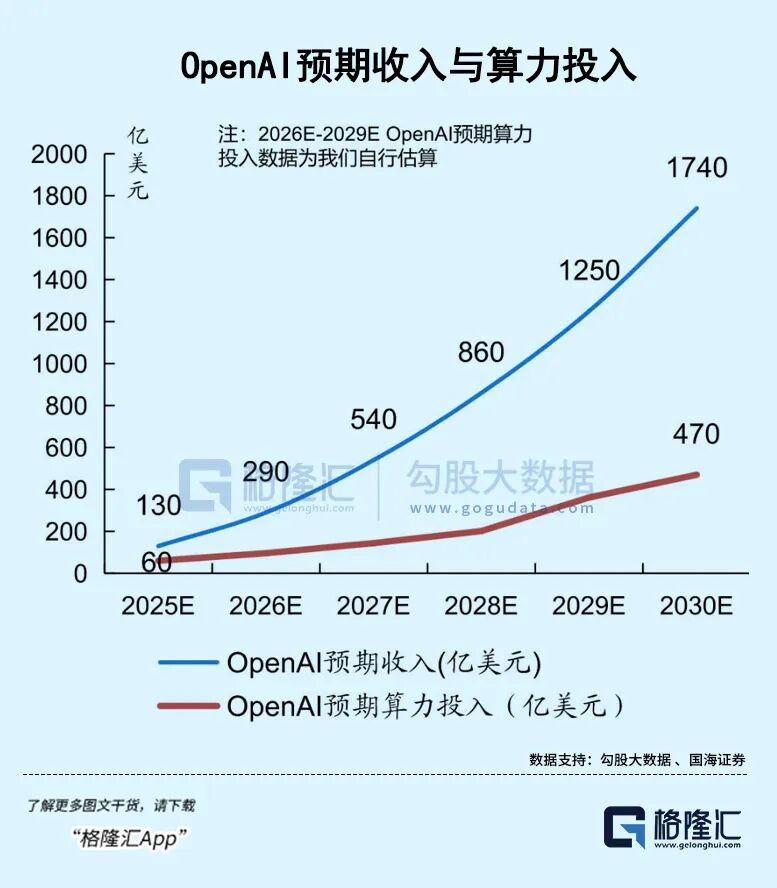
Burning money is endless.
Against this backdrop, OpenAI wants to go it alone.
In the past, 80% of OpenAI's computing power relied on Microsoft Azure, and it had to pay tens of billions of dollars in rent every year.
Now it plans to invest nearly $100 billion to build its own data centers and create "AI super factories" in Texas and Ohio, aiming to achieve self-sufficiency in computing power by 2030.
Barclays estimates that OpenAI's computing power expenditure from 2024 - 2030 will exceed $450 billion, peaking at $110 billion in 2028.
Of course, with such a big investment, the returns are also quite substantial.
Building its own data centers can reduce the PUE value to below 1.1, saving 30% in cost compared to purchasing from cloud providers.
More importantly, it can monetize computing power. In the future, OpenAI may follow AWS's example and rent out computing power. Based on the global computing power demand forecast for 2030, this business can generate an additional $50 billion in revenue.
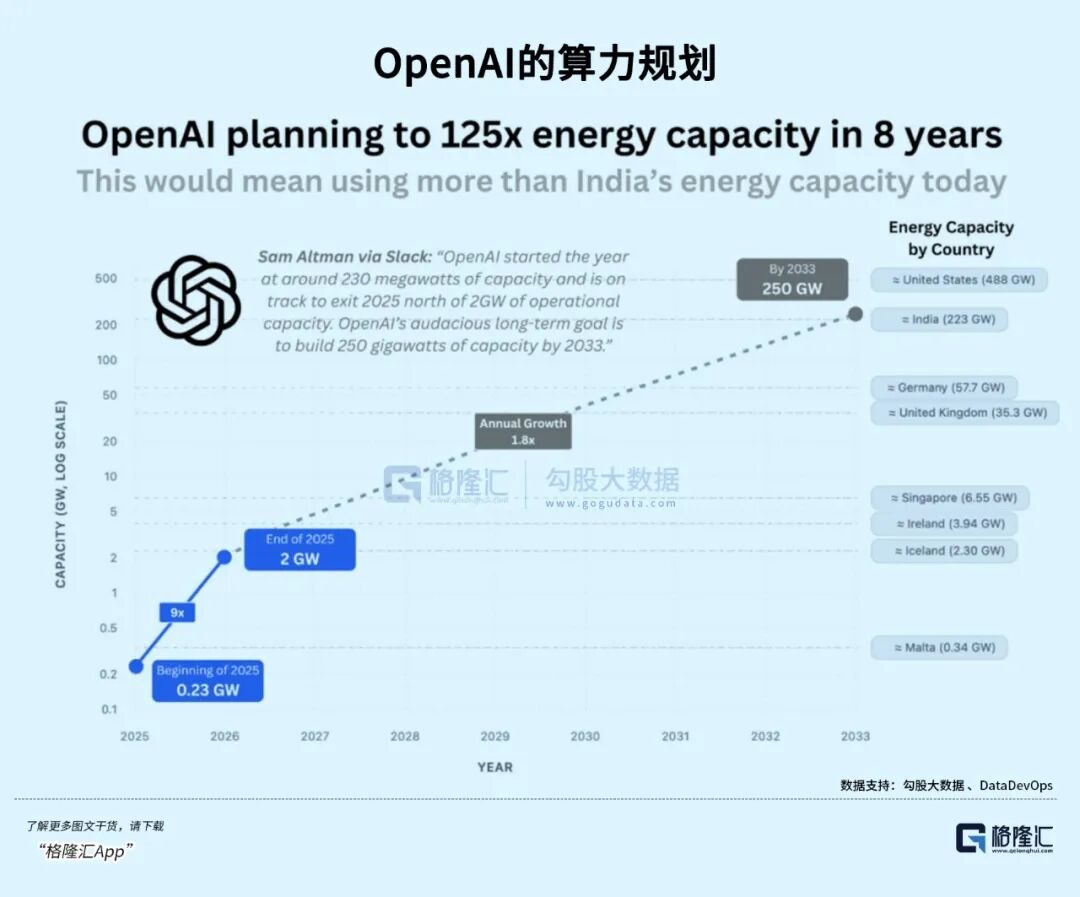
In addition, OpenAI also has to spend money to retain talent.
The competition among tech giants is essentially a competition among the most cutting-edge scientists.
Sam Altman: Retaining a top researcher is more important than building ten data centers.
After all, computing power can be bought, but creativity can't.
However, Google is poaching talent like crazy, offering AI researchers an annual salary of $1.5 million, 25% higher than OpenAI.
OpenAI has to spend $20 billion on stock compensation: The vesting price of restricted stock units for core engineers is 30% lower than the valuation, and the company directly issues additional stocks to make up the difference; for newly recruited former DeepMind researchers, the signing bonus is $10 million.
According to the plan, by 2030, the value of employee stock ownership will reach $50 billion.
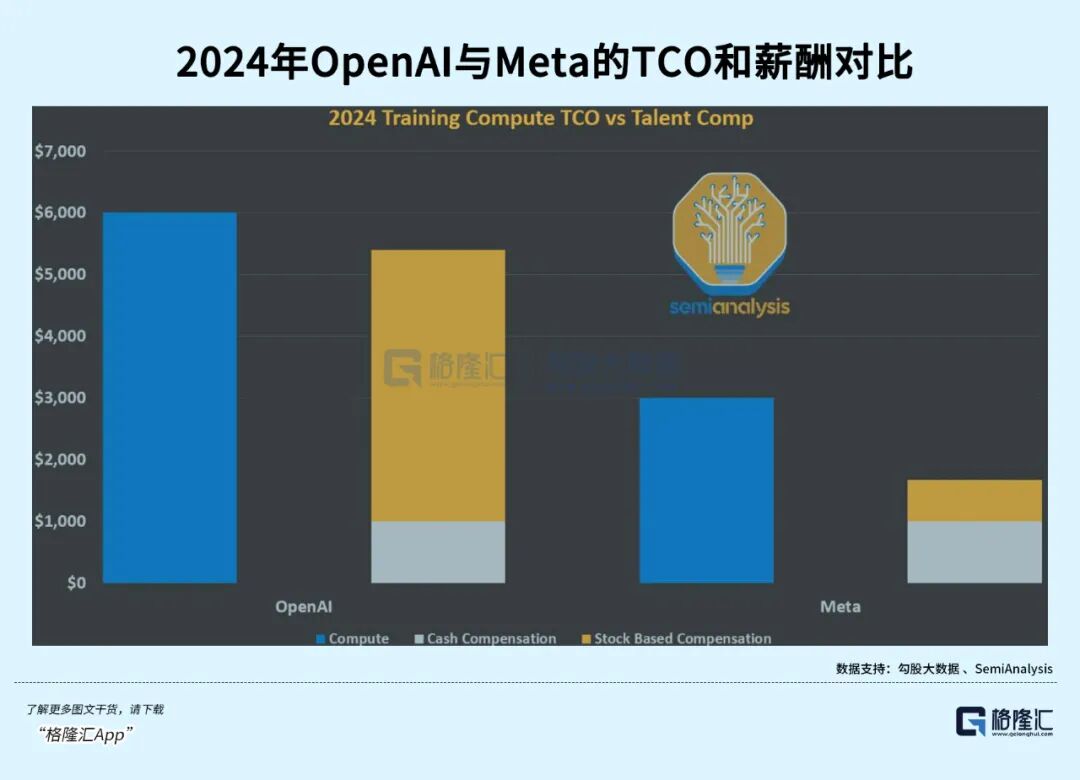
From every aspect, OpenAI's current business model is a typical case of burning money for scale.
Although the revenue side is not bad, the expenditure side is even scarier.
According to data from The Information and TapTwice Digital, OpenAI is expected to lose $14 billion in 2026.
From 2023 - 2028, the cumulative loss may be as high as $44 billion.
To a large extent, this $100 billion in financing is OpenAI's life-saving money.
If it can't achieve AGI and significantly reduce inference costs before its cash flow runs out, this bubble will burst.
But if this money is in place, it may create the thickest defensive barrier in the history of technology.
As long as there is a possibility, someone will pay the bill.
03
The Epilogue
The potential investors in this financing rumor are all heavyweights.
It is rumored that SoftBank has promised $30 billion and is even willing to sell its NVIDIA shares to raise the money.
Masayoshi Son has always dreamed of the singularity, and OpenAI is probably the closest thing to it that he can find at present.
So even if the valuation is outrageously high, he has to get on board, which is in line with SoftBank's consistent style: either go to zero or own the world.
The oil capital in the Middle East (such as MGX in the UAE) is also frantically looking for the next black gold after the depletion of oil.
Data is the new oil, and OpenAI is one of the biggest refineries in the future.
For these sovereign wealth funds, tens of billions of dollars is just a small part of their asset allocation. They are buying the future geopolitical and technological influence.
Currently, Microsoft is in an awkward position.
It already has a 49% profit-sharing right in OpenAI. As the other party's valuation continues to soar, Microsoft's ROI on paper will look very good, but it also means that OpenAI is trying to dilute Microsoft's control by bringing in more giants.
This is not only a financing but also a game by OpenAI's management to "de-Microsoftize."
Since it is a game, there are of course risks.
Firstly, OpenAI is currently sacrificing profitability for growth. If the inference cost doesn't decrease as rapidly as expected, or if B-side customers find that the AI ROI is not cost-effective and cancel their subscriptions, then this money-burning model will be unsustainable.
Secondly, with a scale of hundreds of billions of dollars, OpenAI is already a de facto monopolist. The FTC and the EU are closely watching it, and antitrust investigations may halt some exclusive partnerships at any time.
Thirdly, despite spending a lot of money to retain talent, with the departure of core figures such as Ilya Sutskever and Mira Murati, OpenAI has de facto changed from a pure "research laboratory" to a "product company."
Will the major change in corporate culture affect its ability to make breakthroughs at the level of GPT-6?
If it successfully achieves AGI and combines it with millions or even billions of embodied intelligences in the real world, this $830 billion valuation will seem like a bargain in the future.
After all, that represents infinite productivity.
But if they fail, stuck at the bottleneck of "Scaling Laws" or caught up by open-source models at extremely low cost, then this will be the biggest bubble burst in human history, even more spectacular than the dot-com bubble back then.
Whichever way it goes, the world will never be the same again.
This article is from the WeChat official account "Gelong", author: Wan Lianshan. It is published by 36Kr with permission.