Top executives at BMW and Mercedes-Benz have been reshuffled as they bet on China and go all in on electrification.
Under the heavy pressure of the under - expected results in the first round of electrification transformation, traditional luxury brands such as BMW and Mercedes - Benz are intensively launching strategic adjustments.
Externally, together with Audi, they alternately criticized the EU's 2035 combustion engine ban, strongly reversing the EU's tough attitude and directly leading to the collapse of this policy.

Internally, after facing up to the transformation mistakes and clarifying the strategic direction, BBA has chosen to briefly slow down the radical expansion pace of electrification. Instead, they are seeking a breakthrough through intensive adjustments, and personnel rotation is the core measure of this change.
The BMW Group has recently finalized a leadership change plan: Oliver Zipse, who has been at the helm for a long time, will step down at the end of his term, and Milan Nedeljković, the 54 - year - old production supervisor, will take over. Mercedes - Benz has also been very active, announcing two key personnel changes at once, involving the two core positions of the design director and the CEO of Beijing Benz.
The failure of the previous round of transformation has forced BMW and Mercedes - Benz to seek a breakthrough through systematic adjustments, and the change of "personnel" is of top priority.
Although they belong to two different companies, facing similar development dilemmas, the direction of this series of personnel adjustments is highly consistent: one is to further tilt the strategic focus towards the Chinese market, and the other is to accumulate new momentum for the next round of electrification transformation.
01
Transformation Failure: Stalled Electrification Drags Down Global Performance
The strategic adjustment paces of BMW and Mercedes - Benz are highly convergent, because they are deeply trapped in the same development dilemma - the overall failure of electrification transformation is continuously dragging down the global market performance of the brands.
In 2024, the sales of the three automakers, including Audi, all declined to varying degrees.
The BMW Group sold 2.451 million vehicles throughout the year, the Mercedes - Benz Group sold 2.389 million vehicles, and Audi sold 1.671 million vehicles. Among them, the sales of Mercedes - Benz and BMW slightly decreased by 4%, while Audi suffered a significant decline of 11.8%.
The loss of the Chinese market is the core factor pulling down their global sales.
In 2024, the BMW Group delivered a total of 714,500 BMW and MINI brand cars in the Chinese market, a year - on - year decline of 13.4%. The sales of Mercedes - Benz's passenger car segment in China decreased by 7% year - on - year, recording only 684,000 vehicles. Audi was in a more difficult situation, with its annual sales in China dropping by 10.9% year - on - year, stopping at the 650,000 - vehicle mark.
The setback in the Chinese market is directly attributed to the double stall of electrification and intelligent transformation.
Even BMW, which performed relatively well among the three, could not boast of outstanding results: In 2024, the global sales of the BMW Group's pure - electric vehicles increased by 13.5% year - on - year to 426,000 vehicles, accounting for only 17.4% of the total global sales.
The electrification performance of Mercedes - Benz and Audi was even more dismal. In 2024, the total global sales of Mercedes - Benz's new - energy vehicles were 367,600, among which only 185,100 were pure - electric vehicles, a significant year - on - year decline of 23%. Audi's annual sales of pure - electric vehicles were only 164,000, deeply trapped in the quagmire of stagnant growth.
The past path dependence and brand arrogance have laid the groundwork for today's failure.
Looking at the new - energy models on sale by BBA, there has not yet been a real blockbuster. The sales of most pure - electric models are mediocre. Even the BMW i3, which had the highest sales in China, only sold 47,000 vehicles in 2024, a huge gap compared with the monthly sales of over 10,000 of new - energy models of Chinese independent brands.
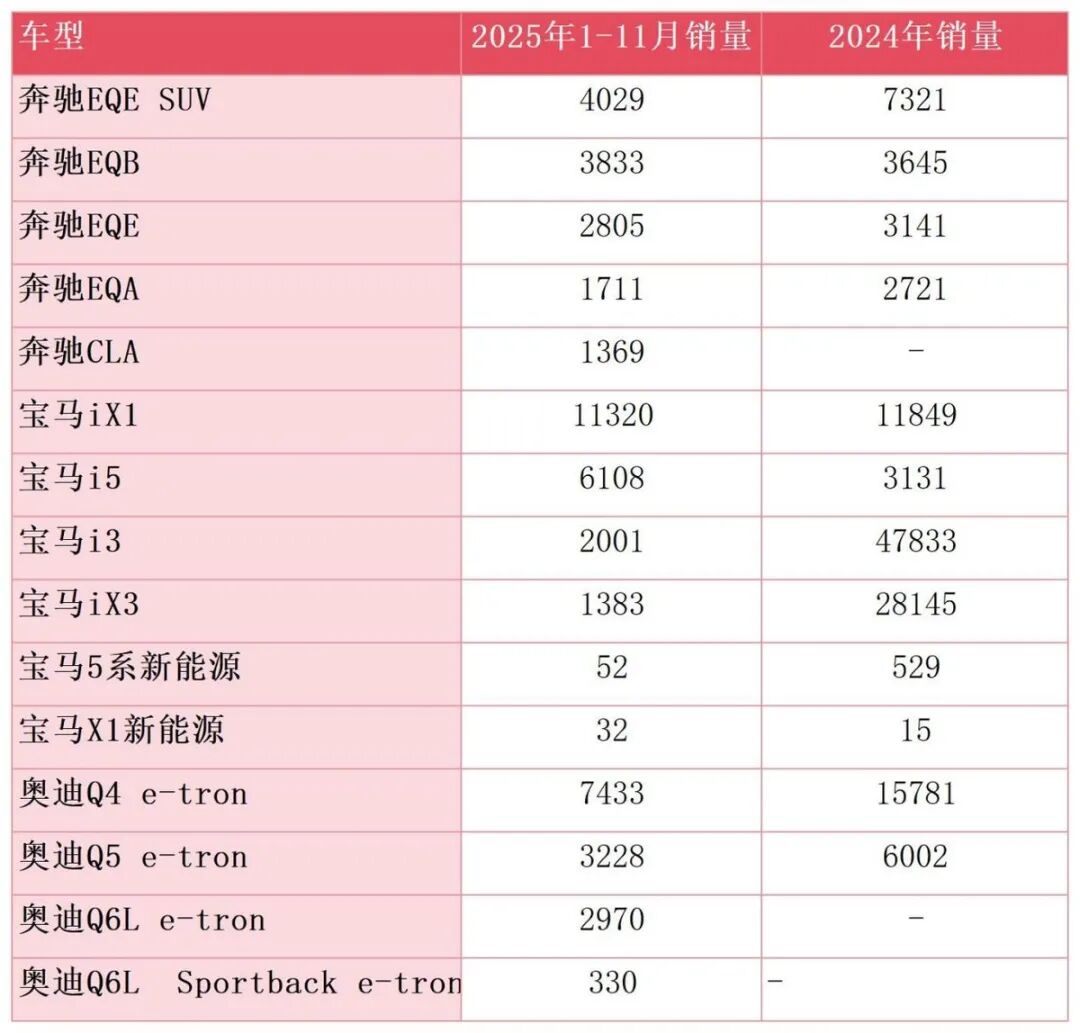
In sharp contrast, the Chinese new - energy vehicle market is advancing by leaps and bounds.
In 2024, the annual production of new - energy vehicles in China exceeded 10 million for the first time, making it the first country in the world to reach this milestone. Under the wave of electrification and intelligence, Chinese automobile brands have risen rapidly, and their market share has climbed to 65.2%, a significant year - on - year increase of 9.2 percentage points.
Although BBA has recently shown determination to break through in the fields of intelligence and electrification and has successively launched a number of important products, compared with its absolute dominance in the fuel - vehicle era, its market performance is still far from satisfactory.
Under pressure, change is imperative. Intensive strategic adjustments have become the choice for BBA to break through, and personnel adjustments are the key fulcrum to leverage this change.
A top - down personnel reshuffle is sweeping through the entire luxury car camp.
02
Personnel Changes Anchor Two Core Areas: The Chinese Market Is the Key to Breakthrough
On the evening of December 17, Mercedes - Benz officially announced two important personnel changes: Chief Design Officer Gordon Wagener will leave his position on January 31, 2026, ending his 28 - year career at Mercedes - Benz. His position will be taken over by Bastian Baudy, the current chief design officer of the AMG brand.
In addition, after completing his tenure in China, Bernd Pischetsrieder, the current president and CEO of Beijing Benz, will return to the German headquarters to be responsible for the R & D of electric drive systems, and Jens Biele, the head of the Hungarian factory, will take over his position.
This adjustment precisely covers two key areas: the design core and the Chinese market. In essence, it is to strengthen the management foundation for Mercedes - Benz's next - stage electrification transformation and achieve in - depth coordination among technology R & D, product design, and the local market.
Design is the core competitiveness of an automobile brand and the key factor determining the market adaptability of electrified models. This personnel change at the design end is an inevitable move for Mercedes - Benz to adapt to the strategic transformation.
As the first non - engineer and longest - serving design leader in the history of Mercedes - Benz, since joining the brand in 1997, Wagener has broken the conservative tradition dominated by engineers with his design philosophy of "sensual purity", creating a series of classic models such as the SLS AMG and F800, and laying the unique design gene of Mercedes - Benz, which combines fluid lines and sharp edges.

However, with the accelerated arrival of the electrification era, Wagener's design concept has gradually become out of touch with the market trend.
In 2021, against the background of the unfavorable start of the EQC, the EQS, regarded as the "declaration of Mercedes - Benz's pure - electric transformation", was officially launched. However, its avant - garde "jelly - like" shape and the 1.41 - meter giant super screen have sparked extensive market controversy, making Mercedes - Benz's situation in the pure - electric track even more difficult.
Facing the mainstream configuration trend of "refrigerators, color TVs, and big sofas" in the electric vehicle market, Wagener has always adhered to the core of the emotional value of luxury brands, emphasizing the emotional connection between people and cars. He even said bluntly, "What we manufacture is not household appliances on wheels", and has a cautious or even critical attitude towards industry trends such as large - screen interiors and AI design.
At present, Mercedes - Benz has not disclosed Wagener's specific future whereabouts.
When the Chinese automobile industry lacks original design and urgently needs to improve the design connotation, if Wagener is willing to moderately adjust his design concept to adapt to the era trend of electrification and intelligence and join a Chinese automaker to help upgrade original design, he is expected to open up new career space. This has also become an important speculation direction for his future whereabouts in the industry.
How to balance the digital trend and the continuity of Mercedes - Benz's design gene in the electrification transformation has become the core proposition for the new design leader, which also determines Mercedes - Benz's strategic consideration of internal promotion.
The successor, Bastian Baudy, has a similar design core to Wagener and also advocates a simple and sculptural design style. At the same time, he has outstanding ability to handle complex mass - production designs and can balance brand genes and market trends.
Mercedes - Benz's choice of internal promotion rather than external introduction is to achieve a smooth transition and active change at the design end through a person who is familiar with the brand core, so that design can better serve the promotion of the electrification strategy.
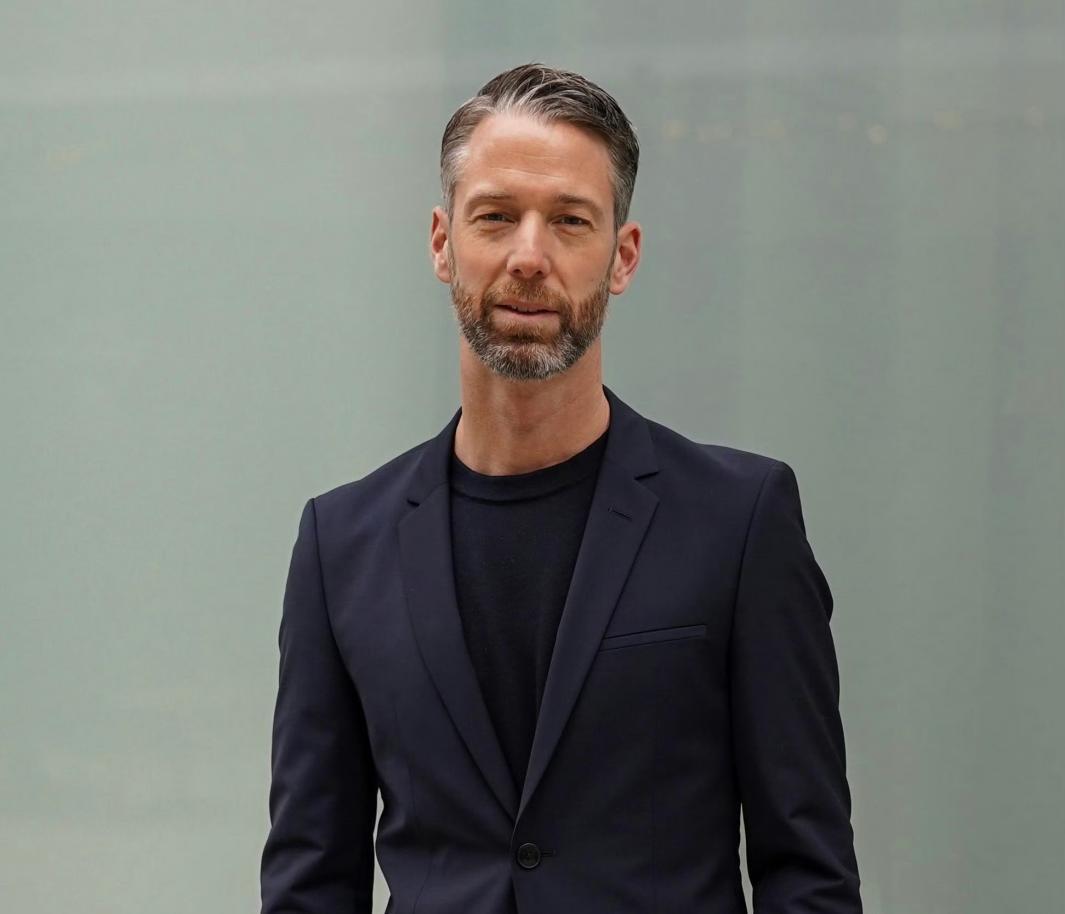
"Under the leadership of Bernd Pischetsrieder in the past three years, Beijing Benz has actively promoted the application of cutting - edge technologies such as artificial intelligence, humanoid robots, and digital twins in the production process, setting a benchmark for the digital transformation of China's high - end manufacturing industry." This is the evaluation of Bernd Pischetsrieder by Hubertus Troska, a member of the board of directors of Mercedes - Benz Group AG.
Having experienced three years of electrification transformation in China, Bernd Pischetsrieder not only has a deep understanding of the competitive landscape of the Chinese market but also has first - hand experience in local production and digital transformation.
As a senior executive who knows the Chinese market best, his return to the German headquarters to be responsible for the R & D of electric drive systems is undoubtedly a key step to feed back the cutting - edge practical experience of the Chinese market to the global core technology R & D.
The electric drive system is the core component of pure - electric vehicles. Bernd Pischetsrieder's accumulated experience in local production and supply - chain management can effectively connect the link between theoretical R & D and product implementation, providing practical support for the breakthrough of Mercedes - Benz's core electrification technologies.
The resume of his successor, Jens Biele, leaves a lot of room for imagination for Mercedes - Benz's future layout in China.
Similarly, as a senior manager with more than 20 years of experience at Mercedes - Benz, Biele was once responsible for the production planning of Beijing Benz's rear - wheel - drive vehicle factory and has an in - depth understanding of the production system of the Chinese market. In addition, he has also led the strategic planning of the production operation business unit and been fully responsible for the global factory planning work.
After he took charge of the Kecskemét factory in early 2024, he successfully promoted the factory to complete the production preparation for MMA and MB.EA pure - electric models.
His resume as the person in charge of global factory planning means that Biele has a comprehensive understanding and decision - making power over the global supply - chain layout and the development of regional markets. His rich factory management experience enables him to coordinate production and manufacturing and optimize costs.
With these multiple capabilities combined, a speculation emerges: After taking office, Biele may increase Mercedes - Benz's efforts to build factories in China, deepen cooperation with local Chinese supply chains, and further improve the scale and efficiency of local production.
Mercedes - Benz's adjustment is not an isolated case but a concentrated manifestation of the strategic anxiety and direction calibration of the entire traditional luxury car camp.
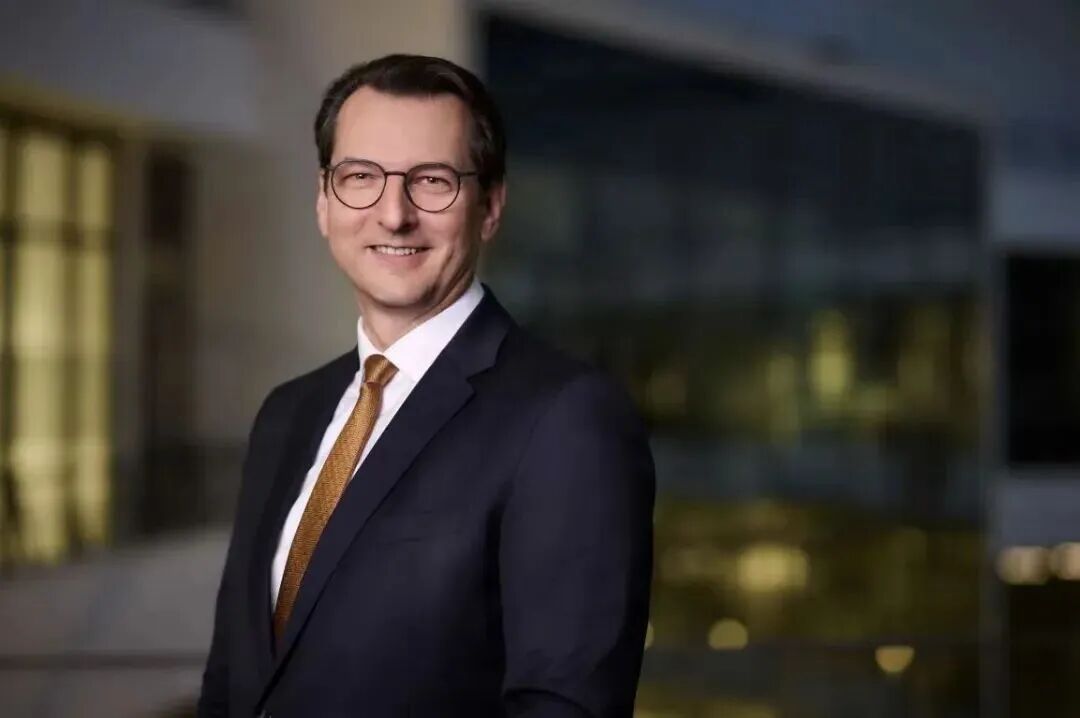
The BMW Group previously announced that Milan Nedeljković, the production director and the core promoter of the new - generation pure - electric platform, will be appointed as the new CEO.
His background of growing up from the production front - line and his in - depth involvement in intelligent manufacturing and digital twin technology indicate that BMW is shifting its strategic focus from electrification declarations to solid industrial implementation and cost control.
As a BMW shareholder said, "The success or failure of the Nedeljković era will be determined by the Chinese market."
The recent hint from Porsche's CEO that production in China is possible also confirms this trend. Traditional luxury brands have deeply realized that it is no longer "the Chinese market needs them", but "they need China more than ever."
The major personnel reshuffle at BMW and Mercedes - Benz, including the CEO changes at brands such as Stellantis, Renault, Volvo Cars, and Porsche, is undoubtedly a microcosm of the transformation pain of global traditional luxury automakers.
Many automakers have launched management reshuffles because their previous aggressive electrification investment strategies and the unmet transformation results did not meet expectations.
Behind a series of personnel changes, it is confirmed that the status of the Chinese market has been unprecedentedly improved - today's Chinese market has long become the key variable determining the success or failure of the electrification transformation of global luxury automakers.
From the handover of the design soul, the return of Chinese experience, to the rise of production experts, the personnel changes at BMW and Mercedes - Benz have been fully carried out.
However, the window period is narrowing. What they need to win back is not only their share in China but also the qualification to redefine luxury in the era of intelligent electrification.
This article is from the WeChat public account "Automobile Commune" (ID: iAUTO2010), author: Sai Jiatong, published by 36Kr with authorization.