A Tsinghua-affiliated embodied brain company secures nearly 100 million yuan in financing, aiming for over 100,000 connected devices in 2026 | Exclusive from Yingke
Author | Huang Nan
Editor | Yuan Silai
Yingke has learned that Beijing Qianjue Technology Co., Ltd. (hereinafter referred to as "Qianjue Technology") recently completed a nearly 100 million yuan Pre-A++ round of financing. We have summarized the information of this round of financing and several highlights of the company:
Financing Amount and Investment Institutions
Financing Round: Pre-A++ Round
Financing Scale: Nearly 100 million yuan
Investors: Six well-known investment institutions and old shareholders participated jointly; Maple Pledge has long served as a private equity financing advisor.
Use of Funds: The funds will be mainly used for technology R & D investment, expansion of the core team, and global commercialization expansion.
Basic Company Information
Establishment Time: June 2023
Registered Address: Beijing, incubated from the Brain-inspired Computing Research Center of Tsinghua University
Enterprise Positioning: Qianjue Technology focuses on the R & D and application of large decision - making and planning models in the field of embodied intelligence. Its ecological niche is comparable to that of the leading US enterprise Physical Intelligence. Its self - developed embodied brain can be adapted to various robot hardware. The goal is to break through the limitations of traditional robot tasks and achieve fully autonomous work and dynamic environment response.
Technical Route: Different from the mainstream "hierarchical" or "end - to - end" approaches in the industry, Qianjue Technology adopts a brain - inspired partition architecture. By simulating the functional areas of the human brain, it deconstructs complex intelligent tasks into large regional differentiation models that work collaboratively, such as vision, hearing, decision - making, interaction, and memory, rather than relying on a single large model. It can achieve full - stack autonomy and control from the underlying chips to the upper - layer algorithms.
Yingke has learned that Qianjue Technology has completed the pre - training of three generations of "embodied brains". During operation, the brain can independently achieve the full - closed - loop work of "perception - decision - action" without human prompts, remote control, pre - programming, or language instructions, and dynamically respond to complex environmental changes. For example, after a home service robot receives the abstract instruction of "tidy up the room", the embodied brain can independently plan and complete dozens to hundreds of subtask sequences such as tidying, organizing, and garbage cleaning. Even if the task is interrupted, it can independently reconstruct the plan and continue execution.
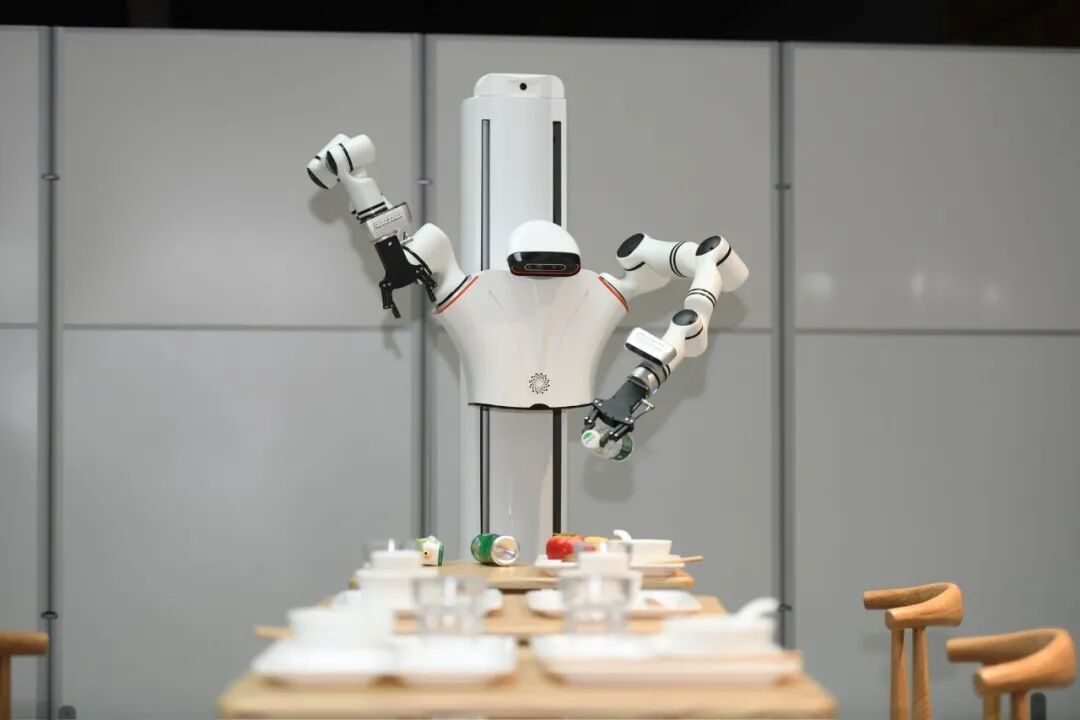
Qianjue Brain provides robots for catering cleaning (Source/Enterprise)
In terms of data, the enterprise has built the largest - scale pure real - collected home - scene dataset within the known global scope, accumulating hundreds of millions of levels of pre - trained data on embodied perception and decision - making, covering multiple scenarios such as home services, logistics, and industrial operation and maintenance. At the same time, based on its self - developed data annotation process, it can obtain customized data such as task decomposition sequences and robot grasping trajectories, and can independently achieve integration from data collection, cleaning, annotation to model training.
In response to the pain points of high technical thresholds and high costs in large - scale implementation, Qianjue Technology has also built an automated training data pipeline to lower the threshold for robot applications. Customers only need to clarify functional requirements such as model fine - tuning and new function development in the data pipeline, and the system can complete the implementation of the requirements through an automated process without manual intervention in complex operations.
Market Size
According to a research report by QYResearch in November 2025, from 2025 to 2031, the compound annual growth rate of the global market size of general brains for embodied intelligent robots will reach 52.0%. Goldman Sachs research shows that the market for humanoid robots will grow year by year, and its valuation may reach up to $38 billion by 2035. Among them, as the core terminal for the embodied brain, the growth of the market size of humanoid robots will directly drive the expansion of the demand for embodied brains.
Business Progress
Qianjue Technology's embodied solution has been fully adapted to multiple mainstream forms of robots, such as bipedal humanoids, wheeled robots, drones, quadrupedal dogs, and floor cleaners, and has reached cooperation with leading customers in various fields. Some projects have entered the stage of large - scale application.
Specifically in terms of implementation, the solution has been deployed in multiple scenarios such as hotel cleaning, restaurant services, humanoid robot reception, and indoor precision operations, and has achieved batch delivery in collaboration with partners. It is expected that by the end of 2026, the number of robot devices equipped with Qianjue Technology's "embodied brain" will reach over 100,000.

Qianjue Brain helps humanoid robots unscrew bottle caps (Source/Enterprise)
In addition, the company is promoting its self - developed robot brain system, Polibrain OS, into the external verification stage. Based on a unified brain - inspired architecture, this system conducts system - level collaboration and engineering integration for robot perception, decision - making, and control capabilities, aiming to provide a reusable and scalable general intelligent base for multi - form robots. At present, the unified perception layer of Polibrain OS has completed engineering polishing first, and it is planned to start external verification within a controllable scope to explore the technical path of "one set of perception covering multi - form robots" for the industry and promote the evolution of robot intelligence from single - point model capabilities to system - level brain capabilities.
Founder's Thoughts
Yingke: What issues do current customers usually focus on during the implementation stage of embodied intelligence solutions? What are the core advantages of Qianjue's solution in terms of market penetration and response to unexpected situations compared with traditional approaches?
Gao Haichuan: For manufacturers, the deployment cycle and cost are the core considerations. Compared with traditional solutions, Qianjue's embodied brain solution has two significant advantages.
First, our solution does not require manufacturers to make any physical modifications to the actual usage environment of their downstream customers. For a long time, environmental modification restrictions have been the key bottleneck restricting the improvement of the robot market penetration rate. Many application scenarios clearly prohibit such modifications, making it difficult for traditional solutions to penetrate effectively.
Second, the core ability of Qianjue's brain is built on an autonomous decision - making model, which is different from the traditional rule - based driving mode. Therefore, it can also respond to various on - site emergencies more efficiently. Its technical characteristics are directly related to the advantage of "no need for environmental modification", enabling it to actively adapt to complex and dynamic real - world environments and fundamentally avoid the rigid demand for environmental modification.
Qianjue Technology is not a traditional "intelligent brain" but a "brain in a vat". By separating the "brain" from the specific robot body, it enables the brain to have the ability of continuous learning, self - evolution, and partition decoupling. Then, it can be attached to various robots across different forms and scenarios and quickly adapt to different forms and environments.
It can be said that Qianjue Technology's "embodied brain" is not just a superposition and optimization of models, but a dynamically evolving system with autonomous learning ability that can continuously adapt to the needs of different robots and environments.
Yingke: In which scenario has Qianjue's embodied brain achieved the largest implementation scale? Can you talk about the core demand characteristics of users in this scenario?
Gao Haichuan: The scenario with the largest implementation scale is the semi - service and semi - home cleaning scenario.
In this type of scenario, the operation requirements for robots are relatively low. Limited by the hardware technology level, the actions that can be completed by arm structures such as dexterous hands and grippers are limited, and the tactile sensor technology is not yet mature. This makes it difficult for the VLA model and planning algorithm to support complex operations. Therefore, in the scenarios served by Qianjue Brain, its core value is not reflected in the complexity of the operation level, but in the spatial understanding and task decision - making ability based on the world model.
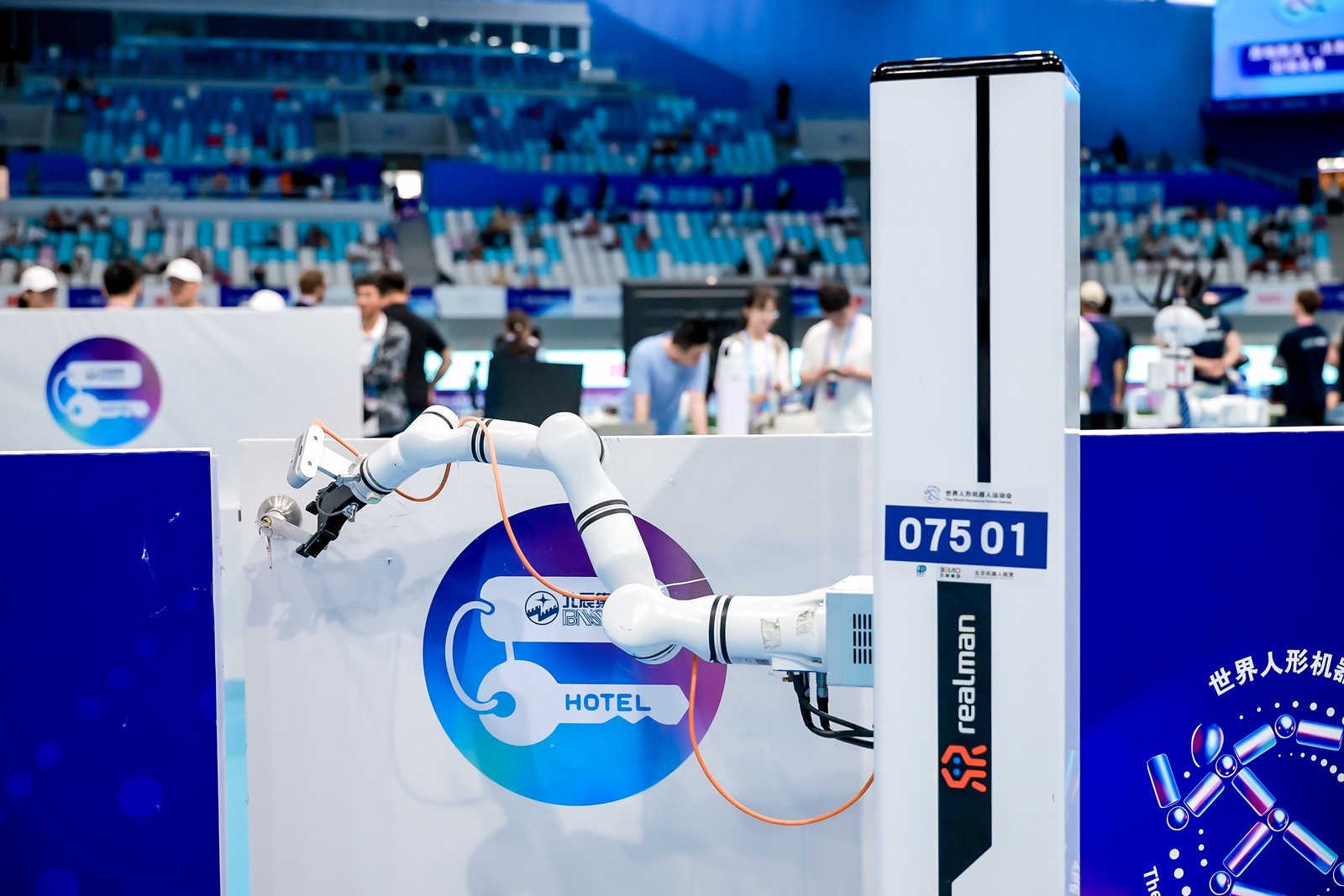
Robots equipped with Qianjue Brain achieve autonomous decision - making for opening doors and cleaning (Source/Enterprise)
Qianjue's embodied brain provides robots with the ability to understand autonomous task goals and plan execution logic, rather than completing highly difficult dexterous operations. This makes our solution particularly suitable for scenarios with high requirements for universality and autonomy but relatively low requirements for operation dexterity and efficiency, that is, robot types that conform to the principle of "task decision - making as the main and basic operations as the auxiliary". Typical representatives include floor - cleaning robots that focus on movement and task response, and humanoid robots engaged in basic services such as cleaning, reception, serving dishes, and wiping tables.
The fundamental difference between this type of robot and fixed - function devices lies in the autonomous decision - making ability. It is not limited to performing a single preset task but can independently judge and perform reasonable subsequent actions after completing the core instructions. For example, after completing the task of wiping the table, it can actively identify and clean the garbage on the ground. At present, Qianjue has several mature implementation cases in this type of scenario.
Yingke: How to adjust and adapt the model capabilities during the collaborative R & D or delivery stage according to the different needs of different scenarios?
Gao Haichuan: Qianjue's embodied brain is a standardized core product that has achieved pre - training of the world model for three consecutive generations, which is rare in the industry. It has fully integrated the dual abilities of spatial understanding and spatial operation. When delivering to different scenarios, we will not reconstruct the model for the scenario but will directionally strengthen specific abilities according to the specific needs of customers.
This strengthening demand usually focuses on the perception level in practice, mainly to solve the corner cases that robots encounter in an open and complex environment. For example, when a robot grabs a paper ball and suddenly encounters a mirror reflection, resulting in identification confusion, or needs to operate a brand - new material, a rag or tool that has never appeared in historical data.
In response to these long - tail problems, we have established an automated training data pipeline. Once the system monitors fluctuations in the average accuracy in a specific scenario, it can automatically collect data and quickly fine - tune and strengthen the corresponding perception module of the model, thus ensuring the performance robustness of the brain in diverse real - world environments.