The crucial leap from "assisted" to "autonomous": the first batch of Level 3 autonomous driving vehicles has been approved. Automobile manufacturers have made it clear that Level 2 vehicles cannot be directly upgraded for now.
During the morning rush hour on Tuesday on the Beijing-Taiwan Expressway in Beijing, the sun had just pierced through the thin mist. Liu Lei (a pseudonym) had kept his fingers on the steering wheel for 23 minutes. He commutes 50 kilometers every day in his 2023 sedan equipped with L2-level driver assistance system. This system, which can automatically follow the vehicle in front and keep the lane, once made him think that "easy driving" was within reach. But at this moment, the warning light on the dashboard that reads "Please stay alert" lit up for the third time, and he had to straighten up and keep a close eye on the slowly moving traffic ahead.
Last week during the evening rush hour, when he was stuck on the Airport North Line, the L2-level driver assistance system helped him follow the vehicle in front, but he had to keep his eyes on the road all the time, and his arms were stiff throughout the journey. Liu Lei remembered the news he saw on his phone about the Ministry of Industry and Information Technology granting permission for two L3-level autonomous driving vehicle models. The description on the screen that said "Free your hands in specific scenarios" made him take a second look. "If I could really take my hands off the steering wheel on a congested highway, even just to stretch my arms, it would be a dream come true," he thought to himself.
Liu Lei's expectation is the common aspiration of tens of millions of L2-level driver assistance system owners in China. Based on the passenger car sales data of the China Passenger Car Association in recent years and considering China's world-leading L2-level driver assistance system penetration rate of over 50%, among the more than 70 million passenger cars sold in the past three years alone, over 35 million are equipped with this function. This means that one out of every two new cars on the road can provide basic driver assistance services. However, as Liu Lei experienced, the L2 level always remains in the category of "assistance," and the driver is still fully responsible. The so-called "liberation" always comes with restrictions.
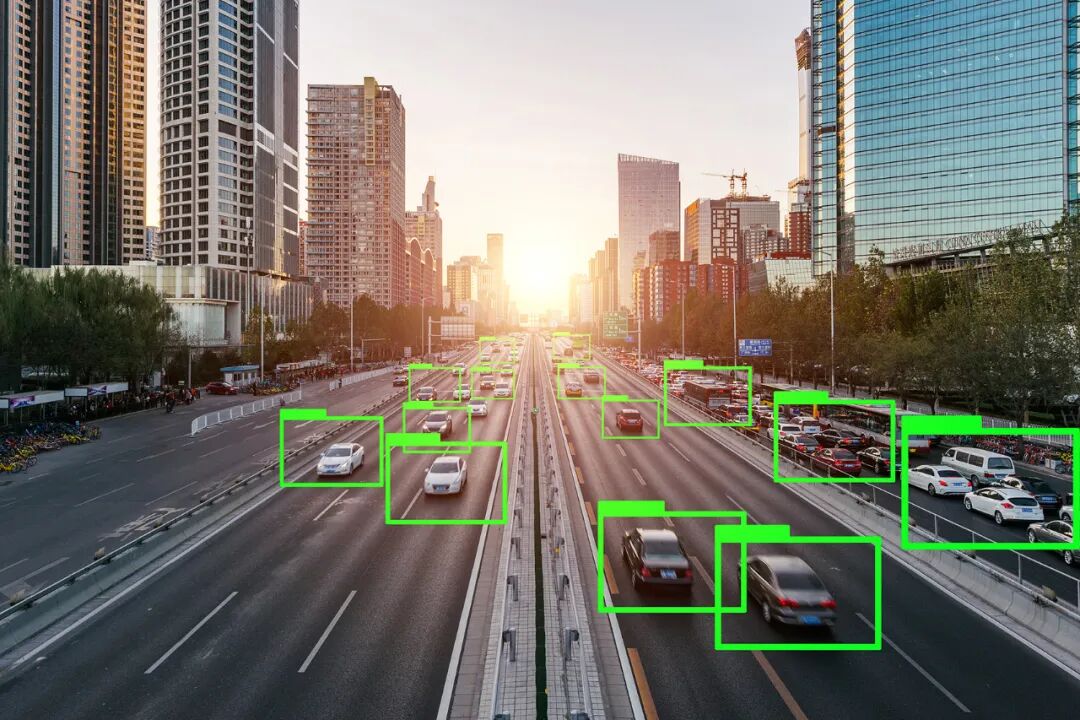
Image source: Visual China
On December 15th, a crucial moment arrived to break this restriction. The Ministry of Industry and Information Technology officially announced the first batch of L3-level conditional autonomous driving vehicle models in China to obtain access permits. One pure electric sedan each from Changan Shenlan and BAIC Jihu were selected and will start on-road pilot tests in designated areas in Chongqing and Beijing respectively.
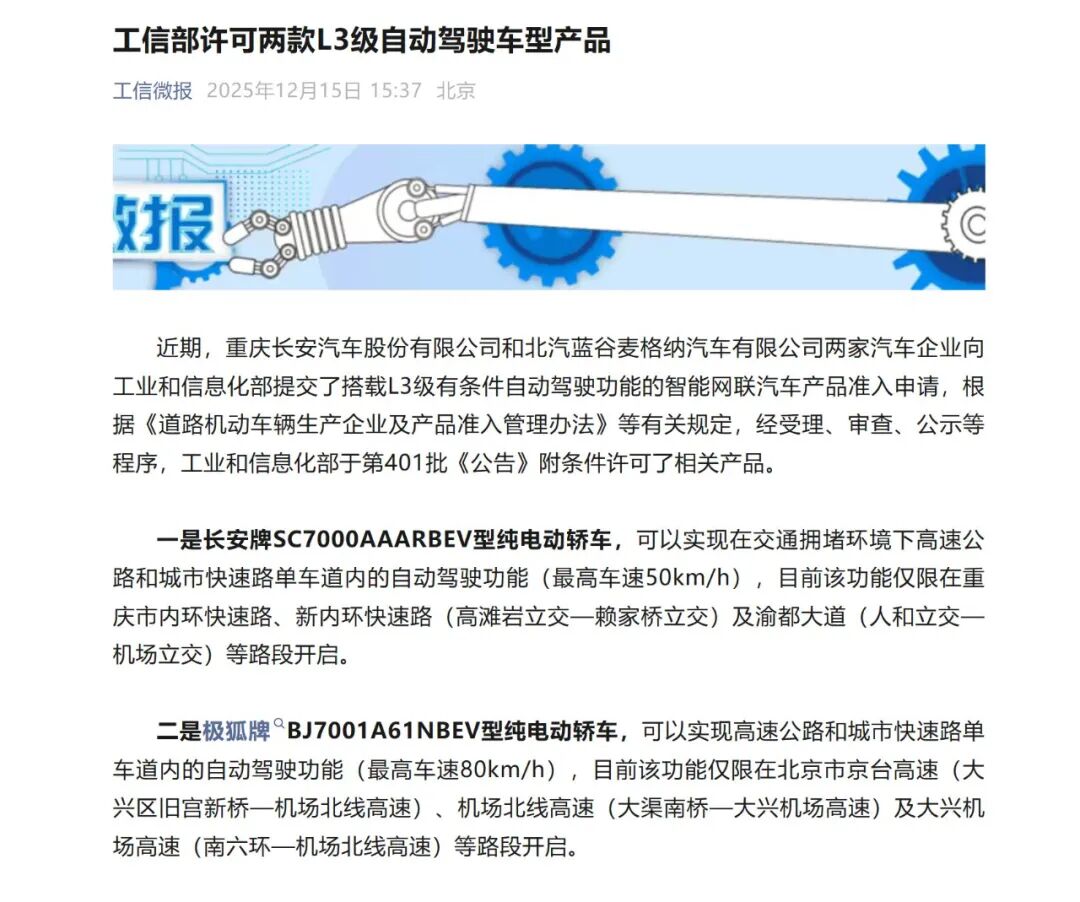
Image source: Official WeChat account of the Ministry of Industry and Information Technology
As soon as the news came out, the capital market responded quickly. On December 16th, the A-share intelligent driving concept sector showed strong performance, with many stocks hitting the daily limit. BAIC BluePark (600733.SH) and Wanjie Technology (300552.SZ) led the gains, and stocks in the industrial chain such as Desay SV (002920.SZ) also followed suit. The enthusiasm was also transmitted to the Hong Kong stock market. As of the close on December 17th, stocks such as Youjia Innovation (02431.HK) and Hesai Technology (02525.HK) soared, forming a cross-market resonance pattern.
"This marks that intelligent connected vehicles have entered a new stage of mass production and application. It is not only a milestone in technological development but also a vivid practice of the country coordinating high-quality development and high-level safety through inclusive and prudent supervision, escorting the implementation of cutting-edge technologies and stimulating the innovation vitality of the industry," said Fu Bingfeng, the executive vice president and secretary-general of the China Association of Automobile Manufacturers, expressing the industry's consensus.
As a crucial watershed in the transition from "driver assistance" to "autonomous driving," the implementation of L3-level not only represents a technological milestone but also reconstructs the driving responsibility chain. According to the national standard "Automobile Driving Automation Classification," under specific conditions, for the first time, the driving control right and the subject of accident liability shift from the driver to the system itself at the L3 level, which is fundamentally different from the L2-level driver assistance system that Liu Lei is currently using.
And the two approved vehicle models outline the initial picture of the implementation of L3. For consumers like Liu Lei, they are more concerned about "when they can use it." A reporter from NBD Auto confirmed with Changan Automobile that currently, all L2-level models that have been registered do not support OTA upgrades to the L3 level. After the policy is improved, an evaluation will be conducted to apply for registration. At present, the approved L3 function will be prioritized for specific scenarios such as airport shuttles and park commutes to accumulate experience for large-scale commercialization.
However, Zhang Yongwei, the chairman of the China Automobile Innovation Conference, made a prediction that has raised high expectations in the market: "In 2026, the penetration rate of new L3 and above autonomous driving passenger cars will achieve a breakthrough, and it is expected to reach 10% by 2030." This means that in a few years, ordinary consumers may be able to achieve real "semi-liberation" during their commutes.
1
Key Watershed:
L3 Reconstructs the Responsibility Chain
Two Technical Paths for Parallel Implementation
According to the information released by the Ministry of Industry and Information Technology, one vehicle model each from Changan Automobile and BAIC Jihu has obtained the conditional autonomous driving permit. Among them, the approved Changan model can achieve single-lane autonomous driving on expressways and urban expressways in specific express sections within Chongqing at a maximum speed of 50 km/h in congested environments. The approved BAIC Jihu model can achieve the same function on multiple designated sections in Beijing at a maximum speed of 80 km/h. The reporter learned from the two automakers that the specific approved models are the "Shenlan SL03" and the "Jihu Alpha S6 (L3) Edition."
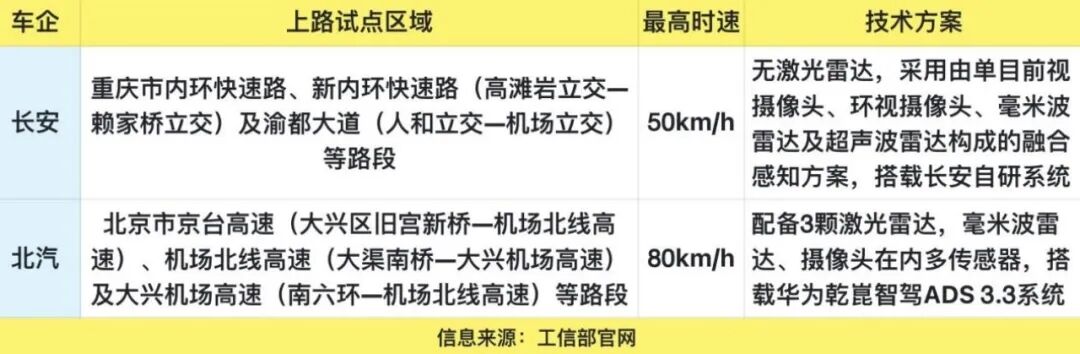
Image source: Produced by reporter Liu Xi of NBD Auto
It is worth noting that the two approved vehicle models adopt different technical paths. The Shenlan SL03 is not equipped with a lidar but uses a fusion perception solution composed of a single front-view camera, surround-view cameras, millimeter-wave radars, and ultrasonic radars. Its intelligent driving system is self-developed by Changan. The Jihu Alpha S6 (L3) Edition is equipped with multiple types of sensors including three lidars and is equipped with Huawei's Qiankun Intelligent Driving ADS 3.3 system.
This difference has drawn the market's attention to technical standards. In September this year, the Ministry of Industry and Information Technology released the "Safety Requirements for Combined Driving Assistance Systems of Intelligent Connected Vehicles" (draft for comments), which for the first time included lidar in the national recommended standard system and emphasized its technical importance. Why aren't the approved L3-level vehicles equipped with lidar?
The reporter learned that, on the one hand, this standard is still in the public comment stage and has not officially come into effect. On the other hand, the application access channel for the L3-level autonomous driving pilot remains open, and it is being promoted in an orderly manner following the principle of "approving one when it is mature." That is to say, the core of regulatory approval is the comprehensive verification result of the safety of the entire vehicle system, rather than specifying a particular sensor.
The industry believes that the far-reaching significance of this approval goes far beyond the approval of the two vehicle models. Before this, autonomous driving companies mainly held road test permits. The action of the Ministry of Industry and Information Technology this time essentially provides a complete legal and management basis for the transition of L3-level from testing to application in specific scenarios. More importantly, as a crucial watershed in the transition from "driver assistance" to "autonomous driving," the actual implementation of L3-level will fundamentally reconstruct the responsibility chain and business model.
"The real competition in the industry begins at the L3 stage," Zhang Yongwei, the chairman of the China Automobile Innovation Conference, emphasized to the reporter. The rapid popularization of the current L2-level driver assistance system has laid the foundation, and the industry is clearly moving towards L3 and L4-level autonomous driving. Among them, L3 allows the driver to be "conditionally liberated" under specific conditions, while L4 achieves "complete liberation of the person." Whoever can gain an advantage in L3-level intelligence will be able to seize the initiative in the future competition in the automotive industry.
2
FSD ≠ L3
L2 Vehicles Cannot Be OTA Upgraded to L3 for Now
According to the national recommended standard "Automobile Driving Automation Classification" issued by the State Administration for Market Regulation, there is a fundamental difference between L2 and L3-level autonomous driving. Systems at the L2 level and below are only auxiliary functions, and the driver bears full responsibility. Starting from the L3 level, under specific conditions, the driving control right and the subject of accident liability shift from the driver to the system itself for the first time.
From the perspective of the pilot requirements, the application scope of the currently approved vehicles is still limited: the maximum speed does not exceed 80 km/h, it is only applicable to specific sections such as expressways, and it only supports single-lane autonomous driving, not allowing automatic lane changes. Liu Fawang, the deputy director of the Equipment Industry Development Center of the Ministry of Industry and Information Technology, clearly stated that currently, the pilot subjects can only be used on limited sections and vehicle models. The vehicles are not available to ordinary consumers and can only be operated by pilot use units.
For ordinary consumers, when will L3-level autonomous driving vehicles on the market be truly available? Can vehicles equipped with L2-level driver assistance systems be upgraded to L3-level autonomous driving through OTA (Over-The-Air) software updates?
In response, Changan Automobile clearly told the reporter: "Currently, all L2-level driver assistance system models that have completed registration do not support software upgrades to L3-level autonomous driving. After the policy is improved, an evaluation will be conducted on existing models and an application will be made for registration according to the requirements." The core value of the currently approved L3-level function is to provide high-quality travel services for specific scenarios such as airport shuttles and park commutes, aiming to accumulate operational experience and data for the future large-scale commercialization of autonomous driving.
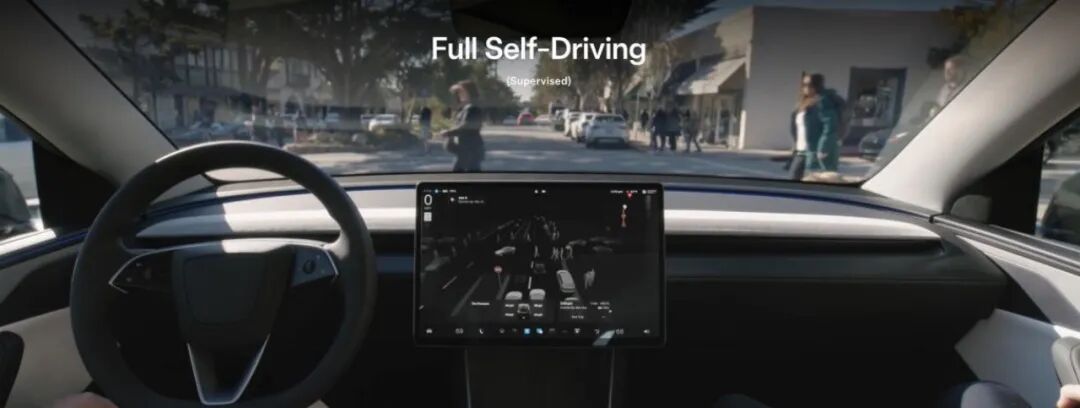
Image source: Tesla's official website
This forms a sharp contrast with the technological evolution of Tesla's FSD in the United States. Although the latest version of FSD V14.2.1 technically allows the driver to briefly send text messages under specific road conditions, attempting to transition the driver's role to that of a "supervisor," it is still legally defined as an L2-level driver assistance system in the global market. This means that no matter how powerful the system is, the accident liability when FSD is activated still lies with the driver. Although Tesla CEO Elon Musk said that FSD has received "partial approval" in China and hopes to obtain full approval next year, this still refers to the implementation and promotion of L2-level functions, rather than the switch to the L3-level liability system.
It is worth noting that although it will take some time for L3 vehicles to directly enter the personal consumer market, L4-level Robotaxis represented by Luobo Kuaipao and Pony.ai have already achieved commercial operation on core sections in many cities such as Beijing, Shanghai, Guangzhou, and Shenzhen. According to the prediction of Pacific Securities, in 2026, the cost of Robotaxis is expected to drop to 2.1 yuan per kilometer, and further drop to 1 yuan per kilometer in 2030. By 2030, the market scale of China's Robotaxis is expected to exceed 2.93 trillion yuan, becoming one of the autonomous driving scenarios with the largest market space.
3
Gradual Opening of Policies
Seven Other Automakers Are in the "Approval" Pipeline
The approval of L3-level autonomous driving vehicles to be on the road is not an overnight success but a standardized process that has taken nearly three years and been advanced step by step. In November 2022, the Ministry of Industry and Information Technology released the "Notice on Carrying out Pilot Work on the Access and Road Traffic of Intelligent Connected Vehicles (Draft for Comments)," for the first time clearly proposing to conduct access management and pilot projects for L3 and L4-level autonomous driving vehicles.
In November 2023, the Ministry of Industry and Information Technology and three other ministries jointly issued the "Notice on Carrying out Pilot Work on the Access and Road Traffic of Intelligent Connected Vehicles." For L3 and L4-level autonomous driving vehicles with mass production conditions, after being selected jointly by the four ministries and undergoing strict safety evaluations and access approvals, they are allowed to conduct road traffic pilot projects in limited areas by designated users.
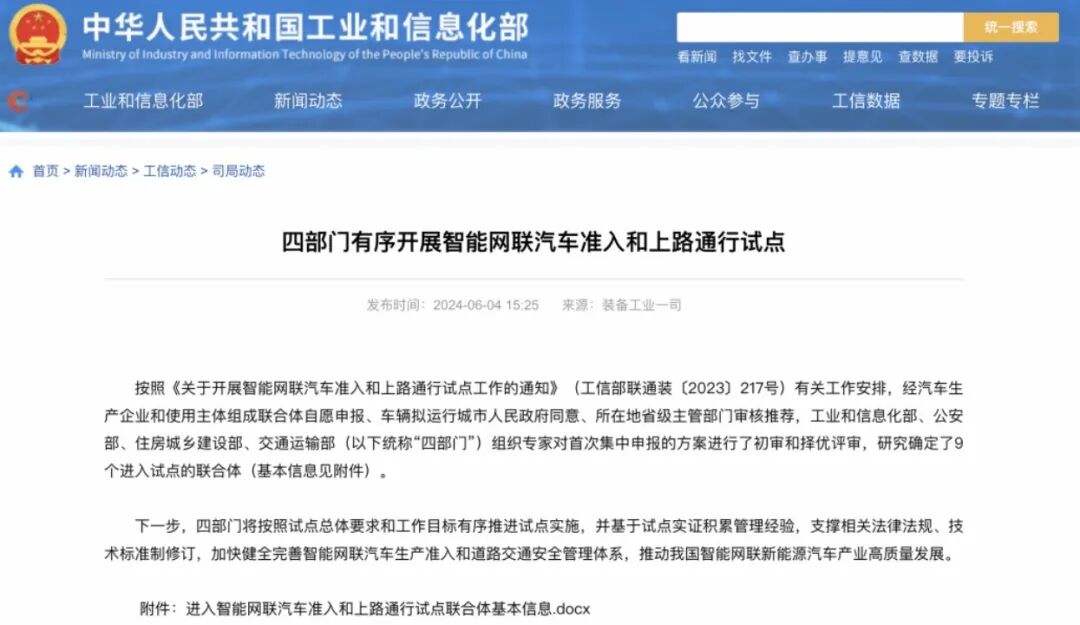
Image source: The official website of the Ministry of Industry and Information Technology
In June 2024, the Ministry of Industry and Information Technology issued the "Notice on the Four Departments' Orderly Implementation of Pilot Work on the Access and Road Traffic of Intelligent Connected Vehicles," announcing the list of the first batch of automakers for the L3-level autonomous driving access and road traffic pilot projects, including BYD, NIO, Changan, GAC, SAIC, BAIC BluePark, FAW, SAIC Hongyan, and Yutong Bus.
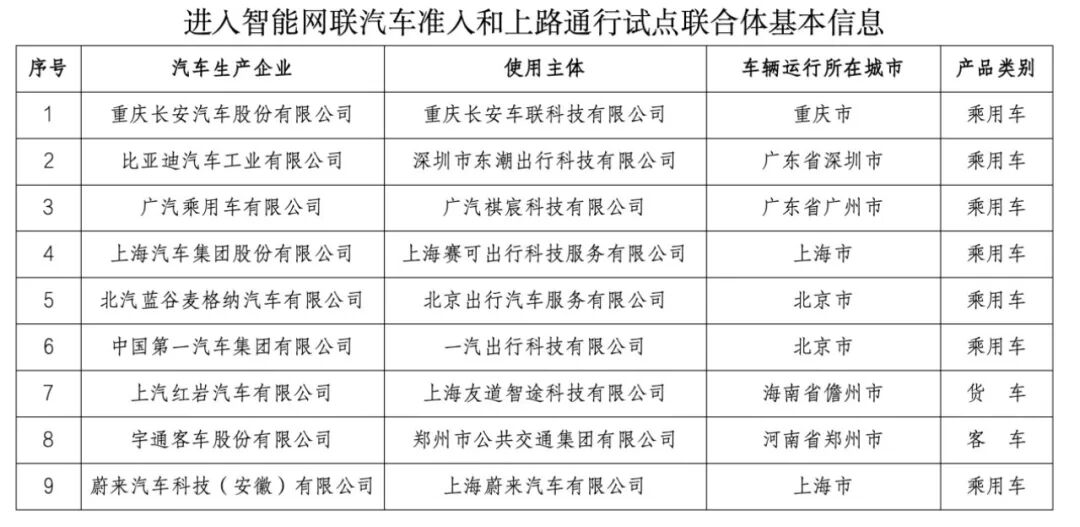
Image source: The official website of the Ministry of Industry and Information Technology
In December 2024, the "Regulations on Autonomous Driving Vehicles in Beijing" and the "Regulations on Promoting the Development of Intelligent Connected Vehicles in Wuhan" were successively introduced, providing pioneering local institutional regulations for L3-level and above autonomous driving, especially for the commercial application of personal passenger cars.
In July 2025, the testing was further implemented, and the list of the first batch of specific vehicle models and test licenses was exposed, involving more than 20 vehicle models from more than 10 manufacturers, including brands such as BMW and Mercedes-Benz. In September, the Ministry of Industry and Information Technology and seven other departments again clearly stated in the "Automobile Industry Stable Growth Work Plan (2025 - 2026)" that "conditionally approve the production access of L