The growth myth is on hold. Has the halo of Li Auto, the "top student", faded?
Perhaps, even Li Xiang, the founder of Li Auto, didn't expect that the failure of MEGA would mark the beginning of Li Auto's downturn.
This year, the delayed release of the all - electric models i8 and i6 didn't enable Li Auto to make a splash in the all - electric market. The Li Auto factory in Changzhou, Jiangsu, is no longer operating at full capacity as it did in the previous two years. There is no more traffic congestion near the factory, and employees have more holidays. Li Auto even faced public opinion pressure for a while, which affected its brand image. Ultimately, all these were reflected in the less - than - ideal sales and financial data.
Li Auto hopes to cope with the fierce external competition through organizational structure adjustments. According to incomplete statistics from Tech Planet, it has adjusted its organizational structure six times this year, with three of them involving the sales system. This frequent adjustment has not yet translated into sales, and many employees are worried that this year's year - end bonus might be gone.
In the face of the sales decline, Li Xiang, the founder of Li Auto, recently gave an answer. At the just - held Yanqi Lake Closed - door Meeting, Li Auto for the first time admitted both internally and externally that "the efficiency has slowed down." The product rhythm and organizational rhythm are difficult to match the current intensity of competition.
Li Auto has entered a new cycle of internal adjustment, hoping to respond to the competition with a more agile speed. However, competitors won't sit idly by. What awaits Li Auto will be a far more difficult battle than that of extended - range models.
First Loss and Sales Warning
After 11 consecutive quarters of profitability, Li Auto suffered its first loss in the third quarter of this year, with a net loss of 624 million yuan.
Li Auto attributes this loss to three factors: the investment during the all - electric transformation period, the temporary impact of the MEGA recall, and the intensification of the market price war.
MEGA is Li Auto's first all - electric MPV model launched in March 2024. Due to insufficient anti - corrosion performance of the coolant, which poses a safety hazard, a recall was initiated in October 2025, involving 11,411 units of the 2024 models. Li Auto accrued about 1.1 billion yuan in warranty costs in the third quarter, directly dragging the gross profit margin down from 21.5% in the same period last year to 16.3%.
An even more severe consequence of the MEGA recall is that it has raised consumers' doubts about the product quality of Li Auto, making the situation of this automaker with already poor sales even worse. In October, the sales volume of MEGA was 1,903 units, and in November, it directly dropped to 680 units, a 64% decrease.
Another factor affecting the brand's potential is the Li Auto all - electric SUV model i6. Its total orders exceeded 70,000, and the popularity even exceeded Li Auto's internal expectations. However, Li Auto, which is always considered to have strict control over the supply chain, also encountered delivery problems: in September, the first month of its launch, 404 units of i6 were delivered; in October, 5,775 units were delivered; in November, 6,790 units were delivered. The cumulative delivery in three months was less than 13,000 units.
According to a report by "21st Century Auto · Yijian Auto", Li Auto's initial plan was to have 7,000 ready - to - sell cars in September, mostly rear - wheel - drive models; starting from October, the production capacity of the Changzhou factory began to increase, reaching 13,000 units; in November and December, the planned production capacities under ideal conditions were 23,000 units and 25,000 units respectively. However, the actual delivery situation lags far behind this plan.
Li Auto's compensation plan is 600 points per day (about 60 yuan), with a maximum of 20,000 points. At the same time, Li Auto launched a dual - battery supplier model in November. Customers who choose the Sunwoda battery version can shorten the vehicle pick - up cycle and get longer warranty rights. However, third - party statistical results show that only 30% of people choose the Sunwoda battery.
This means that if the supply problem of the CATL version of the battery is not solved as soon as possible, the sales of i6 will be difficult to improve in the short term.
In fact, Li Auto's high - speed growth train started to enter a downward channel in June this year. In June this year, Li Auto delivered 36,279 vehicles, nearly 10,000 fewer than in June last year. Since then, from July to November, the monthly sales volume has been far lower than the same period last year.
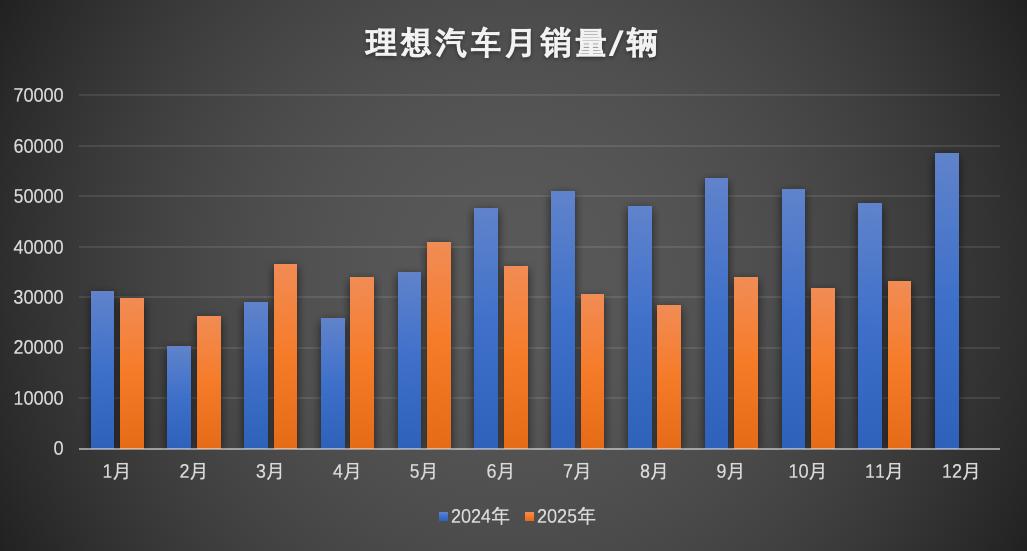
Charting: Tech Planet, Data source: Li Auto official website
Before this, since 2022, Li Auto had achieved 100% growth for two consecutive years, almost being the new - energy automaker with the highest growth rate in those years. Although the growth rate declined in 2024, the sales volume still increased significantly.
The sales decline has affected every aspect. A wheel hub supplier said that the number of orders from Li Auto this year has decreased significantly, leaving him with a large inventory. The Changzhou factory, which used to require overtime work during the Mid - Autumn Festival and National Day holidays in previous years, had an 18 - day holiday in Areas 1 and 2 this year.
As of November, Li Auto has delivered a cumulative total of 362,000 vehicles this year, still far from the annual target sales volume of 640,000 vehicles.
If it were in the third quarter of last year, Li Auto had a net profit of 2.8 billion yuan. Even with 1.1 billion yuan in warranty costs, it would still be profitable. The crux still lies in sales.
Making Up for AI and Infrastructure Lessons
Different from NIO and XPeng Motors, both of which expanded their business scopes as much as possible in the early stage. The former built battery - swapping stations, self - developed chips, and mobile phones, while the latter made significant investments in AI. Li Auto almost only did one thing: build good cars. It also achieved phased success. However, now, the past successful experience seems to have lost its effectiveness. In the all - electric market, Li Auto has to make up for every lesson it missed.
First is the construction of charging piles. One month after the launch of MEGA, there were no charging piles in Shanghai, the venue of its launch press conference. An employee who left the company last year shared his view, saying that without charging piles, all - electric cars won't sell well, but the company adheres to its own design concept and believes that someone will buy them.
Many users who buy all - electric models have charging anxiety, and MEGA also has poor sales due to design and various other reasons. Last year, Li Auto accelerated the construction of charging piles and began to install a large number of super - charging piles on highways and in urban areas. Currently, there are already 20,000 charging piles, and the speed of construction is quite fast.
In terms of AI, at the beginning of 2023, Li Xiang, the founder of Li Auto, first proposed an AI strategy, changing the company's vision from "becoming the world's number one intelligent electric vehicle enterprise" to "becoming a globally leading artificial intelligence enterprise."
Li Auto plans to achieve Level 3 supervised autonomous driving in 2025 and launch its first car defined for Level 4 autonomous driving three years later in 2028. To catch up in the field of intelligent driving, Li Auto self - developed a base model, increased resource investment in intelligent driving, and launched the VLA (Vision, Language, Action) large - scale model, which is the key to its assisted driving system and aims to imitate the way humans learn new knowledge and skills.
A headhunter in the automotive industry told Tech Planet that the key recruitment areas for Li Auto this year are marketing and AI product development. However, compared with XPeng Motors, which has a more mature intelligent driving technology and more specific job responsibilities for AI recruitment, the job descriptions of Li Auto's AI positions are relatively vague. In his view, this means that the direction and route of Li Auto's intelligent driving may not be clear enough at present.
In September this year, Li Auto carried out a large - scale restructuring of its autonomous driving department, splitting the original three secondary departments into 11 smaller teams, aiming to improve R & D efficiency and professional focus.
Although Li Auto is making great efforts to catch up, its intelligent driving function is still not perfect. If the VLA fails to understand or understand instructions inadequately, it cannot execute commands correctly. "For example, I told Li Auto's intelligent assistant not to change lanes, but it still did. I told it to queue on the left, and it didn't change," a car owner shared his experience.
Li Xiang has clearly invested more energy in AI. He has publicly elaborated on Li Auto's understanding and progress in AI many times. At the same time, Li Auto continues to invest in R & D. In the third quarter of this year, Li Auto increased its R & D investment to 3 billion yuan, exceeding that of NIO and XPeng Motors. This shows Li Auto's determination, and since the technological direction in the AI field is constantly changing, Li Auto also has the opportunity to overtake on a curve.
Periodic Dilemma but Greater Challenges
NIO, XPeng Motors, and Li Auto have all encountered periodic dilemmas. The first two have pulled their companies out of the critical situation through product and structural adjustments. Li Auto's most obvious advantage is its sufficient capital. The third - quarter financial report shows that Li Auto's cash reserve is 98.9 billion yuan, more than the combined total of XPeng and NIO. However, the challenges Li Auto faces today are obviously greater.
Most notably, the competition is significantly more intense, especially in the extended - range vehicle segment. Above, there is AITO; below, there is Leapmotor. Even Xiaomi, whose brand potential is far greater than that of Li Auto, will launch its first extended - range model next year. A former Li Auto employee who just left the company but still works in the automotive industry said that the sales growth that price cuts can bring may not be as obvious as before.
Therefore, Li Auto must present sufficiently powerful product capabilities. In the extended - range vehicle segment, which is Li Auto's area of expertise, Li Xiang even released a course called "16 Lectures on Li Xiang's Product."
One of Li Auto's solutions is to change the previous four - year R & D cycle to two years. However, there are still hidden dangers behind this. An R & D engineer in the new - energy vehicle industry told Tech Planet that although the R & D cycle is two years, many design changes are actually made three or four months before mass production. It's equivalent to doing verification in three or four months, which is simply impossible to complete. It's good if 50% of the work can be done. This is also a common problem in the new - energy vehicle industry, and enterprises need to strictly control the entire product quality process.
Next year is not a big product - launch year for Li Auto. Li Auto plans to make major improvements to the L - series models. Learning from the experience of i8 this year, the L - series will return to a simplified SKU model next year. In terms of battery layout, Li Auto is building full - stack self - developed capabilities around 5C super - charging batteries.
Judging from the currently disclosed information, it's still unknown how competitive Li Auto's new products will be in 2026. However, fast - charging and super - charging are no longer new technologies, and automakers including Huawei, XPeng, and NIO already have them.
More than one employee said that according to the current product plan, the challenges next year will still be great.
Their concerns are not unfounded. Automakers usually rely on new products to drive sales growth. In 2024, NIO only launched its flagship model NIO ET9 and the first model of Firefly at the end of the year, and all other models within the year were facelifted versions. Its sales didn't improve that year. This year, it achieved a sales peak with the new NIO ES8 and LeDao L60. Whether Li Auto can reverse its sales decline with only facelifted models remains a question.
It will take some time for the organizational structure adjustment to be reflected in sales, but Li Auto has boosted employees' confidence in other ways. Tech Planet learned that previously, employees were only allowed to be late four times a month, but now, lateness is calculated in minutes, and it's okay as long as the total lateness in a month does not exceed 120 minutes.
The fierce competition in the automotive market requires that no automaker can have obvious weaknesses. Every automaker has encountered a periodic trough but has managed to recover. After experiencing various challenges brought about by product cycles, supply - chain production ramps, and policy changes, Li Auto has returned to the state of a startup. This enterprise with more than 20,000 employees will enter a state of all - out charge again.
This article is from the WeChat official account "Tech Planet" (ID: tech618), author: Wang Lin, published by 36Kr with authorization.