In 1997, the founder led the industrial CT track, and three state-owned capitals bet hundreds of millions of yuan.
For a long time, China's industrial CT has been facing the harsh reality that international giants dominate half of the high - end market. Ultimately, it is because domestic equipment has difficulty breaking through high - end barriers.
In recent years, however, this seemingly impregnable mountain seems to be showing some signs of shaking.
In the lithium - battery field, as the safety standards for power batteries continue to improve, traditional offline sampling inspections can no longer meet the increasingly strict quality control requirements. The industry urgently needs to shift from "sampling inspection" to "100% online full inspection".
How can we achieve a perfect balance between CT detection efficiency and accuracy in the scenario of high - speed full inspection?
Founded in 2021, Gongyuan Sanqian is targeting precisely this core problem.
Take the new - energy lithium - battery field as an example. Through its independently developed complete set of CT scanning, calibration, correction, and reconstruction algorithms, Gongyuan Sanqian has not only broken the technological monopoly of imported equipment but also achieved an overtaking in performance indicators. Its independently developed online ACT - 3600 and offline ACT - 1900 devices can efficiently identify key defects such as the alignment of positive and negative electrodes, electrode - sheet wrinkles, and foreign objects. Data shows that the fastest efficiency of its lithium - battery CT detection can reach 2 - 3 seconds, more than 10 times faster than imported equipment.
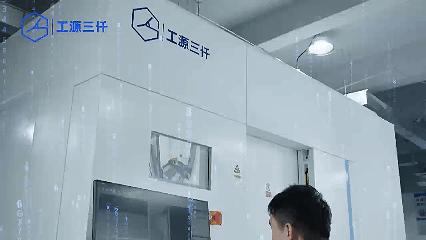
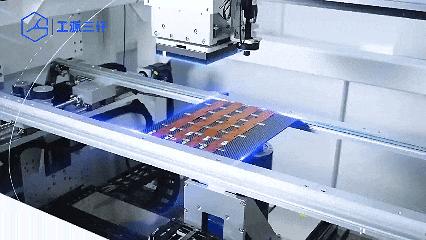
While maintaining its position in the lithium - battery market, Gongyuan Sanqian is also making inroads into the more precise semiconductor - detection field. Its ACT - 3100 series of devices, designed for scenarios such as multi - layer PCBs, PCBAs, IGBTs, and advanced packaging, can achieve rapid CT detection with an accuracy of 1 - 2 microns.
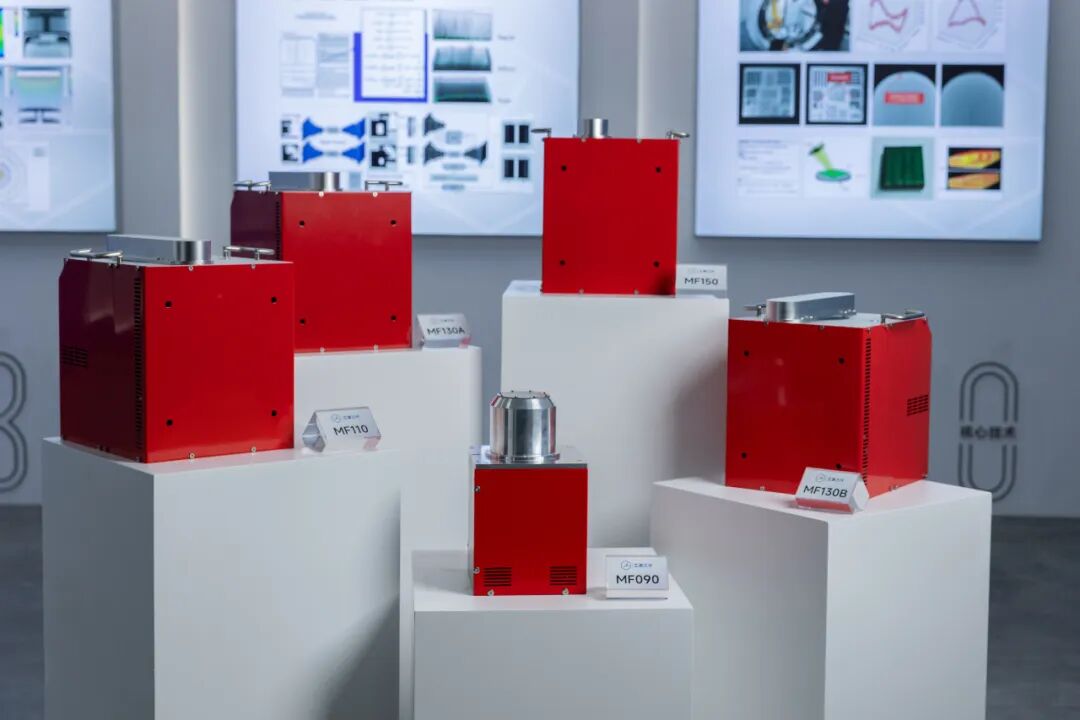
What's even more noteworthy is its breakthrough at the bottom of the supply chain. The core component of industrial CT, the X - ray source, has long relied on imports, which is a typical "chokepoint" area. Gongyuan Sanqian has not stopped at being an integrator. Instead, it has extended upstream and successfully developed its own X - ray source with a voltage range of 90KV - 450KV and a focal spot of less than 5 microns, achieving 100% localization of core components.
This is the fourth year since Gongyuan Sanqian was founded. In the passing year of 2025, this young hard - tech company has become a leading player in the new - energy lithium - battery segment, with its performance growing by 10 times. Its customer list includes many industry giants.
Zuo Jiaming, the founder of Gongyuan Sanqian, is a bit different from the "post - 95s entrepreneurs" in the public's impression.

Zuo Jiaming, Founder & Chairman of Gongyuan Sanqian
In 2021, when the then 24 - year - old Zuo Jiaming entered the not - very - crowded but high - threshold industrial CT field, he was faced with a wall of established giants like Zeiss and Yxlon.
However, age is not a disadvantage. As he said, "Before getting into the system, youth will be questioned; after getting in, youth becomes an advantage."
When Gongyuan Sanqian was starting out, it didn't choose the lighter and more story - telling - friendly pure - algorithm route. Instead, it went for the more capital - intensive and complex whole - machine equipment end. This meant squeezing out a space under the watchful eyes of the giants.
Later, facts proved that this decision became their entry point and the beginning of their moat.
One weekday afternoon, we met Zuo Jiaming. Without the typical geeky style, this young founder showed a business maturity beyond his age. He spoke in a calm tone, with clear logic, and also had the directness typical of young people. He talked about his journey from "wild growth" to "respecting the cycle", how to compete with giants, and his determination for this entrepreneurial journey.
The following is our conversation:
Using Lithium - Batteries as the Foundation, Expanding into Semiconductors
Yingke: Could you first explain Gongyuan Sanqian's main business in industrial X - ray detection?
Zuo Jiaming: Simply put, we do "the essential inspection for battery safety". This inspection is not an option but a mandatory requirement from terminal car manufacturers. From the early BBA to the new - energy carmakers like NIO, XPeng, and Li Auto, they all stipulate that batteries cannot be installed in cars without this inspection.
Now, the national standards for battery safety have become even stricter. The new national standard issued in August this year has raised the requirement from "5 - minute pre - warning before thermal runaway" to "zero tolerance for any fire or explosion".
As soon as the new standard came into effect, the applicable scope of early - warning solutions was significantly reduced. However, we have always been doing result - oriented detection, which is to "find problems and directly eliminate defective products". Therefore, our technical path has stronger certainty in the industry upgrade.
Speaking of the technical aspect, the production process of lithium batteries is long and involves many steps. We are mainly responsible for the mid - to - late - stage detection, using CT and X - Ray to check for problems inside the battery cells. This includes: whether the positive and negative electrodes are aligned, whether there are foreign objects inside, and whether the tabs are folded.
Yingke: In the lithium - battery industry, high - speed full inspection and precise inspection are often contradictory. In many cases, one has to be sacrificed. How does Gongyuan Sanqian solve this problem?
Zuo Jiaming: We improve efficiency by reducing the scanning time. The core is to use sparse projection data to reconstruct high - definition CT tomographic images, and then match the customer's production rhythm through the overall system design. For example, for laminated batteries, the scanning time for a group of batteries can be as fast as 2 seconds, achieving a detection efficiency of 12 ppm at a single workstation; for cylindrical batteries, an online CT detection efficiency of 30 - 60 ppm can be achieved, making CT as fast as X - Ray.
Yingke: There are many fields in industrial X - ray detection. Why did you choose new - energy lithium - batteries as your entry point?
Zuo Jiaming: At that time, we investigated many directions. For example, in the casting - related projects such as automobile chassis, die - castings, and engine pistons, we found that these projects were too scattered. Customers had a large number of product SKUs, and it was difficult to achieve large - scale production. A factory would only buy a few pieces of equipment at most, and the projects were highly customized, with a heavy delivery workload.
I started my entrepreneurial journey in 2021 and believed that I should choose a direction with a high ceiling. The production capacity of the new - energy industry has increased by 25 times in the past 10 years, and the lithium - battery production capacity is expected to triple in the next 5 years. This market is large enough. By now, our business has become a leading player in the new - energy lithium - battery field, and we will further expand into the semiconductor field.
Yingke: Why expand into the semiconductor field?
Zuo Jiaming: The surging demand for computing - power chips from AI large - models and embodied intelligence has brought significant growth to this market. For example, some core PCB suppliers of NVIDIA are our target customers.
There is also a special feature in the semiconductor industry: it is relatively resistant to domestic equipment. Even today, more than 95% of the detection equipment in our stage still mainly relies on imports. However, this means there are clear opportunities for domestic substitution. Although the verification cycle will be longer, we have already started making shipments in this field.
Yingke: In more complex and precise scenarios such as the electronic semiconductor field, what is your production - capacity layout?
Zuo Jiaming: We have currently launched the ACT - 3100 series of devices, mainly targeting scenarios such as multi - layer PCBs, PCBAs, IGBTs, and advanced packaging. Paired with our self - developed planar scanning and reconstruction algorithms, it supports offline, on - the - line - side, and online applications for rapid CT detection of the entire board. For PCBs, it can accurately reconstruct drill - hole cross - sections and effectively measure residual copper inside the holes; for advanced packaging, it comprehensively covers key defects in TGV, TSV, wafer - level, and board - level packaging, achieving rapid CT detection with an accuracy of 1 - 2 microns.
Yingke: When you first entered the market, large enterprises surely had established suppliers, and most of them were imported brands. How did you win?
Zuo Jiaming: In the early days, we relied on saturated service and the organizational form of a startup company.
At the beginning, customers preferred imported products, such as Zeiss. However, most of Zeiss' equipment is standard - model, and it is difficult for them to cooperate with Chinese customers' rapid expansion and iteration. Sometimes, when a function needs to be changed in the software, they have to report back to the German headquarters, which lengthens the cycle. But we can respond to customers' needs at any time. Our fully self - developed software and hardware system allows us to quickly provide solutions for different needs. It was through continuous interaction with leading customers on solutions that we were able to iterate faster. In the early days, our business volume with a leading automobile manufacturer might have been only a few hundred thousand yuan, but later we won all their orders. At that time, our entire company had only 50 - 60 people, and we mobilized dozens of people to specifically follow up on this large - scale order from the leading customer.
After this battle, we won orders worth tens of millions from several leading customers.
Yingke: Compared with domestic suppliers, what are your advantages?
Zuo Jiaming: I can draw an analogy with two product lines: X - Ray and CT. X - Ray is like taking a two - dimensional X - ray photo in a hospital; CT is three - dimensional, and the scanning and reconstruction time is very long, so the efficiency is low, but it represents the future.
Domestic suppliers initially focused on X - Ray and later tried to transform into CT. However, they found that it was not on the same technical level and eventually failed. Some of them went back to do derivative X - Ray business, but their scale was very small, with an annual revenue capped at a few million to ten million yuan.
Our team started with CT from the beginning. The technical threshold of CT is very high, and the industry is very closed. Even now, there are only a few companies capable of doing CT in industrial scenarios.
Therefore, compared with them, the core is that we focus enough on scenarios. Once we choose a product category, we continuously polish our products with leading customers. Long - term accumulation has earned us a good reputation in this industry. In addition, CT is a device mainly driven by software systems. Compared with regular equipment companies, we have technological advantages so far, especially at the algorithm level. We are one of the few equipment suppliers in this industry that can publish top - conference papers every year.
Going All - In 100%
Yingke: Speaking of which, what will this round of financing be mainly used for?
Zuo Jiaming: First, for continuous R & D and iteration, just like what we did in the lithium - battery field in the past few years; second, for capacity expansion and cost control. We plan to build our own production lines for core components to keep the key links in our own hands and avoid being "choked"; third, for market expansion, especially for deepening our product layout in scenarios such as advanced packaging in the semiconductor field.
Overall, it is still about strengthening our position in the upstream and downstream of the industrial chain around our existing core products.
Yingke: You've talked a lot about algorithm advantages, but the core components of industrial CT often determine the cost and supply - chain security. The X - ray source has long been monopolized by imports. Has Gongyuan Sanqian made any upstream - extension layout in this regard?
Zuo Jiaming: Our self - developed X - ray source has been stably shipped. It can cover a voltage range of 90KV - 450KV and achieve a micro - focal spot of less than 5 microns. It took a long time to get on the supplier's approved list. Some leading customers' on - site equipment has already been equipped with our products. After this round of financing, we will further increase the production capacity of core components.
Yingke: How did you start this entrepreneurial journey?
Zuo Jiaming: Before graduation, I interned at YC and was in the same office as Dr. Qi Lu. At that time, the industrial - detection field was very popular, and companies like Aqius and Simu Technology were all involved.
However, I took a fancy to the niche field of industrial X - ray detection. One reason was that my undergraduate laboratory was working on this. The other reason was that I thought compared with the then - popular visual detection based on visible light and cameras, ray detection had higher barriers.
So I spent about half a year systematically researching the industry again. After I sorted out all the understandable logics and possible future technical paths, I decided to start my own business. Later, YC also invested in us, which can be seen as a validation of my judgment at that time.
Yingke: Compared with such large companies or platform - type companies at that time, what did you think were Gongyuan Sanqian's advantages?
Zuo Jiaming: Most companies took the "camera + algorithm" path. We could also do this kind of model, and even using open - source algorithms wouldn't be bad.
However, I firmly believed from the beginning that we must do the whole - machine and not just focus on software or SaaS. In China, it is very difficult to charge for pure SaaS or software. If we only did pure - visual solutions, the barriers would be too low. One could buy a few cameras for a few hundred yuan, apply an open - source algorithm, and sell the product. Eventually, everyone would be involved in a price war. Moreover, if we only did software, leading customers would definitely develop their own software in the future and replace the hardware with cheaper suppliers. We would have no room for survival.
But we are not actually competing with these visual - detection companies. We are complementary rather than substitutable in the production line. We are an X - ray detection company. We choose to do CT because the coupling between its software and hardware is very strong. Customers always need to rely on our services, and we need to build our own brand in the process.
Yingke: In this industry, most entrepreneurs have had a long - term experience. Do your customers or investors care about your age?
Zuo Jiaming: They might have cared at the beginning, but in the hard - tech industry, age has never been the most core evaluation criterion. The most convincing factors are always the product and service themselves.