The truth behind the wave of robot companies going public: short of money and in tight financial straits
The era of coexistence between humans and robots may arrive sooner than expected.
Jensen Huang, the founder of NVIDIA, once proposed that "the next wave of AI will be robotic systems" and predicted that factories will be driven by software and AI in the next decade.
This wave is now reflected in the IPO queuing and financing data.
In just the past few months, more than a dozen robotics companies, including SEER, have submitted their prospectuses to the Hong Kong Stock Exchange. Leading players like Unitree have also accelerated their IPO processes. As of December 8, 34 companies in the robotics industry chain are waiting for hearings.
The primary market is also booming. Yuanli Lingji, spun off from Megvii, raised 200 million yuan in its angel round. Tashizhihang set a new record in the angel round with a 120 million US dollar financing. Galaxy Universal Robotics completed a new round of financing worth 1.1 billion yuan, the largest single - round financing in the field of embodied large - model robots. Xingchen Intelligence completed hundreds of millions of yuan in its A++ round, jointly led by Guoke Investment and Ant Group. Ant Group has led multiple rounds of financing for Xingchen Intelligence within a year. In the first three quarters of 2025, the total financing of domestic robotics startups reached approximately 50 billion yuan.
However, the high popularity is accompanied by high controversy. With immature technology, persistent mass - production cost pressure, and widespread losses among companies, the market has begun to examine whether there is a bubble in the valuations of current robotics companies and whether the entire industry can truly achieve large - scale implementation.
These companies rushing for IPOs or obtaining large - scale financing cover all aspects of the industry chain, including industrial robots, service robots, and core components. We will focus on robot body companies to present the real value and future direction of this emerging industry through their prospectuses and financing details.
Established players go public, new forces attract capital
The robotics track can be roughly divided into two categories: specialized robots rooted in specific scenarios such as industry, agriculture, and services; and general - purpose robots based on multi - modal perception, aiming to adapt to multiple industries.
Specialized robots have been developed for many years. Most related companies were established five to ten years ago, covering forms such as robotic arms, AMRs, and quadruped robots. General - purpose robots have emerged intensively in the past two years. Most of these companies were founded only one to two years ago, mainly in the form of humanoid robots.
However, there is no strict boundary between these two types of robots. For example, to improve practicality, some humanoid robots use wheeled chassis to increase stability, which also weakens their universality to some extent.
Although these "established and new" players differ in business models and underlying technologies, they together form the basic pattern of the robotics track and reflect some common industry trends.
Most of the robotics companies queuing for IPOs recently are "established players" with years of experience. Their products are mainly specialized robots for industrial scenarios, and they have also actively labeled themselves as "AI + robots" in this wave of AI to increase market attention and valuation expectations.
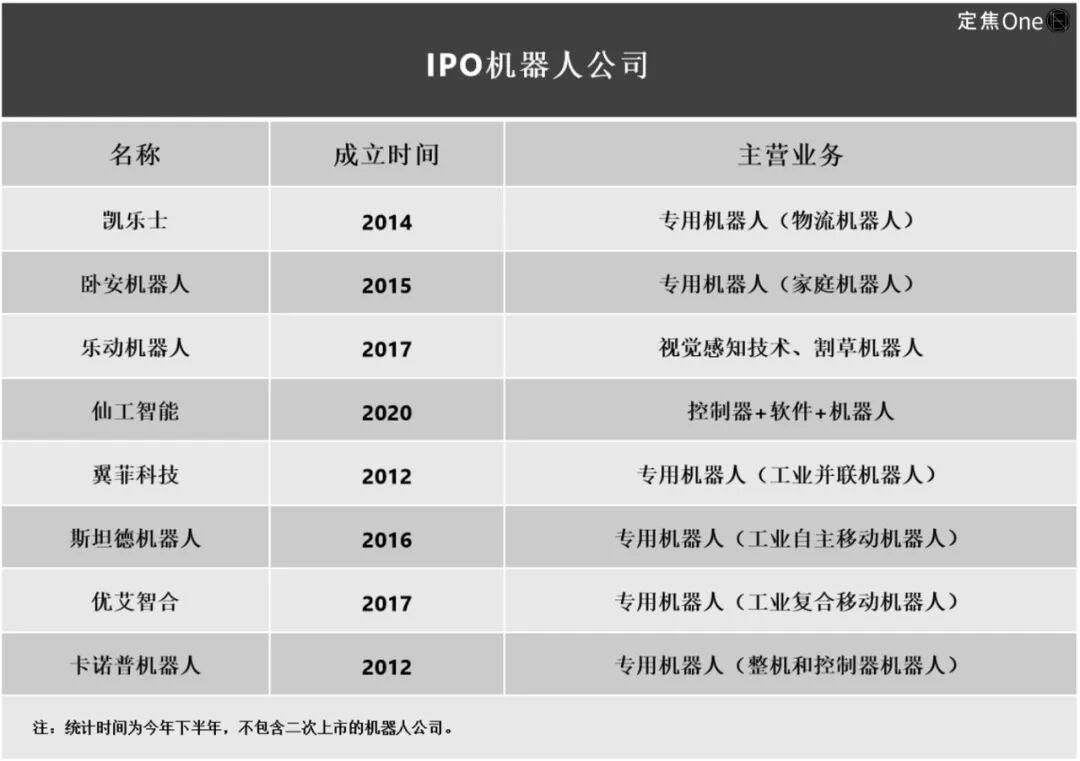
For example, SEER focuses on industrial composite mobile robots (AMR + robotic arm). Its products are equipped with a 3D vision system and AI algorithms, enabling real - time identification, positioning, and grasping of randomly stacked workpieces, breaking through the limitation of traditional robots that can only handle materials in fixed positions.
Another typical example is LD Robot. Its intelligent lawn - mowing robot business is regarded as the company's second growth curve. After being equipped with AI algorithms, it can automatically identify lawn boundaries, obstacles, and terrain changes, optimize mowing paths, and adapt to different environmental conditions such as trees, flower beds, and slopes.
"Established players" are encountering a turning point in development with the IPO wave, while "new forces" are taking off rapidly in the primary market. In particular, humanoid robots have become a key area for capital investment.
Financing data proves the industry's popularity. According to IT Juzi statistics, in the first three quarters of 2025, the number of financing events in the domestic robotics industry doubled. Especially in Q3, there were 243 investment events, a year - on - year increase of 102%.
As the frequency increases, the amount is also rising. In the first three quarters of 2025, the total financing of domestic robotics startups reached approximately 50 billion yuan, 2.5 times that of the same period last year. Among them, the total financing in Q3 was 19.813 billion yuan, a year - on - year increase of 172%. Since the second half of this year, there have been frequent high - financing events with a single - round amount of around 1 billion yuan in this industry.
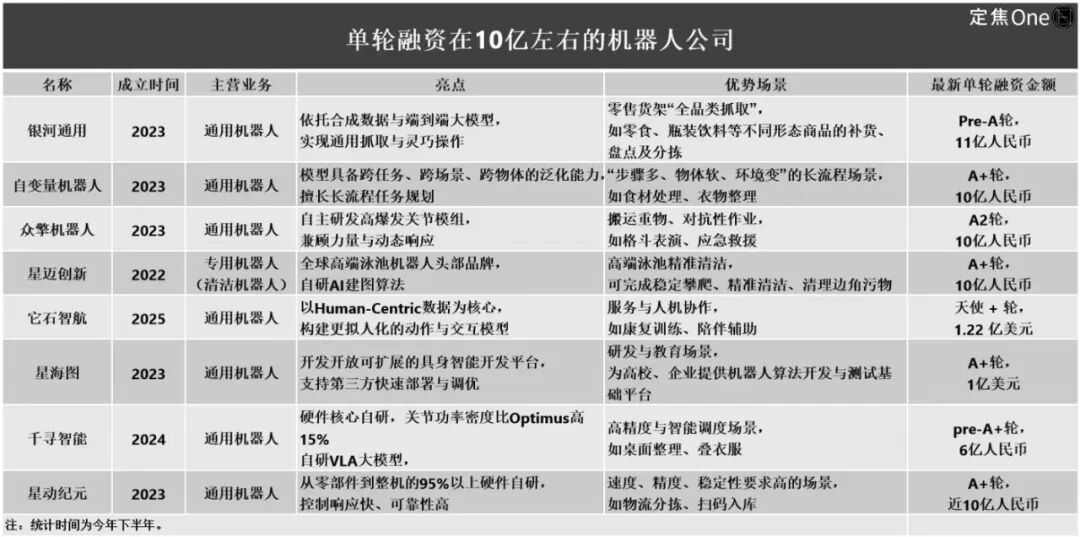
In addition to the above - mentioned financing companies, a number of faster - moving humanoid robot enterprises such as Unitree and Leju have reached the Pre - IPO stage and are just one step away from going public.
Unitree has officially announced that it plans to submit its prospectus in Q4 this year and has disclosed its revenue composition. The sales of quadruped robots, humanoid robots, and component products account for approximately 65%, 30%, and 5% respectively. Among them, approximately 80% of quadruped robots are used in research, education, and consumer fields. Leju Robot has been registered for IPO guidance and plans to go public on the A - share market. Zhiyuan Robot has completed a reverse takeover of Shangwei New Materials.
According to industry insiders, the popularity of the robotics track mainly comes from two key factors.
Firstly, there is sufficient policy support.
An investor told "Dingjiao One" that most of these robotics companies choose to list on the Hong Kong stock market. This is because Chapter 18C of the "Listing Rules" implemented by the Hong Kong Stock Exchange in 2023 has given a "green light" to specialized technology companies. Even if a company has not yet made a profit, as long as it meets certain conditions, it can apply for listing under this new regulation.
In addition, "embodied intelligence" was written into the government work report for the first time this year, and local governments have successively introduced support policies, providing many preferential treatments in terms of funds, venues, and talent support.
On the other hand, the robotics business itself requires high investment, has a long cycle, and consumes a large amount of capital. Going public is a good way to "raise money". Many companies have mentioned in their disclosed fundraising purposes that the funds will be used to expand financing channels and enhance the international influence of the brand.
Next, we will further analyze what kind of business the robotics industry is through the prospectuses.
Where does the money in the robotics industry go?
Let's first look at the financial data of these companies rushing for IPOs.
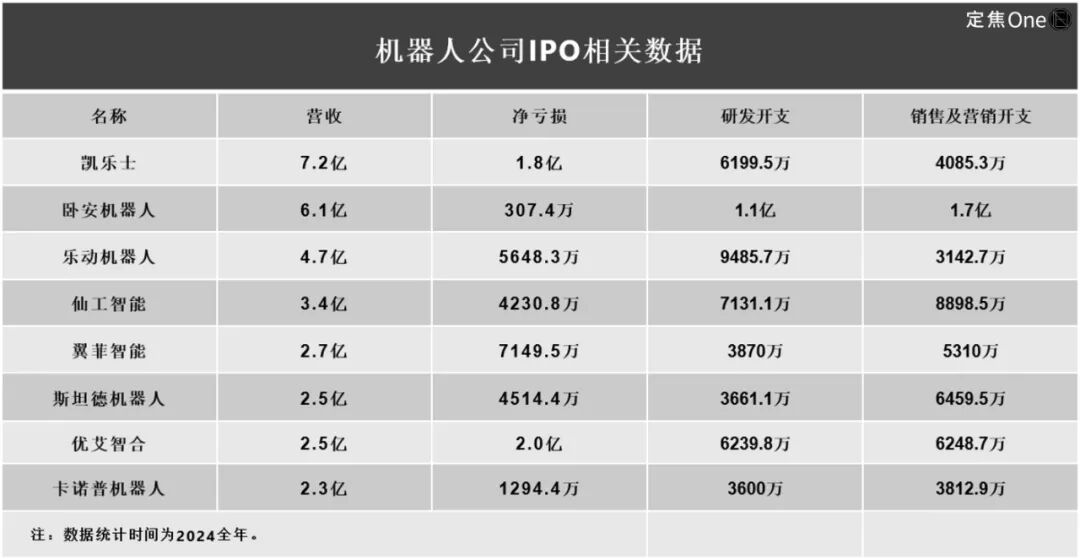
In terms of revenue, the income scale of most companies has reached the level of hundreds of millions of yuan and has been increasing year by year, indicating that the market demand for robotics solutions is expanding.
However, there are certain differences in the revenue composition of each company.
The revenue of robotics companies can be mainly divided into three categories: robot bodies, robot solutions, and robot accessories. For most companies, robot bodies and solutions are the two absolute revenue pillars, usually accounting for more than 80% in total, and even up to 98% for some companies. LD Robot is relatively special, with its revenue mainly coming from visual perception products (including sensors and algorithm modules), accounting for up to 94%.
The high - margin part of this industry has also shifted from standardized hardware to software, algorithms, and deeply integrated industry solutions. Simply selling hardware in the robotics field has fallen into "red - ocean" competition.
Although the business structures are similar (mainly focusing on bodies and solutions), there are obvious differences in the revenue scales of different companies. For example, the annual revenue of Kylas and Woan Robot has reached approximately 700 million yuan, while the revenue of Stander, SEER, and Capno is roughly around 250 million yuan.
This is mainly because Kylas robots are mainly concentrated in the logistics field, and Woan Robot targets commercial and household cleaning markets. The standardization levels of their products are relatively high, and the market demand is also relatively large. Robot companies with smaller revenue scales often focus on more complex and niche scenarios such as industrial manufacturing and semiconductors.
However, the vast majority of companies are in a long - term loss state, regardless of whether they are highly standardized or target niche and high - precision scenarios.
None of the above - mentioned companies that have submitted their prospectuses have achieved profitability. Among them, SEER has the highest loss, losing 200 million yuan in the past year.
Behind the losses are two common pressures in the robotics industry: R & D and marketing.
R & D is one of the heaviest expenditures for robotics companies. A practitioner said that generally, the R & D expenses of robotics companies are second only to the procurement of core components.
Taking SEER as an example, the cumulative R & D expenses in three and a half years exceeded 250 million yuan. In 2022, its R & D investment even exceeded its total revenue for that year. As of June 30, 2025, the company had 144 R & D personnel, accounting for 34.6% of the total number of employees.
In addition to R & D, in the highly competitive market, companies also have to spend money to gain brand recognition. As a result, the phenomenon that marketing and market expenses far exceed R & D expenses has emerged. Stander Robot, Yifei Intelligence, and Woan Robot are all typical examples of this. Many companies mentioned in their prospectuses that due to market expansion, their expenditures on employee salaries, after - sales services, etc. have increased significantly. Woan Robot even said that it will continue to expand the scale of its sales and marketing teams, and the relevant expenses are expected to rise further.
The general - purpose robot track, which is in the early stage of technological breakthrough and product definition, although there is no detailed financial data disclosure, it can be seen from the practitioners' accounts that it is also very "money - burning".
Gashero, a visiting engineer at the School of Computer Science at Peking University, who has long been involved in industries such as the Internet, autonomous driving, and robotics, explained to "Dingjiao One" that specialized robots usually cannot be directly put into use when changing usage scenarios or purposes and often require significant adjustments or modifications. General - purpose robots can quickly adapt to new environments and tasks with little modification. This relies on the integration of a "hardware platform + powerful AI", which requires higher - level "embodied intelligence" technology as support. Therefore, the R & D difficulty and capital investment are much higher than those of specialized robots.
He took salaries as an example. The annual salary of a humanoid robot R & D engineer can reach one million yuan. A company's R & D team usually consists of dozens of people, and the salary expenditure alone may exceed 100 million yuan.
The greater investment comes from the experimental and manufacturing stages. For example, to deploy 10,000 robots for testing (just like Waymo testing autonomous driving by piling up cars to run mileage to prove safety, humanoid robots need to pile up numbers to fully expose possible failure events), calculating at 100,000 yuan per robot, at least 1 billion yuan in funds is required. Coupled with supporting equipment, maintenance engineers, and office space costs, at least 3 billion yuan needs to be invested in the experimental stage. It should be noted that the "10,000 units" in the testing stage is not a hard requirement but an upper - limit cost estimate under extreme assumptions.
Recently, there have also been reports that a group of embodied intelligence companies are competing for the sponsorship qualification of the 2026 CCTV Spring Festival Gala. Zhiyuan Robot has offered 60 million yuan, and Unitree has raised the offer to 100 million yuan. Although Zhiyuan Robot has responded that it is "not true", it also confirms from the side that brand investment has become a necessary factor in the competition among robotics companies.
Although the specialized and general - purpose robot tracks are in different development stages, they both face capital pressure.
After the IPO and financing wave, the robotics track still has three hurdles
Behind the queuing for IPOs and accelerated financing is the long - term optimism of the market about the prospects of the robotics industry.
IDC predicts that by 2029, the global robotics market will exceed 400 billion US dollars, and China will account for nearly half of the share, with an annual compound growth rate of approximately 15%. The expanding demand has attracted more players to enter the market. According to Qichacha data, as of December 1, the number of domestic humanoid robot - related enterprises has reached 1,218. The number of newly registered enterprises in the first 11 months of this year has exceeded the total number of registrations last year, a year - on - year increase of 119.2%.
However, for these enterprises to move from capital enthusiasm to stable development, they still need to overcome three hurdles: cost, reliability, and data.
The first hurdle is cost, which is related to the market pricing and popularization speed of products.
The cost of robots mainly comes from hardware materials and software R & D, and both are high. This is particularly prominent for humanoid robots.
Morgan Stanley pointed out in its latest report "Humanoid Robot Technology: Seizing the Future" that the current BOM (bill of materials) cost of non - Chinese supply chains is approximately 131,000 US dollars. Although the Chinese supply chain can reduce the cost to some extent, practitioners generally believe that the current cost of humanoid robots is still very high, and the high cost directly drives up the product price.
Currently, the cheapest consumer - grade humanoid robot in the world is "Bumi" from Songyan Power, priced at 9,998 yuan. Although it lowers the user threshold, some practitioners believe that its functions are relatively limited.
The industry generally believes that 2026 will be a "big test year" for the commercialization of robotics companies. How to reduce the selling price without sacrificing performance is a question that robotics companies need to consider.
The second hurdle is the "reliability" of robots. That is, whether a robot can perform tasks safely and stably in complex, changeable, and unstructured real - world environments.
Most robots can perform well in demonstration environments, but once they enter real - world family or industrial scenarios, their success rates and fault - tolerance rates decline significantly. Wang Jianan, the vice - president of Xingchen Intelligence, told "Dingjiao One" that this is closely related to the AI model, the performance of the robot body, and the combination of the two.
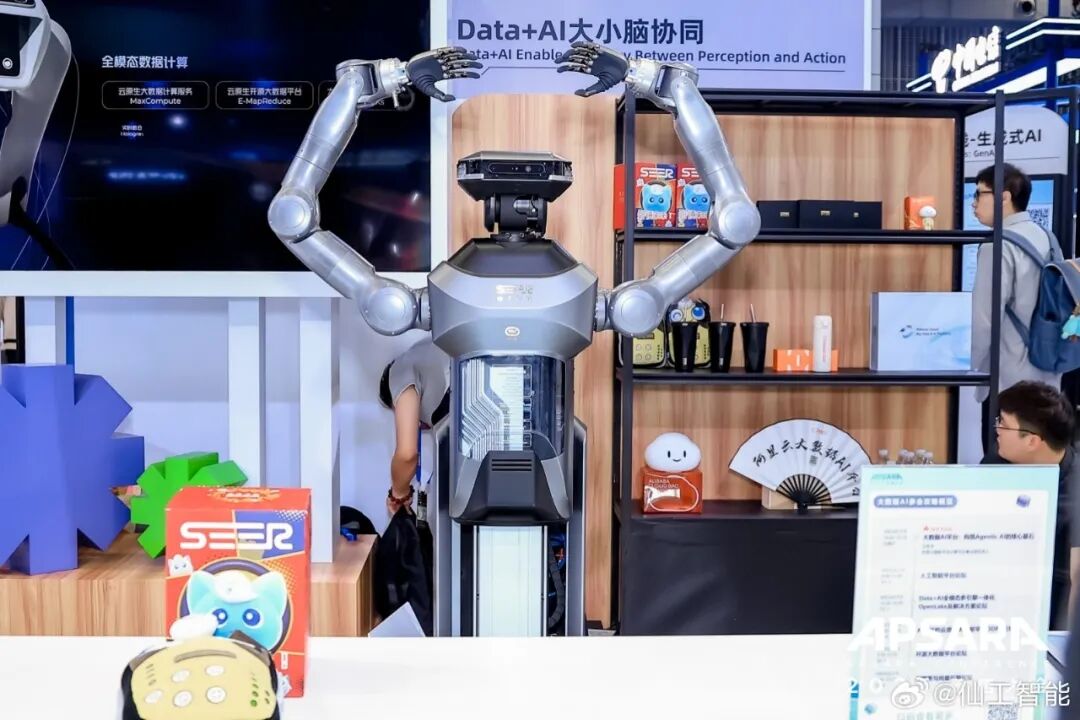
Source / SEER's Weibo
Firstly, the AI model has insufficient cognitive and abstract abilities.
This is mainly reflected in the lack of recognition and physical property estimation of unknown objects, the abstraction and understanding of the essence of operations, the understanding and dynamic planning of complex environments, and the utilization of environmental interaction feedback information. Robots rely on sensors to "see".