Seven iPhones in two years: Beyond foldable screens, Apple launches a "product offensive" strategy.
Apple plans to significantly expand its mobile phone product line in the next two years. It is expected that by the fall of 2027, the number of flagship iPhone models will increase from the current 5 to at least 7.
The core of this round of product upgrades is Apple's first foldable iPhone, which is expected to be officially released in the fall of 2026.
According to people familiar with the matter, when unfolded, this foldable device is more similar in form to a small iPad, promising a different user experience from traditional smartphones.
In addition, Apple plans to launch a more milestone - worthy 20th - anniversary edition of the iPhone in the fall of 2027. This model will feature a front - and - back double - curved glass body design, achieving a true full - screen effect. The screen will extend to the edges of the device, completely eliminating the traditional black borders.
01 Apple at a Crossroads
Apple's expansion and reshaping of the iPhone product line come at a critical time when it is facing market growth pressure - the industry generally faces challenges such as the saturation of the smartphone market and the extension of the user's device replacement cycle.
Apple's financial reports show that its iPhone business achieved annual sales of $209 billion in fiscal year 2025, a year - on - year increase of 4%.
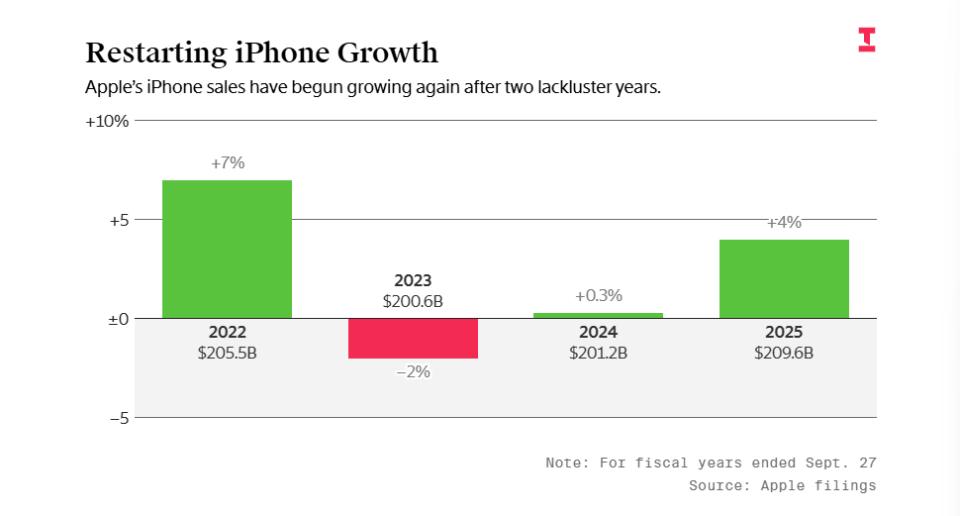
Figure: After two years of sluggishness, iPhone sales finally show a positive trend again.
Analysts generally believe that this growth is mainly due to the significant changes in the appearance design of the iPhone 17 series, which successfully stimulated the device replacement needs of some users.
However, Apple's strategy has sparked discussions with different viewpoints.
Some analysts point out that Apple's new strategy has a clear intention: to increase the average selling price and profit margin through high - end innovative products such as foldable screens, while expanding the user base and market share with more cost - effective models, ultimately achieving market coverage and overall growth across all price segments.

However, there are also critical voices in the market.
Some believe that in recent years, the upgrades of some new iPhone models have focused on internal performance and components, lacking breakthrough innovations in overall design and user experience. This strategy is compared to "changing the blades of a razor" - the external form remains the same, with only routine internal iterations.

Some comments look back at history and believe that Apple has gradually deviated from the product philosophy of "focusing on creating ultimate masterpieces" during the Jobs era. Under the current operation model led by professional managers and more focused on financial indicators (such as average selling price), the product line has become increasingly complex. This may bring financial benefits in the short term but could damage the brand foundation known for innovation and simplicity in the long run.

In any case, from the cross - border exploration of foldable screens to the revolutionary form of borderless design, Apple is trying to redraw its growth curve and respond to the expectations and doubts of all parties in the increasingly competitive smartphone market with a high - density product offensive.
02 Launching Seven New Models in Two Years to Seek a Breakthrough
Apple's roadmap shows the company's aggressive product strategy to break the market deadlock.
In the next two years, Apple plans to release a full range of models from entry - level to top - end, from traditional to new forms at an unusually high - frequency pace, aiming to return to the high - growth track through precise market segmentation and supply - chain innovation.
The specific plan is as follows:
1) Spring 2026 (1 model)
iPhone 17e: Positioned as an entry - level model, it will add magnetic wireless charging to the series for the first time and be equipped with the new - generation self - developed modem C1X, focusing on high cost - effectiveness and basic experience upgrades.
2) Fall 2026 (2 models)
iPhone 18 Pro / Pro Max: The flagship series will receive three important upgrades - under - screen Face ID for a true full - screen, a mechanical aperture camera to enhance imaging control, and advanced chip packaging technology to strengthen edge - side AI capabilities.
iPhone Fold: Apple's first foldable phone, with a horizontal unfolding design similar to a small iPad, featuring a 5.3 - inch outer screen and a 7.7 - inch inner screen, representing Apple's differentiated understanding of the foldable form.
3) Spring 2027 (3 models)
iPhone 18: A regular model that will be released in spring for the first time. The important change lies in the supply - chain strategy, with mass production starting at Indian factories. The product itself may cancel the tactile feedback of the dedicated photo button to optimize costs.
iPhone 18e: An entry - level model released simultaneously with the iPhone 18, continuing with magnetic charging and also serving as a key test product for Apple's "Made in India" strategy.
iPhone Air 2: A rebooted lightweight model, planning to add dual cameras and adjust the pricing strategy to balance portability and functionality.
4) Fall 2027 (1 model)
20th - anniversary edition of the iPhone: A special model created to commemorate the 20th anniversary of the iPhone's birth, featuring a front - and - back curved glass borderless design and an under - screen camera, expected to become a truly "full - screen" phone.
03 Building a Complete Product System around Three Axes
In the product blueprint from 2026 to 2027, Apple will build a complete product system covering all price segments, integrating new technologies, and restructuring the supply chain with seven new iPhones.
It should be noted that this layout is not simply an increase in the number of models but is centered around form breakthroughs, technology diffusion, and manufacturing transfer.
First, Apple will launch the iPhone 18 Pro series and its first foldable iPhone simultaneously in the fall of 2026, forming a clear dual - flagship strategy.
The foldable iPhone uses a unique horizontal unfolding design and may be positioned as a foldable tablet rather than a simple foldable phone.
Before Apple, Samsung and Huawei have established an advantage in the foldable market, and Google's Pixel Fold is also accelerating its iteration. Apple needs to quickly secure a position in the high - end foldable market to avoid falling behind in the form iteration.
The under - screen Face ID and edge - side AI capabilities of the iPhone 18 Pro series represent Apple's pursuit of "invisible intelligence," hiding technological innovation behind the user experience.
Second, this product matrix reflects Apple's response to the current dilemma of the smartphone market: when the incremental market turns into a stock competition, simple technological iteration is no longer enough, and product form innovation must be used to create new demand.
Against the backdrop of Android manufacturers having successively launched models with under - screen cameras, Apple needs to provide a more disruptive answer to consolidate its image as a leader in high - end design.
The seven models may seem scattered, but in fact, they form a complete strategic system that supports each other and progresses step by step. Its goal is not only to launch new products but also to lay a new infrastructure for the next decade of the iPhone.
Finally, spring 2027 will be a critical node.
The initial mass production of the iPhone 18 and iPhone 18e at Indian factories marks a shift in Apple's supply - chain strategy from "China +" to "Made in India."
There are multiple considerations behind this adjustment: including the dispersion of geopolitical risks, the optimization of manufacturing costs, and a more direct response to emerging markets.
Meanwhile, the restart of the trial production of the iPhone Air 2 in China is not a simple return but an attempt to leverage China's mature supply - chain capabilities in precision manufacturing.
Special translator Jin Lu also contributed to this article.
This article is from "Tencent Technology", author: Su Yang, editor: Xu Qingyang. It is published by 36Kr with permission.