Can Apple save the small foldable phones?
As one of the few growing markets in the mobile phone industry, foldable smartphones have been advancing steadily for many years, and finally the footsteps of Apple are approaching.
Apple has been extremely secretive about its foldable smartphone information, but unexpectedly, the details have still leaked out. In March this year, Guo Mingchi, an expert in Apple's supply chain, updated his revelation, precisely revealing the screen size and body thickness down to one decimal place, for the first time vividly outlining the clear form of the foldable iPhone.
According to the reports from The Information and Bloomberg, Apple's foldable smartphone adopts a small clamshell - style folding design. Its size ratio is closer to a square, and its form is quite similar to Huawei's Pura X, a large - fold smartphone.
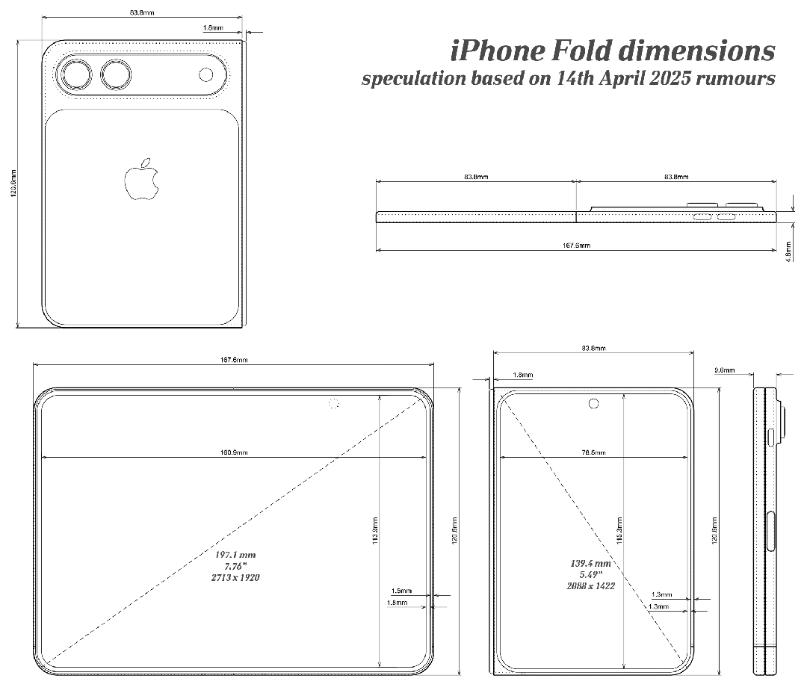
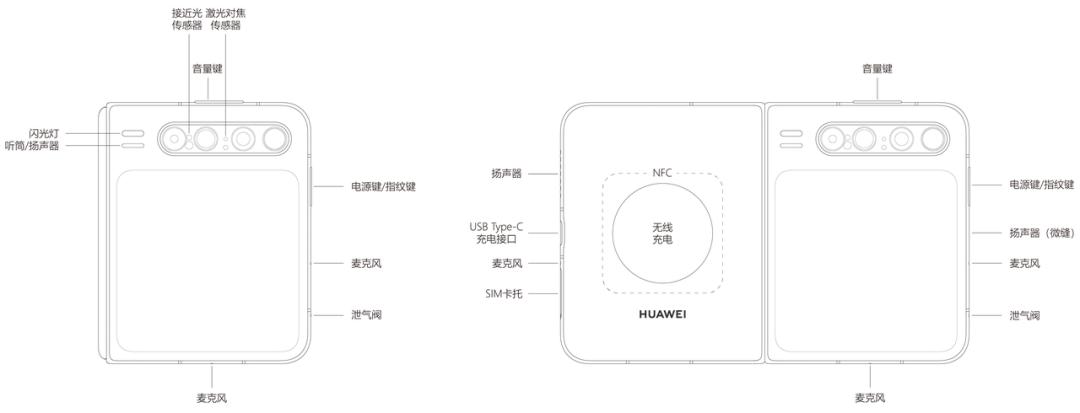
Suspected Apple foldable smartphone design (top) and Huawei Pura X structure (bottom)
In the past few years, Android phone manufacturers have successively entered the foldable smartphone market, exploring both large - fold and small - fold designs. Apple has been observing from the sidelines. The downside is that it missed the high - growth period of foldable smartphones, but the upside is that all the potential pitfalls have been encountered by its competitors, and Apple has accumulated a wealth of reference materials.
According to the latest reports, Apple is now clearly entering the foldable smartphone market. Its first foldable product is unexpectedly similar to Huawei's Pura X, but in terms of size and product definition, it is closer to the "small - fold" form.
The question is, compared with the market size of large - fold smartphones, small - fold smartphones are in an awkward position and have long been popular in name only. Can even Apple break the curse of "all praise but no purchase" for small - fold smartphones?
The Zero - Crease Trap
The project of Apple's foldable iPhone was initiated very early. The relevant patents can be traced back to 2011. After more than a decade, what has been holding Apple back is the most critical problem of foldable smartphones: creases.
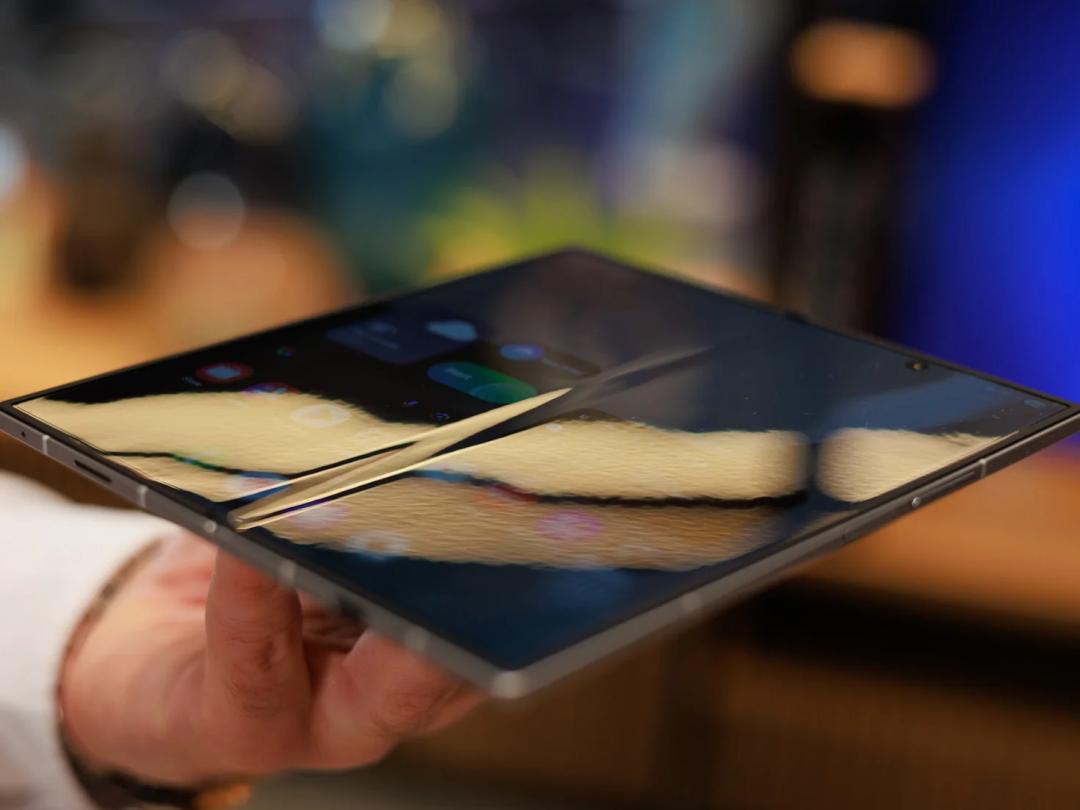
The crease in the center of a foldable smartphone screen
Although the technology related to foldable screens has been developing for many years, eliminating creases has always been the focus of research and development. However, the results so far are still far from satisfactory. In solving the crease problem, Apple can be regarded as a teacher to many of its competitors. The first patent for a foldable smartphone submitted by Apple in 2011 was related to creases [1].
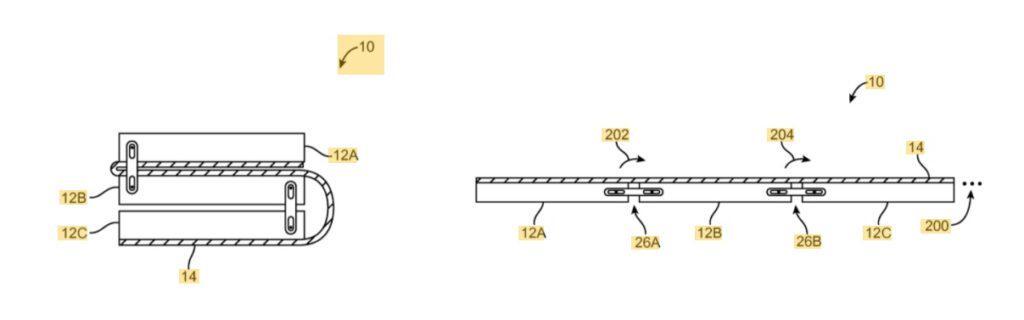
Apple's first patent for a foldable smartphone
The highlight of this patent is the introduction of up to four types of hinges, each with a different function. For example, the four - bar linkage hinge can simulate a more natural bending curve, making the screen bend more smoothly.
However, the extremely complex design and precise structure do not seem to have achieved Apple's ideal results, and the foldable iPhone has been delayed for many years. Instead, Apple's exploration has inspired its competitors. According to statistics, by 2021, this patent had been cited 372 times in total by companies such as Samsung and LG [1].
Since 2016, every update of the rumors about the release date of the foldable iPhone has almost been accompanied by the exposure of Apple's new - generation crease - related patents. Apple's approach can be roughly divided into two directions:
One is to keep adding elements. From filling the outer glass cover of the screen with materials to increase its "elasticity" (in 2016), to pre - planning and manufacturing a "special folding area" on the cover (in 2018), and even installing a heating element inside to prevent the screen from "brittle cracking" in winter (in 2019) [2].
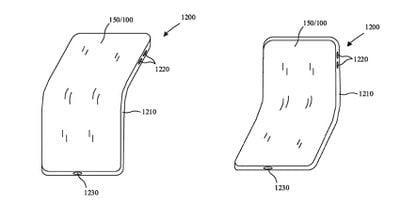
The design concept of adding a "protective layer" to prevent cracking (in 2020)
The other is to "replace folding with splicing". For example, two patents exposed in 2020. One is to set a retractable baffle between the upper and lower screens, which extends to cover the gap when the phone is unfolded. The other is to work on communication, combining two independent displays into one.
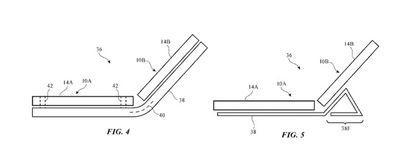
The design concept of "replacing folding with splicing" (in 2020)
These attempts obviously did not meet Apple's requirements. As a result, the release of the foldable iPhone has been postponed year after year, causing well - known leakers such as Mark Gurman, a Bloomberg columnist, and Guo Mingchi, an Apple expert, to make inaccurate predictions about its release time.
Considering that the release of the foldable iPhone is imminent, it can be inferred that the crease problem has reached a state that satisfies Apple. According to the latest reports, the structure, materials, and processes have all been secretly developed by Apple for five years, and it is expected to be unveiled at the last press conference before Cook's retirement.
However, Apple still needs to face a real - world problem: The poor sales of small - fold smartphones may have little to do with creases.
The Beautiful But Useless Gadget
Contrary to the high profile on social media, the actual sales of small - fold smartphones have been sluggish. In China, the largest market for foldable smartphones, the shipment volume of small - fold smartphones in 2024 was less than half of that of large - fold smartphones [3]. If foldable smartphones are niche products, small - fold smartphones are even more niche.
Over the years, small - fold smartphones have failed to solve two key problems:
Firstly, in terms of functionality, they cannot provide a differentiated experience compared with bar - style smartphones; secondly, in terms of business, they cannot bring higher profit margins to manufacturers.
Functionally, a small - fold smartphone is actually a "foldable bar - style phone". Compared with a real bar - style phone, a small - fold phone has an additional external screen but sacrifices a lot of functionality.
The internal space of a phone is extremely limited. Compared with a bar - style phone, a small - fold phone first adds a hinge, which takes up a large amount of space, eroding at least 10% of the internal space. Since the battery cannot be folded, most small - fold phones have two battery modules, and their battery life is generally shorter.
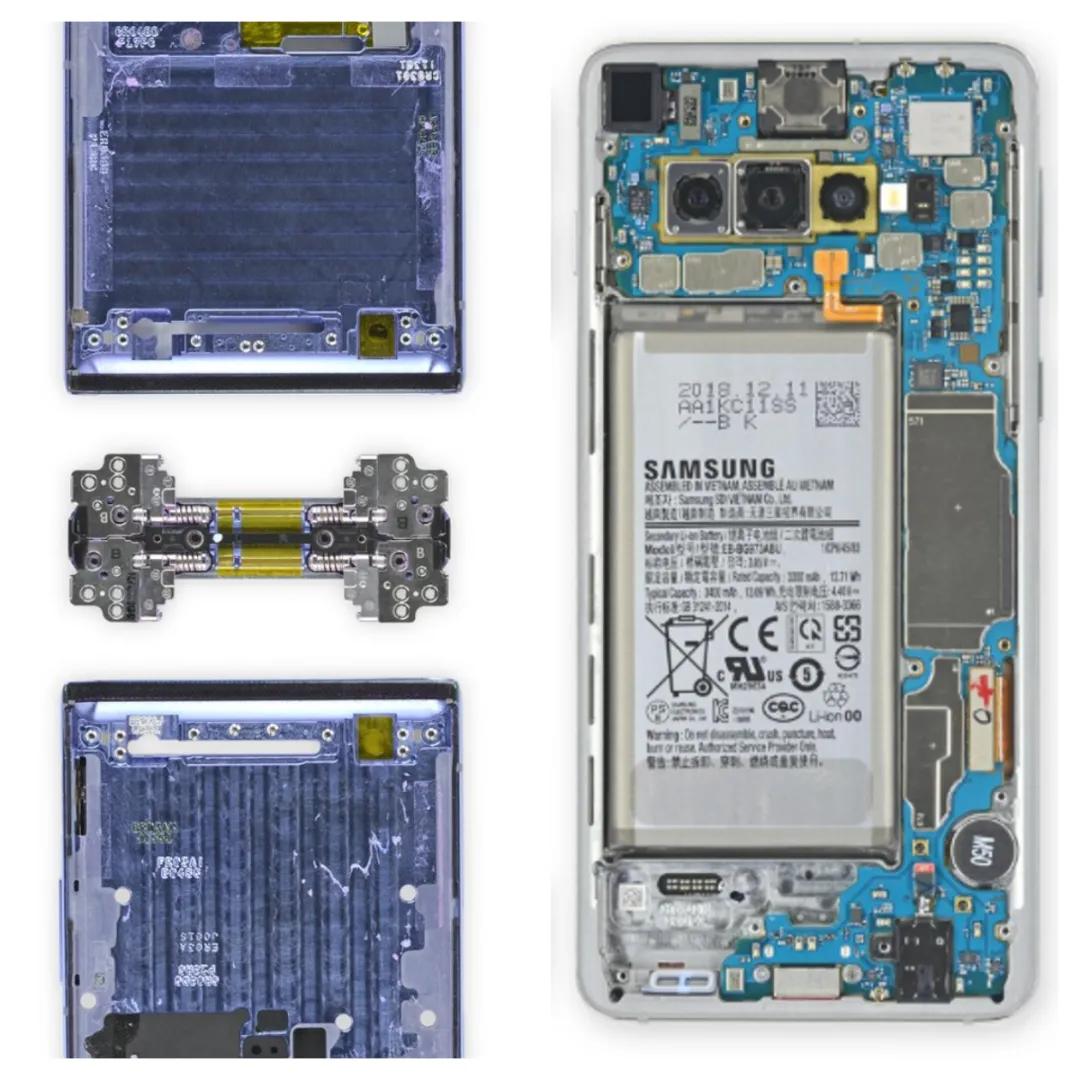
Samsung's small - fold phone (left) and Samsung's bar - style phone (right)
Considering integration and heat dissipation, the camera module and processor of a small - fold phone are often inferior. Compared with the standard configuration of three cameras and the flagship configuration of four cameras for bar - style phones, most small - fold phones only have two cameras.
OPPO's Find X6 Pro, released in 2023, is equipped with a one - inch large - sensor wide - angle lens and a periscope telephoto lens. In the same year, due to space limitations, OPPO's small - fold product, the N3 Flip, could only be equipped with three relatively ordinary cameras at best.
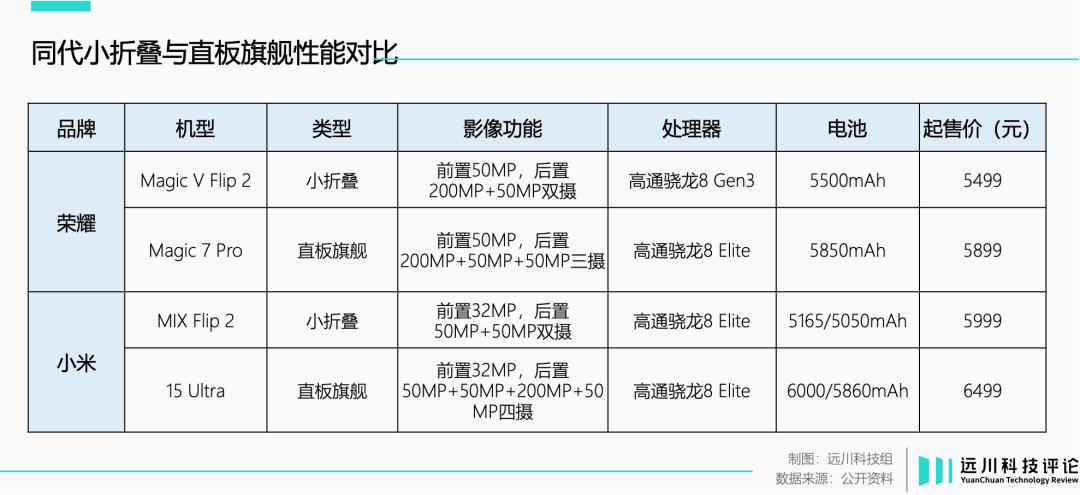
The battery, camera, and processor are crucial for a phone's core functionality. Can the additional external screen of a small - fold phone make up for the lack of experience in these core aspects? Judging from the market feedback, it seems not.
Huawei was the first to recognize the potential of the external screen. The P50 Pocket presents notifications, music, payment, and other functions in the form of slidable cards and adds fun features such as "smile capture". OPPO has made the external screen larger than 3 inches and adapted multiple applications. Xiaomi once took an unconventional approach by bundling a portable camera set.
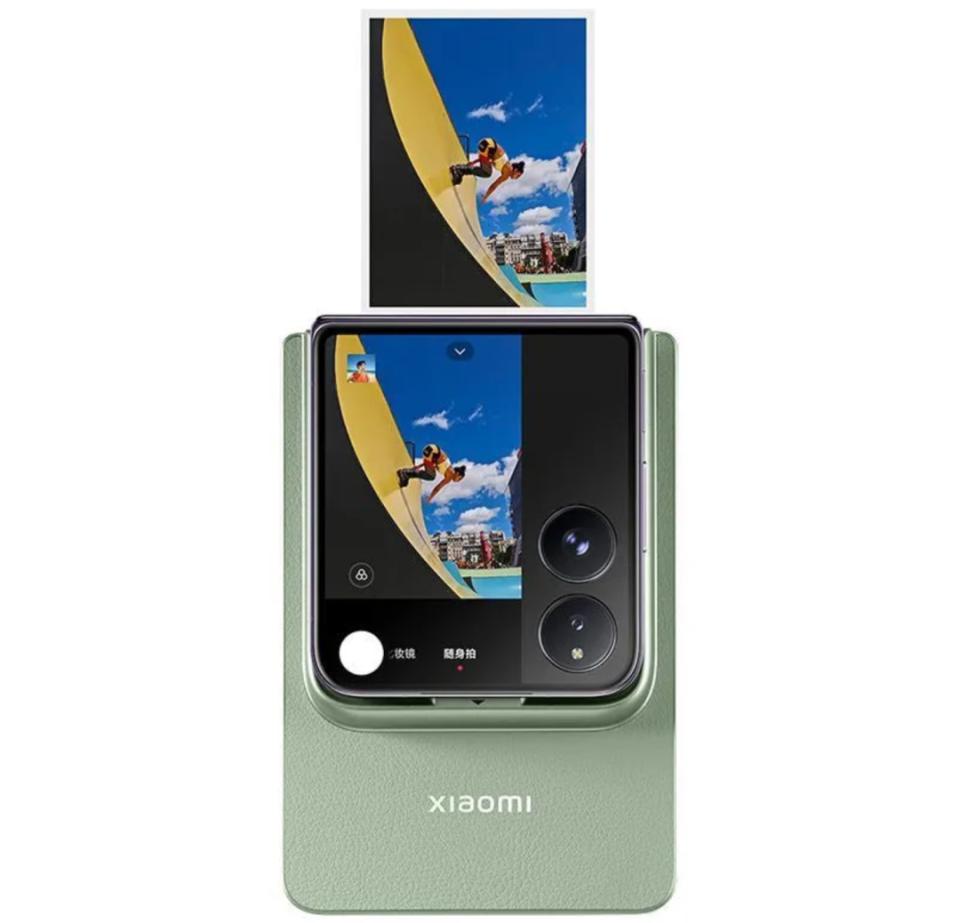
The instant - camera set of Xiaomi's MIX Flip
However, judging from the market feedback, the substitution effect of small - fold phones for bar - style phones has always been limited.
For manufacturers, the extremely limited profit margin of small - fold smartphones is an even more thorny problem.
As a product category with strong rigid - demand attributes, most consumers judge the price of a phone based on the principle of "one - to - one correspondence between function and price". Since small - fold smartphones lack functional differentiation compared with bar - style phones, there is actually an invisible ceiling for their pricing: The price of bar - style phones of the same generation.
Judging from the pricing of each manufacturer's product lines, it seems to be an unspoken rule in the industry that the price of small - fold smartphones should not exceed that of bar - style flagship phones of the same generation.
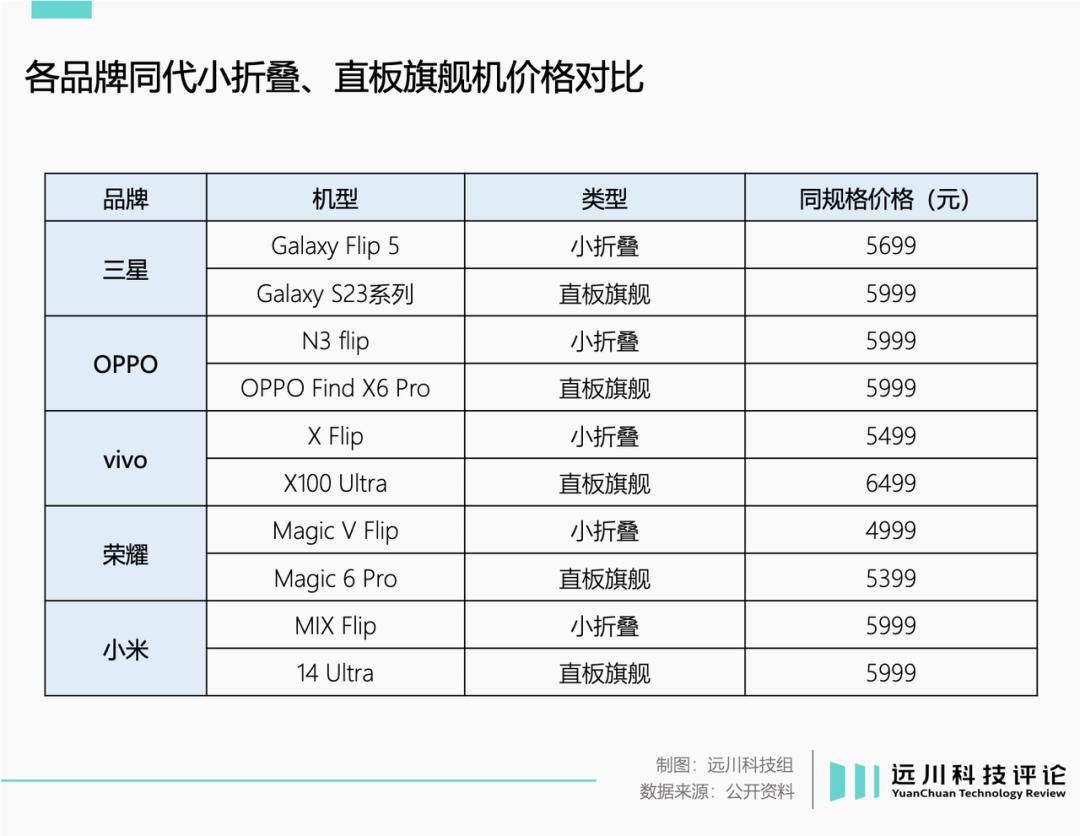
The general development logic of most consumer electronics products is to first determine the price and profit margin, and then select various components and sensors based on the cost. When the price ceiling is set, engineers have to make trade - offs.
Compared with bar - style phones, small - fold phones add a series of costs, including hinges, flexible screens, external screens, irregular - shaped batteries, and stacked motherboards. For example, the cost of the hinge component of OPPO's Find N3 Flip exceeds $100 [4], and the foldable screen is even more expensive. In contrast, the screen cost of an iPhone is less than $90.
If other components are the same as those of bar - style phones of the same generation, manufacturers will earn less for each small - fold phone sold. If they cut costs on other components to increase profits, it will pose a dilemma for consumers:
The additional cost for the foldable screen does not create new functions, while the compromises in performance, imaging, and battery life are clearly felt in daily use.
Phones are not like blind - box toys. Being beautiful is not enough. Most consumers may go through such a decision - making process: they want to place an order immediately after the press conference but decide to wait after careful consideration.
Where there's a will, there's a way out. Some players are already withdrawing from the market before Apple even enters.
Beauty Is Not Enough
In February last year, while researching Apple, Guo Mingchi also took the time to focus on the small - fold smartphone market. In his report, he mentioned that OPPO and vivo had suspended the development of small - fold smartphones [5].
The initial investment in consumer electronics products is very large, and continuous product iteration is needed to gradually reduce R & D costs and increase profits. If a product line is no longer updated, it is probably because of poor sales.
At the same time, OPPO's offline dealers once told the media that the actual activation number of the N2 Flip, released in 2022 and the best - selling small - fold smartphone in China that year, was less than 200,000 [4], accounting for less than 0.2% of OPPO's annual shipment volume.
After the report was released, OPPO flatly denied it, and vivo ignored it. The fact is that neither company has updated its small - fold products since then, while they have continued to release new large - fold smartphones. Currently, except for Samsung, which has strong financial resources, manufacturers' attitudes towards small - fold smartphones can be divided into three categories:
One category includes OPPO and vivo, which entered the market relatively early and exited quickly, effectively discontinuing their small - fold product lines. Another category includes Xiaomi and Honor, which entered the market relatively late but are still persevering. Huawei is relatively special, as it has made a significant change in its positioning of small - fold smartphones.
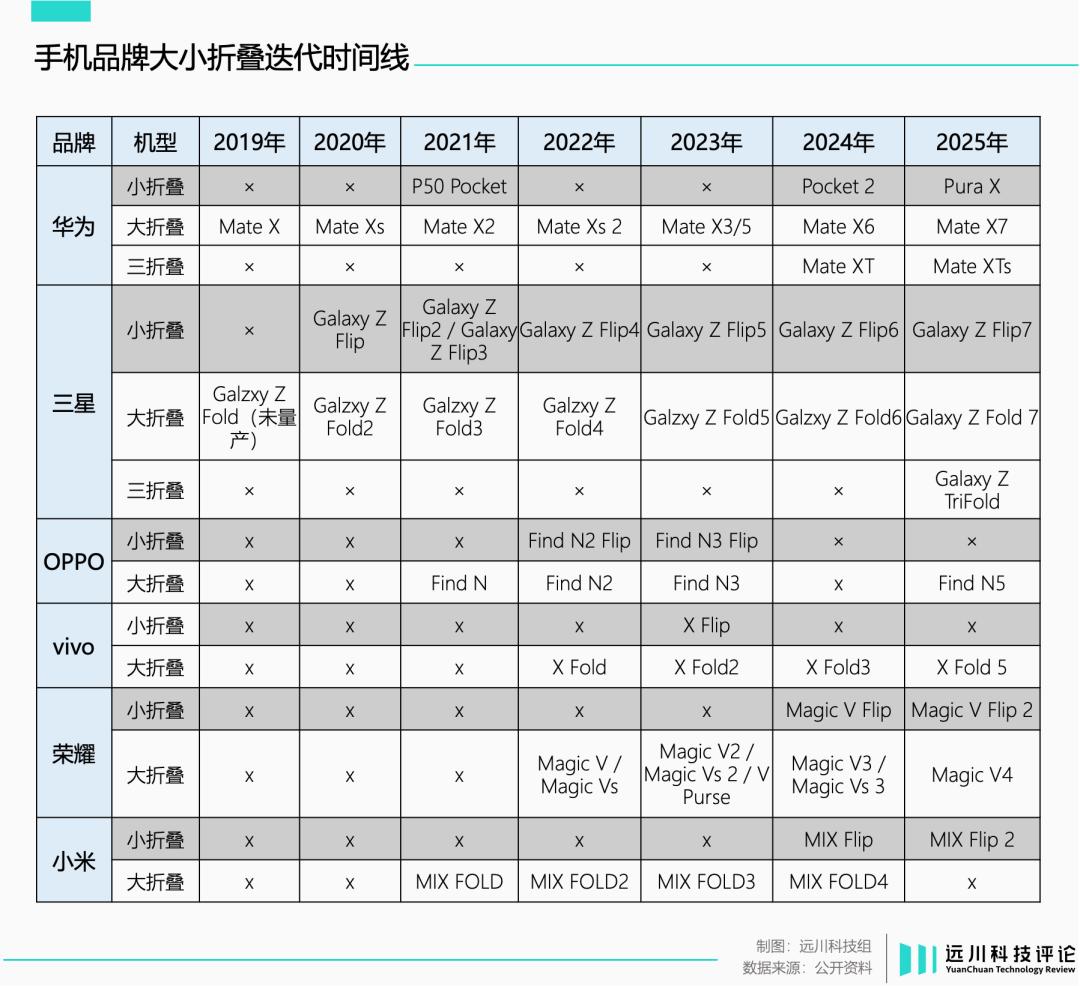
In 2021, Huawei launched its first small - fold product, the P50 Pocket, and released an iterative version, the Pocket 2, in 2024. Interestingly, the press conference for the Huawei Pocket 2 was positioned as a "fashion event", and the product design and marketing strategies were oriented towards fashion