When smart glasses become a short-lived trend in the tech circle, can AI glasses break the curse?
The entry of industry giants is often a sign of the maturity of a market segment. Start - ups like Rokid, Thunderbird Innovation, and Yingmu Technology are the pathfinders in this segment. Now, they are all converging in the "Year of AI Glasses".
Recently, the top keyword of Weibo for 2025 was announced, and it's an old yet fresh term: Cyber.
This term has been around for nearly a century and has undergone multiple rounds of dissemination and evolution in the context of the Internet. Its core meaning needs no further explanation, and it has also spawned numerous new Internet memes. What makes it fresh is its unique essence - it always anchors the wildest imaginations about the future.
Once the science - fiction fantasies associated with the term "Cyber" turn into reality, they shed the "Cyber" label. Then, more cutting - edge and futuristic concepts quickly take over the discourse power of "Cyber", keeping the term always full of exploration and romance towards the unknown.
As the top Weibo keyword of 2025, "Cyber" is like a puzzle piece, giving rise to new terms such as "Cyber Buddies", "Cyber Pets", "Cyber Cloud Wishes", and "Cyber Gossiping". More than 150 million Weibo posts have mentioned the term "Cyber".
When 2025 is regarded as the "Year of Many Smart Technologies", the comment section has become a "Cyber Wishing Well", and AI has become a "Cyber Buddy". Meanwhile, the term "Cyber" has quietly shed its science - fiction filter and entered real life.
If we have to choose a consumer product related to "Cyber", glasses are the obvious choice. From VR to AR and then to AI, the "leading actors" in the "Battle of a Hundred Glasses" have been changing. In the past, AI glasses or smart glasses created demand by combining functions. However, in 2025, AI glasses shed their previous glories and started to break into the mass consumer market from the niche of tech enthusiasts.
AI on Glasses
Right after the Double 11 shopping festival this year, Zhu Mingming, the founder of Rokid, admitted at a press conference that there was a miscalculation in production capacity this year. Since Rokid Glasses went on sale on September 1st, 40,000 units were sold in just 5 days. At the beginning of the year, the internal forecast for the annual shipment volume was between 100,000 and 150,000 units, which was already a very aggressive forecast at that time.
The sales data from e - commerce platforms are more straightforward.
Data from JD.com shows that during this year's Double 11, the top three categories with the highest growth rates in the turnover of 3C digital products were smart glasses (346%), digital cameras (238%), and action cameras (220%). This indicates that in an era when mobile phones are highly competitive in photography, the demand for shooting devices still exists, and shooting is one of the core selling points of AI glasses.
Tmall's sales data shows that the turnover of smart glasses during this year's Double 11 increased by 2500% year - on - year.
The maturity of product function design and industrial chain production capacity has enabled smart glasses to quickly enter the channel of sales growth. According to an IDC report, in the first half of 2025, the global shipment volume of smart glasses reached 4.065 million units, a year - on - year increase of 64.2%. The global shipment volume of smart glasses in 2025 will reach 12.05 million units, a year - on - year increase of 18.3%. Among them, the Chinese market will exceed 2.75 million units, a year - on - year increase of 107%, ranking first in the world.
Since November 2025, Lenovo, Baidu, Alibaba, and Li Auto have successively launched AI glasses. Coupled with Huawei, Xiaomi, which entered the market earlier, and ByteDance, which acquired PICO from Tencent, the AI glasses market has gathered Internet giants, mobile phone manufacturers, precision manufacturing enterprises, and traditional eyewear manufacturers.
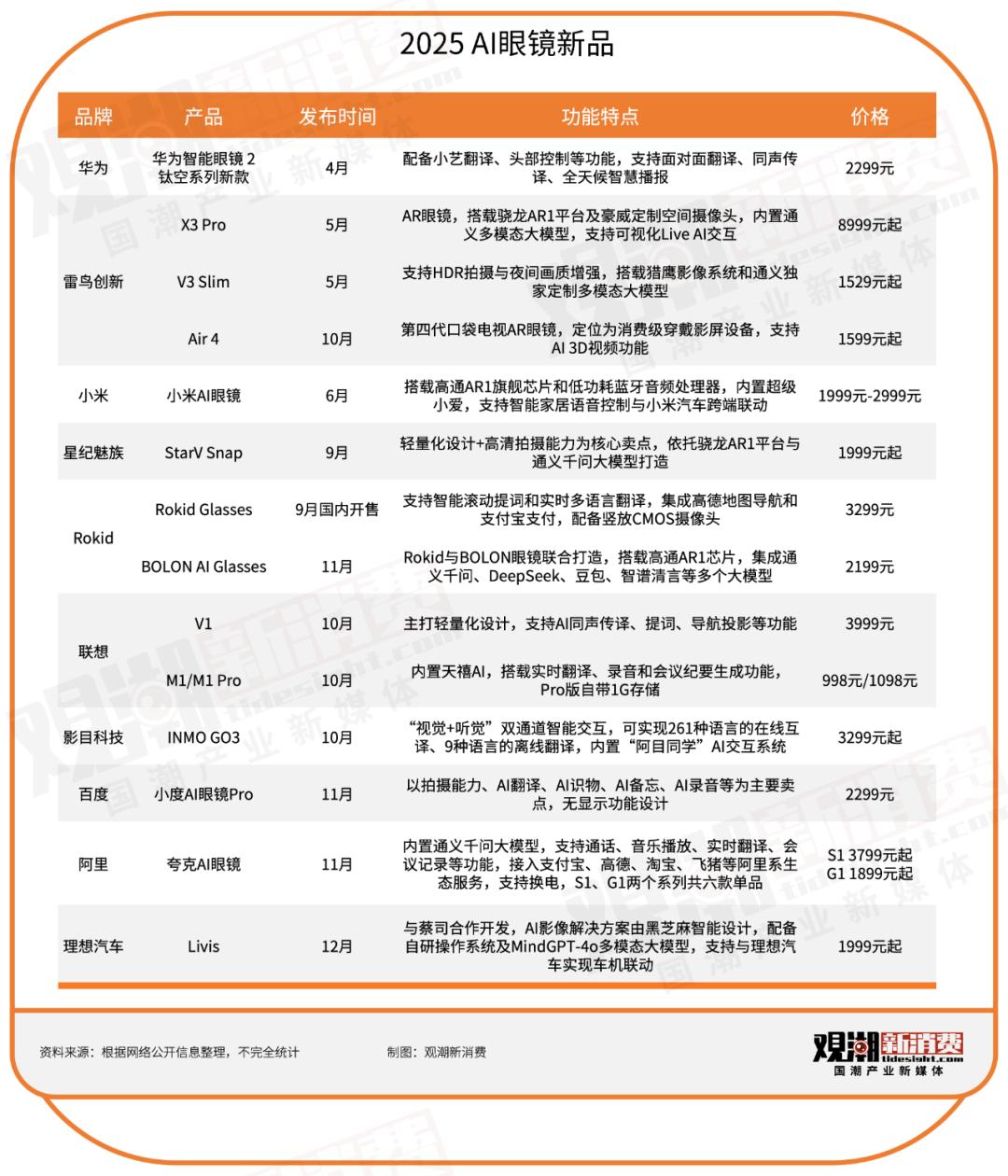
New AI glasses products in 2025
The frequent release of new products has shaken up the rankings on e - commerce platforms. First, Xiaomi topped the hot - selling list of smart glasses on JD.com. Then, during Double 11, Rokid's turnover on Tmall increased by more than 7 times year - on - year. Later, on the night of its launch, Quark AI glasses topped the relevant category lists on platforms such as Douyin, Tmall, and JD.com.
The entry of industry giants is often a sign of the maturity of a market segment. Start - ups like Rokid, Thunderbird Innovation, and Yingmu Technology are the pathfinders in this segment. Now, they are all converging in the "Year of AI Glasses".
In 2025, the most obvious change in the consumer market for AI glasses is the price drop.
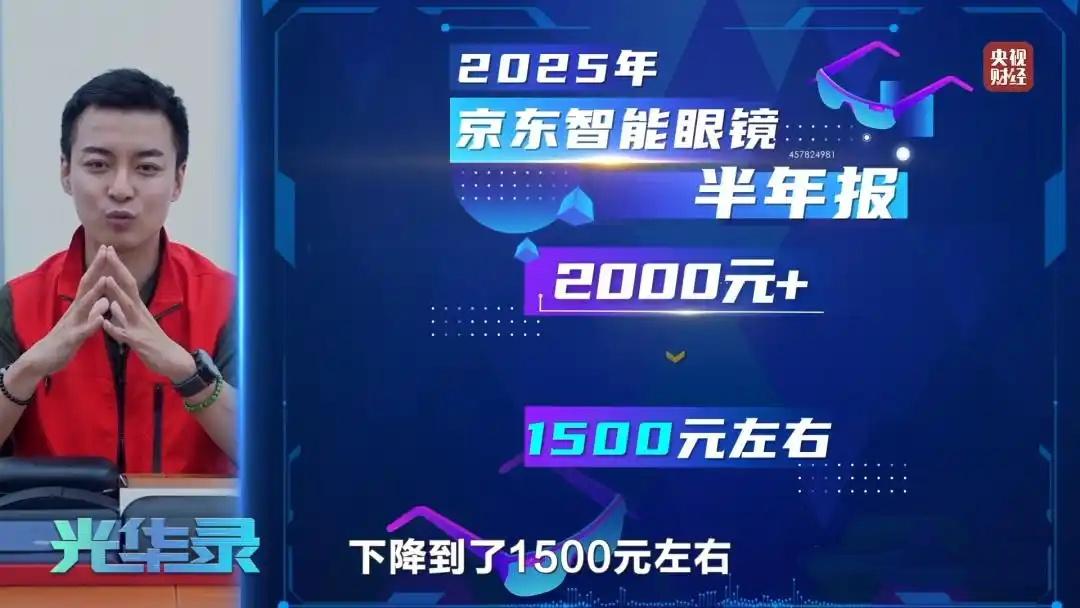
According to the semi - annual report of smart glasses on JD.com, in the first half of 2025, the average price of smart glasses dropped from over 2,000 yuan to around 1,500 yuan.
Xiaomi's first AI glasses, released at the end of June, are priced at 1,999 yuan. After the national subsidy, the price starts from 1,695 yuan. Li Auto's Livis, released in early December, also has a starting price of 1,999 yuan. After the national subsidy, the price starts from 1,699 yuan.
Quark, a subsidiary of Alibaba, has released two versions of AI glasses. The G1 is priced at 1,899 yuan, and the S1 is priced at 3,999 yuan. The difference lies in the display function, while the hardware configurations such as the chip and shooting remain the same. Through the "high - end and low - end" combination, the entry - level price is lowered.
The continuous decline in hardware costs, fierce market competition, large - scale industry growth, and user subsidies are the core driving forces for the price drop. As the product form becomes more complete, the price system becomes more hierarchical. Brands indirectly lower the entry - level price through multiple versions, bringing the product price down to around 1,500 yuan, which is very close to the price of a pair of mid - to high - end ordinary glasses.
A report from Guotai Junan Securities points out that below 1,500 yuan has become an unspoken price breakthrough point in the AI glasses industry. Major brands are adjusting their product strategies around this goal to further lower the overall average price.
Another change is the maturity of product functions.
For a long time, the technology consumer industry has been looking for the next - generation smart terminal to recreate a "smartphone industry". In the wearable device market, glasses are the medium for interaction between people and between people and the environment. As the peripheral device closest to the facial features, they are regarded as the next - generation sensory center that extends human perception.
Consumer - grade smart glasses have been exploring the entertainment function for many years, and it wasn't until 2025 that they truly entered the explosion period, which coincided with the popularity of large - scale models and clearly benefited from it.
When smart glasses are connected to large - scale AI models, their capabilities and response speeds in voice, vision, translation, etc. are greatly improved. In terms of practical functions, they have expanded to multiple dimensions such as payment, navigation, and e - commerce. AI glasses are regarded as one of the best carriers for the implementation of large - scale AI models, and large - scale models are the key driving force for AI glasses to gain popularity.
In addition, most large - scale AI models are open - source and free. Connecting to large - scale models does not incur high costs, which helps AI glasses quickly transform from concept products to consumer products, from "toys" for geeks to "tools" for mass consumers.
Thunderbird has joined hands with Tongyi to create the industry's first large - scale AI model specifically for smart glasses. Rokid has integrated multiple open - source large - scale models such as Tongyi Qianwen, DeepSeek, Doubao, and Zhipu Qingyan. Xiaomi's AI glasses are equipped with its own Xiaoai classmate and connected to Shangtang's "Rixin" large - scale model. Alibaba's Quark AI glasses are connected to the Tongyi Qianwen large - scale model.
Yin Chuanxue, the co - founder and vice - president of operations of Yingmu Technology, said that the emergence of AI has accelerated the popularization of smart glasses. The application of AI has reduced the computing power requirements of glasses, making it possible to make glasses lighter. Glasses are considered the product most likely to replace the scale of mobile phones. In the long run, the future of smart glasses lies in AI.
IDC data shows that in the second quarter of 2025, the proportion of smart glasses products supporting large - scale model voice assistants increased by 14.4% year - on - year, and the shipment volume increased by 281.5% year - on - year.
IDC analysis shows that in the future, the ability to access multiple models will become the focus of competition, helping smart glasses to call the most suitable AI solutions in different scenarios. Smart glasses will enter a deeper stage of exploration and optimization in terms of large - scale AI model adaptation and software collaboration.
The One - Year Fad
The smart glasses industry has long faced a core challenge, the so - called "Impossible Triangle" paradox: it is difficult to achieve a lightweight wearing experience, high - performance operation, and long - lasting battery life in the same product.
The ultimate form of smart glasses in "Ready Player One" cannot be achieved overnight. Currently, there are mainly three product development routes: AI audio glasses, AI shooting glasses, and AI + AR glasses.
From VR headsets to AR glasses and then to AI glasses, the smart glasses market has finally entered the consumer market through AI capabilities. However, more functions do not necessarily mean a better experience. Weight and battery life also need to be considered, which is the fundamental reason why the smart glasses market has been hyped up for years but failed to gain widespread adoption.
In 2011, 18 - year - old Palmer Luckey developed the prototype device CR1 in his parents' garage. The following year, he received investment from Brendan Iribe, and the two co - founded Oculus. At that time, they could not have predicted that on the tenth anniversary of the company's founding, their VR devices would capture more than 80% of the global market share in a single quarter.
Also in 2012, Google released its first consumer - grade AR glasses, Google Glass, with the core positioning of "exploring augmented reality interaction". It pioneered the overlay of digital information on the real - world view, becoming one of the earliest consumer - grade AR terminals in the industry.
The year 2016 was known as the "Year of Virtual Reality". The three core VR headset products, Oculus Rift, HTC Vive, and Sony PlayStation VR, were launched one after another, covering the consumer market at different price points. This marked the transition of VR hardware technology from the laboratory to ordinary consumers, and consumer - grade VR became a hot trend.
According to data from the "Research Report on the Internet + Film and Television Industry" in the domestic market, from 2015 to 2016, the number of VR companies increased eightfold to more than 1,600. According to the "Big Data Report on Investment and Financing in the VR/AR Market in the Past Decade" released by Qichacha, there were as many as 411 domestic VR/AR financing events from 2011 to 2021, with a total amount of 10.2 billion yuan. Among them, 2016 was the peak year of financing, with a total of 120 events and an amount of 2.5 billion yuan.
However, in 2017, the VR market suddenly cooled down.
Looking back at the technology industry in those years, both giants and start - ups seemed to be chasing hot trends calmly and effortlessly. The speed at which an idea turned into a market segment far exceeded the speed at which consumers could notice. However, the hardware market represented by VR did not have strong R & D and supply - chain capabilities. When capital completed its bets, giants allocated funds, and brands held press conferences, these products were destined to enter the market for testing. Thus, the first domino fell.
Consumers who had experienced VR glasses felt dizzy first, and then the sense of dizziness spread up the supply chain. The hardware delivery and interaction in the C - end market were very cumbersome, and the VR market could not meet the needs in terms of both hardware and ecosystem. Whether it was giants or start - ups, they all crossed the 0 - to - 1 stage with the support of capital, but the user scale, data accumulation, and business models were not mature enough.
In 2018, the VR industry shifted from "capital frenzy" to "rational reshuffle". Intel disbanded its smart glasses and wearable device team and announced its withdrawal from the AR/VR market. IMAX announced the closure of all its offline VR experience stores and cancelled its cooperation with Google in VR, completely withdrawing from the VR market. Many start - ups also quietly left this hot trend.
In the following years, capital flowed into the blockchain industry, and the VR market entered a deep adjustment period. It wasn't until 2021 that the metaverse became a new hot trend, and smart glasses, as the entry point, became popular again. Roblox went public on the New York Stock Exchange and became the "first metaverse stock". Its prospectus clearly defined the eight core elements of the metaverse, transforming the science - fiction concept into a quantifiable business model and triggering global capital's attention to the metaverse.
Then, a similar scenario unfolded. In 2022, the investment and financing scale of the metaverse reached its peak, with a total of 704 financing events globally, amounting to 86.867 billion yuan. In the Chinese market, there were 124 metaverse financing events, with a total amount of 12.782 billion yuan. ByteDance acquired Pico and invested in Code Qiankun. Baidu developed the metaverse social platform "Xirang". Alibaba's DAMO Academy established an XR laboratory. Tencent registered the "QQ Metaverse" trademark and laid out the VR/AR hardware ecosystem.
The evolution of smart glasses can be clearly seen through the development of a single company. In 2014, Facebook acquired Oculus for $2 billion, and Luckey continued to be responsible for core technology R & D. Oculus became a key part of Meta's metaverse strategy. In 2021, Facebook officially changed its name to Meta and fully bet on the metaverse. In 2023, the metaverse bubble burst, and Meta laid off a large number of employees due to losses in its metaverse business. In 2024, generative AI became a new hot trend in technology, and Meta shifted its strategic focus to "AI + Metaverse".
Although Meta has changed its focus several times, its commitment to the smart glasses market remains unchanged. Oculus once held an 80% share of the global AR/VR headset market in Q4 2021, and the global share of the Quest series of devices reached nearly 90% in Q1 2022. The total market share of all VR devices under Meta exceeded 60% in mid - 2023, firmly ranking first in the global VR device market.
AR glasses have followed a relatively less - eventful path. Vuzix, Yingmu, and Thunderbird each released their first consumer - grade AR glasses products in 2021, and then XREAL, Lenovo, Meizu, etc. also joined the fray.
The core difference between VR and AR indeed lies in the display method, and this difference directly determines their technical logic, usage scenarios, and user experience.
VR emphasizes "immersive virtual reality", completely isolating the real environment through the display device and constructing a closed, immersive virtual digital space for users. All of the user's visual perception comes from virtual content. AR, on the other hand, is "augmented reality", overlaying virtual digital information (text, images, models, etc.) on the real - world environment through the display device to achieve a "real + virtual" integrated presentation. Users can still perceive the real world.