The financing story of Muxi: A wealth-creation myth of 330 billion in five years
The opening of Monolith was even more astonishing than the remarkable Moore Threads.
Just now, Monolith opened at a high price of 700 yuan per share, and its market value once exceeded 350 billion yuan, instantly surpassing Moore Threads, which went public 12 days ago. In the secondary market, Monolith is a "lucrative lottery ticket" pursued by stockholders. Based on the issue price of 104.66 yuan per share, winning one lottery ticket in the new - share subscription can yield a profit of nearly 400,000 yuan.
Monolith's listing is a huge reward. As a hardcore technology company, Monolith took only an incredibly short five years from its establishment to listing, and enabled more than 100 investment institutions to obtain substantial returns.
Looking back at Monolith's financing story, we can of course abstract it into sets of numbers, forming a picture of a "wealth feast". For example, the Pre - A round investment with a known valuation of 1 billion yuan has multiplied 280 times by now. Even in the Pre - IPO round at the beginning of this year, with a post - investment valuation of 21 billion yuan, it has multiplied 13 times in less than a year - this is extremely high investment efficiency.
The dividends of the specific macro - environment have selected and rewarded many "sons of the era", and Monolith is one of them. Today's phenomenal performance in the secondary market is also the result of a just - right macro - rhythm, just - right internal and external driving forces, and just - right market sentiment.
However, the fact is that the battle is far from over. Monolith rarely makes public statements. If you have the patience to closely examine each round of its financing, challenges always outnumber the acclaim, and perseverance and hard work are the continuous main themes. Even though more than 100 investors have invested in Monolith, seemingly a consensus club deal, in fact, there are non - consensuses at every step.
Everyone wants to be the "Chinese NVIDIA" or the "Chinese AMD". Since this path has been chosen, listing is just a trivial node, and the real test has just begun.
In the process of communicating with multiple Monolith investors this time, most of them clearly realized this, and I saw the growth of primary market investors.
The last of the "Four GPU Upstarts"
Monolith is the last one to be established among the "Four GPU Upstarts".
In September 2020, Monolith was established. Two months later, Monolith completed its angel - round financing, with an unknown valuation. The investors were two somewhat unfamiliar names: Heli Capital and TEDA Technology Investment. According to public information, the former is a semiconductor investment institution, and its leader was an early investor in Cambricon, while the latter is an established institution in Tianjin.
During the same period, Moore Threads, which was established earlier, completed two rounds of financing in three months, and its valuation exceeded 1 billion US dollars within less than 100 days of its establishment. The other two of the Four Upstarts, Enflame and Biren, established in 2018 and 2019 respectively, had also secured cumulative financings of over 1 billion and 2 billion yuan at that time.
The money in the primary market is not infinite. Especially, early - stage VCs have a professional logic of "picking the best in the track" - in each track, investment institutions often only bet on the one they are most optimistic about. It can be said that Monolith was in a somewhat passive position in terms of financing from the very beginning of its establishment.
More than one institution said that they did not invest in Monolith in the early stage simply because they had invested in other upstarts. Apart from this, Monolith was not the first choice for some investors.
Early - stage investment is about investing in people. There was Moore, which had a background from NVIDIA and seemed more well - known. However, Monolith's team also had a dazzling background, known in the industry as the "Iron Triangle" from AMD. The founder, Chen Weiliang, was the global GPU SoC design director at AMD, with over 20 years of experience in GPU design and mass production. The hardware CTO, Peng Li, was the first Chinese female scientist at AMD globally, and the software CTO, Yang Jian, was the first scientist in the Greater China region at AMD.
Early - stage investors in Monolith generally valued two points: a full - fledged team with complete experience from GPU chip design to mass production, and a pragmatic approach.
In the month when Monolith was established, Cao Xi, who was still working at Sequoia at that time, had contact with Chen Weiliang. His impression of Chen was that he was "very pragmatic and extremely experienced". In Cao Xi's view, Monolith assembled a complete and robust core team in a very short time and managed the organization very maturely and efficiently, which was very rare among startups.
Zhu Jia, then an assistant partner at Lightspeed China (now a partner at Photosynthetic Capital), also learned about this new startup team through a former colleague at AMD China. Introduced by the colleague, Zhu Jia quickly met with Chen Weiliang. In Zhu Jia's view, Monolith's team combination was very rare in the industry because computing power chips are a highly complex system, and both the design and implementation of hardware and the construction of software platforms and ecosystems are crucial. Only a team with long - term technical accumulation and sufficient engineering practice can achieve this, which was the key factor for him to choose to invest in Monolith.
Soon, Monolith received an investment of 110 million yuan from Sequoia. ZhenFund also joined in the same round. The pre - investment valuation of this round was about 1 billion yuan. Less than a month later, Monolith received Pre - A+ round investment from Matrix Partners and Lightspeed China, and the post - investment valuation doubled to around 2 billion yuan.
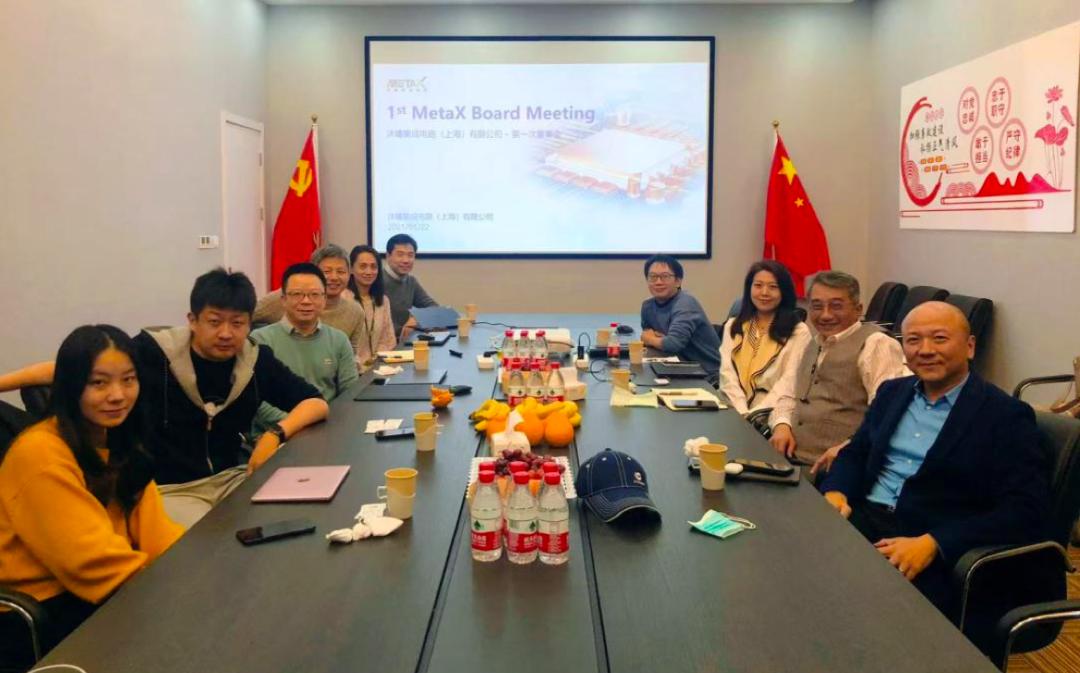
January 22, 2021, Monolith's first board meeting. Source: Monolith
Han Yan, the co - founder of Lightspeed China and the founding partner of Xin Capital, recalled to China Venture Capital that at that time, GPUs were recognized as high - value chips, but they did not yet constitute a particularly popular "track". Most investors were still researching what to invest in the semiconductor field, how to invest, and which company to choose. Whether to invest in DPUs or GPUs, how to choose among the Four Upstarts, and whether it was too late to enter the market.
Even though the industry thought that it was difficult and risky to develop domestic GPUs, Han Yan still believed that GPUs, with the highest technical content and barriers, were the most worthy investment direction.
Non - consensus often comes with disagreements. Monolith inevitably faced debates among early - stage investors in the IC. Even after passing the review, the continuous capital gap, geopolitical risks, and supply - chain security would still concern investors.
Soon, in August of that year, national - level funds officially entered the market, and Monolith completed a 1 - billion - yuan Series A financing. The investors included the State - owned Capital Adjustment Fund, China Internet Investment Fund, Guochuang Zhongding Investment, Smart Interconnection Industry Fund, Shanghai Science and Technology Innovation Fund, Lenovo Capital and Incubator Group, China Merchants Jintai Capital, Fosun RZ Capital, Orient Fortune Capital, Chuangtu Investment, etc. Old shareholders such as Matrix Partners, Heli Capital, Sequoia China, and Lightspeed China continued to increase their investments.
For early - stage investors, "holding on" was probably a more challenging thing. Although Monolith had the endorsement of the "national team", in the next one or two years, some early - stage investors still felt great pressure because Monolith's cash flow was always tight. The money raised was quickly consumed, and there seemed to be no obvious improvement in products and tape - outs, and there was no hope of self - sufficiency in the short term.
Another sword of Damocles hanging over their heads was the continuous demand for old shares. An early - stage investor recalled that when the valuation was between 5 billion and 10 billion yuan, it was the first small peak for Monolith's old - share transactions. At that time, he was always very nervous because every demand for old shares meant the possibility of being sold.
An investor mentioned an interesting perspective. In his view, the entire GPU industry should thank Zhang Wen, the founder of Biren. Biren's financing had set a benchmark for chip financing and valuation, providing market education and giving investors an idea of how much money was needed in this track. This also increased the tolerance of subsequent chip investors for financing, valuation, and capital consumption.
The "Most Difficult Year"
Time moved on to 2022, which was later recognized by investors as the year when Monolith might face the most difficult financing situation.
The enthusiasm for financing declined rapidly because the company's high burning rate made many investors hesitate. In 2022, Monolith's revenue was a negligible 427,000 yuan, while the loss reached as high as 770 million yuan. Coupled with the drastic change in the macro - environment that year, primary - market investors began to "look up at the sky" and became extremely cautious in making investments. The sanctions event at the end of 2022 also discouraged a group of investors from continuing to wait and see.
Another difficulty was that almost all the favorable factors had been exhausted. At that time, there was still a year before the explosion of large - scale models. The markets for AI training, inference, and applications had not been activated, and the demand only existed in computing power centers and the vague concept of domestic substitution.
From the very beginning, Monolith targeted the high - performance GPU computing market, which was more difficult and had higher barriers. Its vision was to independently develop core IP from scratch, design the GPU architecture and instruction set autonomously, and build a Chinese GPU company with independent intellectual property rights.
At that time, Monolith already had a clear business plan - the N series (AI inference), the C series (AI training and general computing), and the G series (graphic rendering). Among them, the 7nm process heterogeneous GPU chip had been officially taped out, but investors still had not seen the mass production of the products.
For many investors, the attractiveness of Monolith at this stage largely came from its relatively reasonable valuation. The pre - investment valuation of 6.8 billion yuan was not low, but compared with companies such as Biren, Moore, Enflame, and Tianshu, whose valuations had already exceeded 10 billion or even 20 billion yuan, it was relatively more acceptable.
Xiang Yuqiu and Zhang Menghan, two partners at Hexuan Capital, recalled that when they contacted Monolith in 2022, its financing was not easy. The valuation, products, and revenue were all stuck in an awkward middle position. However, they made an investment in this round and continued to increase their investment in the following two years, with a total investment of about 200 million yuan.
Xiang Yuqiu and Zhang Menghan came from the Wall Street's Morgan investment bank. Before that, they had conducted in - depth research on the GPU industry for several months. They noticed that in 2014, with the explosion of the application of AlphaGo in artificial intelligence, the application scenarios of GPUs had expanded explosively from game graphics cards. NVIDIA, AMD, etc. had surpassed established semiconductor companies such as Intel with their GPUs, and their stock prices had continuously reached new highs. All of this happened within a span of only five or six years. This made them realize the huge commercial value of GPUs and get ready to invest.
However, the above - mentioned view was heard from more than one investor. Investing at this "three - nothing" node actually showed courage. They joked that it was more of a "belief in Monolith's team". In their eyes, "William (Chen Weiliang) is a world - class semiconductor expert and leader".
An industry rumor is that, different from many technology giants, AMD did not only focus its R & D overseas. As the perennial second in market share, AMD was more enthusiastic about exploring emerging markets and had a R & D center in Shanghai. In the internal competition, the Shanghai high - performance GPGPU R & D team led by Chen was even a more capable R & D force.
They were very excited about this team leaving AMD to start a business, believing that it was "unprecedented and unparalleled" in China. Looking back, Hexuan Capital actually invested just before the mass production. The next year, Monolith's N - series chips were mass - produced, and in February 2024, the integrated training and inference chip, Monolith C500, was officially mass - produced.
In September 2022, Monolith completed a 1 - billion - yuan Pre - B round financing, and the national - level funds continued to increase their investment. This round was jointly led by Chaos Investment of private - equity tycoon Ge Weidong and the CCTV Media Convergence Industry Investment Fund, and followed by institutions such as Shanghai Guosheng Capital, Zhongxin Capital, Jianyin Science and Technology Innovation Capital, Hexuan Capital, Puchao Capital, etc. Old shareholders such as China Internet Investment Fund, Matrix Partners China, Guochuang Zhongding Investment continued to increase their stakes.
A Nearly Two - Year Investment Window
The Pre - B round financing in 2022 was the last officially announced round of financing for Monolith.
As soon as the financing was completed, there was a piece of good news. In October of the same year, the United States significantly tightened its export controls on high - end chips to China, especially the export of high - end chips related to artificial intelligence and high - performance computing. The importance of domestic GPUs further became a consensus, which further stimulated the demand for domestic chips. Large enterprises also began to deploy domestic computing power considering the security of the supply chain.
At the end of this year, ChatGPT emerged suddenly. While the valuations of global large - model companies skyrocketed, the demand for GPU computing power increased exponentially, and NVIDIA's market value began to rise continuously.
However, in the next two years, the financing environment for GPU companies, including Monolith, was still far from ideal. The primary and secondary markets were still dominated by a bear market, and survival was the main logic of the market. NVIDIA's real sky - rocketing myth had not yet arrived, and Cambricon, the secondary - market reference for GPU startups, still had a market value hovering around 30 billion yuan - which meant that even if a company went public, the returns were not very substantial.
This was a nearly two - year investment window, neither too hot nor too cold. During this period, Monolith completed several rounds of financing, large and small. The investors included Orient Fortune Capital, Matrix Partners, GF Xinde Investment, China Internet Investment Fund, Zhongwei Yihe Investment, Qixia Capital, Hunan Guochuang Industrial Investment, Pudong Capital, Shanghai Science and Technology Innovation Fund, Puchao Capital, Rongzhihe, Yuanlu Jiajia, Nisheng International, Zhongyuan Hanggang Fund, Keli Venture Capital, Guodao Financial Services, Yuhang Financial Holdings, Henan Investment Group, TEDA Technology Investment, Zhuoyuan Capital, Beigui Investment, Sanhe Capital, Futeng Capital, China Merchants Capital, Heli Capital, Ge Weidong and his Chaos Investment, etc.
Based on investors' observations, Monolith's attitude towards investors was generally mild, and it "didn't pick investors too much". It did not set an unattainably high investment threshold. As long as it was a regular institution without any flaws and was willing to invest more than 50 million yuan in a single investment, it could always find a way to invest. The valuation hardly increased or only increased slightly in line with the financing amount.
This was another aspect of Monolith's pragmatic approach. For a chip company that had burned 2 billion yuan in R & D expenses in two years and was still far from self - sufficiency, raising funds was the core requirement.
In the primary market, players who raise large amounts of money often have a beautiful capital profile that suits the primary - market taste. They know how to tell stories, deal with the media, make high - profile moves, raise large - scale financing, increase valuations, and continuously create a sense of presence and scarcity.
However, in the eyes of investors, Monolith never hyped up its financing, which sometimes made the company seem at a disadvantage or in a passive position. The pragmatic approach of technical people determined that this was probably something they were not good at and not a priority. Of course, it could also be due to the sensitive consideration of being a core asset in geopolitical games. Monolith has always been low - key to the public. There are not many publicly available interviews with its core team. The occasional Q&A is presented in a rigorous written language, and even the data is explained with sources like in a thesis.
Not making over - optimistic statements and having astonishing execution ability are other common evaluations of Chen Weiliang by investors. Whether facing investors, customers, key upstream partners, or government officials, it is difficult to see him making grand promises or currying favor.