L3-level autonomous driving vehicles are allowed to enter the market, but individual car owners still can't drive them.
On December 15th, four departments including the Ministry of Industry and Information Technology jointly released the list of the first batch of vehicle models that have obtained the access permit for Level 3 "conditional autonomous driving". Changan Deepal SL03 and ARCFOX Alpha S became the first batch of mass - produced vehicle models to obtain the national "birth permit".
Level 3 autonomous driving is regarded as the watershed of human - machine co - driving, and its core change lies in the handover of driving rights: under specific conditions, the driver can "take hands off" the steering wheel, and even "take eyes off" the road conditions, completely transferring the vehicle's control to the intelligent driving system. This is no longer simple assisted driving, but autonomous driving in the true sense.
The release of this access permit marks that China's autonomous driving has ended its long "testing period" and entered the practical stage of commercial implementation. Vehicles are no longer research projects with temporary or test licenses, but industrial products with legal subject qualifications.
However, the path from policy implementation to consumers' real experience is far more complex than expected. The first batch of approved Level 3 vehicle models are not directly sold to ordinary consumers. Instead, a rigorous "consortium" model is adopted, which requires joint applications from automobile manufacturers and users (such as ride - hailing companies and logistics companies). In addition, strict operating area restrictions, speed limits, operating condition restrictions, complex liability determination mechanisms, and high hardware costs form a threshold for individual buyers.
Is Level 3 "visible but out of reach"?
To answer consumers' core questions, we need to strip away technical terms and restore the basic facts of this access.
Both approved vehicle models have strict area restrictions for activating Level 3 autonomous driving. The Changan Deepal SL03 is only allowed on the Inner Ring Expressway in Chongqing, the New Inner Ring Expressway (from Gaotanyan Interchange to Laijiaqiao Interchange), and Yudu Avenue (from Renhe Interchange to Airport Interchange). The ARCFOX Alpha S is only allowed on the Beijing - Taipei Expressway (from Jiugong New Bridge in Daxing District to the Airport North Line Expressway), the Airport North Line Expressway (from Daqunan Bridge to Daxing Airport Expressway), and the Daxing Airport Expressway (from the South Sixth Ring Road to the Airport North Line Expressway). Once the vehicle leaves these "smart roads" equipped with high - precision maps and roadside sensing devices, or encounters environments beyond the system's operating capacity such as heavy rain or snow, the Level 3 function of the vehicle will automatically degrade or turn off, and the driver will be required to take over.
The test speed limit for the Changan Deepal SL03 is 50 km/h. The test target is "traffic congestion guidance". When there is severe congestion on urban ring roads or expressways, the driver can completely transfer the driving right to the system, thus getting liberated in low - speed car - following scenarios.
The ARCFOX Alpha S focuses on high - speed commuting, with a maximum speed limit of 80 km/h. The test target is the autonomous driving ability on high - speed roads. The three open test sections have relatively standardized road conditions with clear markings, but have a large traffic volume and often involve high - speed merging and diverging, which mainly tests the autonomous driving system's ability to play games with surrounding traffic flows.
But this doesn't mean that you can go to a 4S store tomorrow and buy a Deepal or ARCFOX that can drive autonomously.
Currently, the approved operation model is the "consortium", not for individual consumers. The policy requires joint applications from "automobile manufacturers" (such as Changan and BAIC) and "users" (such as ride - hailing companies and online car - hailing platforms). This means that the first batch of Level 3 vehicles will first appear in specific areas in the form of ride - hailing cars, limousines, or rental cars, and will be operated by professionally trained commercial institutions, rather than being directly delivered to ordinary individual consumers. This model actually builds a "safety firewall", restricting high - risk new technologies within a controllable professional operation system first.
How can ordinary consumers use them? Most likely through ride - hailing apps. On specific sections such as the Inner Ring Expressway in Chongqing or the Daxing Airport Expressway in Beijing, you may have the opportunity to call these vehicles with Level 3 functions and experience the autonomous driving service of "the driver not holding the steering wheel" on specific sections. But if you want to buy one for personal use, the current policy window is not open yet.
Why can't you buy one directly? The core lies in safety backup. Level 3 technology has not yet achieved perfect wide - adaptability. The government hopes to ensure that vehicles are supervised by dedicated personnel and data is uploaded by dedicated personnel by binding professional users (such as online car - hailing platforms). Since Level 3 autonomous driving allows drivers to watch videos or reply to emails in the car (depending on specific regulations), the driver's attention will significantly decline. When the system encounters an emergency it cannot handle (such as road construction ahead or traffic police gestures) and requests the driver to take over, it is a huge challenge in ergonomics for a driver who is watching a movie to fully recognize the road conditions and take over the vehicle within a few seconds.
Therefore, although the vehicle models are approved in this pilot, the training requirements for users are extremely high. In the future Level 3 driver's license test, a special test for "emergency takeover" may be added. Before improving the simulation training and assessment standards for relevant Level 3 takeover scenarios, it is still unrealistic for individual consumers to directly buy Level 3 vehicles.
Saying goodbye to the "test license" and getting the "birth permit"
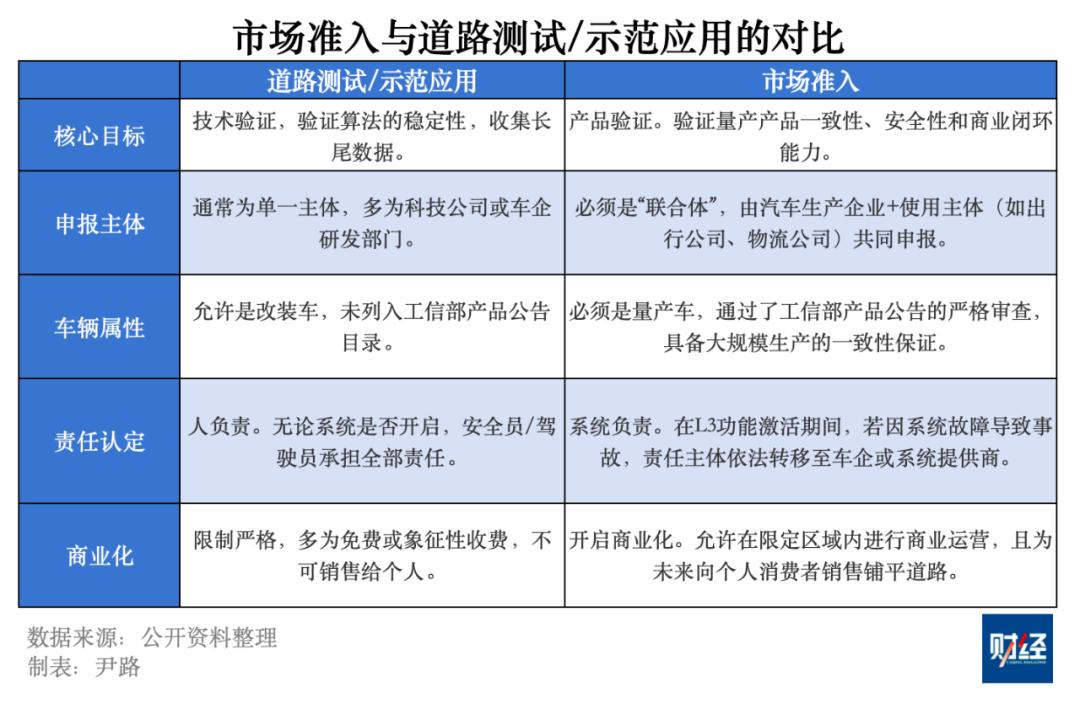
When evaluating the value of this access, people tend to confuse it with the "autonomous driving test vehicles" that have been on the road for several years. In fact, there are essential differences between them.
Previously, the "test license" (T - plate) was mainly used for enterprise R & D verification. The vehicles did not need to be mass - produced models announced by the Ministry of Industry and Information Technology. Usually, they were modified vehicles, such as adding lidar by installing brackets, and there were even a large number of additional computers and other hardware in the car. Legally, test vehicles are still regarded as Level 2. In case of any accident, regardless of whether the system is activated or not, the safety officer/driver bears 100% of the responsibility. And test vehicles usually cannot charge commercially, or only charge symbolically for testing system connectivity. In essence, enterprises are "burning money" to accumulate data.
However, this "market access" is the end of product verification and has entered the mass - production stage.
First of all, the vehicles must be mass - produced models announced by the Ministry of Industry and Information Technology, with consistency in large - scale production, rather than modified samples in the laboratory. This means that the software and hardware status of the vehicles has been solidified and has gone through strict reliability tests.
The most crucial change lies in the transfer of legal liability. During the activation of the Level 3 function, if an accident is caused by a system failure, the liability subject will be legally transferred from the driver to the car manufacturer or system provider. Therefore, the approved vehicle models must be compulsorily equipped with DSSAD (Autonomous Driving Data Recording System), which is the "black box" of the car. It can accurately record whether the system was activated and whether the driver intervened in the few seconds before the accident, which will become the "irrefutable evidence" for accident liability determination and also provide a data basis for future insurance claims.
With the change of the liability subject, the traditional vehicle insurance system also needs to be reformed. The past "compulsory traffic insurance" and "commercial third - party liability insurance" were mainly for drivers' negligence. In the Level 3 era, car manufacturers must purchase huge "product liability insurance" or "autonomous driving liability insurance" to cover accident compensation caused by algorithm defects, sensor failures, or network security vulnerabilities (such as hacker attacks).
Insurance companies need to re - establish the premium model. The vehicle's software version, sensor aging degree, and historical takeover rate will all become key factors in determining the premium level. There may even be a new business model of "car manufacturers bundling vehicle insurance", that is, car manufacturers directly include several years of autonomous driving liability insurance when selling cars.
In terms of commercial operation, after market access, operators are allowed to conduct paid operations within the limited area. Compared with the previous demonstration operations, the biggest difference in the current market access is that the same operator can operate ordinary vehicles and Level 3 autonomous vehicles in a mixed mode, which has higher reference value for verifying the commercial prospects of autonomous driving. The mixed operation mode can more truly reflect the performance of Level 3 vehicles in complex traffic environments and help operators evaluate the efficiency improvement and cost changes brought by autonomous driving. By comparing the order - receiving rates, accident rates, and maintenance costs of the two types of vehicles, enterprises can optimize the fleet composition and gradually achieve the intelligent upgrade of the transportation capacity structure.
China's path and global competition
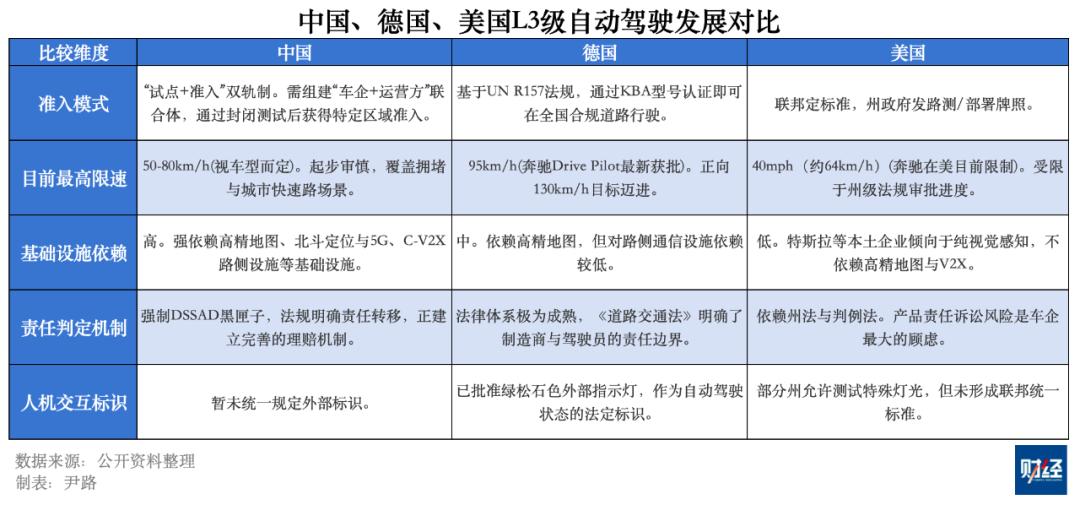
Globally, the competition landscape of Level 3 autonomous driving has shown a multi - polar trend. Chinese enterprises have taken a completely different path compared with their German and American counterparts.
Germany took legislation as a breakthrough and passed the "Autonomous Driving Act" in 2021, clearly defining the legal driving status of Level 3 systems in specific scenarios, and the Federal Motor Transport Authority (KBA) strictly approves the technical solutions. Its core logic is "liability in advance", requiring enterprises to bear full legal responsibility during system activation, forcing the technology to mature.
Mercedes - Benz's Drive Pilot system has long been approved, and the latest speed limit has been increased to 95 km/h. It allows use when following the traffic flow, and allows car owners to watch videos and reply to emails when activating the Level 3 function.
To solve the law - enforcement problem, Germany has approved turquoise exterior marker lights, which light up when the vehicle is in the autonomous driving state, clearly informing surrounding vehicles and traffic police that the system is driving and it is legal for the driver not to watch the road.
The US market is fragmented. Although Tesla's FSD has powerful functions and extremely strong generalization ability, it is always positioned at Level 2 (the driver bears all the responsibility). This is a strategy of "technological radicalism and liability conservatism". Instead, Mercedes - Benz has obtained Level 3 commercial licenses in California and Nevada in the United States. The US model emphasizes single - vehicle intelligence and does not rely on roadside facilities, but is troubled by the fragmentation of state laws.
Compared with overseas, China's Level 3 autonomous driving has its own unique characteristics. Current overseas autonomous driving tests are all concentrated on the "single - vehicle intelligence" technical route, emphasizing that vehicles should be able to handle all situations just like humans, relying only on "eyes" (various sensors) and "brains" (intelligent driving systems). This model has extremely high requirements for in - vehicle computing power and algorithms, but is not restricted by infrastructure.
China has firmly chosen the development path of "vehicle - road - cloud integration", emphasizing "smart cars" + "intelligent roads". Dense roadside sensing units and cloud - control platforms have been deployed on the pilot sections of Changan and ARCFOX, which can provide vehicles with perception information similar to a "God's - eye view", predicting accidents blocked by the vehicle in front or construction information two kilometers away in advance. This is China's "moat" different from the United States and Germany. However, it also limits the vehicles to fully function only in areas with perfect infrastructure. Once away from smart roads, their capabilities may be greatly reduced.
The access of these Level 3 autonomous driving vehicle models has not directly benefited ordinary consumers, but it is a crucial step from "assisted driving" to "autonomous driving". Although it is still cautious in terms of speed limits and operating areas, and faces a series of complex challenges such as liability determination, insurance support, and infrastructure construction, it marks that autonomous driving has finally left the laboratory and started to face the real - world challenges.
For ordinary consumers, don't be overwhelmed by the marketing terms of "autonomous driving". For a long time in the future, the hardware costs of Level 3 vehicles (such as lidar and high - computing - power chips) will still be high, and to cover liability risks, car manufacturers may transfer the insurance costs to the vehicle price or subscription service fees.
Building consumers' trust in autonomous driving is a long - term process. The initial Level 3 experience may not be perfect, such as frequent takeover requests and sudden braking. Car manufacturers need to accumulate a large amount of accident - free mileage data to gradually build consumers' psychological sense of security. In addition, the interactive experience design of human - machine co - driving is crucial. How to effectively remind the driver to take over without causing panic is a psychological problem that car manufacturers must solve. Before that, you might as well try to be the first "pioneer" passenger on the ride - hailing platforms in Chongqing or Beijing.
This article is from the WeChat official account "Semi - cooked Finance" (ID: Banshu - Caijing), author: Yin Lu. Republished by 36Kr with authorization.